
BAR-224 · Lesson 1 of 12 · 22 min
Becoming a lawyer in Minnesota
▶ Video coming soon A video version of this lesson is on the way.
Kirsten Halvorsen joined Hollis Marchetti's Tuesday study group in the fall of 2026, a few weeks after she started work as a law clerk at Maren Ostby's three-lawyer firm in St. Paul. She grew up in Duluth, where her father spent his career as an electrician on the ore docks and her mother worked as a school nurse, and she finished her J.D. at a Minnesota law school in May 2026. She had already filed her application for the February 2027 Minnesota bar exam, but when Marchetti asked her to describe the whole path from law school to her first day as a licensed lawyer, she realized she could name the exam and very little else.
'That is normal,' Marchetti said in their first one-on-one session. 'Most candidates think of admission as one test. It is really a set of separate tracks run by different bodies, and each track has its own deadlines and its own ways to go wrong. We will start with the map, because once you know who does what, every later question has an obvious home.'
This lesson sets out that map. It explains who regulates admission to the Minnesota bar, the three basic routes into Minnesota practice, the order in which the steps happen, and the bodies a Minnesota lawyer deals with after admission. Later lessons fill in each track in detail.
The Minnesota Supreme Court
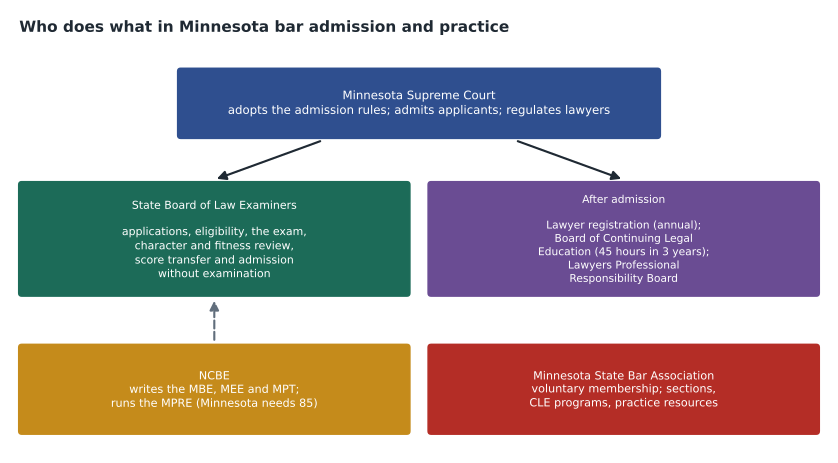
In Minnesota, as in nearly every state, the power to decide who may practice law belongs to the state's highest court. The Minnesota Supreme Court regulates the practice of law as part of its inherent judicial authority. It adopts the Rules for Admission to the Bar, it appoints the members of the State Board of Law Examiners, it decides the most important policy questions about the exam, and it formally admits each new lawyer. When Minnesota adopted the Uniform Bar Examination, when it decided to move to NCBE's NextGen exam, and when it ordered a study of alternative pathways to licensure, each of those decisions came through orders of the Supreme Court in its administrative files.
The Court's role also continues after admission. It adopts the Minnesota Rules of Professional Conduct, which govern every Minnesota lawyer's conduct, and the Rules on Lawyers Professional Responsibility, which set out the disciplinary process. It decides discipline cases, from public reprimands to disbarment. It sets the requirements for continuing legal education and for annual lawyer registration. A Minnesota lawyer is, in a real sense, an officer of the Minnesota Supreme Court from the day of the oath forward.
The State Board of Law Examiners
The Minnesota State Board of Law Examiners, usually called the Board or the BLE, is the body that runs admission day to day. It is made up of lawyers and public members appointed by the Supreme Court, with a professional staff in St. Paul. The Board receives applications, decides whether each applicant meets the education and other eligibility requirements, administers the bar examination, investigates the character and fitness of every applicant, and recommends to the Supreme Court those applicants who qualify for admission.
Unlike some states that hand the character and fitness investigation to a separate committee of the state bar, Minnesota keeps it within the Board. That means a Minnesota applicant deals with one body for eligibility, the exam and character and fitness. It also means the Board is the body that decides whether an applicant may transfer a Uniform Bar Examination score earned elsewhere or be admitted without examination based on practice in another state.
The Board's rules and policies change from time to time, and some of its most important announcements, such as filing deadlines, fees and the details of the NextGen transition, appear on its website and in Supreme Court orders rather than in any textbook. Marchetti's first piece of advice to Kirsten was practical: 'Treat the Board's website and the current Rules for Admission to the Bar as your primary sources. A commercial outline written two years ago may be out of date, and the Board will hold you to the current rule.'
NCBE
The National Conference of Bar Examiners, or NCBE, is a national nonprofit organization. It does not admit anyone to practice, but it writes the tests that most states use. For a Minnesota candidate, NCBE writes all three parts of the Uniform Bar Examination: the Multistate Bar Examination, the Multistate Essay Examination and the Multistate Performance Test. NCBE also writes and administers the Multistate Professional Responsibility Examination, or MPRE, a separate ethics test that Minnesota requires every applicant to pass with a scaled score of 85.
NCBE also maintains the national score services. When a Minnesota candidate later wants to transfer a Minnesota UBE score to another UBE jurisdiction, or when a candidate tested elsewhere wants to transfer a score into Minnesota, the request goes through NCBE. And NCBE has built the NextGen bar exam, which Minnesota will begin giving in July 2027. Lesson 5 covers that change.
Bodies a Minnesota lawyer deals with after admission
Admission is not the end of regulation. Once Kirsten takes the oath, she will deal with several other bodies throughout her career.
The first is the lawyer registration system. Every Minnesota lawyer must register with the Supreme Court each year and pay an annual registration fee, which funds lawyer regulation, client protection and legal services programs. A lawyer who fails to register can be suspended from practice until the registration is brought current.
The second is the Minnesota State Board of Continuing Legal Education. Minnesota requires continuing legal education, or CLE: 45 credit hours in each three-year reporting period, including credits in ethics, in the elimination of bias, and in mental health and substance use, sometimes described as well-being. Lesson 11 covers the details.
The third is the lawyer discipline system. The Office of Lawyers Professional Responsibility investigates complaints against Minnesota lawyers and prosecutes discipline cases, under the supervision of the Lawyers Professional Responsibility Board. District ethics committees, made up of local lawyers and public members, investigate many complaints at first instance. Serious cases end in the Supreme Court, which imposes public discipline.
The fourth is the Minnesota State Bar Association. Unlike states with a unified or integrated bar, where every licensed lawyer must belong to the state bar, Minnesota's state bar association is voluntary. Kirsten can join the MSBA and its sections, attend its CLE programs and use its practice resources, but membership is not a condition of her license. Licensing and discipline sit with the Supreme Court and its boards, not with the bar association.
| Body | What it does for a candidate or new lawyer |
|---|---|
| Minnesota Supreme Court | Adopts the admission rules and the Rules of Professional Conduct; admits applicants; decides discipline |
| State Board of Law Examiners | Applications, eligibility, the exam, character and fitness, score transfer and admission without examination |
| NCBE | Writes the MBE, MEE and MPT and the MPRE; runs score transfer services; built NextGen |
| Board of Continuing Legal Education | Approves CLE courses and tracks the 45-hour three-year requirement |
| Lawyers Professional Responsibility Board and Office | Investigate complaints and prosecute discipline |
| Minnesota State Bar Association | Voluntary professional association; sections, CLE programs and resources |
Three routes into Minnesota practice
Marchetti drew the routes for Kirsten on the shared screen. There are three main ways to become a Minnesota lawyer, and a fourth that was still being designed in late 2026.
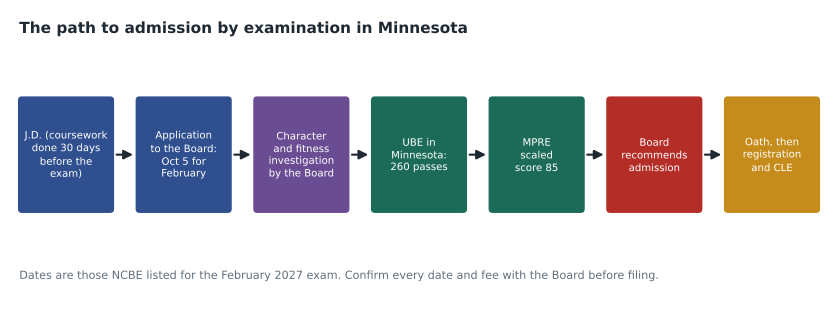
The first route, and the one Kirsten is on, is admission by examination. The applicant files with the Board, passes the Uniform Bar Examination given in Minnesota with a total scaled score of at least 260, earns a scaled score of at least 85 on the MPRE, and satisfies the Board's character and fitness investigation. The Board then recommends the applicant for admission, and the applicant takes the oath.
The second route is the transfer of a score earned elsewhere. Minnesota is a UBE jurisdiction, so it accepts UBE scores earned in other UBE jurisdictions if the score meets Minnesota's 260 passing score and is recent enough, generally within the preceding three years. The applicant still needs the MPRE and a full character and fitness review. Minnesota has also accepted, on an interim basis, NextGen scores of 620 or more starting with the July 2026 exam. Lesson 11 explains the details.
The third route is admission without examination, sometimes called admission on motion. A lawyer licensed in another United States jurisdiction who has actively practiced law for at least three of the five years before applying may be admitted without taking the Minnesota exam, provided the other requirements are met. Minnesota's rules also have a route for applicants who earned a qualifying MBE score elsewhere and were admitted there. Lesson 11 covers both.
The fourth possible route is an alternative pathway that does not depend on a bar exam score. In March 2024 the Minnesota Supreme Court directed an implementation committee to develop a curricular pathway completed during law school, with a supervised practice pathway to be studied afterward. As of November 2026 those pathways were still proposals under development, not routes any applicant could use. Lesson 11 explains where they stood.
The order of the steps
For an applicant on the examination route, the steps overlap more than they follow one after another. Kirsten's timeline shows how the tracks run in parallel.
Kirsten finished law school in May 2026. She took the MPRE in March 2026, during her last semester, and scored 89, comfortably above Minnesota's 85. She filed her application with the Board on September 28, 2026, before the first filing deadline of October 5 that NCBE listed for the February 2027 exam. Filing the application also started her character and fitness investigation, because Minnesota's application includes the character and fitness questions. Her references and records were being gathered through the fall while she studied. She will sit the exam on February 23 and 24, 2027. Results come out in the spring. If she passes and her character and fitness review is complete, the Board will recommend her for admission, and she will take the oath at an admission ceremony.
'Look at what can hold you up,' Marchetti said. 'The exam is the obvious one. But a candidate who passes the exam and has an unfinished character and fitness file waits. A candidate who passes and has not yet passed the MPRE waits. Every track has to cross the finish line before the Board can recommend you.'
Worked problem
Mapping a question to the right body
During the fall, Kirsten writes down five questions she wants answered: (1) whether her 2020 underage consumption citation in Duluth must be disclosed; (2) whether she may take the exam on her own laptop; (3) when her CLE reporting period will begin; (4) whether her MPRE score from March 2026 is still good; and (5) whether a lawyer at her firm who is licensed in Wisconsin could join the Minnesota bar without taking the exam.
Show solution
- Question 1 is a character and fitness question, so it belongs with the Board, which runs Minnesota's investigation. The answer is almost certainly yes; Lesson 3 explains why candor matters so much.
- Question 2 is an exam administration question, also for the Board, which sets the laptop rules for the Minnesota administration of the UBE.
- Question 3 is a CLE question for the Board of Continuing Legal Education, which assigns each new lawyer a reporting category based on the date of admission.
- Question 4 is an admission rule question for the Board, though NCBE reports the score; the Board's rules decide how long an MPRE score remains acceptable.
- Question 5 is an admission without examination question for the Board, under the Rules for Admission to the Bar.
Answer: Four of the five questions go to the Board of Law Examiners, which is why Marchetti calls its rules and website the candidate's home base. The CLE question goes to the CLE board.
What makes Minnesota distinctive for a candidate
Kirsten asked whether Minnesota was really different from any other UBE state. Marchetti gave her four points that set Minnesota apart.
First, Minnesota has one of the lower UBE passing scores. Its 260 is the lowest passing score used in UBE jurisdictions; several states use 266, 268 or 270. That makes the Minnesota exam slightly easier to pass, and it also matters for score transfer: a 260 earned in Minnesota is enough for Minnesota but not for a state that requires 270.
Second, Minnesota does not have a separate state law component. Some UBE states require candidates to complete a course or test on local law before admission. Minnesota, as of late 2026, did not. A Minnesota candidate's knowledge of Minnesota law is tested in practice, not on the exam. Lesson 6 explains what that means for preparation.
Third, Minnesota is moving to NextGen early. Its first NextGen exam is scheduled for July 2027, so February 2027 is the last legacy UBE given in Minnesota. A candidate who sits in February 2027 and does not pass will face a different exam in July 2027. That fact shapes Kirsten's whole study plan.
Fourth, Minnesota has been one of the states most actively studying alternatives to the bar exam itself. Its Board conducted a multi-year study of lawyer licensing, and the Supreme Court has directed work on a curricular pathway. Whatever the outcome, Minnesota is a state where the rules of admission are changing, and a careful candidate checks them each year.
Practicing before admission
Kirsten works as a law clerk, not as a lawyer. Until she is admitted, she may not give legal advice to clients on her own, sign pleadings or appear in court as a lawyer. Her work is done under the supervision of Ostby and the other lawyers at the firm, who remain responsible for it. Minnesota, like other states, has a student practice rule that allows law students and some recent graduates to appear in limited ways under supervision, typically through clinics and public offices, and Kirsten should check its current terms before assuming she is covered.
The distinction matters because unauthorized practice of law is a serious matter in itself and can also become a character and fitness issue. A clerk who holds herself out as a lawyer, even casually, creates a problem that the Board may ask about. Marchetti's rule for Kirsten was simple: introduce yourself as a law clerk, let the supervising lawyer sign everything, and never give advice directly to a client without a lawyer's review.
Common mistakes
MistakeThe Minnesota State Bar Association decides who is admitted.
InsteadThe Minnesota Supreme Court admits lawyers on the recommendation of the State Board of Law Examiners; the MSBA is a voluntary association.
MistakeCharacter and fitness is handled by a separate state bar committee in Minnesota.
InsteadThe Board of Law Examiners conducts Minnesota's character and fitness investigation itself.
MistakeMinnesota requires a 266 to pass the UBE.
InsteadMinnesota's passing score is 260, the lowest used by UBE jurisdictions.
MistakeMinnesota requires a separate Minnesota law test before admission.
InsteadAs of November 2026 Minnesota had no separate state law component.
MistakeA law clerk may advise clients as long as the advice is correct.
InsteadOnly admitted lawyers may practice; a clerk works under a lawyer's supervision.
Summary and key terms
- The Minnesota Supreme Court regulates admission and practice; it adopts the Rules for Admission to the Bar and admits each new lawyer.
- The State Board of Law Examiners handles applications, eligibility, the exam, character and fitness, score transfer and admission without examination.
- NCBE writes the UBE components and the MPRE; Minnesota requires a UBE score of 260 and an MPRE score of 85.
- The three current routes are admission by examination, UBE score transfer and admission without examination; alternative pathways were still under development in 2026.
- After admission a Minnesota lawyer registers annually, completes 45 CLE hours every three years and is subject to the lawyer discipline system; MSBA membership is voluntary.
- February 2027 is Minnesota's last legacy UBE; the first NextGen exam in Minnesota is scheduled for July 2027.
- 0
- State Board of Law Examiners
- 1
- Rules for Admission to the Bar
- 2
- Uniform Bar Examination
- 3
- MPRE
- 4
- admission without examination
- 5
- voluntary bar
- 6
- Office of Lawyers Professional Responsibility
Practice problems
Work each problem on paper first, then reveal the answer to check.
Which body conducts the character and fitness investigation for Minnesota applicants?
Show answer
The State Board of Law Examiners.
Is membership in the Minnesota State Bar Association required to practice law in Minnesota?
Show answer
No. Minnesota's bar association is voluntary; licensing is by the Supreme Court.
Name the three current routes into Minnesota practice.
Show answer
Admission by examination, transfer of a UBE score earned elsewhere, and admission without examination based on practice.
Why does February 2027 matter for Minnesota candidates?
Show answer
It is the last legacy UBE in Minnesota; the first Minnesota NextGen exam is scheduled for July 2027.
Lesson quiz · 5 questions
Score 60% or more to complete this lesson.
Create a free account to save your progress, take quizzes and earn a certificate.