
BAR-224 · Lesson 5 of 12 · 20 min
Exam changes ahead: NextGen in July 2027
▶ Video coming soon A video version of this lesson is on the way.
Kirsten's younger brother Soren started law school in August 2026. When he called home to Duluth in October, he told their parents that his classmates could not agree on which bar exam they would take. Some said the UBE, some said a new exam, and one insisted Minnesota was getting rid of the bar exam altogether. Their mother passed the question to Kirsten, and Kirsten passed it to Marchetti.
'Your brother will take NextGen,' Marchetti said, 'unless Minnesota adopts an alternative pathway he qualifies for, which is a separate question. Minnesota's first NextGen exam is in July 2027. Your February 2027 exam is the last legacy UBE given in Minnesota. You are standing right on the line.'
Marchetti had spent the fall running the group's Sunday NextGen sessions with Marcus Bell, who took the first NextGen exam in Missouri in July 2026 and passed. She knew the new exam well. This lesson explains what NextGen is, Minnesota's timeline, the interim rule on NextGen score transfer, the decisions still open, and what the change means for candidates on each side of the line.
Minnesota's path to NextGen
Minnesota's move began with a study. In June 2021, the Board of Law Examiners started a two-year study of how lawyers should be licensed in Minnesota. Its final report, delivered to the Minnesota Supreme Court on June 1, 2023, recommended that Minnesota adopt NCBE's NextGen bar exam and also develop an alternative pathway to licensure. The Court took public comments and held a hearing in October 2023.
In March 2024, the Court approved the dual approach. It adopted NextGen as Minnesota's future exam and created an implementation committee to develop alternative pathways, giving priority to a curricular pathway completed during law school. The Board then set the timing: the legacy UBE continues through February 2027, and the first NextGen exam in Minnesota is July 2027.
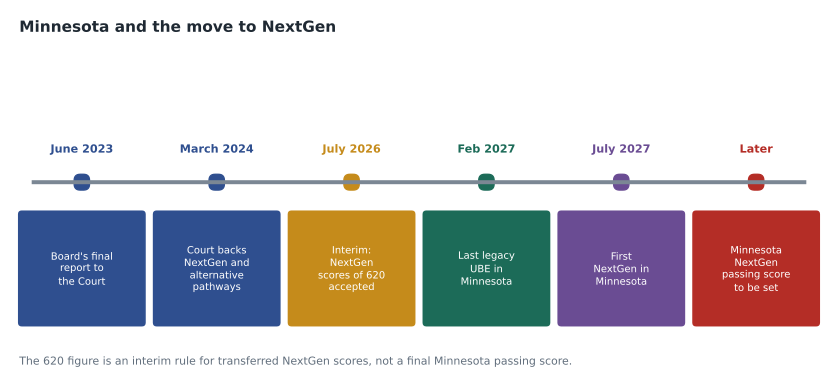
NCBE's own schedule runs alongside. The first NextGen exam anywhere was given in July 2026 in a small group of early-adopting jurisdictions, including Missouri. More jurisdictions join in 2027 and 2028. Minnesota is in the second wave, starting one year after the first administration.
What NextGen is
NextGen is a new exam, not an update of the UBE. NCBE built it after a multi-year practice analysis that asked newly licensed lawyers what they actually do. The study concluded that the bar exam should test fewer subjects in less depth, test lawyering skills more directly, and integrate knowledge and skills in the same questions instead of separating them into a multiple-choice day and an essay day.
The content has two parts. The foundational concepts and principles cover the core subjects: civil procedure, contract law, evidence, torts, business associations, constitutional law, criminal law and procedure, real property, and limited parts of family law and trusts and estates. Some subjects tested on the current MEE, such as conflict of laws and secured transactions, are not part of NextGen. The foundational skills are legal research, legal writing, issue spotting and analysis, investigation and evaluation, client counseling and advising, negotiation and dispute resolution, and client relationship and management.
The question formats change too. NextGen uses standalone multiple-choice questions, some of which ask the candidate to select more than one correct answer; integrated question sets built around one fact pattern, mixing multiple-choice and short written answers; and longer performance tasks that ask candidates to complete realistic work from a file and a library, including some legal research within the exam materials. The exam is computer-based and given over about a day and a half.
| Feature | Legacy UBE (Minnesota through February 2027) | NextGen (Minnesota from July 2027) |
|---|---|---|
| Structure | MPT and MEE on day one; MBE on day two | Integrated sessions over about a day and a half |
| Subjects | Seven MBE subjects plus six more on the MEE | Fewer subjects tested in less depth |
| Skills | Tested mostly through the MPT | Tested throughout, including research and counseling |
| Question types | Single-answer MBE questions; long essays; MPT | Standalone questions, integrated sets, short answers, performance tasks |
| Score scale | 400 points; Minnesota passes 260 | A new NextGen scale; Minnesota's passing score to be set |
The interim rule on NextGen scores
Before Minnesota gives NextGen itself, it has to decide what to do with NextGen scores earned elsewhere. A candidate who passed NextGen in Missouri in July 2026, as Marcus did, might want to transfer that score to Minnesota. Minnesota's answer, set by an interim order of the Supreme Court, is that the Board will accept NextGen scores of 620 or higher, starting with the July 2026 exam.
The Court was careful to say that this interim figure is not a decision about Minnesota's own NextGen passing score. It is a temporary rule for transferred scores while Minnesota prepares to set its own standard. A candidate reading about the 620 figure should not assume it will be the passing score for the July 2027 Minnesota exam.
What Minnesota had not decided
As of November 2026, NCBE's chart listed Minnesota's NextGen passing score as to be announced. That is the most important open question for July 2027 candidates. Minnesota will set its own number on the NextGen scale, informed by NCBE's guidance and by standard-setting work, and announce it before the first administration or as soon as practicable.
A second open question is how long legacy UBE scores remain transferable into Minnesota once Minnesota is giving NextGen. The current rule accepts UBE scores earned within about three years. Transition rules will need to address both kinds of score side by side.
A third question is how NextGen fits with the alternative pathways. The implementation committee's report on the curricular pathway was due by July 1, 2026, and its work on a supervised practice pathway by July 1, 2027. If Minnesota adopts a curricular pathway, some future candidates may become eligible for licensure without any bar exam score. Until the Court acts, NextGen is the path for nearly everyone.
Who takes which exam
The line is easy to state. A candidate sitting in Minnesota in February 2027 or earlier takes the legacy UBE. A candidate sitting in July 2027 or later takes NextGen. The difficult case is the candidate who fails the last legacy exam. Because February 2027 is the last legacy UBE in Minnesota, a candidate who fails it and retakes in July 2027 faces NextGen, with different subjects and question types.
Could a February 2027 candidate who fails take the legacy UBE in another state and transfer the score? In principle, some jurisdictions continue the legacy UBE after Minnesota stops. A candidate could sit a legacy UBE elsewhere and, if the score meets 260 and the other transfer rules, transfer it to Minnesota. But that plan has costs: a second application, travel, and the risk that the other state's own rules or timing do not fit. Marchetti's view is that it is a fallback to know about, not a plan to rely on.
Worked problem
Planning around the line
Three people ask Marchetti for advice. Kirsten sits in February 2027. Her classmate Theo plans to sit in July 2027. Kirsten's brother Soren expects to graduate in May 2029.
Show solution
- Kirsten takes the legacy UBE in February 2027 with the 260 passing score. If she does not pass, her next Minnesota exam is NextGen, so she should treat February as the attempt that counts.
- Theo takes NextGen in July 2027, the first Minnesota administration. He should use NextGen materials only, follow the Board's announcements about the passing score and procedures, and file early.
- Soren expects to take NextGen in July 2029, unless an alternative pathway he qualifies for is adopted. He should choose law school courses with NextGen's skills in mind and watch for the Court's decisions on the curricular pathway.
Answer: Only Kirsten takes the legacy UBE. Theo is in the first NextGen group, and Soren's path may include an option that does not exist yet.
What Marcus learned from the first NextGen exam
At one of the Sunday sessions, Marcus described his July 2026 NextGen exam in Missouri for the group. He said the biggest adjustment was the integrated question sets. A single fact pattern would generate several questions in different formats, and the candidate had to keep the facts straight while switching from a multiple-choice question to a short written answer. He said the performance tasks felt familiar to anyone who had practiced MPTs, but the research component meant reading more carefully and deciding which sources mattered.
'Do not try to memorize your way through it,' Marcus told the group. 'Practice the tasks under time, until the file and library feel routine. The rule knowledge you need is real, but it is narrower than the old exam's. The skills are where people lose points.'
What the change means for preparation
For Kirsten, nothing about the February 2027 exam changes. The study materials, the MEE subject list and the 260 passing score all apply. Marchetti's caution is about materials. As commercial bar courses shift toward NextGen in late 2026 and early 2027, a February 2027 candidate must make sure every practice set is a legacy UBE set. A NextGen practice question may test a skill or format that does not appear on the legacy exam. Older MEE practice sets have the opposite problem: they include conflict of laws, family law, trusts and estates and secured transactions, which left the MEE in July 2026, so Kirsten skips those essays.
For Theo and the July 2027 group, the change rewards practical training and careful reading of official materials. NCBE publishes NextGen content outlines and sample questions, and early practice with the computer-based format matters. Because Minnesota's first administration is new for the Board as well, candidates should expect detailed instructions and should read them early.
For future candidates like Soren, law school choices matter more than before. Clinics, externships, legal research courses, negotiation courses and drafting courses map directly onto NextGen's foundational skills. A student who has done the work of a lawyer under supervision will find the performance tasks less foreign.
For Minnesota employers, the change affects hiring and supervision. A summer associate who will sit NextGen in Minnesota needs different study time and support than one who sat the UBE. Firms that once gave every new hire the same study leave may need to revisit their policies once the Board's details are final.
Common mistakes
MistakeMinnesota's first NextGen exam was July 2026.
InsteadJuly 2026 was the first NextGen exam in early-adopting jurisdictions; Minnesota's first is July 2027.
MistakeMinnesota's NextGen passing score is 620.
Instead620 is an interim minimum for transferred NextGen scores; Minnesota's own passing score was still to be announced.
MistakeA candidate who fails in February 2027 retakes the legacy UBE in Minnesota in July 2027.
InsteadJuly 2027 is NextGen in Minnesota; February 2027 is the last legacy UBE.
MistakeNextGen tests more subjects than the UBE.
InsteadNextGen tests fewer subjects in less depth and puts more weight on skills.
MistakeNextGen practice questions are fine for a February 2027 candidate.
InsteadFebruary 2027 candidates should use legacy UBE materials only.
Why Minnesota moved early
Kirsten asked why Minnesota did not wait until 2028, as several states did, to see how NextGen worked elsewhere. Marchetti explained that Minnesota's study had already concluded that the bar exam should test lawyering skills more directly, which is what NextGen is designed to do. Moving early let Minnesota align its exam with that conclusion sooner and coordinate the change with its work on alternative pathways. It also meant that Minnesota's law schools could plan their curricula around a known date.
There are costs to moving early. Early administrations of a new exam test the systems as well as the candidates: the software, the scheduling, the grading and the score reporting. Commercial study materials for a new exam also take time to mature. Candidates in the first Minnesota NextGen group, like Theo, should expect some uncertainty and should rely on NCBE's own published materials, which are written to the exam's actual content outlines.
Practical advice for the first Minnesota NextGen group
Marchetti gives July 2027 candidates a short list. Read NCBE's content scope outlines for the foundational concepts and skills, and treat them as the boundary of what to study. Take every official sample question and practice set NCBE offers, under time, on a computer. Practice performance tasks from beginning to end, including the research step. Learn to type answers efficiently in the exam's format. And read the Board's announcements every month from January 2027, because details about the testing site, the software and the passing score may arrive during the spring.
Marchetti also asks July 2027 candidates to talk to someone who has taken NextGen already. For her group, that person is Marcus. 'You will hear things in ten minutes with Marcus that no outline tells you,' she says, 'like how long the integrated sets actually take and what it feels like to switch formats in the middle of a fact pattern.'
What does not change
Several things stay the same through the transition. Minnesota still requires the MPRE with a scaled score of 85. Character and fitness works the same way. The Board still administers the exam, and the Supreme Court still admits applicants. Score transfer still exists, though the rules for NextGen and legacy scores will run side by side for a time. A candidate who focuses on the format change should not lose track of the requirements that remain.
Summary and key terms
- Minnesota's Board studied licensing from 2021 to 2023; in March 2024 the Supreme Court adopted NextGen and directed work on alternative pathways.
- February 2027 is the last legacy UBE in Minnesota; the first Minnesota NextGen exam is July 2027.
- Since July 2026 Minnesota accepts transferred NextGen scores of 620 or higher on an interim basis; that is not a decision on Minnesota's own passing score.
- NextGen tests foundational concepts in fewer subjects and seven foundational skills, using integrated sets and performance tasks.
- Open questions include Minnesota's NextGen passing score, transition rules for legacy scores and the role of alternative pathways.
- 0
- NextGen bar exam
- 1
- legacy UBE
- 2
- foundational concepts and principles
- 3
- foundational skills
- 4
- integrated question set
- 5
- interim order
Practice problems
Work each problem on paper first, then reveal the answer to check.
What is the last legacy UBE administration in Minnesota?
Show answer
February 2027.
Marcus passed NextGen in Missouri in July 2026 with a score above 620. Could he transfer it to Minnesota?
Show answer
Under the interim rule, Minnesota accepts NextGen scores of 620 or higher from July 2026, subject to the other admission requirements.
Is 620 Minnesota's NextGen passing score?
Show answer
No. The Court said the interim transfer figure is not a decision on the final passing score.
Name three NextGen foundational skills.
Show answer
Any three of: legal research, legal writing, issue spotting and analysis, investigation and evaluation, client counseling and advising, negotiation and dispute resolution, client relationship and management.
Lesson quiz · 5 questions
Score 60% or more to complete this lesson.
Create a free account to save your progress, take quizzes and earn a certificate.