
BAR-224 · Lesson 4 of 12 · 20 min
The Minnesota bar exam: the UBE, scoring and the 260 passing score
▶ Video coming soon A video version of this lesson is on the way.
In mid-November 2026, Kirsten took a full diagnostic exam under timed conditions. Marchetti graded the written portion against model answers and estimated a scaled MBE score from the number of questions Kirsten answered correctly. The estimate came back at about 133 on the MBE and 125 on the written portion, a total of about 258. Kirsten stared at the number. 'Two points,' she said. 'I am two points short.'
'You are two points short in November,' Marchetti said. 'With three months of work, that gap closes. But to close it efficiently you need to understand exactly how the score is built. Then you will know which hours buy the most points.'
This lesson explains the format of the Uniform Bar Examination as Minnesota gives it, how the three components are weighted and scaled, what Minnesota's 260 passing score means, how results are released, and what Kirsten's diagnostic tells her.
Minnesota and the UBE
Minnesota adopted the Uniform Bar Examination in 2014, and the first UBE given in Minnesota was the February 2014 exam. Before that, Minnesota gave the MBE alongside essays and performance tests of its own design. The move to the UBE gave Minnesota candidates a portable score: a Minnesota UBE score can be transferred to any other UBE jurisdiction whose passing score it meets, and scores earned elsewhere can be transferred into Minnesota.
The UBE is the same exam in every UBE jurisdiction. NCBE writes all three components, and every jurisdiction gives them on the same days. What differs from state to state is the passing score, the rules on score transfer, and whether the state adds a local law requirement. Minnesota's passing score is 260, and it has no separate state law component.
The three parts
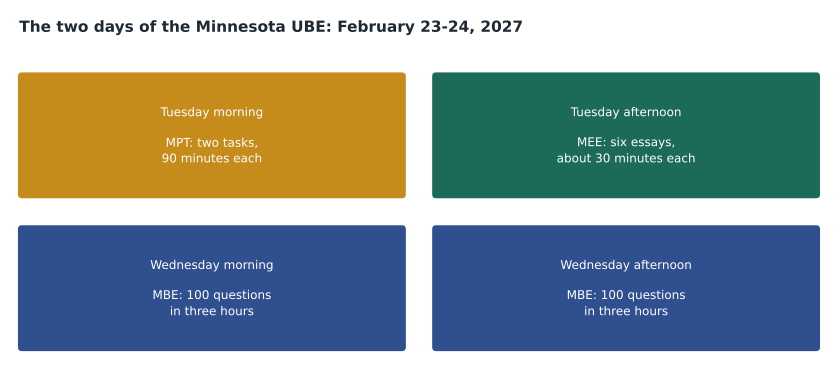
The UBE has three components, given on two consecutive days, the last Tuesday and Wednesday of February and July. For Kirsten, those days are February 23 and 24, 2027.
The Multistate Performance Test, or MPT, comes first, on Tuesday morning. Each MPT task gives the candidate a File, containing the facts in the form of memos, letters, transcripts and documents, and a Library, containing the cases, statutes and rules needed to complete the task. The candidate must produce a piece of lawyer's work product, such as an objective memo, a persuasive brief, a client letter, or a demand letter. Each task is designed for 90 minutes, and the UBE uses two tasks. The MPT does not test knowledge of substantive law; everything needed is in the Library.
The Multistate Essay Examination, or MEE, comes on Tuesday afternoon. It has six essay questions, each designed for about 30 minutes. MEE questions may test any of the MBE subjects and also business associations, conflict of laws, family law, secured transactions under Article 9 of the Uniform Commercial Code, and trusts and estates. Answers are graded on general principles of law, not Minnesota law, using NCBE's grading materials.
The Multistate Bar Examination, or MBE, fills Wednesday. It has 200 multiple-choice questions in two three-hour sessions of 100 questions each. The questions cover seven subjects: civil procedure, constitutional law, contracts, criminal law and procedure, evidence, real property and torts. Of the 200 questions, 175 are scored and 25 are unscored pretest questions mixed in among them, and the candidate cannot tell which is which.
Weighting
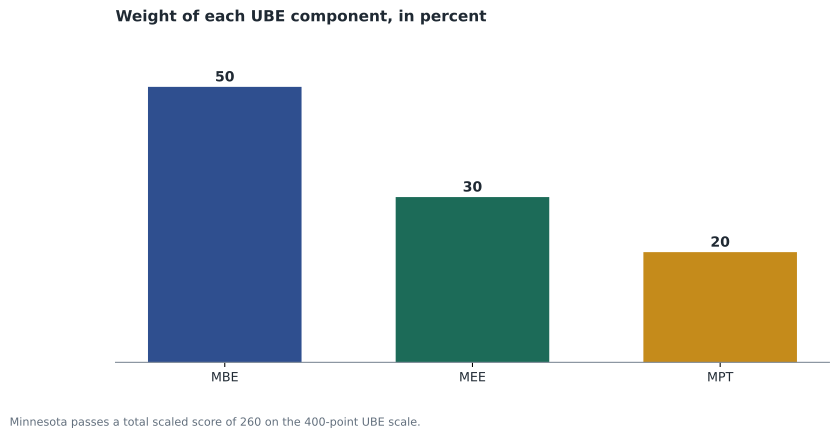
The three components are weighted as follows: the MBE counts for 50 percent of the total score, the MEE for 30 percent and the MPT for 20 percent. The written portion, the MEE and MPT together, is therefore half of the score. Candidates who think of the bar exam as mainly a multiple-choice test underrate the writing, and that is often where points are easiest to gain.
Scaling
The MBE is scored by NCBE. The number of scored questions answered correctly is converted to a scaled score through a statistical process called equating, which adjusts for small differences in difficulty between exam forms. Because of equating, an MBE scaled score of 133 represents the same level of performance in February as in July, and in Minnesota as anywhere else.
The MEE and MPT are graded by graders in each jurisdiction, using NCBE's grading materials and the jurisdiction's own raw grading scale. Those raw written scores are then scaled to the MBE: they are converted so that, for the group of candidates in that jurisdiction at that administration, the written scores have the same mean and spread as their MBE scores. This keeps written scores comparable across administrations and ties them to a measure that is equated nationally.
The scaled MBE score and the scaled written score are then combined on the UBE's 400-point scale. In rough terms, each half is worth about 200 points. A candidate's total is the scaled MBE score plus the scaled written score, with the written score weighted so that the MEE and MPT contribute their 30 and 20 percent shares.
What 260 means
A total of 260 means, roughly, an average of 130 on each half. But the halves do not have to be equal. The UBE score is compensatory: strength on one half can make up for weakness on the other.
| Scaled MBE | Written score needed to reach 260 |
|---|---|
| 120 | 140 |
| 125 | 135 |
| 128 | 132 |
| 130 | 130 |
| 133 | 127 |
| 136 | 124 |
| 140 | 120 |
Minnesota's 260 is the lowest passing score used by UBE jurisdictions. Others require 266, 268 or 270. That matters in two ways. For Kirsten, it means the Minnesota exam is slightly more forgiving than the exam in a 270 state. For transfer, it means a 260 earned in Minnesota is enough for Minnesota and other 260 states, but not for a state that requires more. A candidate who expects to practice in a higher-score state as well as Minnesota should aim higher than 260.
Kirsten's diagnostic
Kirsten's November estimate was 133 on the MBE and 125 on the written portion, a total of 258. Marchetti walked her through what the numbers meant.
Worked problem
Where should Kirsten put her next three months?
Kirsten's diagnostic shows about 133 on the MBE and 125 on the written portion. She has about twelve weeks before February 23. She works part-time at the firm until mid-January.
Show solution
- Find the gap: 260 minus 258 is 2 points. But a diagnostic is an estimate, and Marchetti wants a margin, so the target is about 270, a gap of 12 points.
- Compare the halves: her written score is 8 points below her MBE score. Both halves count equally toward the total.
- Consider what responds fastest to practice: in Marchetti's experience, written scores often rise quickly when a candidate fixes structure, timing and rule statements, while MBE scores rise more slowly.
- Plan: keep a steady MBE practice load of about 30 to 35 questions a day, and add one timed MEE essay a day and one full MPT every third day, each graded against the model answer.
Answer: Kirsten should shift her emphasis toward the written portion while keeping her MBE practice steady. A gain of 6 to 8 points on the written half, plus modest MBE growth, puts her comfortably above 260.
How MEE and MPT answers are graded
Because half the score comes from writing, Marchetti spent time on how graders work. MEE and MPT answers are graded relatively, not against an absolute standard. Graders read many answers to the same question, compare them, and sort them into score bands. An answer is rewarded for being clearer, better organized and more complete than the others.
That has practical consequences. Issue spotting counts heavily: an answer that addresses every issue the call raises, even briefly, usually beats an answer that analyzes one issue at length and misses others. Organization counts: headings that track the call of the question, a clear rule statement, application to the facts and a conclusion for each issue make an answer easy to reward. And application counts most of all: a correct conclusion with no reasoning earns little, because the points are in the analysis.
For the MPT, the most common failure is not legal knowledge but task management. Candidates spend too long reading the Library, run out of time and leave the last section thin. Marchetti teaches a split of about 40 minutes reading and organizing and 50 minutes writing, and she insists that candidates follow the task memo's instructions on format exactly, because graders are told to reward answers that do what the supervising partner asked.
Results
Results for the February exam usually come out in the spring and results for the July exam in the fall. The Board releases Minnesota results, and NCBE reports the scaled scores. A passing candidate will be recommended for admission once the character and fitness review is complete and the MPRE requirement is satisfied.
A failing candidate receives score information, including component scores, which are the best guide to what to work on. A candidate who fails the February 2027 exam in Minnesota faces a special difficulty: the next Minnesota exam, in July 2027, is the first NextGen administration. The retake would be a different exam, with different subjects, question types and materials. That is one reason Marchetti treats Kirsten's February attempt as the one that counts.
Exam-day rules
The Board sets the rules for the Minnesota administration: what candidates may bring into the room, identification requirements, laptop rules, and conduct rules. Candidates receive these instructions before the exam and must follow them exactly. Prohibited items, such as phones or notes, can lead to serious consequences, including disqualification and a character and fitness referral. Marchetti tells every candidate to read the instructions twice, once when they arrive and again the week before the exam.
| Session | Component | Time | Marchetti's pacing target |
|---|---|---|---|
| Tuesday morning | MPT, two tasks | 3 hours | About 90 minutes a task: 40 reading, 50 writing |
| Tuesday afternoon | MEE, six essays | 3 hours | 30 minutes an essay; outline 5, write 25 |
| Wednesday morning | MBE, 100 questions | 3 hours | About 1.8 minutes a question |
| Wednesday afternoon | MBE, 100 questions | 3 hours | About 1.8 minutes a question |
The compensatory score in practice
Kirsten asked whether she should give up on any MBE subject to focus on writing. Marchetti said no. 'The score is compensatory, which means you can be weaker in one place and still pass. It does not mean you can skip anything. Every MBE subject is worth about 25 scored questions, and the MEE can test any of them plus six more. A candidate who abandons a subject usually loses more than she gains.'
Instead, Marchetti recommended what she called targeted effort: identify the two or three areas where Kirsten's practice scores are weakest, review those rules first, and use timed practice everywhere else. 'Your goal is not perfection. Your goal is a total of 260 with a margin. You get there by eliminating the big losses, not by chasing the last few points in your strongest subject.'
Common mistakes
MistakeMinnesota's passing score is 266.
InsteadMinnesota's passing score is 260 on the 400-point UBE scale.
MistakeThe MBE is worth 60 percent of the UBE score.
InsteadThe MBE is 50 percent, the MEE 30 percent and the MPT 20 percent.
MistakeMEE answers should apply Minnesota law.
InsteadMEE answers are graded on general principles of law, not Minnesota law.
MistakeA candidate must reach 130 on each half to pass.
InsteadThe score is compensatory; only the total of 260 matters.
MistakeA candidate who fails in February 2027 retakes the same exam in July.
InsteadJuly 2027 is Minnesota's first NextGen exam, a different test.
Building an MEE answer graders can reward
Kirsten's diagnostic essays had a pattern Marchetti sees often. The analysis was usually right, but it was buried. Rules appeared halfway through paragraphs, issues ran together, and conclusions were stated before the reasoning. Graders reading quickly could miss points Kirsten had actually earned. Marchetti gave her a template for every MEE answer.
First, a heading for each issue, using the words of the call of the question. Second, a one- or two-sentence rule statement, stated as a rule, not as a fact about the case. Third, application: the rule's elements matched to the specific facts, using the facts' own words, with the strongest counterargument addressed briefly. Fourth, a conclusion for the issue in one sentence. Then the next heading. She also asked Kirsten to spend the first five minutes of each 30-minute essay outlining the issues before writing, because an outline is the cheapest way to make sure no issue is missed.
Within two weeks, Kirsten's practice essays were scoring better on Marchetti's grading scale with the same underlying knowledge. 'You did not learn more law,' Marchetti said. 'You made the law you know visible. That is what the written half rewards.'
Practicing the MBE efficiently
For the MBE, Marchetti uses a miss log. Each question Kirsten answers wrong goes into a spreadsheet with the subject, the rule tested, the reason for the miss and the correct rule in one sentence. Reasons fall into a few categories: did not know the rule, knew the rule but misread the facts, fell for a distractor that was true but not responsive, or ran out of time. Each category has a different fix. Rules go into a review list. Misreading calls for slower first reads of the last sentence of each question. Distractor errors call for asking, before looking at the options, what the answer should be. Timing problems call for timed sets of 17 questions in 30 minutes until the pace feels natural.
Summary and key terms
- Minnesota has given the UBE since February 2014; the passing score is a total of 260 on the 400-point scale.
- The MPT (two 90-minute tasks) and MEE (six 30-minute essays) are given on Tuesday and the MBE (200 questions, 175 scored) on Wednesday.
- The MBE counts 50 percent, the MEE 30 percent and the MPT 20 percent; written scores are scaled to the MBE.
- The score is compensatory: a stronger half can make up for a weaker one.
- Written scores often respond fastest to practice in structure, rule statements and timing.
- A February 2027 failure in Minnesota means a July 2027 retake on NextGen.
- 0
- Multistate Performance Test
- 1
- Multistate Essay Examination
- 2
- Multistate Bar Examination
- 3
- scaled score
- 4
- equating
- 5
- compensatory scoring
Practice problems
Work each problem on paper first, then reveal the answer to check.
A candidate scores 126 on the MBE. What written score does she need to reach 260?
Show answer
134.
What share of the UBE score do the MEE and MPT together make up?
Show answer
50 percent (30 percent MEE and 20 percent MPT).
How many of the 200 MBE questions are scored?
Show answer
175; the other 25 are unscored pretest questions.
Why should a candidate who plans to move to a 270 state aim higher than 260 in Minnesota?
Show answer
A 260 transfers only to jurisdictions whose passing score is 260 or lower.
Lesson quiz · 5 questions
Score 60% or more to complete this lesson.
Create a free account to save your progress, take quizzes and earn a certificate.