
BAR-224 · Lesson 8 of 12 · 20 min
Minnesota torts: comparative fault, joint liability and claims against government
▶ Video coming soon A video version of this lesson is on the way.
Kirsten's comparative fault memo, the one Ostby returned with '604.01' circled, came back to her a month later in a new form. A client of the firm had slipped on an icy sidewalk outside a city library in St. Paul and broken her wrist. The client had been looking at her phone, the city had not salted the walk that morning, and the building's contractor had left a downspout draining onto the sidewalk. Ostby asked Kirsten for a memo on three questions: whether the client's own fault would bar recovery, how fault would be divided among the city and the contractor, and whether there was anything special about suing the city.
'This file is a Minnesota torts course in one fact pattern,' Marchetti said when Kirsten described it. 'Comparative fault, joint and several liability, and the Municipal Tort Claims Act. On the MBE you will apply general rules. At the firm you need these.'
This lesson explains Minnesota's modified comparative fault statute, how Minnesota compares fault among multiple defendants, the limits on joint and several liability, the Municipal Tort Claims Act and the State Tort Claims Act, and two other Minnesota tort features a new lawyer meets quickly: the no-fault automobile insurance system and the Civil Damages Act for liquor liability.
Comparative fault under section 604.01
Minnesota abandoned contributory negligence, which barred any recovery by a plaintiff who was even slightly at fault, in 1969, when it adopted a comparative fault statute. The current statute, Minnesota Statutes section 604.01, provides in substance that contributory fault does not bar recovery if the plaintiff's fault was not greater than the fault of the person against whom recovery is sought, but any damages allowed are diminished in proportion to the plaintiff's share of fault.
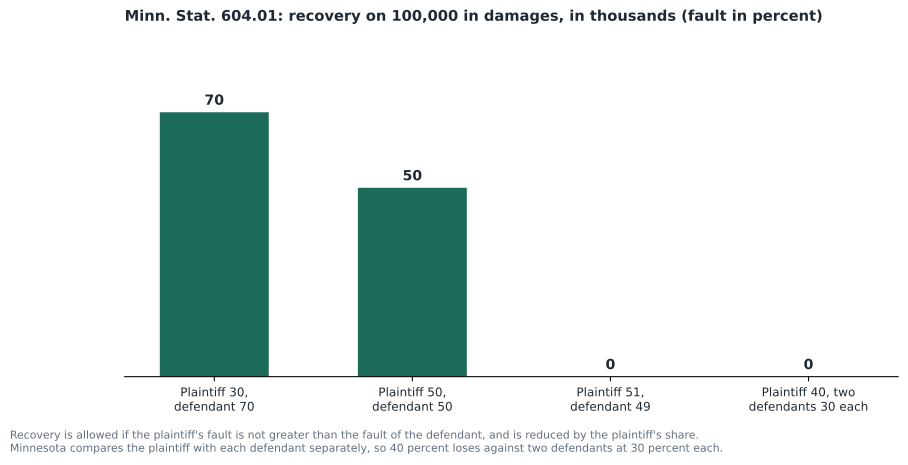
Two features of that rule matter most. The first is the threshold. Minnesota is a modified comparative fault state with what is often called a 51 percent bar or a 'not greater than' rule. A plaintiff whose fault is equal to the defendant's, 50 percent against 50 percent, can still recover, reduced by half. A plaintiff whose fault is greater than the defendant's, 51 percent against 49 percent, recovers nothing. Some other modified comparative fault states use a 50 percent bar, under which a plaintiff who is equally at fault recovers nothing. Minnesota's rule is the more generous one at the margin.
The second feature is the reduction. When the plaintiff can recover, the damages are reduced by the plaintiff's percentage of fault. A plaintiff with 100,000 dollars in damages who is 30 percent at fault recovers 70,000 dollars.
Comparing fault defendant by defendant
Minnesota's statute compares the plaintiff's fault with the fault of 'the person against whom recovery is sought.' Minnesota courts have read that language to require a comparison with each defendant individually, not with the combined fault of all defendants. That is a significant difference from states that aggregate the defendants' fault.
The defendant-by-defendant comparison can defeat a plaintiff who would recover in an aggregating state. Suppose the jury finds the plaintiff 40 percent at fault and two defendants 30 percent each. In an aggregating state, the plaintiff's 40 percent is less than the defendants' combined 60 percent, so she recovers. In Minnesota, her 40 percent is greater than each defendant's 30 percent, so she cannot recover from either one. The same plaintiff found 40 percent at fault against a single defendant at 60 percent would recover 60 percent of her damages.
Joint and several liability under section 604.02
When more than one defendant is liable, the next question is how much each must pay. Under traditional joint and several liability, each defendant could be made to pay the plaintiff's entire judgment, leaving that defendant to seek contribution from the others. Minnesota has limited that rule by statute.
Under Minnesota Statutes section 604.02, as amended in 2003, when two or more persons are severally liable, contributions to awards are generally in proportion to the percentage of fault attributable to each, and each is liable only for that share. Joint and several liability remains for a defendant whose fault is greater than 50 percent, and in a few other categories the statute lists, such as persons who act in a common scheme or plan that results in injury, and persons who commit an intentional tort or certain environmental violations. In those cases, the defendant may be required to pay the whole award, subject to contribution rights against others.
The effect is that, in most multi-defendant negligence cases, a minor defendant pays only its own share. If one defendant is 20 percent at fault and insolvent, the plaintiff usually bears that loss unless another defendant is more than 50 percent at fault or another exception applies. The statute also contains rules for reallocating uncollectible shares in some circumstances, and a lawyer facing that problem should read the current text closely.
| Situation | Each defendant pays |
|---|---|
| Defendant 30 percent at fault, no exception applies | Its own 30 percent share (several liability) |
| Defendant 60 percent at fault | Up to the whole award (joint and several), with contribution rights |
| Defendants acting in a common scheme or plan | Up to the whole award, as the statute provides |
| Intentional tort or listed statutory violations | Up to the whole award, as the statute provides |
The Municipal Tort Claims Act
The library-sidewalk file raises the third issue: the defendant is a city. Minnesota abolished the common law governmental immunity of municipalities by statute in 1963, in what is now Minnesota Statutes chapter 466, the Municipal Tort Claims Act. Chapter 466 makes every municipality, a term that includes cities, counties, towns, school districts and many other local public bodies, liable for its torts and those of its officers, employees and agents acting within the scope of their duties, but with important limits.
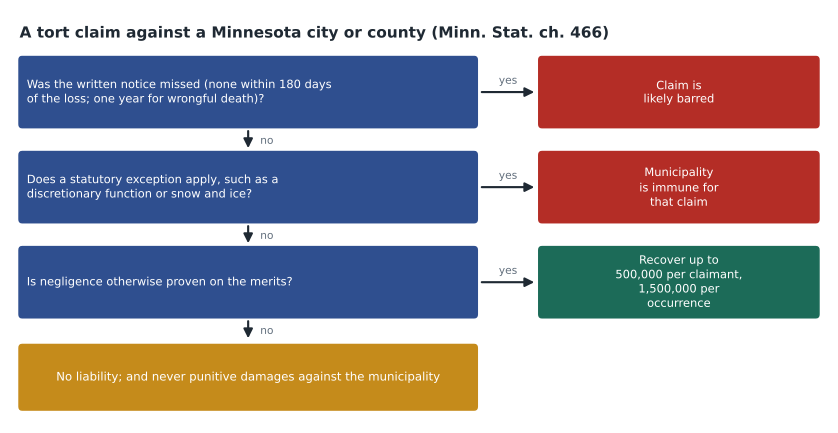
The first limit is a list of exceptions in section 466.03. The most important is the discretionary function exception, which preserves immunity for claims based on the performance of, or failure to perform, a discretionary function or duty, whether or not the discretion is abused. Minnesota courts distinguish between planning-level decisions, which involve the balancing of policy considerations such as cost, safety and public needs and are immune, and operational-level decisions, which involve the ordinary performance of established policies and are not. A city's decision about how to allocate a limited snow removal budget across the city may be a planning decision. A worker's failure to follow the city's established salting policy at a particular building is more likely operational.
Other exceptions in section 466.03 cover claims based on snow or ice conditions on highways and public sidewalks that do not abut publicly owned buildings or parking lots, except when the condition is affirmatively caused by the municipality's negligence, along with claims involving certain parks and recreation areas, tax collection and other listed matters. The precise terms of each exception matter, and the library-sidewalk file shows why: a sidewalk that abuts a public building, such as a library, may fall outside the snow and ice exception.
The second limit is a cap on damages. Under section 466.04, a municipality's liability for claims arising on or after July 1, 2009 is limited to 500,000 dollars for any one claimant and 1,500,000 dollars for any number of claims arising out of a single occurrence. Punitive damages are not allowed against a municipality.
The third limit is notice. Under section 466.05, a person who claims damages from a municipality must give written notice to the governing body within 180 days after the alleged loss or injury is discovered, stating the time, place and circumstances of the loss and the amount of compensation sought, if known. For wrongful death claims, the notice period is one year. A claimant who fails to give timely notice risks losing the claim, subject to limited exceptions, such as incapacity.
Official immunity
Alongside the statutory discretionary function exception, Minnesota recognizes a common law doctrine of official immunity, which protects individual public officials from personal liability for discretionary acts taken in the course of their duties unless they acted willfully or maliciously. When an employee is protected by official immunity, Minnesota courts may extend vicarious official immunity to the employer, so that the municipality is also protected. Official immunity turns on whether the conduct was discretionary or ministerial: a ministerial duty is simple, absolute and definite, leaving nothing to judgment, and its negligent performance is not protected.
The State Tort Claims Act
Claims against the State of Minnesota itself, rather than local governments, are governed by Minnesota Statutes section 3.736, the State Tort Claims Act. Its structure is similar: the state is liable for torts of its employees acting within the scope of employment, subject to listed exceptions, including a discretionary function exception, and subject to damage caps in the same amounts as the municipal caps. There are notice requirements as well. A lawyer whose client was injured on state property, such as a state park or a state university campus, should look to section 3.736 rather than chapter 466.
Worked problem
The library sidewalk
The client slipped on ice on the sidewalk directly outside a city library. The city had a written policy to salt walks at public buildings by 8 a.m.; the crew did not salt that morning. A contractor's downspout drained meltwater onto the walk. The client was looking at her phone. She fell on January 6 and called the firm in early March.
Show solution
- Timely notice: the firm must give written notice to the city council within 180 days of the injury under section 466.05. With the fall in January, the deadline falls in early July. Ostby sends notice in March.
- Exceptions: the snow and ice exception for sidewalks does not clearly apply, because the walk abuts a public building. The failure to follow an established salting policy looks operational rather than planning, so the discretionary function exception is unlikely to apply.
- Comparative fault: the jury will assign percentages to the client, the city and the contractor. Under section 604.01, the client's fault is compared with each defendant separately. If she is 20 percent, the city 50 percent and the contractor 30 percent, she can recover from both, reduced by 20 percent.
- Several liability: under section 604.02, neither defendant is over 50 percent, so each pays only its own share unless another exception applies.
- Caps: the city's liability cannot exceed 500,000 dollars to this claimant, and no punitive damages are available against the city.
Answer: The client has a viable claim against both defendants if notice is timely, the exceptions do not apply, and her fault is not greater than each defendant's. Each defendant will likely pay only its own share.
No-fault automobile insurance
A new Minnesota lawyer who handles car crash cases, as Kirsten does, meets the Minnesota No-Fault Automobile Insurance Act, Minnesota Statutes chapter 65B, almost immediately. Minnesota requires motor vehicle owners to carry personal injury protection, often called basic economic loss benefits, which pay medical expenses and certain other losses regardless of fault, up to statutory limits.
The no-fault system also limits tort suits. An injured person may sue the other driver for noneconomic damages, such as pain and suffering, only if the injury meets one of the statutory thresholds, which include medical expenses above a dollar amount set in the statute, permanent injury, permanent disfigurement, death, or disability for a set period. A lawyer must analyze the threshold before filing a negligence claim for pain and suffering, and the current statute should be checked for the exact figures.
The Civil Damages Act
Minnesota's dram shop law, the Civil Damages Act in Minnesota Statutes section 340A.801, allows a person injured by an intoxicated person to sue a liquor licensee that illegally sold alcohol to that person, for example by selling to someone who was obviously intoxicated or to a minor, if the illegal sale caused the intoxication that caused the injury. The Act has its own notice requirement, which requires written notice to the licensee within a set period after the claimant first retains a lawyer, and its own limitations period. The Act is a frequent companion claim in serious crash cases, and its notice requirement is another Minnesota deadline new lawyers must calendar.
Common mistakes
MistakeA Minnesota plaintiff who is 50 percent at fault recovers nothing.
InsteadUnder section 604.01, a plaintiff whose fault is not greater than the defendant's recovers, reduced by her share; 50 against 50 still recovers half.
MistakeMinnesota compares the plaintiff's fault with all defendants combined.
InsteadMinnesota compares the plaintiff with each defendant separately.
MistakeEvery defendant in Minnesota is jointly and severally liable.
InsteadUnder section 604.02, liability is generally several, with joint and several liability for defendants over 50 percent at fault and listed exceptions.
MistakeA claim against a Minnesota city can be brought any time within the general limitations period.
InsteadWritten notice must be given within 180 days (one year for wrongful death) under section 466.05.
MistakeA municipality can be liable for punitive damages in an egregious case.
InsteadSection 466.04 bars punitive damages against municipalities.
Summary and key terms
- Under section 604.01, a plaintiff recovers if her fault is not greater than the defendant's, with damages reduced by her percentage.
- Minnesota compares the plaintiff's fault with each defendant separately.
- Under section 604.02, liability is generally several; defendants over 50 percent at fault and some listed categories remain jointly and severally liable.
- The Municipal Tort Claims Act, chapter 466, makes municipalities liable subject to exceptions (including discretionary functions), caps of 500,000 per claimant and 1,500,000 per occurrence, no punitive damages, and a 180-day notice requirement.
- Official immunity protects public officials' discretionary acts; the State Tort Claims Act, section 3.736, governs claims against the state.
- No-fault thresholds limit pain and suffering claims after car crashes, and the Civil Damages Act creates liquor liability with its own notice rule.
- 0
- modified comparative fault
- 1
- several liability
- 2
- joint and several liability
- 3
- Municipal Tort Claims Act
- 4
- discretionary function exception
- 5
- official immunity
- 6
- notice of claim
Practice problems
Work each problem on paper first, then reveal the answer to check.
A plaintiff is 45 percent at fault and a single defendant 55 percent. Damages are 200,000 dollars. What does she recover?
Show answer
110,000 dollars (200,000 reduced by 45 percent).
Same plaintiff, 45 percent at fault, but two defendants at 30 and 25 percent. Can she recover?
Show answer
No. Her fault is greater than each defendant's individually.
A defendant is 60 percent at fault. Can it be required to pay the whole award?
Show answer
Yes. Under section 604.02, a defendant whose fault is greater than 50 percent is jointly and severally liable.
What must a claimant do within 180 days of an injury caused by a city employee?
Show answer
Give written notice of the claim to the city's governing body under section 466.05.
Lesson quiz · 5 questions
Score 60% or more to complete this lesson.
Create a free account to save your progress, take quizzes and earn a certificate.