
BAR-224 · Lesson 2 of 12 · 22 min
Eligibility, education, deadlines and fees
▶ Video coming soon A video version of this lesson is on the way.
Kirsten's classmate Theo called her in late September 2026 with a question she could not answer. Theo had decided to wait and sit the bar in July 2027 rather than February, and he wanted to know whether he had missed anything by not filing in the fall. Kirsten, who had filed her own application on September 28, realized she had followed the Board's checklist without understanding why the dates were what they were. She brought Theo's question to her next session with Marchetti.
'Good,' Marchetti said. 'Eligibility and deadlines are the part of admission where a careful candidate never has a problem and a careless one can lose a whole exam cycle. The rules are not hard. They are just unforgiving.'
This lesson covers who is eligible to sit the Minnesota bar exam, the education requirement, the timing of the J.D., the filing deadlines for the February 2027 exam and later exams, the fees, and the practical steps of filing.
The education requirement
The usual route to eligibility in Minnesota is a Juris Doctor degree from a law school approved by the American Bar Association. Most Minnesota candidates, including Kirsten, graduate from one of the ABA-approved law schools in the state or from an ABA-approved school elsewhere.
Minnesota's rules are more flexible than those of some states. NCBE's jurisdiction chart for Minnesota notes that an ABA-approved J.D. is not the only way to become eligible and that graduates of foreign law schools can qualify. In practice, these alternative routes usually involve additional conditions, such as admission and practice in another jurisdiction. A candidate who does not hold an ABA-approved J.D. should read the Board's eligibility rule closely, and ideally contact the Board, before assuming eligibility either way.
For the ordinary candidate, the important detail is timing. Minnesota allows a candidate to sit the exam before the J.D. has formally been conferred, provided two conditions are met. All coursework required for the degree must be completed at least 30 days before the exam, and the degree must be conferred within 120 days after the exam. Kirsten, who graduated in May 2026, meets both conditions easily. Theo, who graduates on the usual schedule, will too. The rule matters most for candidates who finish their coursework in December and want to sit in February, before a spring conferral ceremony.
Who else must meet eligibility rules
Applicants for admission by score transfer and admission without examination must meet eligibility rules of their own. A transfer applicant needs a qualifying UBE score earned elsewhere within the time limit. An applicant for admission without examination needs a license in another United States jurisdiction, good standing, and the required period of active practice. Those routes are covered in Lesson 11. Every applicant, on every route, must also satisfy the character and fitness requirement and earn a scaled score of 85 on the MPRE.
The filing deadlines
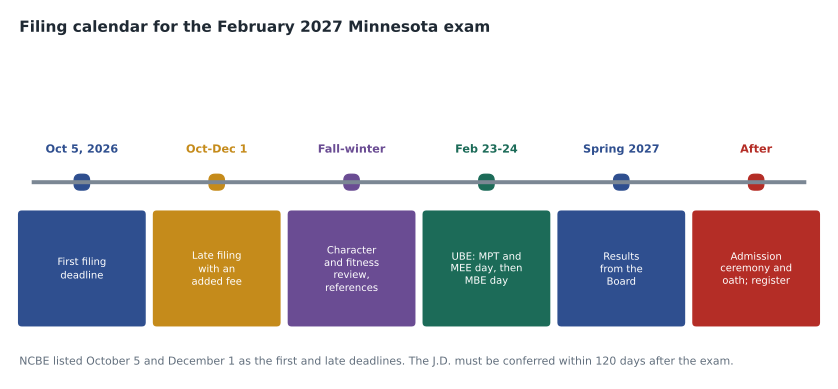
Minnesota gives the bar exam twice a year, on the last Tuesday and Wednesday of February and July, the national dates for the UBE. For each exam there is a first filing deadline and a later deadline for late filing with an additional fee. NCBE's jurisdiction information for Minnesota listed these dates for the two exams around Kirsten's:
| Exam | First filing deadline | Late filing deadline |
|---|---|---|
| July 2026 | March 16, 2026 | May 1, 2026 |
| February 2027 (last legacy UBE) | October 5, 2026 | December 1, 2026 |
The deadlines for July 2027, the first Minnesota NextGen exam, were expected to follow the same general pattern, with a first deadline in the spring and a late deadline a few weeks later. Theo should not rely on that expectation. He should check the Board's announcements early in 2027 and file as soon as the application opens.
Kirsten filed on September 28, a week before the first deadline. Marchetti approved: 'Early filing costs you nothing and buys you time. If the Board needs a document or a clarification, you want that conversation to happen in October, not in January when you are trying to study.'
What happens if a deadline is missed
A candidate who misses the first filing deadline but files by the late deadline can still sit the exam, but must pay a late fee on top of the regular fee. A candidate who misses the late deadline generally cannot sit that exam and must file for the next one. In Kirsten's case, missing December 1, 2026 would have meant waiting for July 2027, which is a NextGen exam with a different format, different subjects and different study materials. For candidates near the transition, a missed deadline does not just delay admission by five months; it changes the exam.
Marchetti told Kirsten about a candidate she had coached years earlier in another state who assumed the deadline was a postmark date and mailed the application on the last day. The application arrived two days late, and the board refused it. 'Read the rule for what counts as filed,' she said. 'Minnesota's application is filed online, so the question is usually whether the submission and the fee went through before the deadline. Get a confirmation and keep it.'
Fees
Minnesota charges an application fee for the exam, with higher amounts for late filing and for some categories of applicant, such as attorneys licensed in other jurisdictions. Separate fees apply to score transfer and to admission without examination. The Board publishes the current fee schedule, and fees change from time to time, so a candidate should look up the current amount at the time of filing rather than relying on a figure from a friend or a study guide.
Several other costs should go into a candidate's budget. The MPRE has its own registration fee paid to NCBE. A candidate who will type the exam on a laptop may need to pay for exam software. And if a candidate later wants to transfer a Minnesota UBE score to another jurisdiction, NCBE charges a fee for each score transfer request. Commercial bar review courses, travel to the test site and a hotel night are not required, but most candidates spend money on at least one of them.
| Cost | Paid to | Notes |
|---|---|---|
| Exam application fee | Board of Law Examiners | Higher if filed after the first deadline; check the current schedule |
| MPRE registration | NCBE | Separate test; Minnesota needs a scaled score of 85 |
| Laptop exam software | The software provider | Only for candidates who type the written portions |
| Score transfer request (later) | NCBE | Only if the score is sent to another UBE jurisdiction |
| Annual lawyer registration (after admission) | Minnesota Supreme Court | Due every year once admitted |
Filing the application
The Minnesota application is completed online. It asks for the applicant's education, employment history, residences, any criminal, civil or disciplinary history, financial matters, and references, among other things. Because the application doubles as the basis for the character and fitness investigation, it is long and detailed. Kirsten spent most of two weekends on hers.
The application also asks the applicant to authorize the Board to obtain records, such as law school records and records from courts or agencies. Applicants should expect the Board to verify their answers. An omission discovered later is much worse than an awkward disclosure made at the start.
Marchetti gave Kirsten a checklist she uses with every candidate.
Worked problem
Kirsten's filing checklist
Before submitting, Kirsten goes through Marchetti's list.
Show solution
- Every residence and job since the age the application asks about, with dates that leave no unexplained gaps.
- Every citation, arrest, charge or court case, including the 2020 underage consumption citation in Duluth, even though it was a petty misdemeanor and the fine was paid.
- Every financial problem the form asks about, including the credit card account that went 90 days late in 2023, with proof that it has since been paid.
- Law school records, including any academic discipline (Kirsten had none).
- References who know her well and will respond promptly.
- Payment confirmation and a saved copy of the submitted application.
Answer: Kirsten's application was complete when submitted, which is the best predictor of a smooth character and fitness review.
Accommodations and laptops
A candidate with a disability may request testing accommodations, such as extra time or a separate room. Accommodation requests have their own forms and supporting documentation requirements and often their own deadlines, which can be earlier than the regular filing deadline because the Board needs time to review medical or professional documentation. A candidate who received accommodations in law school or on the MPRE should not assume they carry over automatically; each testing body decides separately.
Most Minnesota candidates type their MPT and MEE answers on a laptop using exam software approved by the Board. A candidate who wants to type must register the laptop and complete the software steps by the Board's deadlines, which usually include downloading the software and taking a practice exam. Candidates may also handwrite, though few do. The MBE is answered on a separate answer sheet or as the Board directs.
The timing question Theo asked
Back to Theo's question. He had not missed anything by not filing for February 2027, but his choice had a consequence he had not fully considered. By choosing July 2027, he will be among the first candidates to take NextGen in Minnesota. That is not a reason to change his plan, but it is a reason to choose study materials built for NextGen and to keep an eye on the Board's announcements about the new exam, including its passing score.
Marchetti added a practical point. 'Theo should mark the application opening date for July 2027 as soon as the Board announces it. The first administration of a new exam is exactly the time when you want to be early, because there may be new steps, new software and new questions to answer.'
Worked problem
Choosing an exam date near the transition
Theo asks whether he should switch to February 2027 to take the familiar legacy UBE instead of the new NextGen exam in July 2027. He has not filed. It is late September 2026.
Show solution
- Check eligibility: Theo graduated in May 2026, so he can sit in February 2027 if he files on time.
- Check the deadline: the first deadline is October 5 and the late deadline December 1, 2026, so he can still file for February.
- Weigh the risk: February 2027 is the last legacy UBE in Minnesota. If he fails, his retake in July 2027 is NextGen, a different exam.
- Weigh preparation: Theo has a full-time job until December and planned to study from April to July. Cramming the legacy UBE into ten weeks with a job may be harder than a full NextGen study period.
Answer: There is no single right answer. Theo should choose the date he can prepare for properly, knowing that a February candidate has no legacy retake and a July candidate faces a new exam with new materials.
Keeping the application current
Filing the application is not the end of the applicant's duty. A Minnesota applicant must keep the information current until admission. If Kirsten moves, changes jobs, receives a citation, becomes a party to a lawsuit, or has any other change that the application asked about, she must update the Board. A new matter disclosed promptly is usually routine. The same matter discovered by the Board months later, with no update, raises a question about candor.
Marchetti gave Kirsten one more rule: 'When in doubt, disclose. Nobody has ever been denied admission for telling the Board too much.'
Common mistakes
MistakeThe J.D. must be conferred before the candidate can sit the Minnesota exam.
InsteadCoursework must be finished 30 days before the exam, and the degree conferred within 120 days after it.
MistakeMissing the first filing deadline means waiting for the next exam.
InsteadA candidate can still file by the late deadline with an additional fee.
MistakeFees from a friend's application last year are good enough to budget with.
InsteadFees change; check the Board's current schedule when filing.
MistakeAccommodations granted in law school carry over automatically.
InsteadThe Board decides accommodation requests separately, with its own forms and deadlines.
MistakeOnce the application is filed, nothing more needs to be reported.
InsteadApplicants must update the Board about changes until admission.
A filing timeline that works
Marchetti gives every February candidate the same backward plan. In August, read the Board's current instructions and fee schedule and gather the documents the application will ask for: addresses, employers, court records and financial records. In September, complete the application over two or three sittings, with a day in between to reread it. File before the first deadline, keep the confirmation, and put the late deadline on the calendar anyway in case the Board asks for something that has to be resubmitted. In October and November, respond to any Board request within days, not weeks. In December, register the laptop and complete the software steps. In January, read the exam instructions. Nothing on this list is difficult. The candidates who get into trouble are the ones who leave all of it for the same week.
Kirsten followed that plan almost exactly. The one surprise was a request in October for a copy of the court record from her 2020 citation, which the Board wanted to match against her description. Because she had filed early, she could request the record from St. Louis County, wait the two weeks it took to arrive, and send it in without any pressure from a deadline.
Summary and key terms
- The usual route to eligibility is a J.D. from an ABA-approved law school; Minnesota has additional routes, including for some foreign law graduates, with extra conditions.
- Coursework must be completed 30 days before the exam and the J.D. conferred within 120 days after it.
- For February 2027, NCBE listed October 5, 2026 as the first filing deadline and December 1, 2026 as the late deadline.
- Fees vary by category and filing date; candidates should check the Board's current schedule.
- The application is detailed, must be complete and candid, and must be kept current until admission.
- Near the NextGen transition, a missed deadline can change not only the exam date but the exam itself.
- 0
- first filing deadline
- 1
- late filing
- 2
- conferral
- 3
- testing accommodations
- 4
- duty to update
Practice problems
Work each problem on paper first, then reveal the answer to check.
Kirsten finished her coursework in May 2026. Could she have sat the July 2026 exam before her degree was formally conferred?
Show answer
Yes, if her coursework was finished at least 30 days before the exam and the degree was conferred within 120 days after it.
What were the first and late filing deadlines NCBE listed for the February 2027 Minnesota exam?
Show answer
October 5, 2026 and December 1, 2026.
Why is a missed deadline especially costly for a February 2027 candidate?
Show answer
The next exam, July 2027, is NextGen, a different exam with different materials.
Kirsten receives a speeding ticket in January 2027. What should she do?
Show answer
Update the Board promptly, as the application requires applicants to keep their information current until admission.
Lesson quiz · 5 questions
Score 60% or more to complete this lesson.
Create a free account to save your progress, take quizzes and earn a certificate.