
BAR-224 · Lesson 6 of 12 · 22 min
What the exam tests and how Minnesota law appears
▶ Video coming soon A video version of this lesson is on the way.
In her first week at the firm, Kirsten drafted a short memo for Maren Ostby on whether a client who was 50 percent at fault in a car crash could recover anything. She answered with the rule she had learned for the MBE, a general modified comparative fault rule, and cited a treatise. Ostby returned the memo with one line circled and a note: 'What does 604.01 say?' Kirsten realized she had answered a Minnesota question with bar exam law.
She told the story to Marchetti, half embarrassed. Marchetti laughed. 'That is the most useful mistake you will make this year,' she said. 'It shows you the difference between what the exam tests and what Minnesota practice requires. The two overlap, but they are not the same. You need both, and you need to keep them in separate boxes.'
This lesson explains what the UBE tests, why Minnesota law does not appear on the exam, how to keep general principles and Minnesota rules apart, where Minnesota law does show up for a new lawyer, and how the remaining lessons on Minnesota law fit into exam preparation.
Minnesota has no separate state law component
Several UBE jurisdictions add a local law requirement on top of the UBE. Some require an online course with short quizzes on state law; others require a short state-specific test. Michigan, for example, requires its candidates to complete a course on Michigan law. New York requires a course and an online test on New York law.
Minnesota, as of November 2026, did not. NCBE's chart for Minnesota did not list any jurisdiction-specific component, and the Board's admission requirements consisted of the UBE score, the MPRE and character and fitness. A Minnesota candidate who passes the UBE with 260 or more, earns 85 on the MPRE and clears character and fitness is eligible for admission without any additional course or test on Minnesota law.
That choice reflects a view of what a bar exam can do. A state law component tests a sample of local rules at one moment. Minnesota relies instead on the professional duty of competence: a newly admitted lawyer must learn the Minnesota law needed for each matter, through research, supervision and continuing legal education. The Rules of Professional Conduct, not the bar exam, enforce that duty.
What the UBE does test
The UBE tests general principles of law. On the MBE, that means the rules NCBE identifies in its subject matter outline for each of the seven subjects, applied as most American jurisdictions would apply them. For civil procedure, the MBE tests the Federal Rules of Civil Procedure and federal jurisdiction. For evidence, it tests the Federal Rules of Evidence. For constitutional law, it tests the United States Constitution. For contracts, it tests common law principles and Article 2 of the Uniform Commercial Code. For criminal law, torts and property, it tests the majority or generally accepted rules, often with notes about common alternatives such as the Model Penal Code.
On the MEE, the same approach applies. When an MEE question tests family law, the expected answer uses general principles, such as the usual factors for child custody or the general distinction between marital and separate property, not any single state's statute. When an MEE question tests trusts and estates, graders look for the Uniform Probate Code approach or the general common law approach, depending on the question. When a question depends on a specific statute or rule, the question will usually give it.
The MPT, as Lesson 4 explained, tests no substantive law at all. Everything a candidate needs is in the Library, which may contain the law of a fictional jurisdiction. The MPT rewards candidates who use only the law provided.
Two boxes
Marchetti's advice to every candidate in a UBE state without a local component is to keep two boxes. The first box holds the general rules the exam tests. The second holds the Minnesota rules practice requires. During bar preparation, the first box gets almost all the attention. But a candidate who works as a law clerk while studying, as Kirsten does, will encounter the second box every day, and the two will sometimes conflict.
The danger runs in both directions. On the exam, a candidate who answers an MEE question with a Minnesota rule may get the analysis wrong, because the grading materials expect the general rule. In practice, a lawyer who answers a client's question with an MBE rule may give wrong advice. Kirsten's comparative fault memo was an example of the second mistake.
| Topic | What the UBE expects | What Minnesota law provides |
|---|---|---|
| Comparative fault | The general pure and modified versions; the question tells you which applies or you note both | Minn. Stat. 604.01: recovery if the plaintiff's fault is not greater than the defendant's, compared defendant by defendant |
| Pleading standard | Federal plausibility standard under Twombly and Iqbal | Plain notice pleading under Minn. R. Civ. P. 8.01, as Walsh v. U.S. Bank (2014) held |
| Starting a lawsuit | Under the federal rules, an action is commenced by filing the complaint | Under Minn. R. Civ. P. 3.01, service of the summons commences the action |
| Professional conduct | ABA Model Rules (on the MPRE) | Minnesota Rules of Professional Conduct, with Minnesota variations |
| Probate | General principles and the Uniform Probate Code | Minnesota's version of the Uniform Probate Code, Minn. Stat. ch. 524, with Minnesota features |
How to handle the conflicts on the exam
When Kirsten meets a topic where she knows the Minnesota rule differs from the general rule, Marchetti's instruction is clear: on the UBE, use the general rule. If an MEE question about a negligence claim does not say which comparative fault rule applies, the best answer explains the general approach, notes the difference between pure and modified systems, and applies them to the facts. It does not cite Minnesota Statutes section 604.01. The graders have NCBE's materials, not Minnesota's statutes.
The same is true for civil procedure. The MBE and MEE test federal procedure. A question about whether a complaint survives a motion to dismiss expects the federal plausibility standard from Bell Atlantic v. Twombly and Ashcroft v. Iqbal, even though Minnesota state courts use a more lenient notice pleading standard. Kirsten must answer the exam question as a federal court would and save the Minnesota rule for practice.
Worked problem
Which box?
During one study week, Kirsten meets three questions. (1) An MEE question asks whether a defendant can be served by leaving papers with a co-worker; the facts are set in federal court. (2) Ostby asks her whether a client's state court action against a contractor has been commenced if the summons was served but nothing has been filed. (3) An MBE question asks whether a complaint containing only conclusory allegations of discrimination survives a motion to dismiss in federal court.
Show solution
- Question 1 is an exam question set in federal court, so it belongs in the first box: apply Federal Rule of Civil Procedure 4.
- Question 2 is a Minnesota practice question, so it belongs in the second box: under Minnesota Rule of Civil Procedure 3.01, service of the summons commences the action, and the case must be filed within one year under Rule 5.04.
- Question 3 is an MBE question in federal court, so it belongs in the first box: apply the Twombly and Iqbal plausibility standard.
Answer: Kirsten keeps the federal and general rules for the exam and the Minnesota rules for the firm.
Where Minnesota law does show up
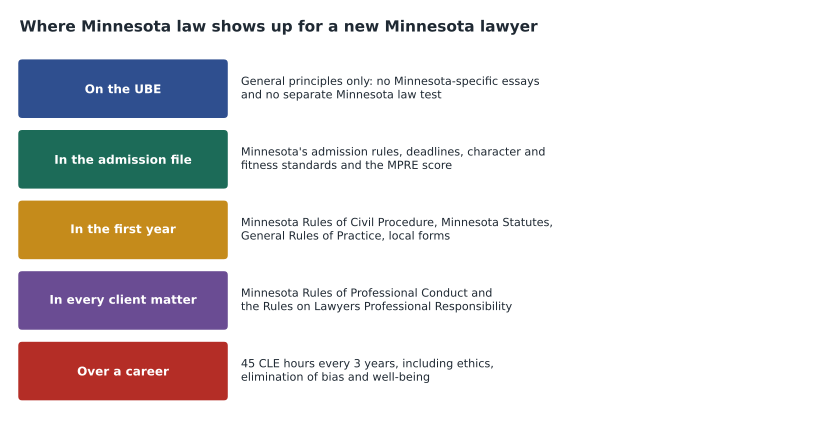
Even though Minnesota law is not on the exam, a Minnesota candidate meets it in several places before and soon after admission.
The first is the admission process itself. The Rules for Admission to the Bar, the Board's policies on deadlines and fees, the character and fitness standards and the MPRE requirement are all Minnesota law. Lessons 1 through 3 covered them.
The second is the first year of practice. A new Minnesota lawyer will work under the Minnesota Rules of Civil Procedure, the General Rules of Practice for the District Courts, the Minnesota Rules of Evidence, the Minnesota Rules of Criminal Procedure if the practice includes criminal work, and the Minnesota Statutes. Many of these track their federal or model counterparts closely, but the differences, such as how a civil action is commenced, are exactly where new lawyers make mistakes.
The third is professional conduct. Every Minnesota lawyer is bound by the Minnesota Rules of Professional Conduct, which are based on the ABA Model Rules but differ in several places. Lesson 10 covers the most important differences.
The fourth is continuing legal education. Minnesota requires 45 CLE hours every three years. Many Minnesota CLE programs focus on Minnesota practice, such as updates on Minnesota civil procedure, family law or probate.
Why the next four lessons matter
If Minnesota law is not on the exam, why does this course spend four lessons on it? Marchetti gave Kirsten three reasons.
First, the overlap is large. Most of what Lessons 7 through 10 cover, such as comparative fault, governmental immunity, marital property, felony murder and professional conduct, is also tested on the UBE in its general form. Learning the Minnesota version alongside the general version sharpens both, as long as the candidate keeps them labeled.
Second, a candidate who works while studying will need the Minnesota rules immediately. Kirsten drafts memos for Ostby every week. Getting the Minnesota rule right at work and the general rule right on the exam is a skill she must practice anyway.
Third, the first months after admission are when new lawyers are most exposed. The Minnesota rules that differ from the general ones, such as service-based commencement, defendant-by-defendant comparison of fault, notice of claim deadlines against cities, and Minnesota's advance fee rule, are the rules most likely to cause a malpractice claim or a disciplinary complaint in a new lawyer's first year. Knowing them before admission is cheap insurance.
Worked problem
Turning Ostby's circled note into a study habit
After the comparative fault memo, Kirsten sets up a two-column page in her notes for each topic she studies.
Show solution
- Left column, general rule: modified comparative fault in its common forms; pure comparative fault; contributory negligence in the few jurisdictions that keep it.
- Right column, Minnesota rule: Minn. Stat. 604.01; recovery allowed if the plaintiff's fault is not greater than the fault of the person against whom recovery is sought; damages reduced by the plaintiff's percentage.
- Bottom line, exam instruction: on the UBE, use the left column unless the question supplies a statute.
Answer: The two-column page keeps the boxes separate and makes Minnesota practice knowledge a byproduct of bar study rather than a competitor for time.
A note on federal practice in Minnesota
One more distinction matters for a new Minnesota lawyer. Federal courts sitting in Minnesota, the United States District Court for the District of Minnesota, apply the Federal Rules of Civil Procedure and their own local rules. Appeals go to the United States Court of Appeals for the Eighth Circuit. A Minnesota lawyer who practices in both state and federal court must keep the procedural rules apart: a case commenced by service in state court may be removed to federal court, where federal rules govern from removal forward. Here the exam's federal rules and the lawyer's Minnesota practice meet directly.
Common mistakes
MistakeMinnesota requires a state law course or test in addition to the UBE.
InsteadAs of November 2026 Minnesota had no separate state law component.
MistakeMEE answers should apply Minnesota statutes when the candidate knows them.
InsteadMEE answers should use general principles unless the question supplies a specific rule.
MistakeThe MBE tests Minnesota civil procedure.
InsteadThe MBE tests the Federal Rules of Civil Procedure.
MistakeMinnesota state courts use the Twombly and Iqbal plausibility standard.
InsteadMinnesota courts use notice pleading under Rule 8.01, as Walsh v. U.S. Bank held in 2014.
MistakeMinnesota law can be ignored until after admission.
InsteadClerks need it at work, and new lawyers are most exposed to Minnesota-specific mistakes in their first year.
Learning Minnesota law efficiently after admission
Marchetti's last piece of advice in this session was about the first year after admission. A new Minnesota lawyer cannot learn all of Minnesota law at once, and does not need to. The efficient approach is to learn by matter. When a file arrives, identify the Minnesota statutes and rules that govern it, read them in full rather than relying on a summary, check the most recent Minnesota appellate decisions, and ask a supervising lawyer what traps the area holds. The Minnesota Practice series and MSBA section materials are common starting points, and the Minnesota State Law Library is a resource for any Minnesota lawyer.
Kirsten saw the value of that approach at the firm. Ostby's practice is concentrated in a handful of areas: car crashes, premises claims, claims against public bodies, family law and probate. Kirsten does not need to know Minnesota's securities statutes or its tax court procedure. She needs to know the rules that govern the firm's cases, and she needs to know them precisely. The next four lessons cover those areas.
Summary and key terms
- Minnesota had no separate state law component as of November 2026; admission requires the UBE, the MPRE and character and fitness.
- The UBE tests general principles: federal procedure and evidence, the federal Constitution, and majority rules elsewhere.
- Keep two boxes: general rules for the exam and Minnesota rules for practice.
- Examples of differences include comparative fault under 604.01, notice pleading under Rule 8.01 and commencement by service under Rule 3.01.
- Minnesota law appears in the admission process, in first-year practice, in professional conduct and in CLE.
- 0
- jurisdiction-specific component
- 1
- general principles of law
- 2
- notice pleading
- 3
- plausibility standard
- 4
- duty of competence
Practice problems
Work each problem on paper first, then reveal the answer to check.
Does Minnesota require a state law course or test for admission?
Show answer
No, not as of November 2026.
An MEE question about a negligence claim does not specify the comparative fault rule. Should Kirsten cite Minn. Stat. 604.01?
Show answer
No. She should explain the general pure and modified approaches and apply them to the facts.
What pleading standard do Minnesota state courts apply?
Show answer
Plain notice pleading under Minn. R. Civ. P. 8.01, as confirmed in Walsh v. U.S. Bank (2014).
Name three places where a new Minnesota lawyer meets Minnesota law despite the UBE's general focus.
Show answer
Any three of: the admission process, the Minnesota Rules of Civil Procedure and other court rules, the Minnesota Statutes, the Rules of Professional Conduct and CLE.
Lesson quiz · 5 questions
Score 60% or more to complete this lesson.
Create a free account to save your progress, take quizzes and earn a certificate.