
BAR-224 · Lesson 3 of 12 · 22 min
Character and fitness and the MPRE
▶ Video coming soon A video version of this lesson is on the way.
Kirsten had two items on her application that made her uneasy. The first was a 2020 citation for underage consumption in Duluth, written up at a party in her first year of college. It was a petty misdemeanor, and she had paid the fine the same month. The second was a credit card account that went 90 days late in 2023, during a semester when her part-time hours were cut. She had since paid it in full. Neither seemed serious to her, but the application asked about both, and she wondered whether either could keep her out of the profession.
'Almost certainly not,' Marchetti said. 'But the way you handle them matters more than the events themselves. Let us go through what the Board is actually looking for.'
This lesson explains the character and fitness requirement in Minnesota, how the Board investigates, what kinds of conduct raise concern, how rehabilitation is shown, what happens if the Board has doubts, and the MPRE, the separate ethics test on which Minnesota requires a scaled score of 85.
The purpose of the requirement
Every United States jurisdiction requires applicants to show that they have the character and fitness to practice law. The idea is not to find perfect people. It is to protect clients, courts and the public by screening out applicants whose past conduct shows that they are likely to be dishonest, untrustworthy, or unable to meet a lawyer's obligations. Lawyers hold clients' money, keep their secrets, make promises on their behalf and owe duties of candor to courts. The question for the Board is whether the applicant can be trusted to do those things.
In Minnesota, the burden is on the applicant. The applicant must establish good character and fitness, and the Board may deny admission if the applicant does not do so. That allocation of the burden is why complete and candid disclosure is so important. An applicant who leaves gaps in the record leaves the Board unable to find what the applicant has to prove.
Who investigates
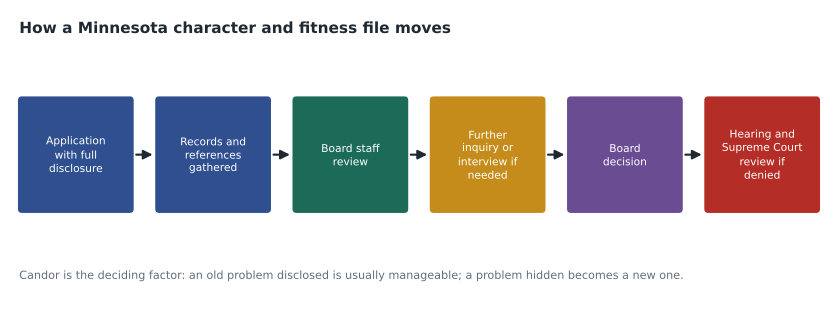
Minnesota's character and fitness investigation is done by the State Board of Law Examiners and its staff, using the information in the application. Unlike states that send applicants through a separate committee of the state bar, Minnesota keeps eligibility, the exam and character and fitness in one place. The Board's staff reviews each application, obtains records, contacts references, and may ask the applicant for more information. Most applications are cleared at the staff level without any further proceedings.
What the Board looks at
Bar examiners across the country look at the same broad categories of conduct, and Minnesota's are typical. They include unlawful conduct, from minor offenses to serious crimes; academic misconduct, such as plagiarism or cheating; employment problems, such as being fired for dishonesty; neglect of financial responsibilities, such as unpaid debts or defaulted loans; neglect of professional obligations; violations of court orders, including child support orders; evidence of mental or emotional conditions or substance use that currently impairs the ability to practice; and, above all, any lack of candor, including on the bar application itself.
Two points about the list deserve emphasis. First, the Board looks at conduct, not labels. A diagnosis, by itself, is not a reason to deny admission. The question is whether the applicant can currently meet the essential obligations of a lawyer. Second, lack of candor is in a category of its own. Nearly every disclosed problem can be explained and weighed. An undisclosed problem that the Board discovers is a new and often more serious problem, because it shows the applicant was willing to mislead the body deciding on admission.
| Category | Examples the Board may ask about |
|---|---|
| Unlawful conduct | Arrests, citations, charges and convictions, including petty misdemeanors and juvenile matters the form asks about |
| Academic misconduct | Plagiarism, cheating, discipline by a college or law school |
| Employment | Terminations, especially for dishonesty or misconduct |
| Financial responsibility | Unpaid debts, defaults, collections, tax problems, bankruptcies |
| Court orders | Unpaid child support, ignored judgments, violations of orders |
| Candor | Omissions or misstatements on the bar application or law school application |
How the Board weighs conduct
When the Board finds conduct of concern, it does not simply count incidents. It weighs them. The factors commonly considered include the applicant's age at the time of the conduct, how recent it was, how serious it was, the circumstances, whether there is a pattern, whether the applicant has been candid about it, and the evidence of rehabilitation. Conduct that happened once, years ago, when the applicant was young, and that the applicant has disclosed and taken responsibility for, carries much less weight than recent, repeated or concealed conduct.
Marchetti applied the factors to Kirsten's two items. The underage consumption citation happened six years before her application, when she was a first-year college student. It was a petty misdemeanor, she paid the fine promptly, and there has been nothing like it since. The late credit card account happened three years before the application, during a period of reduced income, and she paid it in full. Neither shows dishonesty, and both are being disclosed. 'If you had left either one off,' Marchetti said, 'you would have turned an old, minor matter into a current question about your honesty.'
Worked problem
Disclosing a minor matter well
Kirsten drafts her explanation of the 2023 late credit card account.
Show solution
- She states the facts plainly: the account was opened in 2021; payments fell 90 days behind in the spring of 2023 when her part-time hours were cut; the account was referred to collection.
- She accepts responsibility without excuses: she should have contacted the issuer when she first fell behind.
- She shows what happened next: she set up a payment plan in the summer of 2023 and paid the balance in full by early 2024.
- She attaches proof: the collection agency's letter confirming payment in full.
- She shows the present: she has had no late payments since, and she keeps a written budget.
Answer: A short, factual, documented explanation that accepts responsibility and shows changed conduct is the strongest way to present a financial problem.
Rehabilitation
For more serious matters, the applicant may need to show rehabilitation. Rehabilitation means evidence that the applicant has changed, not just that time has passed. Evidence that boards commonly accept includes a record of good conduct since the incident, completion of any sentence, probation or treatment, restitution, candid acknowledgment of the conduct, community service, steady employment and education, and the views of people who know the applicant now. The more serious the conduct, the more evidence of rehabilitation is needed.
An applicant with a serious matter, such as a felony conviction, a history of substance use affecting school or work, or a finding of academic dishonesty, should begin assembling that evidence early, long before the application is filed. Some applicants retain a lawyer experienced in admission matters. That is not a sign of guilt; it is a sensible step when the stakes are high and the process is unfamiliar.
When the Board has doubts
If the Board's staff cannot clear an application, the Board may ask for more information or invite the applicant to meet with Board members. If the Board is still not satisfied, it may decide to deny admission. A denied applicant has the right to a hearing, with the opportunity to present evidence and witnesses, and may then seek review in the Minnesota Supreme Court. A denial typically comes with a waiting period before the applicant may reapply.
Very few applicants reach that stage. The large majority of character and fitness files, including many with minor matters like Kirsten's, are cleared without any formal proceeding. What separates the files that move smoothly from those that do not is usually candor and completeness, not the underlying conduct.
The MPRE
The second subject of this lesson is the Multistate Professional Responsibility Examination. The MPRE is a separate test, written and administered by NCBE, that measures knowledge of the rules governing lawyers' professional conduct. It is not part of the UBE and is taken on a different day, at computer test centers, during testing windows NCBE offers several times a year.
Minnesota requires a scaled score of at least 85 on the MPRE. The score is reported on a scale from 50 to 150. Most jurisdictions require between 75 and 86, so Minnesota's 85 sits toward the upper end of the range. A score earned for another jurisdiction counts in Minnesota if it meets 85 and satisfies the Board's rule on when the MPRE must have been taken. Kirsten scored 89 in March 2026, comfortably above 85.
The MPRE has 60 multiple-choice questions, of which 50 are scored and 10 are pretest questions. Candidates have two hours. The questions test the ABA Model Rules of Professional Conduct, the ABA Model Code of Judicial Conduct, and generally accepted principles of the law governing lawyers, including some federal procedural and evidence rules where they bear on professional conduct. The MPRE does not test Minnesota's own rules. That point matters, because Minnesota's Rules of Professional Conduct differ from the Model Rules in several places, as Lesson 10 explains. On the MPRE, the Model Rules govern.
| Feature | MPRE |
|---|---|
| Who writes it | NCBE |
| Format | 60 multiple-choice questions (50 scored), two hours, computer-based at test centers |
| What it tests | ABA Model Rules of Professional Conduct, Model Code of Judicial Conduct, law governing lawyers |
| Score scale | 50 to 150 |
| Minnesota requirement | Scaled score of 85 |
| When to take it | Usually during law school; check the Board's rule on timing |
Preparing for the MPRE
Most candidates take the MPRE during their second or third year of law school, after a course in professional responsibility. Taking it early separates it from the bar exam and leaves time for a retake if needed. Preparation usually takes a few weeks of focused study. The most heavily tested topics include conflicts of interest, the client-lawyer relationship, confidentiality, and the lawyer's duties to the court and to third parties.
Marchetti's MPRE advice to candidates is consistent. Learn the Model Rules, not your state's rules, for the test. Work through practice questions written to the MPRE's format, which often turn on whether a lawyer may, must, or must not take an action. And pay attention to the words 'subject to discipline,' which are the MPRE's way of asking whether conduct violates the rules, as distinct from whether it is merely unwise.
Worked problem
Model Rule or Minnesota rule?
In a practice set, Kirsten meets a question about whether a lawyer may treat a flat fee paid in advance as the lawyer's own money on receipt. She remembers that Minnesota's Rule 1.5(b) has specific conditions for advance fees. How should she answer?
Show solution
- Identify the test: the MPRE tests the ABA Model Rules and general principles, not Minnesota's rules.
- Apply the Model Rule approach: under the Model Rules, unearned fees paid in advance generally belong in trust until earned, and fees must be reasonable and refundable to the extent unearned when the representation ends.
- Set aside the Minnesota detail for practice: Minnesota's specific written-agreement conditions matter for her career, but not for this question.
Answer: Kirsten answers according to the Model Rules and saves Minnesota's version for the professional conduct lesson and for practice.
How character and fitness and the MPRE fit together
Both requirements are about the same thing from different angles. The MPRE tests whether the applicant knows the rules. Character and fitness asks whether the applicant's past conduct shows that the applicant will follow them. A candidate can pass the MPRE with a perfect score and still be denied admission for lack of candor on the application, and a candidate with a spotless record still needs the 85.
Kirsten's position at the end of the session was strong. Her MPRE score was in hand, her application was complete, her two minor matters were disclosed and documented, and she understood her duty to keep the file current. 'Now,' Marchetti said, 'you can put character and fitness out of your mind and concentrate on the exam. That is exactly where you want to be in November.'
Common mistakes
MistakeA petty misdemeanor is too minor to disclose if the application asks about citations.
InsteadDisclose everything the application asks about; omissions create candor problems.
MistakeA mental health diagnosis disqualifies an applicant.
InsteadThe Board looks at conduct and current ability to meet a lawyer's obligations, not labels.
MistakeThe MPRE tests Minnesota's Rules of Professional Conduct.
InsteadThe MPRE tests the ABA Model Rules and general principles of the law governing lawyers.
MistakeMinnesota requires an MPRE score of 75.
InsteadMinnesota requires a scaled score of 85.
MistakeThe Board must prove an applicant lacks good character.
InsteadThe applicant bears the burden of establishing good character and fitness.
References and the people who speak for you
The application asks for references, and the Board may contact them. Marchetti's advice is to choose people who know the applicant well and recently, such as a supervising lawyer, a professor, or an employer, rather than a family friend with an impressive title who has met the applicant twice. A reference who knows about a disclosed problem and can speak to how the applicant has handled it since is especially valuable. Kirsten chose Ostby, a clinic professor who supervised her in her third year, and the manager of the Duluth restaurant where she waited tables through college.
Applicants should also tell their references to expect contact and should give them the correct spelling of the applicant's name and the dates of their acquaintance. A reference who is surprised by the Board's inquiry, or who responds months late, slows the file. None of this changes the outcome for most applicants, but it changes how long the file takes, and a file that clears in the fall leaves the candidate free to study in the winter.
Summary and key terms
- The applicant bears the burden of proving good character and fitness in Minnesota.
- The Board of Law Examiners investigates character and fitness itself, using the application, records and references.
- Reviewers weigh age, recency, seriousness, pattern, candor and rehabilitation; lack of candor is the most serious problem.
- Denied applicants may have a hearing and seek Supreme Court review.
- Minnesota requires an MPRE scaled score of 85; the MPRE tests the ABA Model Rules, not Minnesota's rules.
- 0
- character and fitness
- 1
- candor
- 2
- rehabilitation
- 3
- MPRE
- 4
- scaled score
- 5
- Model Rules of Professional Conduct
Practice problems
Work each problem on paper first, then reveal the answer to check.
Who bears the burden of proof on character and fitness in Minnesota?
Show answer
The applicant.
Name four factors the Board weighs when it finds conduct of concern.
Show answer
Any four of: age at the time, recency, seriousness, circumstances, pattern, candor and rehabilitation.
What MPRE scaled score does Minnesota require?
Show answer
85.
Which rules does the MPRE test?
Show answer
The ABA Model Rules of Professional Conduct, the Model Code of Judicial Conduct and general principles of the law governing lawyers.
Lesson quiz · 5 questions
Score 60% or more to complete this lesson.
Create a free account to save your progress, take quizzes and earn a certificate.