
BAR-224 · Lesson 11 of 12 · 22 min
Score transfer, admission without examination, alternative pathways and CLE
▶ Video coming soon A video version of this lesson is on the way.
Three questions reached Kirsten in the same week of November. Her cousin Liv, who had passed the UBE in North Dakota with a 266 and was thinking about moving to the Twin Cities, asked whether she would have to take the exam again. A lawyer at Ostby's firm, licensed in Wisconsin for many years, asked how he could join the Minnesota bar without sitting for an exam. And her brother Soren asked whether the 'no bar exam' option his classmates kept talking about was real. Kirsten brought all three to Marchetti.
'Good timing,' Marchetti said. 'These are the routes into Minnesota that do not go through the Minnesota exam room, plus the one route that is still being built. Then we will finish with what happens after you are admitted, because the license comes with obligations.'
This lesson covers UBE score transfer into Minnesota, the interim rule for NextGen scores, admission without examination based on practice, admission based on an MBE score, Minnesota's work on alternative pathways, and the duties of a Minnesota lawyer after admission, including continuing legal education and annual registration.
Transferring a UBE score into Minnesota
Because Minnesota is a UBE jurisdiction, it accepts UBE scores earned in other UBE jurisdictions. An applicant may be admitted on a transferred score if the score is at least 260, Minnesota's passing score, and was earned within the time limit, which is generally the preceding three years, measured as the Board's rule provides. The applicant must still satisfy the MPRE requirement of 85 and pass Minnesota's character and fitness review. The applicant files with the Board and asks NCBE to send the score.
Liv's 266 from North Dakota clears Minnesota's 260. If the score is within the time limit when she applies, she can transfer it rather than sitting for the Minnesota exam. She should file promptly; a score that is two and a half years old when she starts thinking about the move may be too old by the time she gets around to filing. Score transfer is also not instant. Liv will need to complete the full application, including the character and fitness questions, and wait for the Board's review.
The 260 threshold cuts both ways. A Minnesota candidate who passes with 262 can transfer that score to any UBE jurisdiction with a passing score of 262 or lower, but not to a 266, 268 or 270 jurisdiction. A candidate who expects to practice in a higher-score state should aim above that state's threshold, not just Minnesota's.
NextGen scores
As Lesson 5 explained, Minnesota accepts NextGen scores of 620 or higher on an interim basis, starting with scores from the July 2026 exam. A lawyer like Marcus, who passed NextGen in Missouri in July 2026, could use that rule to seek admission in Minnesota, subject to the time limit, the MPRE and character and fitness. The Court emphasized that the 620 figure is not a decision on Minnesota's final NextGen passing score, so the rule for transferred NextGen scores may change once Minnesota sets its own number.
Admission without examination
The Wisconsin lawyer at Ostby's firm is the classic candidate for admission without examination. Minnesota allows a lawyer licensed in another United States jurisdiction to be admitted without taking the Minnesota exam if the lawyer has actively practiced law for at least three of the five years immediately before applying, is in good standing in every jurisdiction of licensure, and meets the other requirements of the Rules for Admission to the Bar, including character and fitness and the MPRE.
What counts as active practice is defined in the rules and can include private practice, work as a government lawyer or in-house counsel, judicial clerkships and some teaching, but the details matter. Practice must generally have been lawful where it occurred, and part-time practice may be counted differently from full-time practice. A lawyer whose career includes gaps, unusual roles or practice in a jurisdiction where the lawyer was not licensed should read the rule carefully and ask the Board before applying.
The Wisconsin lawyer has practiced full-time in Wisconsin for more than ten years and is in good standing. He meets the three-of-five-years requirement. If he took the MPRE when he was admitted in Wisconsin and it met 85, and the Board's rule accepts it, he may not need to retake it. He will still need to complete the full application and character and fitness review.
Admission based on an MBE score
Minnesota has one more route that some states do not. An applicant who earned a scaled MBE score of at least 145 in another jurisdiction, passed that jurisdiction's bar exam and was admitted there may apply for admission in Minnesota based on that MBE score, within the time limit the rule sets, subject to the other requirements. The route is useful for lawyers who took a non-UBE exam elsewhere with a strong MBE score but have not practiced long enough for admission without examination.
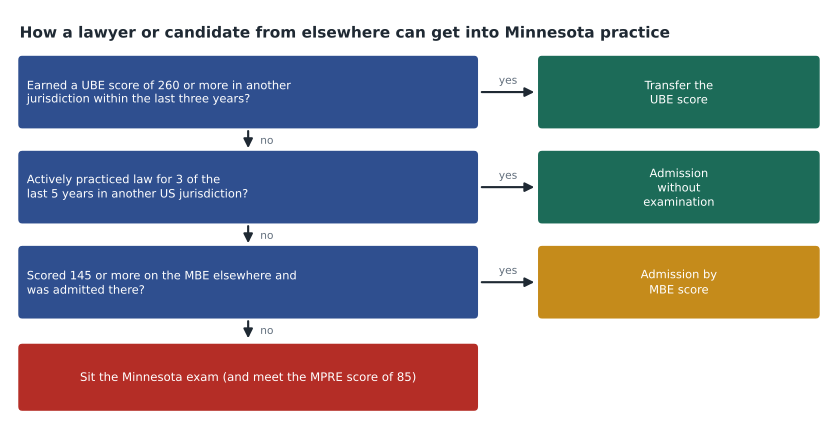
| Route | Key requirement | Still required |
|---|---|---|
| UBE score transfer | UBE score of 260 or more, within about three years | MPRE 85; character and fitness |
| NextGen score (interim) | NextGen score of 620 or more, from July 2026 on | MPRE 85; character and fitness |
| Admission without examination | Active practice for 3 of the last 5 years; good standing | MPRE 85; character and fitness |
| Admission by MBE score | MBE 145 or more elsewhere, passed and admitted there, within the time limit | MPRE 85; character and fitness |
Alternative pathways: where Minnesota stood in November 2026
Soren's classmates were talking about something real, but not yet available. Minnesota's Board of Law Examiners spent two years, from 2021 to 2023, studying how lawyers should be licensed. Its final report recommended that Minnesota adopt NextGen and also develop an alternative pathway that would not depend on a bar exam score. In March 2024, the Supreme Court approved that dual approach and created an implementation committee.
The Court directed the committee to give priority to a curricular pathway, completed during law school, and to study a supervised practice pathway after graduation as a second step. Under the curricular model the Board proposed for public comment in 2025 and revised in early 2026, students would complete required foundational coursework and experiential learning, such as clinics, externships or simulation courses, document their work with clients, and submit portfolios and supervisor evaluations that the Board would assess. The supervised practice pathway would let graduates qualify through a set number of hours of supervised practice, again documented through portfolios. The committee's report on the curricular pathway was due by July 1, 2026, and its report on the supervised practice pathway by July 1, 2027. Commentators expected any pathway to start with a limited number of participants and a review.
As of November 2026, neither pathway was a route any applicant could use. Both depended on further action by the Supreme Court. Soren, as a first-year student in fall 2026, is exactly the kind of student who might one day be eligible for a curricular pathway, if the Court adopts one and if its timing reaches his class. He should follow the Board's announcements and his law school's guidance, and he should plan as if he will take NextGen unless and until a pathway is formally available to him.
Marchetti added context. Several other states have moved in the same direction: Oregon, for example, has adopted a supervised practice pathway, and other states have launched or approved alternatives. Minnesota's approach is distinctive mainly for its emphasis on a law school curricular route. 'Do not let anyone tell you the bar exam is gone in Minnesota,' Marchetti said. 'Tell them Minnesota is building an alternative and see what the Court does.'
Worked problem
Three questions, three answers
Kirsten summarizes Marchetti's answers to Liv, the Wisconsin lawyer and Soren.
Show solution
- Liv: her 266 from North Dakota clears Minnesota's 260. If she applies within the time limit, she can transfer the score, subject to the MPRE and character and fitness.
- The Wisconsin lawyer: with more than three of the last five years in active practice and good standing, he can apply for admission without examination, again subject to the MPRE and character and fitness.
- Soren: Minnesota is developing a curricular pathway and studying a supervised practice pathway, but as of November 2026 neither was available. He should plan for NextGen and watch for the Court's decisions.
Answer: Two of the three can use existing routes; the third is waiting on a route still under construction.
After admission: registration
Once admitted, every Minnesota lawyer must register each year with the Minnesota Supreme Court's lawyer registration office and pay the annual registration fee. Part of the fee funds the lawyer discipline system, the Client Security Board, and legal services programs. A lawyer may register as active or in another status, such as inactive, with different fees and privileges. A lawyer who fails to register can be suspended from the practice of law until the registration is brought current, so new lawyers should calendar the registration date from the start.
Minnesota does not have a unified bar, so registration with the Court, not membership in the bar association, is what keeps a license active. The Minnesota State Bar Association and the local bar associations, such as those in Hennepin and Ramsey counties, offer membership, sections, CLE and mentoring, and many new lawyers join, but membership is voluntary.
Continuing legal education
Minnesota requires continuing legal education. Under the Rules of the Minnesota State Board of Continuing Legal Education, an active Minnesota lawyer must complete 45 credit hours in each three-year reporting period. Within the 45 hours, a lawyer must complete at least 3 hours in ethics, at least 2 hours in the elimination of bias in the legal profession and in the practice of law, and at least 1 hour in mental health and substance use disorders, sometimes described as well-being. The well-being requirement took effect July 1, 2024.
Each lawyer is assigned to a reporting category based on the date of admission, which determines when the lawyer's three-year period ends. Credits are generally reported through the Board's online system, with a deadline after the end of the period. Minnesota does not allow lawyers to carry over excess credits from one period to the next. A newly admitted lawyer receives a first reporting period that includes the rest of the admission year plus a full three-year period, and courses taken after admission but before that period begins may count toward it.
Credits can be earned by attending approved courses, live or on demand within the rules' limits, by teaching approved courses, by providing pro bono legal services through approved programs within limits, and in some other ways the rules describe. The CLE Board's rules and booklets are updated periodically, and a lawyer should check the current version for the details.
| Requirement | Minnesota rule |
|---|---|
| Total credits | 45 hours every three years |
| Ethics | At least 3 hours |
| Elimination of bias | At least 2 hours |
| Mental health and substance use (well-being) | At least 1 hour, effective July 1, 2024 |
| Carryover | Not allowed |
| New lawyers | First period includes the rest of the admission year plus three years |
Worked problem
Kirsten's first CLE period
Assume Kirsten passes in February 2027 and is admitted in the spring of 2027.
Show solution
- Her reporting category depends on her admission date; the CLE Board will assign it.
- Her first reporting period includes the rest of 2027 plus a full three-year period, so she has more than three years for her first 45 hours.
- Within the 45 hours she needs at least 3 ethics hours, 2 elimination of bias hours and 1 mental health and substance use hour.
- She cannot carry excess credits into the next period, so she should spread her CLE across the period rather than front-loading it.
Answer: Kirsten should plan roughly 15 hours a year, including the specialty credits, and record each course as she takes it.
Practicing in more than one state
Many Minnesota lawyers near the borders practice in Wisconsin, North Dakota, South Dakota or Iowa as well. Each state has its own admission rules, and a lawyer admitted in Minnesota by UBE can use the Minnesota score to seek admission in other UBE states that accept it, within their time limits and passing scores. A lawyer who wants to appear in a single case in a state where the lawyer is not licensed can seek admission pro hac vice under that state's rules. And Rule 5.5 of the Rules of Professional Conduct, in both Minnesota and other states, permits some temporary practice across state lines without full admission. A new lawyer whose firm has clients across the border should learn these rules early.
Common mistakes
MistakeA UBE score from any state transfers into Minnesota forever.
InsteadThe score must be at least 260 and within the time limit, generally about three years.
MistakeAdmission without examination requires one year of practice.
InsteadIt requires active practice for at least three of the five years before applying.
MistakeMinnesota has already adopted a no-exam pathway that 1Ls can use.
InsteadAs of November 2026, the curricular and supervised practice pathways were still under development.
MistakeJoining the Minnesota State Bar Association keeps a license active.
InsteadAnnual registration with the Supreme Court keeps a license active; the MSBA is voluntary.
MistakeExtra CLE hours carry over to the next Minnesota period.
InsteadMinnesota does not allow carryover.
Summary and key terms
- Minnesota accepts transferred UBE scores of 260 or more within about three years, subject to the MPRE and character and fitness.
- On an interim basis, Minnesota accepts NextGen scores of 620 or more from July 2026; the figure is not the final Minnesota passing score.
- Admission without examination requires active practice for 3 of the last 5 years and good standing; Minnesota also has an MBE score route (145 or more, with admission elsewhere).
- Minnesota is developing a curricular pathway and studying a supervised practice pathway; neither was available as of November 2026.
- Minnesota lawyers register annually with the Supreme Court and complete 45 CLE hours every three years, including 3 ethics, 2 elimination of bias and 1 mental health and substance use hour, with no carryover.
- 0
- score transfer
- 1
- admission without examination
- 2
- admission by MBE score
- 3
- curricular pathway
- 4
- supervised practice pathway
- 5
- reporting period
- 6
- elimination of bias credit
Practice problems
Work each problem on paper first, then reveal the answer to check.
A lawyer passed the UBE in Colorado with 272 two years ago and never practiced. Can she transfer to Minnesota?
Show answer
Yes, if she applies within the time limit; 272 exceeds 260. She also needs the MPRE score and character and fitness.
What practice is required for admission without examination in Minnesota?
Show answer
Active practice for at least three of the five years immediately before applying, with good standing.
Was a no-exam alternative pathway available in Minnesota in November 2026?
Show answer
No. The curricular pathway and supervised practice pathway were still under development.
List Minnesota's specialty CLE credits within the 45 hours.
Show answer
At least 3 ethics, 2 elimination of bias and 1 mental health and substance use.
Lesson quiz · 5 questions
Score 60% or more to complete this lesson.
Create a free account to save your progress, take quizzes and earn a certificate.