
BAR-229 · Lesson 1 of 12 · 21 min
Becoming a lawyer in Nevada
▶ Video coming soon A video version of this lesson is on the way.
Maribel Etcheverry grew up in Elko, where her grandparents ran a Basque boardinghouse for sheepherders and miners until the late 1980s and where her grandmother still makes picon punch for every family wedding. She finished law school at an ABA-approved law school in May 2026 and sat for Nevada's bar examination in July 2026. It was the last time Nevada gave that exam. When results came out in the fall, she had missed. Since September 2026 she has been a law clerk at Arrieta & Haddad, a three-lawyer firm in Reno that handles divorces and custody cases, car and slip-and-fall claims, small business formation and the occasional claim against Washoe County. In November 2026 she joined Hollis Marchetti's online study group.
At her first one-on-one session, Maribel explained why she felt as though the ground had moved under her. 'Everyone else in this group is talking about the UBE, NextGen and score transfer,' she said. 'Nevada never took the UBE, and now Nevada does not even have a bar exam in the old sense. If I had passed in July, I would be sworn in by now. Instead I have to do the Nevada Plan: a multiple-choice exam, a performance exam, supervised practice hours, the MPRE and a character review. I do not know which order to do them in or how long it will take.'
Marchetti had read the State Bar of Nevada's materials the night before. 'Nevada built something no other state has,' she said. 'It took effect in January 2026. Instead of one combined score, you pass separate parts: the Foundational Law Exam, the Lawyering Performance Exam, the Supervised Practice Program and the MPRE, then the character and fitness review. Each part stands alone, and you can take them in almost any order inside a six-year window. You already have your MPRE. You have done the hardest kind of studying already, for July. Now we organize the parts so that you are sworn in during 2027.'
This lesson maps the whole process: who controls admission in Nevada, the bodies that do the work, the routes into practice and the usual order of events for a new candidate under the Nevada Plan. Later lessons take each step in detail and then turn to the distinctive Nevada law a new lawyer meets in Reno, Las Vegas, Carson City or Elko: Nevada's courts and civil procedure, community property and family law, Nevada tort law and its damages limits, and the Nevada Rules of Professional Conduct.
The Supreme Court of Nevada controls admission
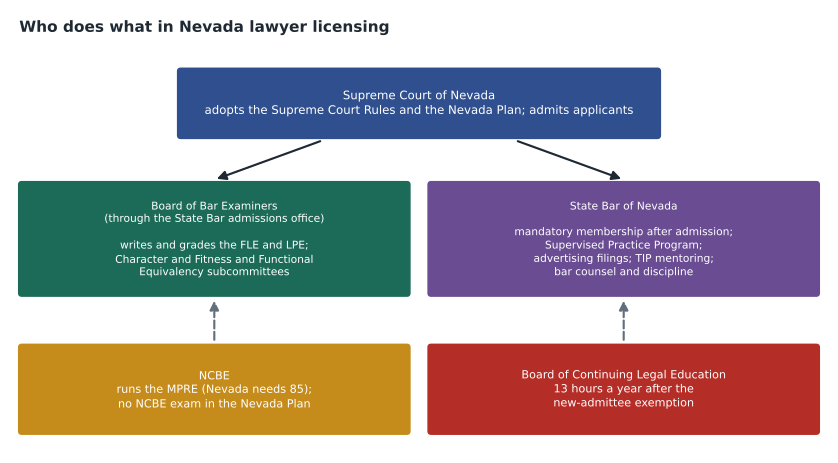
Admission to practice law in Nevada is a judicial function. The Supreme Court of Nevada adopts the Supreme Court Rules (often cited as SCR) that govern admission, and it alone admits applicants. The rules on eligibility, education, character and fitness, the examination, the oath and continuing legal education are all Supreme Court Rules. When Nevada decided to replace its traditional bar exam, the change came through the Court: it approved the plan in May 2025, and the new licensing system, formally called the Nevada Comprehensive Licensing Examination and informally the Nevada Plan, took effect on January 19, 2026.
That structure matters in practice. A candidate who wants an exception to a deadline, a ruling on eligibility or a review of a character and fitness decision deals first with the Board of Bar Examiners and its admissions staff under the rules and, if the matter goes further, with the Supreme Court by petition. Advice from classmates, bar review companies and older lawyers is useful background, but the rules and the State Bar of Nevada's current instructions are the authority. Maribel keeps a folder with the current admission rules, printouts of the Nevada Plan pages, every confirmation email and every receipt.
The Board of Bar Examiners and the State Bar of Nevada
Nevada's admissions work runs through the State Bar of Nevada. The Board of Bar Examiners, whose members are appointed under the Supreme Court Rules, prepares and grades the examinations and recommends applicants for admission. The rules also codify two subcommittees: a Character and Fitness subcommittee, which reviews each applicant's background, and a Functional Equivalency subcommittee, which decides whether applicants educated at law schools that are not ABA-approved can be treated as equivalent. The State Bar's admissions office handles applications, fees, deadlines and correspondence, and it publishes the Nevada Plan pages that describe each component.
After admission, the State Bar of Nevada plays a different role. It is the mandatory, integrated bar: every lawyer licensed in Nevada is a member and pays annual dues. Its Office of Bar Counsel investigates grievances and prosecutes discipline cases before disciplinary boards, subject to the Supreme Court. Lawyers file copies of their advertisements with the State Bar under Rule 7.2A of the Nevada Rules of Professional Conduct. New lawyers complete the State Bar's Transitioning into Practice mentoring program, known as TIP. And the Board of Continuing Legal Education tracks the annual CLE requirement once a new lawyer's exemption ends.
Where NCBE fits, and where it does not
For most states, the National Conference of Bar Examiners writes the heart of the bar exam. Nevada has always been different. Even under its legacy exam, Nevada wrote its own essay questions and its own performance tests and used only one NCBE product, the Multistate Bar Examination. Under the Nevada Plan, NCBE's exam products are gone from the licensing exam entirely. The Foundational Law Exam and the Lawyering Performance Exam are Nevada's own. NCBE still matters for one component: the Multistate Professional Responsibility Examination, on which Nevada requires a scaled score of 85.
Because Nevada does not use the UBE or the NextGen bar exam, two consequences follow that surprise candidates from other states. First, Nevada does not accept UBE or NextGen scores earned elsewhere, and it does not accept MBE scores transferred from other jurisdictions. Second, passing the Nevada Plan does not produce a portable score that another state can accept. A Nevada lawyer who later wants to practice elsewhere will look to that other state's rules on admission on motion or examination.
The Nevada Plan in one paragraph
Under the Nevada Plan, a candidate must pass the Foundational Law Exam, a 100-question, closed-book, multiple-choice exam on seven foundational subjects that can be taken after completing 42 credits at an ABA-approved law school; pass the Lawyering Performance Exam, a full day of three two-hour performance scenarios taken only after earning the J.D.; complete the Supervised Practice Program, at least 40 hours of supervised legal work with a self-directed learning project and journal; earn a scaled score of 85 on the MPRE; and clear the character and fitness review. Each part is passed on its own. A strong result on one part does not make up for a weak result on another, as it could under the old combined score. All parts must fall within a six-year window that runs from three years before to three years after the year in which the candidate passes the Lawyering Performance Exam.
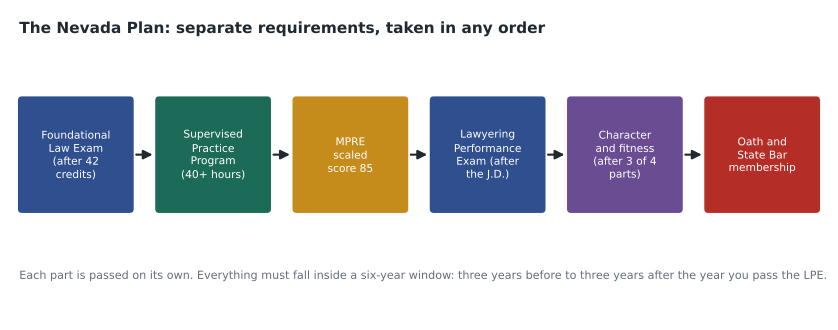
| Component | When you can do it | What it measures |
|---|---|---|
| Foundational Law Exam (FLE) | After 42 credits at an ABA-approved school | Core doctrine in seven subjects, by multiple choice |
| Lawyering Performance Exam (LPE) | After the J.D. is conferred | Lawyering skills on three realistic scenarios |
| Supervised Practice Program (SPP) | After 42 credits, during or after law school | Supervised client work, reflection and self-directed learning |
| MPRE | Any time; NCBE schedules it three times a year | Professional responsibility rules; Nevada needs 85 |
| Character and fitness | After three of the four parts are done and the last is registered | Good moral character and fitness to practice |
Routes into practice
There are only a few ways to begin practicing law in Nevada, and Nevada is stricter than most states. The main route is admission under the Nevada Plan. Every new graduate takes it, and so does every lawyer licensed elsewhere who wants a full Nevada license, because Nevada does not offer admission on motion or reciprocity. An experienced lawyer from another state does get some relief: a lawyer who has recently practiced for more than six continuous months can ask to be exempted from the Supervised Practice Program. But that lawyer still must pass the Foundational Law Exam and the Lawyering Performance Exam.
The second route is limited. A lawyer admitted elsewhere may appear in a particular Nevada case by permission of the court, under the pro hac vice rule in SCR 42, associated with Nevada counsel. Certain in-house lawyers can apply for limited house counsel status under SCR 49.1. And out-of-state lawyers who handle Nevada transactional or other matters outside court must register annually under Rule 5.5A. Lesson 11 covers these routes and their limits.
A brief history worth knowing
Candidates sometimes hear that Nevada's bar exam was once the hardest in the country, or that Nevada is a 'closed' state. Both stories have some truth. Nevada long refused admission on motion, and its legacy exam combined six one-hour essay questions on Nevada and general law, the MBE and two two-hour Nevada performance tests, scored on a 75-point scaled passing standard. The written portions counted far more than the MBE. Nevada's lawyers and judges were proud of the performance tests, which asked candidates to do the kind of work new lawyers actually do. The Nevada Plan builds on that tradition: the Lawyering Performance Exam is modeled on the legacy Nevada performance tests, while the separate Foundational Law Exam checks core doctrine earlier, often during the second year of law school, when the material is fresh.
For Maribel, the history explains her situation. Her July 2026 exam was the final legacy administration. Candidates who did not pass that exam move to the Nevada Plan. She will not sit the old exam again; she will complete the new components.
Worked problem
Mapping Maribel's path
Maribel graduated in May 2026, already has an MPRE score of 89 from August 2025, missed the July 2026 legacy exam and now works as a law clerk in Reno. Which Nevada Plan parts remain, and in what order could she finish them during the 2026-27 cycle?
Show solution
- List the requirements: FLE, LPE, SPP, MPRE, character and fitness.
- Mark what is done. Her MPRE score of 89 exceeds 85 and was earned well within three years of any 2027 passing year, so it counts.
- Check eligibility. She has her J.D., so she can register for the LPE. She has more than 42 credits, so she can sit the FLE and do the SPP.
- Look at the calendar. The first LPE is January 18, 2027; the late deadline for it is November 30, 2026. An FLE window falls on February 18-19, 2027, with a regular deadline of November 30, 2026.
- For the SPP, her supervising partner qualifies as a private supervisor if she meets the residence and five-year Nevada practice rules and files notice. The fall 2026 cycle runs through December, with the journal due January 1, 2027.
- Character and fitness opens once three of the four components are complete and the last is registered.
Answer: A realistic plan: register for the February 2027 FLE now, file a late application for the January 2027 LPE, complete the SPP in the fall 2026 cycle at her firm, then file the character and fitness application once the results arrive, aiming for admission in spring 2027.
Marchetti added one practical warning. 'Every part has its own registration, fee and deadline,' she said. 'Under the old exam, you filed one application. Now you have at least three. Build a calendar on the first day and check it every week.'
Why the parts are separate
The Nevada Plan reflects a view about what a licensing exam should measure. A single combined score let a candidate with excellent essay skills pass despite weak doctrine, or the reverse. The Plan's designers wanted each competency demonstrated on its own: enough doctrinal knowledge to spot issues and avoid malpractice, the skills to do realistic legal work under time pressure, actual supervised experience with clients and knowledge of the ethics rules. Testing doctrine earlier, close to when students take the courses, was meant to improve retention and reduce reliance on expensive commercial review. Whether the Plan achieves those goals will become clear over the next several years; the first Foundational Law Exam, in May 2026, had a pass rate of 76 percent.
For a candidate, the separation has two practical effects. Each part can be prepared for with a narrower focus, which many candidates find less overwhelming than a single exam. But each part must also be passed, so a candidate cannot neglect any of them. Maribel's July preparation gave her strong doctrine and good performance-test practice; the question now is how to keep both sharp while she completes her supervised hours.
What this course covers
Lessons 2 and 3 cover eligibility, education, deadlines, fees, character and fitness and the MPRE. Lesson 4 explains the Nevada Plan's structure and the Foundational Law Exam in detail. Lesson 5 explains the change from the legacy exam and what it means for candidates caught in the transition. Lesson 6 covers the Lawyering Performance Exam and the Supervised Practice Program, the parts most distinctive to Nevada. Lessons 7 through 10 teach Nevada courts and civil procedure, community property and family law, Nevada torts and damages limits, and the Nevada Rules of Professional Conduct. Lesson 11 covers practicing in Nevada without full admission, the lack of reciprocity and life after admission. Lesson 12 is a capstone with original practice problems and an exam-day plan.
Common mistakes
MistakeNevada is a UBE state, so I can transfer my score in.
InsteadNevada has never used the UBE and does not accept UBE, NextGen or transferred MBE scores. Everyone seeking full admission completes the Nevada Plan.
MistakeNevada still gives a two-day bar exam every February and July.
InsteadThe legacy exam ended with the July 2026 administration. The Nevada Plan replaced it with separate components taken on their own schedules.
MistakeAn experienced lawyer from another state can be admitted on motion.
InsteadNevada offers no admission on motion. An experienced lawyer may be exempted from the Supervised Practice Program but must pass the FLE and LPE.
MistakeA great score on one part will carry a weak part.
InsteadEach Nevada Plan component is passed on its own. There is no combined score.
Summary and key terms
- The Supreme Court of Nevada adopts the admission rules and admits applicants; the Nevada Plan took effect January 19, 2026.
- The Board of Bar Examiners, working through the State Bar of Nevada, writes and grades the exams and reviews character and fitness.
- The Nevada Plan requires the Foundational Law Exam, the Lawyering Performance Exam, the Supervised Practice Program, an MPRE score of 85 and character and fitness clearance.
- Each component is passed separately, inside a six-year window centered on the year the candidate passes the LPE.
- Nevada uses no NCBE exam in its licensing exam, accepts no transferred scores and offers no admission on motion.
- The legacy Nevada exam, with Nevada essays, the MBE and Nevada performance tests, ended in July 2026.
- 0
- Nevada Plan
- 1
- Nevada Comprehensive Licensing Examination
- 2
- Board of Bar Examiners
- 3
- State Bar of Nevada
- 4
- Supreme Court Rules
- 5
- Foundational Law Exam
- 6
- Lawyering Performance Exam
- 7
- Supervised Practice Program
- 8
- pro hac vice
Practice problems
Work each problem on paper first, then reveal the answer to check.
Who admits applicants to practice law in Nevada?
Show answer
The Supreme Court of Nevada, under the Supreme Court Rules.
Name the four primary components of the Nevada Plan.
Show answer
The Foundational Law Exam, the Lawyering Performance Exam, the Supervised Practice Program and the MPRE.
Can a lawyer with ten years of practice in Arizona be admitted in Nevada on motion?
Show answer
No. Nevada has no admission on motion. The lawyer may seek an exemption from the SPP but must pass the FLE and LPE and clear character and fitness.
When was the last legacy Nevada bar exam given?
Show answer
July 2026.
Lesson quiz · 5 questions
Score 60% or more to complete this lesson.
Create a free account to save your progress, take quizzes and earn a certificate.