
BAR-229 · Lesson 3 of 12 · 20 min
Character and fitness and the MPRE
▶ Video coming soon A video version of this lesson is on the way.
Maribel's character and fitness history was mostly ordinary. She had a speeding ticket on Interstate 80 near Winnemucca when she was nineteen, paid within a week. In her second year of college she had been placed on academic probation for one semester after a family illness kept her away from classes, and she had recovered with a strong record. And in 2024 she had been a party to a small claims case in Washoe County over a security deposit, which she won. She had disclosed all of it on her application for the July 2026 exam. Now, under the Nevada Plan, she wanted to know whether she had to start over.
Marchetti's answer had two parts. 'First, assume you will complete a fresh application under the current process and disclose everything again, consistently with what you said before. Consistency matters more than anything else in a character file. Second, ask the admissions office in writing how your earlier file will be treated, and keep the reply. Do not guess.'
This lesson covers what the character and fitness review asks, how Nevada decides, when the application fits into the Nevada Plan, the outcomes the Board can reach and the MPRE requirement of a scaled score of 85.
The standard: good moral character and fitness
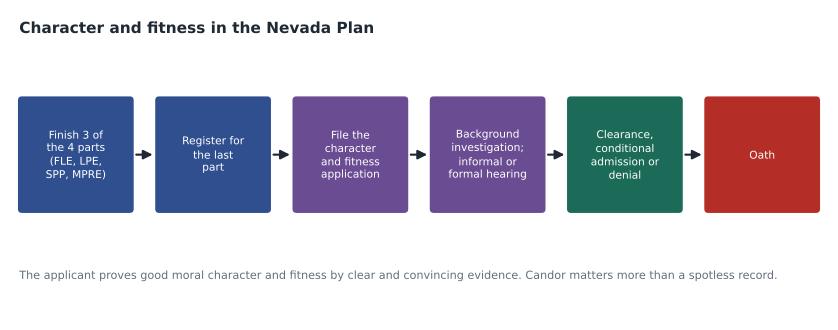
Nevada's rules require every applicant to show good moral character and fitness to practice law. The burden is on the applicant, and the standard is demanding: the applicant must prove good moral character and fitness by clear and convincing evidence. The review asks a forward-looking question. The Board is not punishing past conduct; it is deciding whether the applicant can be trusted to handle client money, keep confidences, meet deadlines, tell the truth to courts and comply with the rules of the profession.
The application asks for a detailed history: every address for a period of years, every job, every school, every license, every arrest or citation, every civil case as a party, every bankruptcy, every academic or employment discipline, and information about any condition or conduct that currently impairs the ability to practice. Applicants authorize the release of records so that the Board's staff can verify what they report. Investigators compare the application against court records, credit reports, law school records and the answers given on law school applications.
Candor is the core
Character and fitness reviewers see the same problem again and again: a minor matter becomes a serious one because the applicant left it off the form. A paid speeding ticket rarely matters. Failing to disclose it, or describing it differently from the way it was described on a law school application, raises questions about honesty, and honesty is the trait the review most cares about. The best practice is to over-disclose, explain briefly and factually, and attach documents.
Maribel's approach was methodical. She pulled her law school application and her July 2026 bar application and compared every answer. Her law school application had described the probation as 'a semester of academic difficulty following a family medical emergency'; her bar application had used nearly the same words. She would use the same words again and attach the letter from her college that lifted the probation. For the speeding ticket, she attached the receipt. For the small claims case, she attached the judgment.
When to file under the Nevada Plan
Under the legacy exam, the character and fitness application was part of the exam application, and the review ran in parallel with the exam. The Nevada Plan changes the timing. According to the State Bar's materials, a candidate may begin the character and fitness process once three of the four primary components (the FLE, the LPE, the SPP and the MPRE) are complete and registration for the final component is underway. The idea is to avoid investigating candidates who are years away from finishing, while still letting the review run alongside the last component.
For a law student who passes the FLE in the second year, completes the SPP in a clinic and takes the MPRE in the third year, character and fitness opens in the spring of the third year, once the student registers for the post-graduation LPE. For Maribel, the order is different. Her MPRE is done. She expects to finish the SPP in the fall 2026 cycle, with grading of her journal taking about two months, and to sit the LPE on January 18, 2027 and the FLE on February 18-19, 2027. Once two of those are complete and graded and she is registered for the last, she can file. That puts her filing in early 2027.
| Common issue | Usually disqualifying? | What reviewers want to see |
|---|---|---|
| Traffic citations, paid | No | Full disclosure and proof of payment |
| Academic probation or discipline | Rarely | Consistent explanation across applications; recovery |
| Past due debts, defaulted loans | Depends | A plan and a record of payments; honesty about the cause |
| Criminal convictions | Depends on nature and time | Full records, rehabilitation, candor, references |
| Lack of candor on any application | Often the most serious problem | Avoid it entirely: disclose everything |
| Substance use or mental health concerns | Not by diagnosis alone | Current fitness and, where relevant, treatment and monitoring |
Investigation, interviews and hearings
Most applicants are cleared on the papers after investigation. When questions arise, the Board's staff may ask for more documents or an explanation. If concerns remain, the matter can go to an informal hearing before members of the Character and Fitness subcommittee, and, if needed, a formal hearing. Nevada's rules give the subcommittee power to take evidence and issue subpoenas, and they require notice to the applicant before an appearance. Applicants may be represented by counsel at their own expense. Hearing fees are set by rule and are significant for a formal hearing, which is one more reason to present a complete and well-documented application at the start.
Outcomes: clearance, conditional admission or denial
The review can end in several ways. Most applicants are cleared. Some are recommended for conditional admission under SCR 49.7: they are admitted, but subject to conditions for a period, such as monitoring of a substance use recovery program, financial reporting or a practice mentor. Conditional admission lets the Board admit an applicant who has shown rehabilitation but whose recent history calls for structure. A small number are denied. A denial may be with prejudice or without prejudice; a denial without prejudice can carry a waiting period, which under the rules can be as long as five years, before the applicant may reapply.
An applicant who receives an adverse recommendation may petition the Supreme Court for review under the admission rules. The Court makes the final decision. The Board's findings carry weight, but the Court reviews the record itself.
Rehabilitation
When an applicant has a serious past problem, such as a criminal conviction, a pattern of financial irresponsibility or a period of untreated addiction, the question becomes rehabilitation. Reviewers ask how much time has passed, whether the applicant accepts responsibility without minimizing, whether restitution was made, what the applicant's conduct has been since, and what people who know the applicant now say. A thoughtful, honest written account, supported by documents and references, does far more than a defensive one. Candidates in this position should consider getting advice from a lawyer experienced in admission matters before filing.
The MPRE requirement
Nevada requires a scaled score of at least 85 on the Multistate Professional Responsibility Examination. Under the rules, the MPRE must be taken within the period running from three years before through three years after the year in which the applicant passes the Nevada exam. Under the Nevada Plan, the MPRE is one of the four primary components and must fall within the Plan's eligibility window.
The MPRE is a two-hour, 60-question multiple-choice exam on the ABA Model Rules of Professional Conduct, the ABA Model Code of Judicial Conduct and controlling constitutional and procedural law on lawyer conduct. NCBE administers it at testing centers three times a year, and candidates register with NCBE, not with the State Bar. NCBE sends the score to jurisdictions the candidate designates. Candidates should make sure Nevada receives the score; a score sitting unreported in an NCBE account does not satisfy the requirement.
Because the MPRE tests the ABA Model Rules, not the Nevada Rules of Professional Conduct, a Nevada candidate has to keep two sets of rules in mind. The MPRE answer to a confidentiality question follows Model Rule 1.6, under which disclosure to prevent reasonably certain death or substantial bodily harm is permitted. The Nevada rule goes further and requires disclosure to prevent a criminal act likely to cause death or substantial bodily harm. Lesson 10 covers these differences; for the MPRE, answer under the Model Rules.
Worked problem
Is Maribel's MPRE score still good?
Maribel scored 89 on the MPRE in August 2025. She expects to pass the LPE in January 2027. Does her score satisfy Nevada?
Show solution
- Nevada requires 85 or more. 89 qualifies.
- Timing: the MPRE must fall within three years before through three years after the year she passes the Nevada exam. If she passes in 2027, the period begins in 2024.
- August 2025 falls within that period.
- Check that NCBE has sent the score to Nevada; if not, request a score transfer through her NCBE account.
Answer: Yes. Her 89 from August 2025 satisfies Nevada for a 2027 passing year, provided Nevada has the score report.
Financial responsibility
Debt alone does not disqualify anyone, and most law graduates carry substantial student loans. What reviewers look at is how an applicant handles obligations. Defaulted loans that the applicant has ignored, unpaid judgments, unfiled tax returns or a history of bounced checks suggest the kind of carelessness that, in a lawyer, leads to mishandled trust accounts and missed deadlines. An applicant with financial problems should show what caused them, what has been done since and what the plan is now. A rehabilitation agreement with a loan servicer, a payment plan with a taxing authority or a record of steady payments on an old judgment can turn a concern into evidence of responsibility.
Lawyers in Nevada handle client money in trust accounts governed by Rule 1.15, including rules about what happens to unclaimed funds after years of effort to find the client. The character review's interest in finances is a preview of that duty. Maribel had no financial issues beyond student loans in repayment, which she listed with their current status.
Mental health and substance use questions
Character and fitness questions about mental health have narrowed across the country in recent years, with a growing focus on current conduct and current ability to practice rather than diagnosis or past treatment. Applicants should answer the questions exactly as asked on the current form. Seeking help is not a mark against an applicant; untreated problems that have led to misconduct are what concern reviewers. Nevada's continuing legal education rules reflect the same priority after admission, with a required annual hour on substance abuse, addictive disorders and mental health, discussed in Lesson 11.
Preparing the file early
Even though the application cannot be filed until most components are done, the preparation can start immediately. Marchetti asked Maribel to spend one evening a week on her character file: gathering court records, getting a credit report, listing every address and job since age eighteen and writing short explanations for each disclosure. 'When the window opens, you want to file within a week, complete,' she said. 'Incomplete files sit in a queue. Complete files move.'
There is also a practical reason to start early. Some records take weeks to obtain. A court record from a justice court in a rural county, a transcript from a college that has merged with another, or a letter from a former employer that has closed can all take time. The application is easier to complete when the documents are already in a folder.
Conduct while the application is pending
The duty of candor continues after filing. If something changes while the application is pending, such as a new citation, a lawsuit, a change of address or a new job, the applicant must update the Board promptly. An applicant who is working in a law office, as Maribel is, should also be careful about the unauthorized practice of law. Her work at Arrieta & Haddad is supervised, and in her SPP hours she works under a limited practice certification; she does not sign pleadings, give legal advice on her own or hold herself out as a lawyer. Lapses in that area are taken seriously because they go directly to fitness to practice.
Common mistakes
MistakeOld minor matters do not need to be disclosed.
InsteadDisclose everything the application asks for. Nondisclosure is usually more serious than the underlying matter.
MistakeI file character and fitness with my first Nevada Plan registration.
InsteadThe process opens once three of the four primary components are complete and the last one is registered.
MistakeThe MPRE tests the Nevada Rules of Professional Conduct.
InsteadThe MPRE tests the ABA Model Rules. Nevada's rules differ in places, such as mandatory disclosure under Nevada Rule 1.6.
MistakeA denial is always permanent.
InsteadA denial may be without prejudice, with a waiting period of up to five years before reapplying, and conditional admission is available in suitable cases.
Summary and key terms
- Applicants must prove good moral character and fitness by clear and convincing evidence.
- Candor and consistency across applications matter more than a spotless record.
- Under the Nevada Plan, character and fitness opens after three of the four primary components are done and the last is registered.
- Outcomes include clearance, conditional admission under SCR 49.7 and denial with or without prejudice; the Supreme Court has the final word.
- Nevada requires an MPRE scaled score of 85, earned within three years before through three years after the passing year.
- The MPRE tests the ABA Model Rules, so Nevada candidates must keep Nevada's rule differences separate.
- 0
- character and fitness
- 1
- clear and convincing evidence
- 2
- conditional admission
- 3
- rehabilitation
- 4
- MPRE
- 5
- candor
Practice problems
Work each problem on paper first, then reveal the answer to check.
What standard of proof applies to Nevada character and fitness?
Show answer
The applicant must prove good moral character and fitness by clear and convincing evidence.
When can a Nevada Plan candidate file the character and fitness application?
Show answer
After completing three of the four primary components and registering for the last.
What MPRE score does Nevada require?
Show answer
A scaled score of 85.
Name two possible outcomes other than clearance.
Show answer
Conditional admission under SCR 49.7, or denial with or without prejudice.
Lesson quiz · 5 questions
Score 60% or more to complete this lesson.
Create a free account to save your progress, take quizzes and earn a certificate.