
BAR-229 · Lesson 5 of 12 · 20 min
Exam changes: from the legacy Nevada bar exam to the Nevada Plan
▶ Video coming soon A video version of this lesson is on the way.
In the group's Tuesday session, Dana Whitfield, who is sitting the February 2027 Texas exam, asked Maribel what it was like to be in the first group of graduates to go through the Nevada Plan after the old exam. Maribel thought about it. 'Strange,' she said. 'I studied for an exam that no longer exists. Some of my classmates passed in July and were sworn in this fall. I am starting a new system with a calendar instead of a single date. But honestly, the parts of the old exam I was best at are the parts that survived.'
Marchetti used the exchange to make a broader point for the whole group. 'Every state's exam is changing right now,' she said. 'Most are moving to NCBE's NextGen exam. Nevada went its own way. Understanding why helps you understand what the new exam rewards.'
This lesson explains Nevada's legacy exam, why Nevada replaced it, how the transition worked, what it means for different kinds of candidates and how Nevada's choice fits the national picture in 2026.
The legacy Nevada bar exam
For decades, Nevada gave its own bar exam twice a year. In its final form, the exam combined three parts: six one-hour essay questions on Nevada and general law, the Multistate Bar Examination, and two two-hour performance tests written by Nevada, sometimes described as foundational skills questions. The Nevada essays covered a list of subjects set by rule, including Nevada-specific topics such as community property and Nevada civil procedure. The performance tests gave candidates a file and a library and asked them to complete a lawyering task.
Scores were combined into a single scaled total, and a candidate needed 75 on Nevada's scale to pass (NCBE reports this as equivalent to 138 on a 200-point scale). The written portions, essays and performance tests together, counted for roughly two-thirds of the total and the MBE for about one-third. Nevada did not use the MEE or the MPT, did not give or accept the UBE, did not accept transferred MBE scores and did not offer admission on motion. In February 2026, 56 percent of candidates passed, including repeat takers.
The final legacy administration was held in late July 2026. Results came out roughly eight weeks later. Candidates who passed went on to character and fitness clearance and admission. Candidates who did not pass, like Maribel, did not get another chance at the legacy exam. Their path is the Nevada Plan.
Why Nevada changed
The Nevada Plan was in development for about four years before the Supreme Court approved it in May 2025. Several concerns drove it. One was timing: a single exam months after graduation tested first-year doctrine two or three years after students had learned it, encouraging expensive memorization courses. Another was validity: a compensatory score let candidates pass with serious weaknesses in one area. A third was the absence of any requirement that a new lawyer had actually worked with clients under supervision before being licensed. And a fourth was cost and access, especially for candidates who could not afford to stop working for two months to study.
The Plan's answers are visible in its design. Doctrine is tested earlier, in a shorter exam focused on general principles, so that students can take it while the courses are fresh. Lawyering skills are tested in a separate performance exam after graduation. A modest but real supervised practice requirement brings client contact into licensing. And because each part is passed separately and can be retaken, a candidate who stumbles on one part does not have to repeat everything. The chair of the Board of Bar Examiners described the change as driven by a desire for better licensing, contrasting it with changes elsewhere driven by budget pressure.
Nevada and the national picture
Nevada's choice stands out. By 2026, most jurisdictions had decided to adopt NCBE's NextGen bar exam, an integrated exam that tests foundational concepts and lawyering skills together. The first NextGen exam was given in July 2026 in a group of early-adopting jurisdictions. California, after a troubled experiment with its own exam in 2025, decided in July 2026 to adopt NextGen. Nevada, by contrast, chose not to use any NCBE exam product in its licensing exam and kept only the MPRE.
There are tradeoffs. Nevada's approach lets it tailor the exam to its own goals and include supervised practice, which NextGen does not. But a Nevada license is not backed by a portable score. A lawyer who completes the Nevada Plan and later wants to practice in a NextGen state will usually need to qualify under that state's rules, such as admission on motion after years of practice, or take that state's exam. How other states will treat the Nevada Plan when deciding whether a Nevada lawyer 'passed a bar examination' for motion purposes is a question each state will answer for itself; candidates who expect to move should check the rules of the state they have in mind.
| Feature | Legacy Nevada exam (through July 2026) | Nevada Plan (from January 2026) |
|---|---|---|
| Structure | One exam, two administrations a year | Separate components on their own calendars |
| Doctrine | MBE plus six Nevada essays | Foundational Law Exam, 100 Nevada-written questions |
| Skills | Two Nevada performance tests | Lawyering Performance Exam, three scenarios |
| Experience | None required | Supervised Practice Program, 40+ hours |
| Scoring | Compensatory: 75 total scaled score | Conjunctive: each part passed separately |
| Timing | After graduation | FLE and SPP after 42 credits; LPE after the J.D. |
| NCBE products | MBE and MPRE | MPRE only |
| Portability | None (no UBE) | None (no UBE or NextGen score) |
The rollout
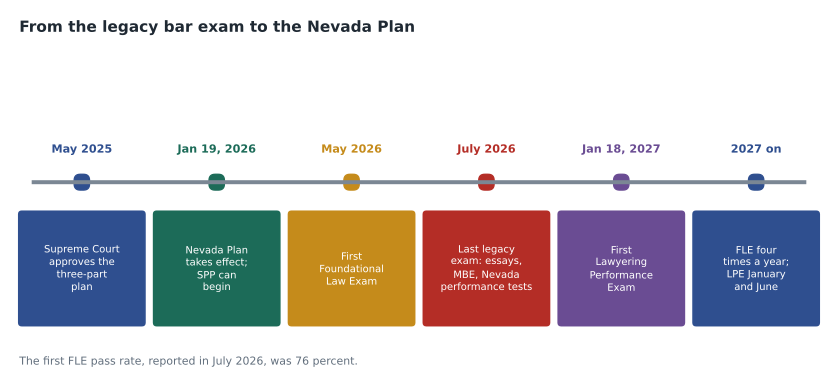
The Plan took effect on January 19, 2026. From that point, qualified law students could begin supervised practice through clinics and externships. The first Foundational Law Exam was given in May 2026, open to students in the class of 2027 who had the required credits and to out-of-state attorneys; further FLE windows followed in October and December 2026, and quarterly windows are scheduled for 2027. The first Lawyering Performance Exam is scheduled for January 18, 2027, with a second in June 2027. Meanwhile, the legacy exam continued through its final administration in July 2026, so that graduates of 2026 and earlier could finish under the system they had prepared for.
That overlap created a short transition period with three groups of candidates. Graduates who passed the July 2026 legacy exam were admitted under the old system. Students in the class of 2027 and later are fully under the Plan. And graduates who did not pass the legacy exam, or who did not sit it in time, are moving into the Plan after graduation, as Maribel is.
What the change means for different candidates
For a current law student, the Plan offers a chance to finish most of licensing before graduation. A student can sit the FLE after the first year or during the second, complete the SPP through a clinic or externship in the third year and take the MPRE during law school. After graduation, only the LPE and character and fitness remain. The State Bar's materials stress that the LPE requires the J.D., so the timing of graduation still matters.
For a recent graduate who missed the legacy exam, the Plan means building a new calendar. The FLE and LPE are each narrower than the old exam, and the SPP can sometimes be done in the candidate's current job, as Maribel will do at her firm. The main risks are administrative: missing a registration deadline, overlooking the SPP's journal requirement, or assuming that something from the legacy exam carries over. Candidates in this group should ask the State Bar in writing about anything they are unsure of.
For a lawyer licensed in another state, the change is mixed. Nevada still offers no admission on motion, so the lawyer must pass the FLE and LPE. But the FLE is shorter than the old exam, the LPE is a single day, and a lawyer with more than six continuous months of recent active practice can ask to be exempted from the SPP. Attorneys pay the higher fees for each exam.
For graduates of law schools that are not ABA-approved, including foreign-trained lawyers, the functional equivalency route under SCR 51.5 remains the first step before any component.
Worked problem
Advising three hypothetical candidates
Three people ask Marchetti what they need to do. Saoirse is a 2L at an ABA-approved school with 48 credits. Iker passed the July 2026 Nevada legacy exam and is awaiting character and fitness clearance. Aitana has practiced in Oregon for eight years and wants a Nevada license.
Show solution
- Saoirse: she is under the Nevada Plan. She can register for an FLE window now, look for an SPP placement such as a law school clinic, take the MPRE before graduation and sit the LPE after she receives her J.D.
- Iker: he passed the legacy exam, so he finishes under the old system. He needs character and fitness clearance and an MPRE score of 85 within the required period, then the oath.
- Aitana: Nevada has no admission on motion. She must pass the FLE and LPE and clear character and fitness. With eight years of active practice, she can request an exemption from the SPP. She pays the attorney fees of 325 dollars for the FLE and 500 dollars for the LPE.
Answer: One state, three different paths. The transition rules turn on whether the candidate finished the legacy exam, where they are in law school, and whether they are already licensed.
Where Nevada law appears now
Under the legacy exam, Nevada law appeared directly in the six essays. A candidate memorized Nevada community property rules, Nevada civil procedure and other Nevada topics because an essay might test them. The Nevada Plan has no Nevada essay component. The FLE tests general principles in seven core subjects, with federal civil procedure rather than Nevada procedure. The LPE provides the law each task needs in a library of authorities, which may include Nevada statutes, rules and cases or the law of a fictional jurisdiction, and candidates are graded on how well they use it.
So why does this course still spend four lessons on Nevada law? There are three reasons. First, a candidate who knows the Nevada framework reads an LPE library faster and spots what matters, even though the library supplies the rules. Second, a new Nevada lawyer meets these rules in the first month of practice: community property in nearly every divorce and estate, the anti-SLAPP statute in defamation and business disputes, the damages caps in injury cases, and the Nevada advertising and confidentiality rules in daily practice. Third, the Supervised Practice Program places candidates in real Nevada matters before admission, and the supervising lawyer will expect the candidate to know the basics.
What to keep from legacy preparation
For candidates like Maribel who prepared for the legacy exam, very little is wasted. MBE preparation translates directly to the FLE, because the subjects are the same and both tests reward accurate application of general rules. Legacy performance-test practice translates directly to the LPE, which the State Bar describes as modeled on the Nevada performance tests. Nevada essay preparation is the one piece without a direct exam home, but it becomes the foundation for practice and for the SPP. Marchetti told Maribel to keep her Nevada essay outlines on her desk at the firm: 'You studied them for an exam. Now you will use them on clients.'
Early results and open questions
The first FLE's 76 percent pass rate drew national attention when the State Bar reported it in July 2026. It is an encouraging start, but it says little yet about the Plan as a whole. The first LPE has not been given as of November 2026, the passing standard for the LPE had not been published by that date, and the first full cohort of candidates who complete all parts will not be admitted until 2027. Observers will be watching whether the Plan reduces costs, whether it changes who passes, how law schools adjust their clinics and externships to meet SPP demand, and how other states respond.
For candidates, the lesson is practical. The Plan is new, and its pages are updated as the State Bar learns from each administration. Read the current pages before each registration, save copies of what they said when you registered, and do not rely on summaries more than a few months old, including this course.
Common mistakes
MistakeNevada adopted the NextGen bar exam.
InsteadNevada chose its own Nevada Plan and uses no NCBE exam product except the MPRE.
MistakeCandidates who failed the July 2026 legacy exam can retake it in February 2027.
InsteadJuly 2026 was the final legacy administration. Those candidates move to the Nevada Plan.
MistakeThe Nevada Plan produces a score that other states accept like a UBE score.
InsteadIt produces no portable score. Other states decide for themselves how to treat a Nevada lawyer.
MistakeThe legacy exam used the MEE and MPT.
InsteadNevada wrote its own essays and performance tests and used only the MBE from NCBE.
Summary and key terms
- The legacy Nevada exam combined six Nevada essays, the MBE and two Nevada performance tests, with a 75 scaled passing score; it ended in July 2026.
- Nevada replaced it with the Nevada Plan to test doctrine earlier, measure skills separately and require supervised practice.
- The Plan took effect January 19, 2026; the first FLE was in May 2026 and the first LPE is January 18, 2027.
- Graduates who did not pass the legacy exam move to the Nevada Plan.
- Most states moved to NextGen; Nevada did not, so Nevada licensure is not backed by a portable score.
- Experienced lawyers from other states still have no admission on motion but may be exempt from the SPP.
- 0
- legacy exam
- 1
- Nevada performance test
- 2
- compensatory scoring
- 3
- NextGen bar exam
- 4
- transition
- 5
- portability
Practice problems
Work each problem on paper first, then reveal the answer to check.
What were the three parts of the legacy Nevada bar exam?
Show answer
Six one-hour Nevada essays, the MBE and two two-hour Nevada performance tests.
What passing score did the legacy exam use?
Show answer
75 on Nevada's scaled score.
What happens to a candidate who failed the July 2026 legacy exam?
Show answer
The candidate completes the Nevada Plan; there is no further legacy exam.
Name one reason Nevada gave for the change.
Show answer
For example, testing doctrine closer to when it is learned, measuring skills separately, or adding supervised practice.
Lesson quiz · 5 questions
Score 60% or more to complete this lesson.
Create a free account to save your progress, take quizzes and earn a certificate.