
BAR-229 · Lesson 6 of 12 · 22 min
The Lawyering Performance Exam and the Supervised Practice Program
▶ Video coming soon A video version of this lesson is on the way.
On a Thursday evening in November 2026, Maribel sat at her kitchen table in Reno with a timer, a laptop and a packet she had printed from the State Bar of Nevada's website: a past Nevada performance test and an example of a passing answer. She gave herself two hours. When the timer went off, she had finished a persuasive memorandum, though the last section was thinner than she wanted. Then she compared her work with the passing answer. 'The passing answer is not brilliant,' she told Marchetti afterward. 'It is organized. It answers exactly what the assigning partner asked for. It uses the library and does not invent law.'
'That is the whole skill,' Marchetti said. 'Read the task, follow it exactly, use only what you are given, and finish.'
The Lawyering Performance Exam and the Supervised Practice Program are the two parts of the Nevada Plan most distinctive to Nevada. This lesson explains how each works, what each requires and how to prepare.
The Lawyering Performance Exam
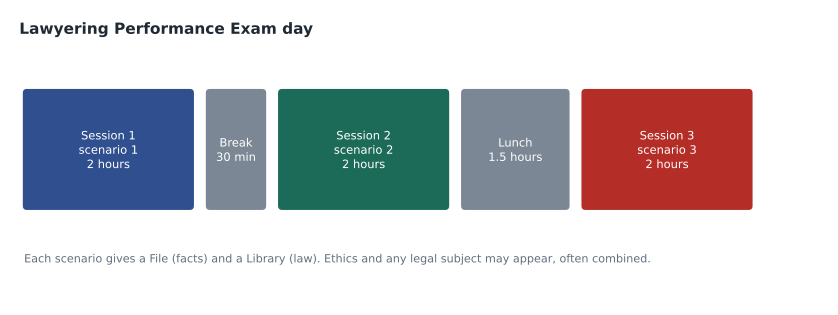
The Lawyering Performance Exam, or LPE, is a full-day exam of three performance scenarios. Each scenario is a two-hour session. The State Bar's schedule places a 30-minute break after the first session and a lunch break of an hour and a half after the second. Each scenario gives the candidate a packet of materials, usually a File of facts (client interview notes, correspondence, documents) and a Library of legal authorities (statutes, rules, cases), and asks the candidate to complete one or more lawyering tasks: an objective memo, a persuasive brief, a client letter, a demand letter, a set of discovery requests, a contract provision, a closing argument outline or a plan for an interview.
The LPE is modeled on the legacy Nevada performance tests, which Nevada wrote and graded for years. According to the descriptions published for candidates, content may include legal ethics and any legal subject, often combining several subjects in one scenario. The skills tested include professional conduct, legal processes and sources of law, interpreting legal materials, client interaction, issue identification, legal and factual research, and written communication.
LPE eligibility, dates and fees
The LPE is open only to candidates who have earned a J.D. from an ABA-accredited law school, or an approved equivalent, before the exam. The State Bar lists January and June administrations. The first LPE is January 18, 2027; the next is June 22, 2027. For the January exam, registration opened August 3, 2026, the regular and accommodation deadline was September 30, 2026, and late applications are accepted through November 30, 2026. The fee is 265 dollars for non-attorneys and 500 dollars for attorneys, plus 150 dollars for late filing. The State Bar publishes pages on permitted and prohibited exam materials and on taking the exam by computer; candidates should read them early.
As of November 2026, a passing score for the LPE had not been published. The State Bar does publish past Nevada performance tests and examples of passing answers, which are the best available guide to what graders reward.
How to approach a scenario
Two hours is enough time to do a good job on one task, but only with discipline. Marchetti teaches a four-phase approach for each scenario.
In the first 10 minutes, read the task memo carefully, twice. It tells you who you are, who the audience is, what document to produce, what format to use and what to leave out. Then skim the File to learn the story. In the next 35 to 40 minutes, read the Library carefully, extracting the rules, elements and factors, and then reread the File for the facts that matter under those rules. Many candidates build a short grid: issues down the side, rules and facts across. In the next 60 minutes, write. Use headings that track the task, state the rule from the Library with a citation, apply it to the specific facts, and reach a conclusion. In the last 10 minutes, finish any section left thin, check that every question in the task memo is answered, and stop.
| Phase | Time | What to do |
|---|---|---|
| Read the task | 0-10 minutes | Identify role, audience, document type, format, limits |
| Read the Library and File | 10-50 minutes | Extract rules and elements; match facts; build a grid |
| Write | 50-110 minutes | Headings that track the task; rule, application, conclusion |
| Finish | 110-120 minutes | Answer every question asked; fix thin sections; stop |
Three errors cost the most points on performance tests. The first is doing the wrong task, such as writing a persuasive brief when an objective memo was requested, or addressing issues the task memo told you to ignore. The second is importing law from memory instead of using the Library. If the Library's case states a three-factor test, use those three factors, even if you remember a different version from law school. The third is running out of time on the third scenario of the day. Fatigue is real on a six-hour exam, and practice under full-day conditions is the only cure.
Worked problem
Reading a task memo
An original task memo reads: "Our client, a Sparks food truck owner, received a letter from the city ordering her to stop parking within 300 feet of any restaurant. Draft a letter to the client, who is not a lawyer, explaining whether the ordinance in the Library applies to her and what her options are. Do not address any constitutional claims; another associate is handling those." What must the answer do, and what should it avoid?
Show solution
- Role and audience: you are an associate writing to a non-lawyer client, so plain language and a clear bottom line matter.
- Document: a client letter, not a memo or brief. Use a letter format with a greeting, a short answer near the top and a polite close.
- Content: apply the ordinance in the Library to her facts (where she parks, what counts as a restaurant, any exceptions) and explain practical options such as complying, seeking a permit or variance, or contesting the order.
- Limits: say nothing about constitutional claims, as instructed.
Answer: A focused client letter that answers whether the ordinance applies, explains why in plain terms using the Library, lists options and omits the constitutional issues.
Practicing for the LPE
The best practice is past Nevada performance tests, done under time. Start with one scenario a week, compare each answer with the published passing answer, and note what the passing answer did that yours did not. Build to two scenarios in one sitting, then to a full three-scenario day at least twice before the exam. Maribel planned two full simulations in the first two weeks of January 2027, using a weekend day for each and keeping the same breaks as the real exam.
Typing speed and comfort with the exam software also matter. Candidates should practice on the device they will use and learn the software's rules before exam day.
The Supervised Practice Program
The Supervised Practice Program, or SPP, requires at least 40 hours of supervised legal work. The work must include at least four of eight designated lawyering tasks, and one of them must be interviewing or counseling a client. Alongside the practice hours, the candidate completes a self-directed learning project and a reflective journal in the State Bar's online learning platform. The two pieces, practice experience and project-plus-journal, are evaluated separately, and the program shows as complete only when both are satisfied. The journal must be the candidate's own work; the State Bar prohibits the use of AI for it.
The SPP is certified complete rather than scored. Its purpose is to make sure every new Nevada lawyer has done some real legal work with real clients under the eye of an experienced lawyer before being licensed.
Who may do the SPP, and where
A candidate may start the SPP after completing at least 42 credits at an ABA-accredited law school or receiving functional equivalency approval. The SPP can be done during or after law school. Lawyers who have had more than six continuous months of active, licensed practice in a United States jurisdiction within the last two years may request an exemption.
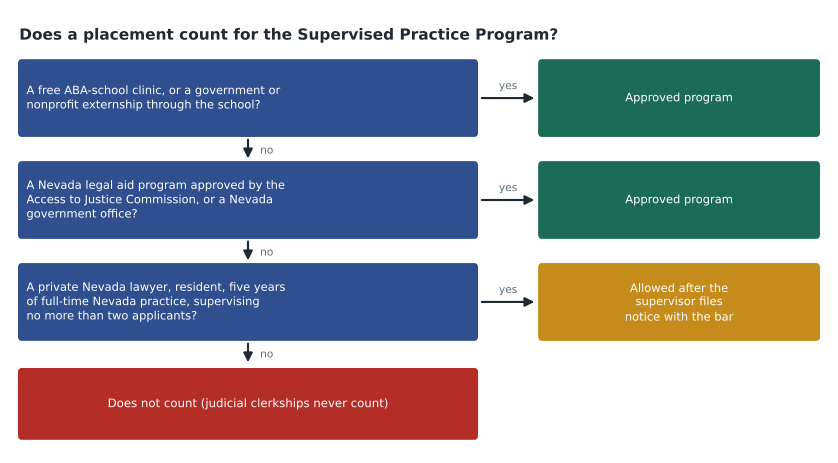
Approved settings include ABA-accredited law school clinics that do not charge clients; government or nonprofit externships run through ABA-accredited schools; Nevada legal aid programs approved by the Access to Justice Commission; Nevada government offices; and certain pro bono cases assigned through an approved Nevada legal aid office. A candidate may also work under a private practitioner, but the supervisor must be an active, resident member of the State Bar of Nevada who has practiced full time in Nevada for at least five years, may supervise no more than two applicants at once, must be personally present for client-related activities and must file notice with the State Bar before supervising. Supervisors review and sign the applicant's work and attend court or tribunal appearances. Judicial clerkships do not qualify.
Out-of-state placements are allowed only through ABA-accredited law school externships or clinics approved by the State Bar, and the candidate must obtain the equivalent of Nevada's Level 2 limited practice certification in that state. In Nevada, candidates doing supervised work that involves appearing or acting for clients generally need a Level 2 limited practice certification, which requires the 42 credits, a transcript and, for students, a dean's certification; the State Bar asks that the application be filed at least two weeks before the program starts.
SPP cycles, deadlines and documentation
The SPP runs in cycles. For the fall 2026 cycle, registration opened August 15, 2026 and runs to December 15, 2026, with late registration from December 1 to 15, and the self-directed project and journal are due January 1, 2027. Spring 2027 registration opens January 15, 2027. Journal grading takes about 60 days after a cycle closes. After the experience, the candidate files an Applicant's Certification form, and the supervisor automatically receives a certification form to complete. The SPP fee is 350 dollars. Supervisors may earn continuing legal education credit for documented supervision, up to four credits per cycle and twelve per year.
Worked problem
Can Maribel do her SPP at Arrieta & Haddad?
Begoña Arrieta has practiced full time in Reno since 2001, lives in Washoe County, is an active member of the State Bar and supervises no other applicants. Maribel has her J.D., has never been licensed, and wants to do her SPP hours at the firm in the fall 2026 cycle, including a client intake interview in a custody matter.
Show solution
- Eligibility: Maribel has well over 42 credits and no prior licensed practice, so she may participate and is not exempt.
- Supervisor: Arrieta is active, resident, has more than five years of full-time Nevada practice and supervises fewer than two applicants. She must file notice with the State Bar before supervising.
- Certification: Maribel should obtain Level 2 limited practice certification at least two weeks before starting supervised client work.
- Tasks: a client intake interview satisfies the required interviewing or counseling task; she needs at least three more of the designated tasks and at least 40 hours.
- Deadlines: register by December 15, 2026 and submit the project and journal by January 1, 2027.
Answer: Yes, if Arrieta files the supervisor notice, Maribel obtains limited practice certification, registers for the cycle and completes the hours, tasks, project and journal on time.
When a placement falls through
Supervised practice depends on other people: a clinic with space, a legal aid office with a supervising attorney free to take on applicants, or a private lawyer willing to meet the supervision rules. Placements can fall through when a supervisor changes jobs, a clinic fills, or a firm cannot guarantee the supervisor's personal presence at client meetings. Candidates should have a second option in mind, such as a Nevada government office or an approved legal aid program's pro bono assignments, and should start looking well before the cycle in which they want to finish. Because SPP grading takes about two months after a cycle closes, a candidate whose placement collapses in the fall may need to move to the spring cycle, which pushes character and fitness and admission back as well. Marchetti suggested that Maribel ask the Washoe County legal aid program, in writing, whether it could take her in the spring 2027 cycle if anything went wrong at the firm.
Getting the most from supervised practice
Marchetti encouraged Maribel to treat the SPP as more than a box to check. 'Pick tasks you will actually do as a new lawyer,' she said. 'Sit in on a consultation and then do one yourself with Begoña watching. Draft a demand letter and get it marked up. Write in your journal about what surprised you.' The journal asks candidates to reflect on what they learned, and reflective writing works best when it is specific: what happened, what the candidate did, what the supervisor said and what the candidate would do differently.
Common mistakes
MistakeI can take the LPE before graduating if I have finished my coursework.
InsteadThe LPE requires the J.D. to have been earned before the exam.
MistakeOn the LPE, I should use the rule I remember from law school.
InsteadUse the Library. Importing outside law is one of the costliest performance-test errors.
MistakeMy judicial clerkship will satisfy the SPP.
InsteadJudicial clerkships do not qualify for the SPP.
MistakeThe SPP is just 40 hours of any legal work.
InsteadIt requires at least four designated tasks, including client interviewing or counseling, plus a self-directed learning project and journal.
Summary and key terms
- The LPE is a full day of three two-hour performance scenarios, each with a File and a Library, modeled on Nevada's legacy performance tests.
- The LPE is open only after the J.D.; the first is January 18, 2027 and the next June 22, 2027.
- Success on the LPE depends on reading the task carefully, using only the Library and finishing every scenario.
- The SPP requires at least 40 supervised hours, four designated tasks including client interviewing or counseling, and a project and journal.
- Approved SPP settings include free law school clinics, school externships, approved legal aid, Nevada government offices and qualified private supervisors; judicial clerkships do not count.
- Lawyers with more than six continuous months of recent licensed practice may request an SPP exemption.
- 0
- Lawyering Performance Exam
- 1
- performance test
- 2
- File
- 3
- Library
- 4
- task memo
- 5
- Supervised Practice Program
- 6
- limited practice certification
- 7
- reflective journal
Practice problems
Work each problem on paper first, then reveal the answer to check.
How many scenarios are on the LPE, and how long is each?
Show answer
Three scenarios, two hours each.
What is the single required SPP task?
Show answer
Interviewing or counseling a client.
What must a private supervisor have to supervise an SPP candidate?
Show answer
Active, resident State Bar membership, at least five years of full-time Nevada practice, no more than two applicants at once, personal presence for client activities and notice filed with the State Bar.
When is the fall 2026 SPP journal due?
Show answer
January 1, 2027.
Lesson quiz · 5 questions
Score 60% or more to complete this lesson.
Create a free account to save your progress, take quizzes and earn a certificate.