
BAR-229 · Lesson 12 of 12 · 20 min
Capstone: Nevada practice problems and an exam-day plan
▶ Video coming soon A video version of this lesson is on the way.
Maribel's last one-on-one session of the fall was a capstone. Marchetti had written an original Nevada problem, longer than any single performance test task, that pulled together the Nevada law from this course. Maribel would work it under time and then talk it through with the group. 'This is not a released exam question and not an LPE scenario,' Marchetti said. 'It is practice in seeing Nevada issues in a real-looking file and writing about them clearly. After that, we build your plan for January and February.'
This lesson has three parts: an original Nevada fact pattern with a model answer in memo form, a set of short original practice questions across the course, and an exam-day and study plan for the January 18, 2027 Lawyering Performance Exam and the February 18-19, 2027 Foundational Law Exam.
The fact pattern (original hypothetical)
Odalys and Benicio Vidal married in Henderson in 2015. Before the marriage, in 2012, Benicio opened a small bakery in Henderson with 60,000 dollars of his own savings. During the marriage, Benicio worked at the bakery six days a week and grew it into three locations; it is now worth about 900,000 dollars. In 2016, Odalys's grandmother died and left Odalys 120,000 dollars, which Odalys deposited in an account in her name alone and has never touched. In 2019, the couple bought a house in Henderson with a down payment from their joint checking account, into which both deposited their paychecks. The deed lists both of them. Neither ever signed a premarital agreement or any written agreement about property.
In March 2026, Benicio posted a long statement on a neighborhood social media page open to the public, saying that a city health inspector had 'shaken down' small restaurants for cash in exchange for passing grades. Benicio says two other restaurant owners told him this, but he has no documents. The inspector sued Benicio for defamation in district court in Clark County. Benicio was served on October 20, 2026.
Also in March 2026, Odalys was driving home when a Clark County road maintenance truck backed out of a yard into her lane without a spotter. Odalys, who was going 10 miles per hour over the limit, could not stop in time. Her injuries total 280,000 dollars in damages. A jury would likely find Odalys 25 percent at fault and the county 75 percent.
In October 2026, Odalys moved out and told Benicio she wants a divorce. She has lived in Nevada continuously since 2014. Benicio wants to know three things: whether he will lose half of his bakery; what he should do about the defamation suit; and, because Odalys has asked him to help her find a lawyer for the crash, what Odalys can expect to recover from the county.
The task: you are an associate at a Las Vegas firm. The assigning partner asks for an objective memo analyzing (1) the characterization and likely division of the bakery, the inheritance and the house; (2) whether Benicio should file an anti-SLAPP special motion to dismiss and what each side must show; and (3) the likely recovery in Odalys's claim against the county. The partner also asks you to (4) flag any professional responsibility issue in the firm's representing Benicio while being asked to help Odalys.
Model answer
Issue 1: Property characterization and division
Rule. Under NRS 123.130, separate property includes property owned before marriage and property acquired by gift, bequest, devise or descent, with its rents, issues and profits. Under NRS 123.220, other property acquired during marriage is community property, and under NRS 123.225 each spouse holds a present, equal interest. On divorce, NRS 125.150 requires an equal disposition of community property to the extent practicable unless the court finds a compelling reason, stated in writing. When separate property increases in value because of community effort, the increase must be apportioned between the separate estate and the community (Cord v. Neuhoff, 1978), using the Pereira or Van Camp method.
Application: the bakery. Benicio started the bakery before the marriage with his own savings, so the business began as his separate property. But its growth from one shop to three locations and to a value of about 900,000 dollars came largely from Benicio's full-time work during the marriage, which is community effort. The increase must be apportioned. Because the growth was driven by Benicio's personal labor and management rather than by passive market appreciation, a court would likely use the Pereira approach: Benicio's separate estate receives his original 60,000-dollar investment plus a fair rate of return on it over the years of the marriage, and the rest of the value is community property. Under Van Camp, by contrast, the community would receive the reasonable value of Benicio's services less what the family already received in salary and draws, with the remainder separate; that method fits better when capital, not effort, drives growth. Either way, Benicio will not 'lose half the bakery' outright, but a large part of its value is likely community property to be divided equally. Valuation experts will be essential.
Application: the inheritance. Odalys's 120,000-dollar inheritance from her grandmother is separate property under NRS 123.130, acquired by bequest. She kept it in an account in her name alone and never commingled it, so tracing is simple. It remains her separate property, along with any interest it earned.
Application: the house. The down payment came from a joint account funded by both spouses' paychecks during the marriage, which is community property. Mortgage payments presumably came from the same source. The house is community property, and title in both names is consistent with that. Absent a compelling reason found in writing, it will be divided equally, either by sale or by one spouse buying out the other.
Conclusion. The house is community property and will be divided equally. The inheritance is Odalys's separate property. The bakery is partly separate and partly community; most of its growth during the marriage is likely community property under Pereira, so Benicio should expect to share a substantial part of its value with Odalys, though not necessarily half of the whole business. Odalys meets the six-week residence requirement of NRS 125.020, and incompatibility under NRS 125.010 is available as the ground.
Issue 2: The anti-SLAPP motion
Rule. Under NRS 41.660, a defendant may file a special motion to dismiss within 60 days after service of the complaint, extendable for good cause. At step one, the defendant must show by a preponderance of the evidence that the claim is based on a good faith communication in furtherance of the right to petition or free speech in direct connection with an issue of public concern, as defined in NRS 41.637, which includes a communication in direct connection with an issue of public interest in a place open to the public or a public forum, and which must be truthful or made without knowledge of its falsehood. At step two, the plaintiff must demonstrate, with prima facie evidence, a probability of prevailing. Discovery is stayed. If the motion is granted, fees and costs are mandatory and the court may add up to 10,000 dollars (NRS 41.670); if denied, the defendant may appeal immediately; if the motion is found frivolous or vexatious, the plaintiff recovers its fees.
Application. Benicio was served October 20, 2026, so the 60-day deadline falls on December 19, 2026, which is a Saturday; counsel should file well before then rather than rely on any weekend rule. Alleged corruption by a public health inspector is an issue of public interest, and a public neighborhood social media page is a public forum. The harder question at step one is the requirement that the statement be truthful or made without knowledge of its falsehood. Benicio relied on what two other owners told him; if he believed them, his statement was arguably made without knowledge of falsity, and declarations from those owners would be important. If step one is met, the inspector must produce prima facie evidence of a probability of prevailing on defamation, including that the statement was false and made with the required fault; as a public official, the inspector will likely have to show actual malice under the First Amendment.
Conclusion. Benicio should file a special motion to dismiss before mid-December, supported by his declaration and, ideally, declarations from the two restaurant owners. The motion has a reasonable chance of success. If it is granted, he recovers his fees and possibly up to 10,000 dollars more; if it is denied, he can appeal immediately. Counsel should advise him that a motion found frivolous could expose him to the inspector's fees.
Issue 3: Odalys's claim against the county
Rule. Nevada waives sovereign immunity under NRS 41.031, subject to discretionary-function immunity under NRS 41.032. NRS 41.035 caps damages against a political subdivision at 200,000 dollars per claimant, exclusive of post-judgment interest, with no punitive damages. Under NRS 41.141, a plaintiff recovers unless the plaintiff's negligence is greater than the defendants' combined negligence, and damages are reduced by the plaintiff's percentage of fault. Tort claims against a political subdivision may be filed with its governing body within two years under NRS 41.036, and the general limitations period for personal injury is two years.
Application. Backing a truck into traffic without a spotter is operational negligence, not a policy decision, so discretionary-function immunity likely does not apply. Odalys's 25 percent fault is not greater than the county's 75 percent, so she can recover. Her damages of 280,000 dollars reduced by 25 percent come to 210,000 dollars. The cap under NRS 41.035 then limits her recovery to 200,000 dollars. The crash occurred in March 2026, so her claim and suit should be filed well before March 2028.
Conclusion. Odalys can likely recover 200,000 dollars, the statutory cap, plus post-judgment interest, and no punitive damages.
Issue 4: Professional responsibility
The firm represents Benicio, and Odalys is his spouse and the opposing party in a likely divorce. Referring Odalys to an unrelated lawyer for her injury claim is not itself a problem, but the firm must not represent Odalys in the injury case or give her legal advice while representing Benicio in the divorce: their interests are directly adverse, and the divorce lawyers will have to address how her injury recovery is treated; under NRS 123.130 an award of personal injury damages is her separate property, a point Benicio's lawyers should not be advising her about. Nevada Rule 1.7 bars the concurrent representation of directly adverse clients without informed consent, and consent would not be reasonable here. The firm should tell Benicio that it cannot help Odalys, and anything said to Odalys should make clear that the firm represents Benicio only. If the firm considered an advertisement or mailer to recruit injury clients like Odalys, Nevada's 30-day written solicitation ban and advertising rules would also apply.
Short practice questions (original)
Work these quickly, then check the answers in the practice section at the end of the lesson.
| No. | Question |
|---|---|
| 1 | A Nevada lawyer reasonably believes a client is about to commit a crime likely to result in death. Under the Nevada Rules, must the lawyer disclose information to prevent it? |
| 2 | A candidate with 50 law school credits wants to take the LPE in January 2027. May she? |
| 3 | A plaintiff is 52 percent at fault in a Las Vegas slip-and-fall. What does she recover? |
| 4 | A 2026 malpractice plaintiff files without an expert affidavit and the case does not fit NRS 41A.100. What happens? |
| 5 | A Nevada lawyer admitted in April 2027 asks when she must first complete 13 CLE hours. What do you tell her? |
The exam-day and study plan
With the capstone done, Marchetti and Maribel turned to the calendar. Maribel's components are the LPE on January 18, 2027 and the FLE on February 18-19, 2027, with her SPP hours and journal due by January 1, 2027. The plan had to fit around a job and the holidays.
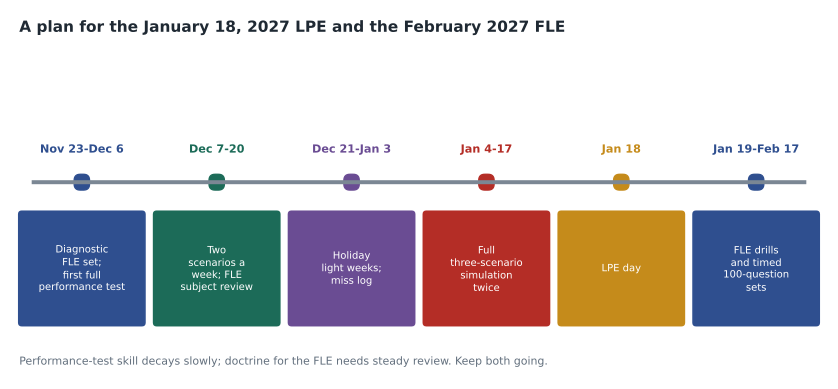
From late November to early December, the focus is diagnosis: one full FLE practice set and one full performance scenario, each reviewed carefully. Through mid-December, two performance scenarios a week and short daily FLE sets, with the SPP hours scheduled at the firm and the journal written as she goes, not at the end. Over the holidays, lighter weeks: the journal finished and submitted early, the miss log reviewed, and rest. In the first two weeks of January, two full three-scenario LPE simulations on weekend days, with the real exam's timing and breaks, and a check of the exam software and permitted materials. After the LPE, a short break and then a return to FLE drills, with two full 100-question simulations at the same time of day as her testing center appointment.
| Day | LPE (January 18) | FLE (February window) |
|---|---|---|
| Week before | Read the permitted-materials page; test laptop and software; plan travel | Confirm test center, time and identification |
| Day before | Light review of task-memo checklist only; early night | Light review of miss log only; early night |
| Morning | Breakfast, arrive early, nothing new | Breakfast, arrive early for check-in |
| During | Ten minutes on each task memo; use only the Library; watch the clock | Steady pace of about 2.4 minutes a question; mark and move on |
| After | Do not replay answers; rest | Do not replay questions; rest |
Marchetti added the advice she gives every candidate. 'On the LPE, the third scenario is where tired people lose points. Practice full days, eat lunch, and treat the last scenario as seriously as the first. On the FLE, the questions are about general principles. If an answer depends on an obscure exception, be suspicious. And for both: do what the question asks.'
After the exams
Once the SPP is graded and two of the remaining components are complete with the last registered, Maribel can file her character and fitness application, which she has been assembling since November. When every component is passed and character and fitness clears, she will take the oath, join the State Bar of Nevada and start Transitioning into Practice. If any component does not go as planned, the Nevada Plan's structure means she repeats only that component in the next window, keeping everything else she has passed within the six-year window.
Common mistakes
MistakeIn a capstone memo, I should discuss every rule I know.
InsteadAnswer the questions asked, in the order asked, using rule, application and conclusion for each.
MistakeThe anti-SLAPP motion can wait until after the divorce is sorted out.
InsteadThe 60-day deadline runs from service regardless of other matters.
MistakeOdalys recovers 210,000 dollars because her damages are reduced by 25 percent.
InsteadThe NRS 41.035 cap limits recovery against the county to 200,000 dollars per claimant.
MistakeA business started before marriage is always entirely separate property.
InsteadGrowth from community effort during the marriage must be apportioned under Pereira or Van Camp.
Summary and key terms
- Nevada characterization starts with NRS 123.130 and 123.220; separate business growth from community effort is apportioned, and community property is divided equally on divorce absent a written compelling reason.
- An anti-SLAPP special motion must be filed within 60 days after service and turns on a two-step burden.
- Claims against Nevada local governments face discretionary-function immunity, comparative fault reduction and the 200,000-dollar per-claimant cap.
- Representing one spouse while advising the other on a related matter raises a direct conflict under Rule 1.7.
- A plan for the LPE and FLE should combine timed performance scenarios, short doctrinal sets, full simulations and rest.
- Under the Nevada Plan, a failed component is retaken alone, within the six-year window.
- 0
- IRAC
- 1
- objective memo
- 2
- apportionment
- 3
- special motion to dismiss
- 4
- statutory cap
- 5
- concurrent conflict
- 6
- simulation
Practice problems
Work each problem on paper first, then reveal the answer to check.
Question 1: must the lawyer disclose?
Show answer
Yes. Nevada Rule 1.6(d) requires disclosure to the extent reasonably necessary to prevent a client's criminal act likely to result in reasonably certain death or substantial bodily harm.
Question 2: may the candidate with 50 credits take the January 2027 LPE?
Show answer
No. The LPE requires the J.D. She may take the FLE and do the SPP.
Question 3: what does the 52 percent plaintiff recover?
Show answer
Nothing. Under NRS 41.141, her negligence is greater than the defendant's.
Question 4: what happens to the malpractice case filed without an affidavit?
Show answer
It must be dismissed without prejudice under NRS 41A.071; the plaintiff may refile with an affidavit if the limitations period has not run.
Question 5: when must the April 2027 admittee first complete 13 CLE hours?
Show answer
For calendar year 2029, by December 31, 2029; SCR 214 exempts the rest of 2027 and all of 2028. She must still complete Transitioning into Practice.
Lesson quiz · 5 questions
Score 60% or more to complete this lesson.
Create a free account to save your progress, take quizzes and earn a certificate.