
BAR-229 · Lesson 10 of 12 · 21 min
Nevada Rules of Professional Conduct
▶ Video coming soon A video version of this lesson is on the way.
Maribel scored 89 on the MPRE by learning the ABA Model Rules. In her second month at Arrieta & Haddad, she discovered that Nevada's rules differ in ways that matter every week. Begoña Arrieta asked her to draft a contingent fee agreement for a new injury client, and the firm's template had a bold paragraph about the client's possible liability for the other side's costs that Maribel had never seen in a Model Rules casebook. The same week, Chris Haddad asked her to review a postcard the firm wanted to mail to people involved in recent car accidents, and she found that Nevada would not allow it for thirty days after the crash.
'The MPRE tests the Model Rules,' Marchetti reminded her. 'Your license, your malpractice risk and your discipline exposure depend on the Nevada Rules. Learn the differences now, while you are still allowed to ask questions without a client depending on the answer.'
Nevada adopted rules based on the ABA Model Rules, with Nevada-specific changes. This lesson covers how the rules and comments work in Nevada, then the differences most likely to matter to a new lawyer: fees, confidentiality, conflicts and screening, client property, the sale of a practice, multijurisdictional practice, pro bono, advertising and solicitation, specialization, and Nevada's comments on cannabis.
How the rules and comments work
Nevada Rule 1.0A explains that the ABA's comments may be consulted for guidance in interpreting the Nevada rules, but they are not enacted as part of the rules, and where a Nevada rule differs from the Model Rule, the Nevada text controls. That matters because many lawyers reach for the ABA comment first. In Nevada, start with the Nevada rule's text, then look at any Nevada comment, and only then at the ABA comment for guidance.
Fees and contingent fee agreements
Nevada Rule 1.5 follows the Model Rule's reasonableness standard but adds detailed requirements for contingent fees. A contingent fee agreement must be in writing and signed by the client, and Nevada requires certain terms to appear in boldface type at least as large as the largest type used in the agreement. The agreement must state the method by which the fee will be determined, including the percentages that apply at different stages, the litigation and other expenses to be deducted and whether they are deducted before or after the fee is calculated. Nevada adds two disclosures that the Model Rule does not require: the agreement must tell the client whether the client could be liable for the opposing party's fees and costs, and it must address the client's potential liability for malicious prosecution or abuse of process if the claim is found to be frivolous. At the end of the matter, the lawyer must give the client a written statement showing the outcome and how the remittance was calculated.
That is why the firm's template had the bold paragraph. A contingent fee agreement that leaves out the cost-exposure disclosure is not only a discipline risk; it can damage the client relationship when an adverse cost award arrives.
Confidentiality: mandatory disclosure
Confidentiality is the area where Nevada differs most sharply from the Model Rules. Model Rule 1.6(b)(1) permits a lawyer to reveal information to prevent reasonably certain death or substantial bodily harm. Nevada Rule 1.6(d) makes disclosure mandatory in one situation: a lawyer shall reveal information relating to the representation to the extent the lawyer reasonably believes necessary to prevent a client from committing a criminal act that the lawyer believes is likely to result in reasonably certain death or substantial bodily harm. Nevada keeps the other permissive exceptions familiar from the Model Rule, such as disclosures to secure ethics advice or to establish a claim or defense in a controversy with the client.
| Situation | ABA Model Rule | Nevada Rule |
|---|---|---|
| Client is about to commit a crime likely to cause death or substantial bodily harm | Disclosure permitted (Rule 1.6(b)(1)) | Disclosure required (Rule 1.6(d)) |
| Contingent fee agreement | Writing signed by client; method of calculation | Also bold type, disclosure of exposure to opposing fees and costs and to malicious prosecution liability |
| Lateral lawyer with a conflict | Screening permitted under Rule 1.10(a)(2) | Screening permitted under Rule 1.10(e) with prompt written notice |
| Advertising | No filing requirement | Copy filed with the State Bar within 15 days (Rule 7.2A) |
| Written solicitation after an injury | Labeling rules | Banned for 30 days after the incident (Rule 7.3) |
| Pro bono | Aspirational 50 hours | Aspirational 20 hours, with annual reporting (Rule 6.1) |
On the MPRE, answer confidentiality questions under the Model Rule: disclosure to prevent death or substantial bodily harm is permitted. In Nevada practice, remember the duty.
Conflicts, gifts and screening
Nevada Rule 1.8 follows the Model Rule's specific conflict rules with some changes. Nevada's version of Rule 1.8(c), on gifts from clients and instruments giving the lawyer a gift, extends to persons related to the lawyer, and Nevada defines related persons to include anyone with whom the lawyer or client maintains a close, familial relationship. Nevada's Rule 1.8(e), on financial assistance to clients, allows a lawyer representing an indigent client pro bono, through a nonprofit legal services program or in certain public defender settings, to provide modest gifts or humanitarian help to the client, without seeking reimbursement from the client.
On imputed conflicts, Nevada Rule 1.10(e) allows a firm to avoid imputation of a lateral lawyer's former-client conflict by timely screening the lawyer from any participation in the matter, apportioning no part of the fee to that lawyer, and giving prompt written notice to the affected former client so that it can check compliance. The structure is similar to the Model Rule's screening provision, with Nevada's own wording and numbering.
Client property and unclaimed funds
Nevada Rule 1.15 governs client trust accounts. A distinctive Nevada provision addresses money that cannot be returned. When a lawyer holds funds whose owner cannot be identified or located, the lawyer may, after five years of reasonable efforts, remit the funds to the State Bar's Clients' Security Fund. The efforts must be documented and must include regular and certified mail, telephone and email attempts. The Fund then handles any later claim by the owner. This rule is a reminder that trust account problems often come from old, small balances that no one remembers.
Selling a law practice
Nevada Rule 1.17 permits the sale of a law practice or an area of practice. The seller must stop practicing in the area sold for at least six months, unless the agreement states a different term. Clients must receive written notice of the proposed sale, their right to retain other counsel or take their files, and the fact that their consent to transfer of their files will be presumed if they do not object within 90 days. Fees may not be increased because of the sale.
Multijurisdictional practice and out-of-state lawyers
Nevada Rule 5.5 ties temporary practice by out-of-state lawyers to Supreme Court Rule 42, the pro hac vice rule, and to other specific permissions. An out-of-state lawyer may not establish an office or other systematic and continuous presence in Nevada for the practice of law, or hold out as admitted in Nevada. Nevada Rule 5.5A adds a registration requirement unusual among the states: a lawyer admitted elsewhere who represents clients in Nevada transactional or other matters that do not involve a court appearance must register annually with the State Bar, pay a 150-dollar fee by January 31, and may be fined up to 500 dollars for failing to file. Lesson 11 discusses these routes further.
Pro bono
Nevada Rule 6.1 states an aspirational goal of 20 hours of pro bono legal service a year, or alternatives such as 60 hours at a substantially reduced fee or a 500-dollar annual contribution to a qualifying legal services organization. The service itself is voluntary, but reporting is not: Nevada lawyers must file an annual pro bono reporting form, and failing to file after notice brings a 100-dollar fine. The Model Rule's aspirational figure is 50 hours with no reporting requirement.
Advertising: content, filing and advisory opinions
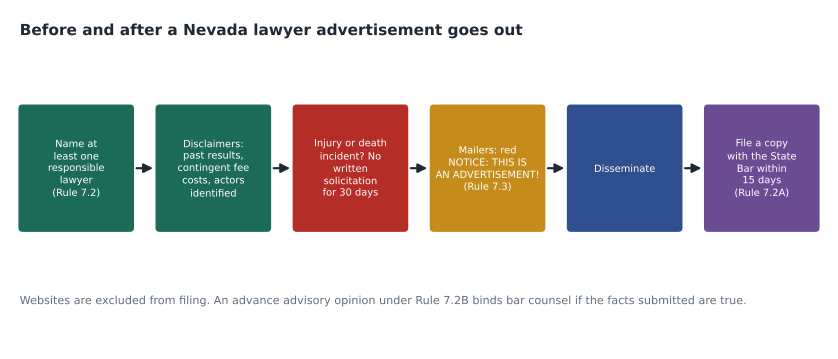
Nevada regulates lawyer advertising more closely than the Model Rules. Under Nevada Rule 7.2, every advertisement and written communication must include the name of at least one lawyer responsible for its content. If actors portray lawyers, staff or clients, or the advertisement depicts fictionalized events, it must disclose that, identifying which people are actors while they appear. An advertisement that mentions contingent fees or a percentage of recovery must state that the client may be liable for the opposing party's fees and costs. An advertisement that refers to past results must meet conditions: the lawyer must have been lead counsel or primarily responsible for the result, the advertisement must disclose that past results do not guarantee future outcomes, and monetary figures must reflect amounts actually received, with fees and expenses disclosed. Required disclaimers must appear in each language used in the advertisement and must be reasonably prominent.
Nevada Rule 7.2A requires a lawyer to file with the State Bar a copy or recording of each paid advertisement and each written or recorded communication used to advertise legal services, within 15 days after it is first disseminated, on the State Bar's form and with a fee set by the Board of Governors. Websites are excluded from the filing requirement. Failure to file is grounds for discipline. Under Rule 7.2B, a lawyer may request an advance advisory opinion from the Standing Lawyer Advertising Advisory Committee; an opinion that the advertisement complies binds bar counsel and the disciplinary panel in the lawyer's favor, provided the facts submitted were true and not misleading.
Solicitation and the 30-day rule
Nevada Rule 7.3 restricts direct solicitation of prospective clients with whom the lawyer has no family or prior professional relationship when a significant motive is pecuniary gain. Written solicitations, such as mailers to people who may need legal services, must carry the Rule 7.2 disclaimers, and both the envelope and each page must bear the words 'NOTICE: THIS IS AN ADVERTISEMENT!' in red ink. Most significantly for injury practice, Nevada prohibits written solicitation of a person injured in an incident, or that person's family or legal representative, for 30 days after an incident involving personal injury or wrongful death. The ban also applies to lawyers representing potential defendants or their insurers.
Worked problem
Reviewing the accident postcard
Arrieta & Haddad wants to mail a postcard to people involved in car accidents in Washoe County during the past two weeks. The card says: "Hurt in a crash? We have recovered millions for clients. No fee unless we win. Call Arrieta & Haddad." It names no lawyer and has no disclaimers. Can it go out?
Show solution
- Timing: the recipients were in injury accidents within the past two weeks. Rule 7.3 bans written solicitation for 30 days after the incident. The mailing must wait.
- Responsible lawyer: Rule 7.2 requires the name of at least one lawyer responsible for the content.
- Past results: "recovered millions" must meet Rule 7.2 conditions, including that the lawyer was lead counsel, a statement that past results do not guarantee future outcomes and amounts actually received.
- Contingent fee: "no fee unless we win" refers to a contingent fee, so the card must state that the client may be liable for the opposing party's fees and costs.
- Labeling and filing: a mailer must bear the red-ink advertisement notice, and a copy must be filed with the State Bar within 15 days after it is first sent.
Answer: Not as written. Wait at least 30 days after each recipient's accident, name a responsible lawyer, add the past-results and fee disclaimers, add the red NOTICE label and file a copy within 15 days of mailing. An advance advisory opinion under Rule 7.2B would add protection.
Specialization
Nevada Rule 7.4 allows a lawyer to claim to be a specialist or expert only if certified by an organization the State Bar has approved. The lawyer must have devoted at least one-third of the practice to the specialty in each of the two prior years, complete 10 hours of accredited CLE in the specialty in the prior year, carry at least 500,000 dollars of professional liability insurance (unless practicing exclusively in public law), report annually and pay a registration fee. Advertising must identify the certifying organization.
Cannabis and the Nevada comments
Nevada legalized recreational cannabis under state law, while cannabis remains illegal under federal law. Nevada's comments address both sides. Comment 1 to Nevada Rule 1.2 allows a lawyer to counsel and assist a client regarding Nevada's cannabis constitutional and statutory provisions, but the lawyer must also advise the client about related federal law and policy. Comment 1 to Nevada Rule 8.4 warns that a lawyer who personally uses, possesses or distributes cannabis risks federal prosecution and discipline. The comments thus let Nevada lawyers serve a lawful state industry while reminding them of the federal overlay.
The lawyer's biographical information
Nevada Rule 1.4(c) refers to a Lawyer's Biographical Data Form, which covers matters including the lawyer's disciplinary history (including private reprimands imposed after March 1, 2007) and whether the lawyer carries malpractice insurance. A new lawyer should know what the form says, when it must be provided, and keep it current.
Common mistakes
MistakeIn Nevada, disclosure to prevent a client's crime that will cause death or serious injury is optional.
InsteadNevada Rule 1.6(d) requires disclosure to the extent reasonably necessary. The Model Rule only permits it.
MistakeLawyer websites must be filed with the State Bar.
InsteadRule 7.2A requires filing of advertisements within 15 days of first dissemination, but websites are excluded.
MistakeA personal injury mailer can go out the day after an accident if it is labeled an advertisement.
InsteadNevada bans written solicitation of the injured person or family for 30 days after the incident.
MistakeABA comments are binding in Nevada.
InsteadUnder Nevada Rule 1.0A, ABA comments are guidance only; the Nevada rule text controls.
Summary and key terms
- Nevada Rule 1.0A treats ABA comments as guidance only; the Nevada text controls.
- Contingent fee agreements need bold-type terms and disclosures of exposure to opposing costs and malicious prosecution liability, plus a closing statement.
- Nevada Rule 1.6(d) requires disclosure to prevent a client's criminal act likely to cause death or substantial bodily harm.
- Nevada permits lateral screening under Rule 1.10(e), lets unclaimed trust funds go to the Clients' Security Fund after five years of documented efforts, and requires out-of-state transactional lawyers to register under Rule 5.5A.
- Advertisements must name a responsible lawyer, include required disclaimers and be filed within 15 days; websites are excluded; written injury solicitation is banned for 30 days.
- Nevada's pro bono goal is 20 hours with mandatory annual reporting; Nevada comments address cannabis counseling and personal use.
- 0
- Rule 1.0A
- 1
- contingent fee agreement
- 2
- mandatory disclosure
- 3
- screening
- 4
- Clients' Security Fund
- 5
- Rule 5.5A registration
- 6
- Rule 7.2A filing
- 7
- advance advisory opinion
- 8
- 30-day solicitation ban
Practice problems
Work each problem on paper first, then reveal the answer to check.
What must a Nevada contingent fee agreement disclose that the Model Rule does not require?
Show answer
Whether the client may be liable for the opposing party's fees and costs, and potential liability for malicious prosecution or abuse of process.
How does Nevada Rule 1.6 differ from the Model Rule on preventing death or bodily harm?
Show answer
Nevada requires disclosure to prevent a client's criminal act likely to cause death or substantial bodily harm; the Model Rule permits it.
Within how many days must a Nevada advertisement be filed with the State Bar?
Show answer
Within 15 days after first dissemination.
What is Nevada's aspirational pro bono goal?
Show answer
20 hours a year, with mandatory annual reporting.
Lesson quiz · 5 questions
Score 60% or more to complete this lesson.
Create a free account to save your progress, take quizzes and earn a certificate.