
BAR-229 · Lesson 2 of 12 · 20 min
Eligibility, education, deadlines and fees
▶ Video coming soon A video version of this lesson is on the way.
Maribel spent the first weekend after joining the group building a calendar. She printed the Nevada Plan pages, marked each deadline in red and each fee in green, and taped the result above her desk at Arrieta & Haddad. Begoña Arrieta, her supervising partner, looked at it on Monday morning and laughed. 'When I took the bar in 2001, I filled out one form and wrote one check,' she said. 'You have a project plan.'
Marchetti thought the project plan was exactly right. 'The Nevada Plan rewards organized candidates,' she told Maribel at their next session. 'The doctrine is no harder than before. The paperwork is more spread out. Missing a deadline now costs you a late fee, or worse, a whole testing window.'
This lesson covers who may take each component, the education the rules require, the registration deadlines and fees for the 2026-27 cycle, and the paths available to graduates of law schools that are not ABA-approved. Dates and fees in this lesson are those posted by the State Bar of Nevada for the cycle running from fall 2026 into 2027. They change, so treat them as the starting point for your own check of the current pages.
Education: the ABA J.D. requirement
Nevada's admission rules require a law degree, a J.D. or the older LL.B., from a law school approved by the American Bar Association. That requirement applies under the Nevada Plan as it did under the legacy exam. The rules also expect substantial college work before law school; the admission rules refer to at least three-fourths of the work toward a bachelor's degree. Nearly every candidate meets this through a completed bachelor's degree, but candidates admitted to law school through unusual paths should check the rule early.
Under the Nevada Plan, the education requirement is applied component by component. The Foundational Law Exam and the Supervised Practice Program are open to candidates who have completed at least 42 credits at an ABA-accredited law school, which for a full-time student usually means the end of the first year or early in the second. The Lawyering Performance Exam is open only to candidates who have earned the J.D. before the exam date. So a law student can complete two of the four primary components before graduation, and many students in the class of 2027 and later will.
Functional equivalency for other law graduates
Graduates of law schools that are not ABA-approved, including graduates of foreign law schools, are not automatically excluded, but they must first obtain a determination that their education is the functional equivalent of an ABA-approved J.D. The rules provide this route through SCR 51.5 and the Functional Equivalency subcommittee of the Board of Bar Examiners. The application carries its own filing fee and documentation requirements, including transcripts, course descriptions and evidence of any practice experience. A candidate in this group should apply well before registering for any component, because the components that depend on ABA credits or an ABA J.D. are open to them only once the subcommittee has approved them.
NCBE's summary of Nevada eligibility notes that graduates of non-ABA law schools in other states may also qualify with additional requirements, such as admission in another state and years of practice. The details sit in the rule and the subcommittee's procedures, and each case turns on its facts.
| Candidate | FLE | SPP | LPE |
|---|---|---|---|
| 2L at an ABA-approved school with 42+ credits | Eligible | Eligible (with limited practice certification) | Not yet; needs the J.D. |
| May 2026 ABA J.D. graduate | Eligible | Eligible | Eligible |
| Graduate of a non-ABA school | After functional equivalency approval | After approval | After approval |
| Lawyer licensed elsewhere, 6+ months of recent practice | Eligible | May request exemption | Eligible |
Registration deadlines in the 2026-27 cycle
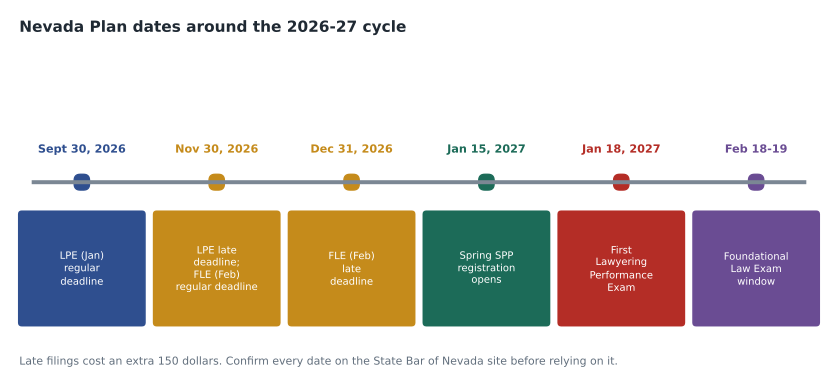
Each component has its own calendar. For the Foundational Law Exam, the State Bar lists testing windows four times a year beginning in 2027: February 18-19, May 27-28, August 19-20 and October 28-29, 2027. For the February 2027 window, registration opened October 16, 2026, the regular deadline (which is also the deadline for requesting testing accommodations) is November 30, 2026, and late registration runs to December 31, 2026. Each later window has its own opening date, regular deadline and late deadline, roughly three months ahead of the exam.
For the Lawyering Performance Exam, the State Bar lists January and June administrations. The first is January 18, 2027. Registration opened August 3, 2026; the regular and accommodation deadline was September 30, 2026; and late applications are accepted through November 30, 2026. The next administration is June 22, 2027, with deadlines posted on the State Bar's LPE page.
For the Supervised Practice Program, registration runs in cycles. For the fall 2026 cycle, registration opened August 15, 2026 and closes December 15, 2026, with late registration from December 1 to 15; the self-directed learning project and journal are due January 1, 2027. Spring 2027 registration opens January 15, 2027. A candidate who needs a limited practice certification to do the supervised work should apply at least two weeks before the program begins.
| Component and date | Registration opens | Regular deadline | Late deadline |
|---|---|---|---|
| LPE, January 18, 2027 | August 3, 2026 | September 30, 2026 | November 30, 2026 |
| FLE, February 18-19, 2027 | October 16, 2026 | November 30, 2026 | December 31, 2026 |
| FLE, May 27-28, 2027 | January 5, 2027 | February 19, 2027 | March 19, 2027 |
| SPP, fall 2026 cycle | August 15, 2026 | December 15, 2026 (late window from December 1) | Journal due January 1, 2027 |
Fees
The fees are set component by component. As posted for this cycle, the Foundational Law Exam costs 150 dollars for non-attorneys and 325 dollars for attorneys, including anyone who has passed a bar exam elsewhere. The Lawyering Performance Exam costs 265 dollars for non-attorneys and 500 dollars for attorneys. The Supervised Practice Program fee is 350 dollars. A late filing adds 150 dollars. The character and fitness application, the licensing fee on admission and the State Bar dues that follow have their own amounts. Compared with the legacy exam, where a first-time applicant paid a single application fee of several hundred dollars plus a laptop fee, the Nevada Plan spreads costs out and, for a first-time candidate who passes each part once, is not dramatically more expensive.
Worked problem
Budgeting Maribel's remaining fees
Maribel registers for the February 2027 FLE on November 2, 2026, files a late application for the January 18, 2027 LPE on November 9, 2026, and registers for the fall 2026 SPP cycle on November 4, 2026. She is not an attorney anywhere. What will these three registrations cost, before character and fitness?
Show solution
- FLE, non-attorney, registered before the November 30 regular deadline: 150 dollars.
- LPE, non-attorney: 265 dollars, plus the 150-dollar late fee because September 30 has passed: 415 dollars.
- SPP: 350 dollars. Registering on November 4 is within the regular window.
- Add them: 150 + 415 + 350.
Answer: 915 dollars in component fees, before the character and fitness application and admission fees. Her MPRE fee was paid to NCBE in 2025.
Marchetti pointed out a hidden cost: a failed component means paying that component's fee again. 'Under the old exam, a retake cost a full application fee. Now a retake of the FLE costs 150 dollars and a few months. That is a reason not to panic about any single part. It is not a reason to walk in unprepared.'
The six-year eligibility window
The Nevada Plan replaces the old rule that tied everything to a single exam date with a window. All components must be completed within six years: from three years before to three years after the year in which the candidate passes the Lawyering Performance Exam. A component completed outside the window must be redone. For a typical law student, the window is generous. A student who passes the FLE in spring of the second year, completes the SPP in a clinic in the third year, takes the MPRE in the third year and passes the LPE after graduation will finish everything in about two years. The window matters mainly for candidates who start early and then pause, or for lawyers returning to Nevada after years elsewhere.
The MPRE follows the same logic: Nevada accepts a score of at least 85 earned within three years before through three years after the year the candidate passes the Nevada exam. Maribel's August 2025 score therefore counts for a 2027 passing year.
Retakes and attempts
Each component can be retaken. Bar review providers describe the Plan as allowing unlimited retakes within the eligibility window, and NCBE's summary lists no limit on attempts under Nevada's rules. Each retake requires a new registration and fee. A failed LPE in January can be retaken in June; a failed FLE can be retaken in the next quarterly window. Because the parts are separate, a candidate who fails one does not lose the parts already passed, so long as they remain inside the window.
Testing accommodations
Candidates who need testing accommodations request them by the regular deadline for each component. The request goes with the registration, and the supporting documentation must be complete; an incomplete request can delay a decision past the testing date. Because the FLE is delivered at testing centers by a vendor and the LPE is given by the State Bar, the logistics differ, and a candidate approved for one component should not assume the approval automatically carries over to another. Ask, and keep the written decision for each.
Practical habits
Maribel's calendar has three columns for every item: registered, paid and confirmed. When she registered for the FLE, she saved the confirmation, then checked a week later that her test-center appointment had been scheduled. When she filed her LPE application, she called the admissions office to confirm that the late fee had been received. Begoña Arrieta signed the supervising attorney notice for the SPP the same week, and Maribel diarized the January 1 journal deadline twice, once on December 15 as a warning and once on December 30.
Marchetti's rule of thumb for the group: 'For any deadline that matters, put it in your calendar three times: two weeks before, three days before and the day itself.'
Where the exams are given
The Foundational Law Exam is computer-based and delivered at testing centers run by a commercial vendor, both inside and outside Nevada. That is a real advantage in a state as large as Nevada. A candidate in Elko, Ely or Winnemucca no longer has to plan a multi-day trip to Las Vegas or Reno for a doctrinal exam; a candidate who has moved out of state for a job or a clerkship can test where they live. The candidate chooses a center and a time slot within the testing window when scheduling, and popular centers fill early, so scheduling promptly after registration matters.
The Lawyering Performance Exam is different. It is a full day, given by the State Bar on its January and June dates, and the State Bar publishes its own rules on permitted and prohibited materials and on taking the exam by computer. Candidates should read those pages well before the exam rather than the night before. Maribel's plan is to drive from Reno to the exam site the evening before, stay nearby and do nothing on exam morning except eat breakfast and check her laptop.
Keeping the record clean
Each registration asks for identifying details, and the State Bar matches records across components and across years. A candidate whose name has changed, who uses two surnames, or who registered for the MPRE under a slightly different name should make sure every record lines up. Maribel uses her full name, Maribel Ane Etcheverry, on every form, because her MPRE score report shows her middle name and she did not want the score to sit unmatched in a file. Candidates who have moved should update addresses with both NCBE and the State Bar, since notices about scores, deadlines and character and fitness questions go to the address on file.
Planning around a job
Most candidates finishing the Nevada Plan after graduation are working. The Plan's structure helps: a candidate can study for one component at a time instead of taking two months off for a single exam. But it also creates a long tail. Maribel's employer agreed that she would cut back to thirty hours a week in December and take two days off before the January LPE. Her supervised practice hours for the SPP happen at the firm itself, under Begoña Arrieta's supervision, which means her clerk work and her licensing work overlap. Not every employer can offer that. Candidates working in judicial clerkships, for example, should note that judicial clerkships do not qualify for the SPP, so they will need a separate placement.
Common mistakes
MistakeI can take the LPE as a 3L to get it out of the way.
InsteadThe LPE is open only after the J.D. has been conferred. The FLE and SPP can be done after 42 credits.
MistakeGraduates of non-ABA schools cannot be licensed in Nevada at all.
InsteadThey can apply for a functional equivalency determination under SCR 51.5 before registering for components.
MistakeThere is one application deadline for everything.
InsteadEach component has its own registration window, regular deadline and late deadline.
MistakeAn attorney pays the same FLE fee as a student.
InsteadAttorneys pay higher fees for the FLE and LPE, 325 and 500 dollars respectively in this cycle.
Summary and key terms
- Nevada requires a J.D. from an ABA-approved law school; others may seek a functional equivalency determination under SCR 51.5.
- The FLE and SPP are open after 42 ABA law school credits; the LPE is open only after the J.D.
- The first LPE is January 18, 2027; FLE windows run four times a year from February 2027.
- Fees for this cycle: FLE 150 or 325 dollars, LPE 265 or 500 dollars, SPP 350 dollars, plus 150 dollars for late filing.
- All components must fall within a six-year window around the year the LPE is passed; the MPRE must fall within three years before or after that year.
- Each component can be retaken with a new registration and fee.
- 0
- ABA-approved law school
- 1
- functional equivalency
- 2
- eligibility window
- 3
- late fee
- 4
- testing accommodations
- 5
- limited practice certification
Practice problems
Work each problem on paper first, then reveal the answer to check.
When may a law student first sit the Foundational Law Exam?
Show answer
After completing at least 42 credits at an ABA-accredited law school.
What was the late application deadline for the January 18, 2027 LPE?
Show answer
November 30, 2026.
A non-attorney files a late LPE application. What fee applies in this cycle?
Show answer
265 dollars plus a 150-dollar late fee, 415 dollars in total.
Does a candidate who fails the LPE lose a passed FLE?
Show answer
No, as long as the FLE stays within the six-year eligibility window.
Lesson quiz · 5 questions
Score 60% or more to complete this lesson.
Create a free account to save your progress, take quizzes and earn a certificate.