
BAR-229 · Lesson 7 of 12 · 19 min
Nevada courts and civil procedure
▶ Video coming soon A video version of this lesson is on the way.
Maribel's first assignment at Arrieta & Haddad had been a research memo for Chris Haddad, the firm's litigator. A client who owned a Reno tile business had posted a long online review accusing a competitor of dumping construction waste in a wash north of town. The competitor sued for defamation in the Second Judicial District Court in Washoe County. 'Before you do anything else,' Haddad told her, 'check the anti-SLAPP clock. If we are going to file a special motion to dismiss, we have sixty days from service, and the client was served three weeks ago.'
Maribel had learned Nevada procedure for the legacy essays. Now she was learning it the way lawyers use it: as a set of deadlines and choices that shape a case from the first day. This lesson covers the Nevada court system, the structure of Nevada civil procedure, the court-annexed arbitration and short trial programs, offers of judgment and the anti-SLAPP statute, all of which a new Nevada lawyer meets early in practice.
The Nevada court system
The Supreme Court of Nevada is the state's highest court, with seven justices. Every appeal in Nevada is filed with the Supreme Court. Since 2015, Nevada has also had a Court of Appeals, created by an amendment to Article 6 of the Nevada Constitution that voters approved on November 4, 2014. The Court of Appeals has three judges.
Nevada uses what its courts call a deflective model. Appeals are filed with the Supreme Court Clerk and remain with the Supreme Court until it assigns them to the Court of Appeals. The Court of Appeals generally receives matters that do not set precedent and take less time to prepare, while the Supreme Court keeps cases raising questions of first impression or important public policy. About 700 cases a year, roughly one-third of the Supreme Court's caseload, are assigned to the Court of Appeals. A party who loses in the Court of Appeals may petition the Supreme Court for review, but review is in the Supreme Court's sole discretion and is granted only in extraordinary cases.
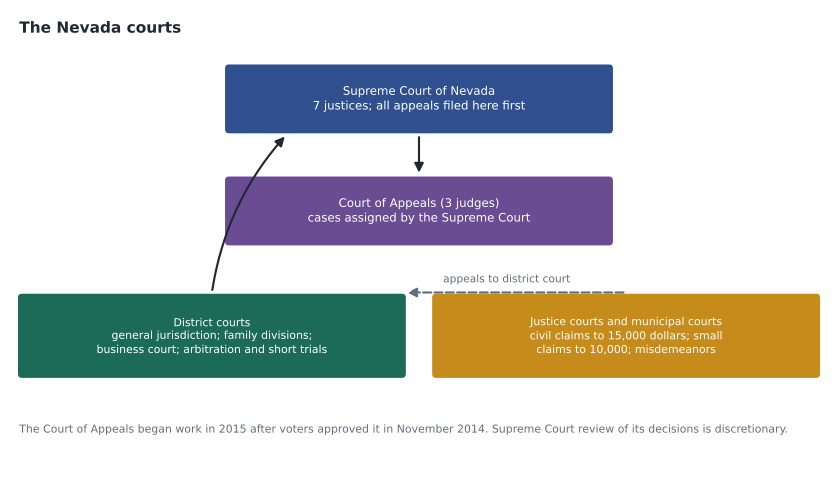
The district courts are Nevada's courts of general jurisdiction. They hear civil cases above the justice court limit, felony criminal cases, family matters, probate, and appeals from justice and municipal courts. The larger districts have family divisions, and the largest have specialized business court dockets. Justice courts are courts of limited jurisdiction in each township. Under NRS 4.370 they hear most civil claims where the amount claimed does not exceed 15,000 dollars, landlord-tenant possession actions within the same damages limit, small claims under chapter 73 (up to 10,000 dollars), and misdemeanors and preliminary hearings in felony cases. Municipal courts handle city ordinance violations and misdemeanors within city limits.
| Court | Main jurisdiction |
|---|---|
| Supreme Court (7 justices) | All appeals filed here; keeps precedent-setting cases; discretionary review of Court of Appeals |
| Court of Appeals (3 judges) | Cases assigned by the Supreme Court, generally non-precedential |
| District courts | General civil and criminal jurisdiction; family, probate, business dockets; appeals from limited courts |
| Justice courts | Civil claims to 15,000 dollars; small claims to 10,000 dollars; misdemeanors; preliminary hearings |
| Municipal courts | City ordinance violations and misdemeanors |
The Nevada Rules of Civil Procedure
The Nevada Rules of Civil Procedure (NRCP) govern civil cases in the district courts. In 2018 the Supreme Court adopted a comprehensive revision in ADKT 522, effective March 1, 2019, applying to civil actions pending or filed on or after that date. The revision brought the NRCP much closer to the Federal Rules of Civil Procedure while keeping some distinctly Nevada features, and the revised rules take precedence over local district court rules. A lawyer who learned federal procedure will recognize most of the NRCP: notice pleading, liberal joinder, discovery tools, summary judgment and the general shape of pretrial practice.
The most important Nevada feature is NRCP 16.1, titled mandatory pretrial discovery requirements. It requires the parties in most civil cases to hold an early case conference, exchange initial disclosures of witnesses, documents, damages computations and insurance, and file a joint case conference report that frames discovery. Rule 16.1 has its own deadlines and its own sanctions for failing to disclose, including exclusion of undisclosed evidence. Family cases and some other categories follow their own versions of the disclosure rules. New lawyers should read Rule 16.1 in full before their first civil case, because its deadlines start running soon after the answer is filed.
Statutes of limitations in Nevada are mostly in NRS chapter 11. Two years is the general period for personal injury and wrongful death claims, six years for actions on a written contract and four years for oral contracts. Specialized claims have their own periods: medical malpractice claims under NRS 41A.097, for example, discussed in Lesson 9. Calendaring the limitations period on the first day of a new matter is one of the most basic malpractice-prevention habits.
Court-annexed arbitration and short trials
Nevada sends many smaller civil cases to court-annexed arbitration before trial. Under the Nevada Arbitration Rules, the program applies in judicial districts that include a county with a population of 100,000 or more, which covers the Las Vegas and Reno areas. Civil cases in district court in those districts are subject to the program unless exempt. Arbitrators may award no more than 100,000 dollars per plaintiff, excluding fees, interest and costs. Many categories are automatically exempt, including class actions, probate, divorce and other domestic cases, real property title cases, declaratory and equitable relief, medical malpractice, business court cases, construction defect cases, product liability and bad-faith insurance claims seeking punitive damages. A party may also seek an exemption by showing, among other grounds, that the case probably is worth more than 100,000 dollars per plaintiff; the request is due within 21 days after the first answering defendant answers.
An arbitrator's award can be challenged by requesting a trial de novo within 30 days after the award is served. That deadline is jurisdictional. The Nevada Arbitration Rules discourage unnecessary trials de novo with fee-shifting: if the party who demanded the new trial does not improve its position by a set margin (20 percent for awards of 20,000 dollars or less and 10 percent for larger awards), it pays the other side's fees and costs incurred after the request. In districts with a short trial program, trials de novo generally proceed under the Nevada Short Trial Rules unless a party timely demands removal. Short trials use small juries, strict time limits and simplified procedures to bring modest cases to verdict quickly.
Offers of judgment
Nevada's offer of judgment rule, NRCP 68, gives parties a powerful settlement tool. A party may serve an offer to allow judgment on stated terms. If the offeree rejects it and then fails to obtain a more favorable judgment, the offeree faces penalties, which under Nevada's rule can include the offeror's post-offer costs and reasonable attorney fees, and the offeree cannot recover its own post-offer costs and fees. Courts deciding whether to award fees under the rule weigh whether the offer was reasonable in timing and amount and whether rejecting it was grossly unreasonable or in bad faith, under factors long associated with Beattie v. Thomas (1983). Because Nevada's version can shift attorney fees, unlike the federal rule, every Nevada litigator considers an early offer of judgment.
The anti-SLAPP statute
Nevada has one of the stronger anti-SLAPP statutes in the country. A SLAPP, or strategic lawsuit against public participation, is a suit filed to punish or silence someone for speaking on public matters. NRS 41.635 to 41.670 give defendants a fast way to end such suits.
The statute protects a good faith communication in furtherance of the right to petition or the right to free speech in direct connection with an issue of public concern. Under NRS 41.637, that covers four categories: a communication aimed at procuring a governmental or electoral action, result or outcome; a communication of information or a complaint to a legislator or a government officer or employee about a matter reasonably of concern to that body; a statement made in direct connection with an issue under consideration by a legislative, executive or judicial body or other official proceeding; and a communication made in direct connection with an issue of public interest in a place open to the public or in a public forum. In each case the communication must be truthful or made without knowledge of its falsehood. A person who makes such a communication is immune from civil liability for claims based on it (NRS 41.650).
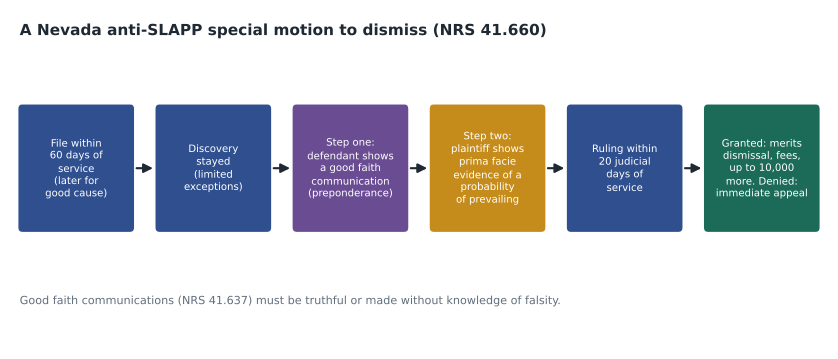
The procedure is in NRS 41.660. The defendant files a special motion to dismiss within 60 days after service of the complaint, which the court may extend for good cause. At step one, the defendant must show by a preponderance of the evidence that the claim is based on a good faith communication as defined. If that showing is made, the burden shifts at step two to the plaintiff to demonstrate, with prima facie evidence, a probability of prevailing on the claim. Discovery is stayed while the motion and any appeal are pending, with a narrow exception allowing limited discovery when information needed for step two is in another party's hands and not reasonably available. The court must rule within 20 judicial days after the motion is served on the plaintiff. A dismissal operates as an adjudication on the merits.
The consequences are significant. Under NRS 41.670, if the motion is granted, the court must award reasonable costs and attorney fees to the defendant and may award up to an additional 10,000 dollars; the defendant may also bring a separate action for compensatory and punitive damages and fees. If the motion is denied and the court finds it was frivolous or vexatious, the court must award the plaintiff its reasonable costs and fees for responding and may award up to 10,000 dollars. And a denial can be appealed immediately to the Supreme Court.
Worked problem
Applying the anti-SLAPP statute to the tile business
The client posted on a public review website that a competitor was dumping construction waste in a wash north of Reno. The client says he saw the competitor's truck there twice and has photos. The competitor sued for defamation; the client was served three weeks ago. Should the firm file a special motion to dismiss, and what must each side show?
Show solution
- Timing: the motion must be filed within 60 days after service. With three weeks gone, about five weeks remain.
- Step one: illegal dumping that affects the environment is plausibly an issue of public interest, and a public review website is a public forum. The client must show by a preponderance that the post falls within NRS 41.637 and was truthful or made without knowledge of falsity; his observations and photos support that.
- Step two: if step one is met, the competitor must produce prima facie evidence of a probability of prevailing on defamation, including falsity.
- Stakes: if the motion is granted, fees are mandatory and up to 10,000 dollars more may be awarded; if denied, the client can appeal immediately.
Answer: The firm should calendar the 60-day deadline and prepare a special motion with the client's declaration and photos. The motion has a reasonable chance at step one; the outcome will turn on whether the competitor can show prima facie falsity at step two.
Practical habits for a new Nevada litigator
Chris Haddad gave Maribel a short list, which she pinned beside her Nevada Plan calendar. Calendar the limitations period on intake. On service of any complaint, calendar the answer deadline, the anti-SLAPP 60-day deadline if speech is involved, and the arbitration exemption window. After the answer, calendar the Rule 16.1 early case conference. Consider an offer of judgment early. And in every appeal, remember that the notice of appeal goes to the Supreme Court Clerk even if the case ends up in the Court of Appeals.
Common mistakes
MistakeAppeals from district court go to the Court of Appeals first.
InsteadAll appeals are filed with the Supreme Court, which assigns some to the Court of Appeals.
MistakeNevada follows the federal rules exactly.
InsteadThe NRCP were revised in 2019 to track the federal rules closely but keep Nevada features such as Rule 16.1 and a fee-shifting offer of judgment rule.
MistakeA defendant can file an anti-SLAPP motion any time before trial.
InsteadThe special motion must be filed within 60 days after service, unless the court extends the time for good cause.
MistakeA party can request a trial de novo whenever it is ready after an arbitration award.
InsteadThe request is due within 30 days after the award is served, and the deadline is jurisdictional.
Summary and key terms
- All Nevada appeals are filed with the seven-justice Supreme Court, which assigns some to the three-judge Court of Appeals created in 2014.
- Justice courts hear civil claims up to 15,000 dollars and small claims up to 10,000 dollars.
- The NRCP were revised effective March 1, 2019 to track the federal rules, keeping Nevada's mandatory pretrial disclosures under Rule 16.1.
- Court-annexed arbitration covers many civil cases in the larger districts, with awards capped at 100,000 dollars per plaintiff and a 30-day jurisdictional deadline for trial de novo.
- NRCP 68 offers of judgment can shift attorney fees to a party who rejects an offer and does worse.
- Nevada's anti-SLAPP statute provides a special motion to dismiss within 60 days, a two-step burden, a discovery stay, mandatory fees on success and an immediate appeal on denial.
- 0
- Court of Appeals
- 1
- deflective model
- 2
- justice court
- 3
- NRCP 16.1
- 4
- court-annexed arbitration
- 5
- trial de novo
- 6
- offer of judgment
- 7
- anti-SLAPP
- 8
- good faith communication
Practice problems
Work each problem on paper first, then reveal the answer to check.
Where is a notice of appeal from a Nevada district court filed?
Show answer
With the Supreme Court Clerk; the Supreme Court may assign the case to the Court of Appeals.
What is the justice court civil jurisdiction limit under NRS 4.370?
Show answer
15,000 dollars for most civil claims.
What must the plaintiff show at step two of an anti-SLAPP motion?
Show answer
Prima facie evidence demonstrating a probability of prevailing on the claim.
What is the arbitration award cap under the Nevada Arbitration Rules?
Show answer
100,000 dollars per plaintiff, excluding fees, interest and costs.
Lesson quiz · 5 questions
Score 60% or more to complete this lesson.
Create a free account to save your progress, take quizzes and earn a certificate.