
BAR-237 · Lesson 1 of 12 · 20 min
Becoming a lawyer in Oklahoma
▶ Video coming soon A video version of this lesson is on the way.
Talia Brewer joined Hollis Marchetti's online study group late in the fall of 2026, after a friend from law school told her the Tuesday evening calls had kept her sane. Talia grew up in Tahlequah, is a citizen of the Cherokee Nation, and finished her JD at an ABA-approved Oklahoma law school in May 2026. Since the summer she has worked as a law clerk for Wade Renfro, who runs a small general practice in Tulsa: car wrecks, oil and gas title questions, divorces, wills and the occasional matter in tribal court. She is registered for the February 2027 Oklahoma bar exam, which will be the last time Oklahoma gives the legacy Uniform Bar Examination.
Hollis had coached candidates from more than a dozen states, but not many from Oklahoma, so she suggested a series of one-on-one sessions in addition to the group calls. 'Every state looks the same from a distance,' she told Talia. 'Same NCBE exam, same MPRE, same general idea of character and fitness. Up close, each one has its own calendar, its own forms and its own traps. Let us build your Oklahoma map first and then work through the Oklahoma law Wade will expect you to know on your first day.'
This course follows those sessions. Lessons 1 through 6 cover admission: who admits Oklahoma lawyers, law student registration and the filing calendar, character and fitness and the MPRE, the UBE and Oklahoma's 260 passing score, the move to the NextGen exam in July 2027, and how Oklahoma law relates to an exam that tests general law. Lessons 7 through 10 cover distinctive Oklahoma law: the courts and civil procedure, tort law and the Governmental Tort Claims Act, oil and gas, property, family law and probate, and Indian country jurisdiction together with the Oklahoma Rules of Professional Conduct. Lesson 11 covers score transfer, admission on motion and practice after admission, and Lesson 12 is a capstone with original practice questions and an exam-day plan.
The Supreme Court of Oklahoma admits lawyers
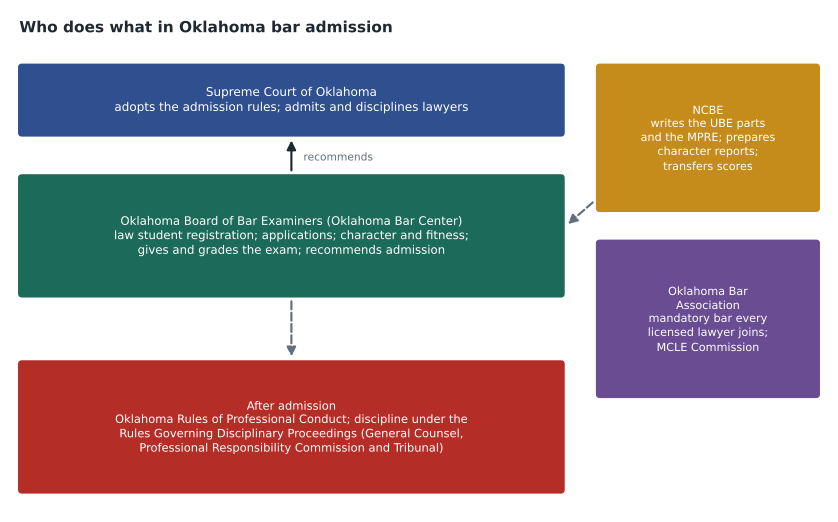
In Oklahoma, as in every state, the power to admit lawyers belongs to the state's highest court with civil jurisdiction. The Supreme Court of Oklahoma regulates the practice of law as part of its constitutional authority over the courts, and it does so through the Rules Governing Admission to the Practice of Law in the State of Oklahoma. Those rules are published as an appendix to Title 5 of the Oklahoma Statutes, the title on attorneys, but they are court rules, adopted and amended by order of the Court rather than by the Legislature. When the Court changes them, it does so in a short published order, and those orders are the best way to see what changed and when.
The admission rules are numbered by subject. Rule 1 sets out the basic qualifications to practice law in Oklahoma. Rule 2 governs admission on motion without examination for lawyers from reciprocal states. Rule 3 makes the examination compulsory for everyone else. Rule 4 governs applicants, including law student registration in its Section 2 and the bar examination application in its Section 3, and it also contains the MPRE requirement and the rule that admission must be completed within one year after passing. Later rules deal with fees, the oath and related matters. A candidate does not need to memorize the numbers, but knowing that Rule 4 is the heart of the process for a new graduate makes the official materials much easier to read.
The Court also has original and exclusive jurisdiction over lawyer discipline. After admission, an Oklahoma lawyer is bound by the Oklahoma Rules of Professional Conduct and subject to the Rules Governing Disciplinary Proceedings, which Lesson 10 covers. The same Court that admits a lawyer can suspend or disbar her, and the standards it applies at admission, especially candor, are the same standards it applies afterward.
The Oklahoma Board of Bar Examiners
The Court does not run admissions itself. It acts through the Oklahoma Board of Bar Examiners, whose office is in the Oklahoma Bar Center at 1901 North Lincoln Boulevard in Oklahoma City. The Board receives law student registrations and bar exam applications, investigates character and fitness, gives and grades the examination, and certifies to the Court which applicants are qualified for admission. Its members are Oklahoma lawyers appointed under the Court's rules, and its staff handles the daily work of processing files.
Talia noticed something on her first visit to the Board's materials that confuses many applicants: the Board's office sits in the same building as the Oklahoma Bar Association, but the two are different bodies. The Board decides who is admitted. The Bar Association is the organization every licensed lawyer joins after admission. Questions about an application go to the Board, not to the Bar Association, and nothing the Bar Association says about admission binds the Board.
NCBE's part
The National Conference of Bar Examiners writes the parts of the exam Oklahoma uses. Through February 2027 that means the Multistate Bar Examination, the Multistate Essay Examination and the Multistate Performance Test, which together make up the Uniform Bar Examination. NCBE also writes the Multistate Professional Responsibility Examination, the separate ethics test Oklahoma requires. From July 2027, Oklahoma will give NCBE's NextGen bar exam instead of the legacy UBE. NCBE scales the multiple-choice scores, provides grading materials for the written parts, and transfers UBE scores between jurisdictions when an applicant asks.
NCBE also plays a role in character and fitness. Oklahoma requires law student registrants to obtain an NCBE character and fitness report at their own expense, and attorneys applying on motion pay for an NCBE report as well. NCBE gathers the information and contacts schools, employers and courts; the Oklahoma Board conducts the final review and decides. NCBE makes no eligibility decisions of its own.
The Oklahoma Bar Association
After admission, every licensed Oklahoma lawyer must belong to the Oklahoma Bar Association. Oklahoma has what is called an integrated or unified bar: membership and dues are a condition of practicing law. The Bar Association runs the Mandatory Continuing Legal Education Commission, publishes the Oklahoma Bar Journal, offers ethics guidance, and employs the General Counsel who investigates and prosecutes grievances against lawyers under the Court's disciplinary rules. The Bar Association also elects the six lawyer members of the Judicial Nominating Commission, which Lesson 7 discusses.
Three ways in
Oklahoma admits lawyers in three main ways. The first is admission by examination: a new graduate registers as a law student, applies for the exam, passes it, satisfies the MPRE and character and fitness, takes the oath and signs the Roll of Attorneys. The second is admission by transferred UBE score: an applicant who earned a passing UBE score in another jurisdiction, generally within the last three years, may ask the Board to accept that score instead of sitting the exam again. The third is admission on motion under Rule 2, for lawyers licensed in a reciprocal state who have practiced actively for the required period.
There are also narrower forms of permission to practice. Rule 2 provides a special temporary permit for the spouse of a service member stationed in Oklahoma on military orders, without examination, if the spouse meets education, good standing, MPRE and background requirements. Lawyers from other states may appear in a particular Oklahoma case with the court's permission. And law students may practice in limited ways under Oklahoma's legal internship rules while still in school. Lesson 11 covers these routes in detail.
The order of the steps
Talia listed the steps she had taken so far and the ones still ahead. She registered as a law student in the fall of her second year, before the October 15 deadline. She graduated in May 2026. She filed her bar exam application before the first deadline of September 3, 2026 for the February exam. She took the MPRE during law school and scored well above Oklahoma's minimum of 80. Ahead of her are the completion of her character and fitness review, the exam itself on February 23 and 24, 2027, results in the spring, and then the oath and enrollment in the Bar Association.
Hollis pointed out how early Oklahoma's process starts compared with many states. 'Most candidates in other states first meet the bar examiners in their third year,' she said. 'Oklahoma wants to know you by the fall of your second year. That registration is where most of the character work happens, and a student who misses it has to ask the Board for late registration, which is discretionary.' Talia nodded. Two of her classmates had registered late and had spent weeks gathering records they could have collected calmly a year earlier.
'The other thing to fix in your mind,' Hollis added, 'is the one-year clock after you pass. Oklahoma expects you to complete admission within a year of passing unless the Board extends the time. Candidates who pass and then drift, without finishing the MPRE or the paperwork, can lose the benefit of the exam.'
How Oklahoma law fits in
The UBE tests general law. It does not test Oklahoma's own rules, and Oklahoma has no separate state law component: NCBE's summary lists no jurisdiction-specific requirement for Oklahoma, either for the legacy UBE or for NextGen. On the exam, a candidate answers according to the majority or model rule that the exam tests, even where Oklahoma differs.
Oklahoma law still matters a great deal to a new Oklahoma lawyer. Oklahoma is a modified comparative negligence state with several liability, its claims against governmental entities run through a strict notice statute, its oil and gas law is unusually rich and largely administered by the Corporation Commission, it accepts holographic wills, it recognizes common-law marriage, and since 2020 it has had to absorb the effects of McGirt v. Oklahoma on criminal jurisdiction across much of the eastern half of the state. A candidate should keep the two bodies of law separate: general law for the exam, Oklahoma law for practice. The second half of this course covers the Oklahoma law that matters most in the first years of practice.
Reading the official sources
Hollis ended the first session with a habit she asks every candidate to adopt. 'For each fact you rely on, know where it comes from,' she said. 'For Oklahoma there are three layers. The Court's admission rules are the law. The Board's own instructions and forms tell you how the Board applies them. NCBE's Comprehensive Guide charts summarize everything in a standard format, which is handy for comparing states but is only a summary.' When the layers disagree, the rule controls and the Board's current instructions come next. Talia found an example almost at once: one NCBE chart listed the practice requirement for admission on motion as three of the last five years in one place and five of the last seven in another, while the current text of Rule 2 says three of five. 'That is exactly why you read the rule,' Hollis said, 'and then call the Board if anything still looks inconsistent.'
| Body | Main role | When a candidate deals with it |
|---|---|---|
| Supreme Court of Oklahoma | Adopts the admission rules; admits and disciplines lawyers | Oath and admission; appeals from Board decisions |
| Oklahoma Board of Bar Examiners | Registration, applications, character and fitness, the exam | From the second year of law school to admission |
| NCBE | Writes the UBE parts and the MPRE; character reports; score transfers | MPRE registration; character report; score transfer |
| Oklahoma Bar Association | Mandatory membership; MCLE; ethics guidance; General Counsel | After admission, for the rest of a career |
Worked problem
Mapping the authority
A classmate tells an Oklahoma law student that she can wait until her third year to contact the bar examiners, that the Oklahoma Bar Association will decide whether she passes, and that she will need to study Oklahoma statutes for a state law portion of the exam. Which of these statements are right?
Show solution
- Law student registration is due by October 15 of the second year of law school under Rule 4, Section 2, so waiting until the third year means asking for discretionary late registration.
- The Oklahoma Board of Bar Examiners, acting under the Supreme Court of Oklahoma's rules, gives and grades the exam; the Bar Association is the organization a lawyer joins after admission.
- NCBE lists no jurisdiction-specific component for Oklahoma, so there is no Oklahoma law portion; the exam tests general law.
Answer: None of the three statements is right. Register in the second year, deal with the Board on admission questions, and study general law for the exam while learning Oklahoma law for practice.
Common mistakes
MistakeThe Oklahoma Bar Association decides who passes the bar exam.
InsteadThe Oklahoma Board of Bar Examiners gives and grades the exam under the Supreme Court's rules; the Bar Association is joined after admission.
MistakeRegistration with the bar examiners can wait until after graduation.
InsteadOklahoma requires law student registration by October 15 of the second year of law school; late registration is at the Board's discretion.
MistakeOklahoma tests its own law on a separate section of the exam.
InsteadOklahoma has no jurisdiction-specific component; the UBE and NextGen test general law.
MistakeOnce a candidate passes, there is no deadline to finish admission.
InsteadAdmission must be completed within one year after passing unless the Board extends the time.
Practice problems
Work each problem on paper first, then reveal the answer to check.
Which court adopts the rules for admission to the Oklahoma bar?
Show answer
The Supreme Court of Oklahoma, through the Rules Governing Admission to the Practice of Law in the State of Oklahoma.
Where is the Oklahoma Board of Bar Examiners located?
Show answer
In the Oklahoma Bar Center, 1901 North Lincoln Boulevard, Oklahoma City.
Name the three main routes to admission in Oklahoma.
Show answer
By examination, by transferred UBE score, and on motion under Rule 2.
Does Oklahoma require a state law component?
Show answer
No. NCBE lists no jurisdiction-specific requirement for Oklahoma.
Summary and key terms
- The Supreme Court of Oklahoma admits and disciplines lawyers under its admission rules and disciplinary rules.
- The Oklahoma Board of Bar Examiners handles registration, applications, character and fitness and the exam.
- NCBE writes the UBE parts and the MPRE and prepares character reports; the Board makes the decisions.
- Every licensed lawyer must join the Oklahoma Bar Association, which runs MCLE and employs the disciplinary General Counsel.
- Oklahoma admits by examination, by transferred UBE score, and on motion; there is no Oklahoma law component on the exam.
- Rules Governing Admission
- The Supreme Court of Oklahoma's rules on qualifications, registration, the exam and admission, published as an appendix to Title 5.
- Oklahoma Board of Bar Examiners
- The body that registers law students, investigates character and fitness, and gives and grades the bar exam.
- Integrated bar
- A bar association that every licensed lawyer must join as a condition of practice; Oklahoma has one.
- Roll of Attorneys
- The official register a new lawyer signs on admission.
Lesson quiz · 5 questions
Score 60% or more to complete this lesson.
Create a free account to save your progress, take quizzes and earn a certificate.