
BAR-237 · Lesson 2 of 12 · 19 min
Law student registration, eligibility, application deadlines and fees
▶ Video coming soon A video version of this lesson is on the way.
Talia brought a folder to her second session with Hollis: a copy of her law student registration from the fall of her second year, the confirmation of her bar exam application, and a page of notes on fees. 'I want to make sure there is nothing I have missed,' she said. Hollis suggested they treat the session as if Talia were advising a first-year student in Wade's office who wanted to know, step by step, how to get to the Oklahoma bar exam on time.
Two filings, not one
Oklahoma's process has two separate filings. The first is law student registration under Rule 4, Section 2 of the admission rules, made during law school. The second is the application to take the bar examination under Rule 4, Section 3, made for a particular exam. Many states have only the second filing. Oklahoma's two-step design moves much of the character and fitness work into law school, so that by the time a graduate applies for the exam, the Board already has fingerprints, an NCBE report and years of history on file.
Law student registration
A student who intends to practice in Oklahoma must file a verified application for registration as a law student by October 15 of the second year of law school. The registration must include a certificate showing a bachelor of arts or bachelor of science degree based on at least 120 college hours, at least 90 of them in resident study, together with a transcript. It must include two sets of fingerprints so that Oklahoma and FBI records can be checked, a recent photograph, and an NCBE Student Application Report for Character and Fitness, obtained at the student's own expense.
A student who misses October 15 has not lost the chance to practice in Oklahoma. The Board may register students from ABA-accredited law schools late, nunc pro tunc, in its discretion. But discretion is the key word. Late registration means asking for a favor, often paying more, and gathering records under time pressure, at the same moment the student is also carrying a full course load. Hollis's advice to every Oklahoma first-year is simple: put October 15 of the second year on the calendar the week classes start.
A registration remains valid for ten years. If it is not activated by an application to take the bar exam within that time, the Board destroys the file. For almost every student this is academic, because the bar application follows within two years, but it matters for someone who takes a long break between law school and the bar, for example to work in another field or another state.
Who is eligible to sit
Oklahoma requires a JD from a law school approved by the American Bar Association. NCBE's summary for Oklahoma lists the ABA-approved JD as required and states that foreign law graduates are not eligible. There is no route in Oklahoma, as there is in New York or California, for a graduate of a non-ABA school or a foreign-educated lawyer to qualify for the exam by taking extra coursework. A lawyer trained abroad who wants to practice in Oklahoma generally needs an ABA-approved JD first.
The bar application must be supported by a certified law school transcript and a certificate from the dean or an associate dean confirming that the applicant graduated with a JD from an ABA-accredited law school in the United States. The rules also protect students whose schools lose accreditation after they enroll: an applicant is treated as a graduate of an accredited school if the school was accredited when the applicant enrolled and the applicant graduated.
The two exam dates and their deadlines
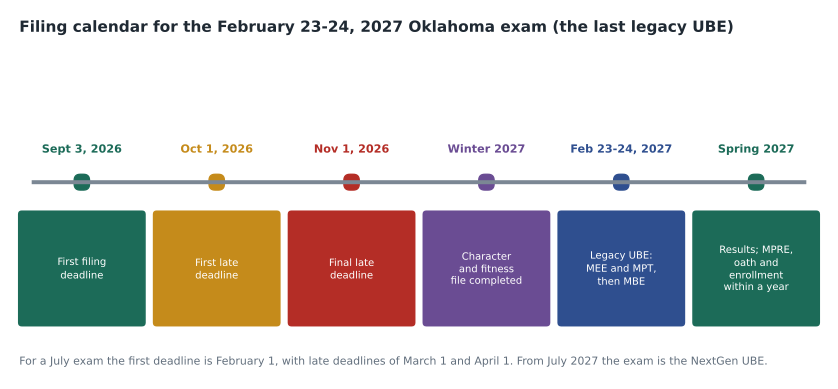
Oklahoma gives the bar exam twice a year, on the last Tuesday and Wednesday of February and July, the national UBE dates. For the February 2027 exam, Talia's exam, the dates are February 23 and 24, 2027. The filing calendar from NCBE's Comprehensive Guide for Oklahoma is the same pattern each year:
| Exam | First filing deadline | Late filing deadlines |
|---|---|---|
| July exam | February 1 | March 1 and April 1 |
| February exam | September 3 | October 1 and November 1 |
Filing by the first deadline is the norm. The two late deadlines exist for applicants who need them, but filing late costs more, and a late file leaves less time for the character and fitness review to finish before the exam. Hollis has a rule she repeats to every group: never plan to use a late deadline. Treat it as insurance against a disaster, not as a second chance to procrastinate.
Fees
NCBE's chart for Oklahoma lists the application fees. A first-time applicant who is not already a lawyer pays 650 dollars plus the character and fitness fee. A repeater pays 650 dollars plus the character and fitness fee. An applicant who is already licensed elsewhere and chooses to sit the exam, which the chart calls the attorneys' exam, pays 1,250 dollars plus the character and fitness fee. An applicant who wants to type the written portions on a laptop pays an additional 125 dollars. An attorney applying for admission by transferred UBE score pays 1,250 dollars, and an attorney applying on motion pays 2,000 dollars plus the character and fitness fee.
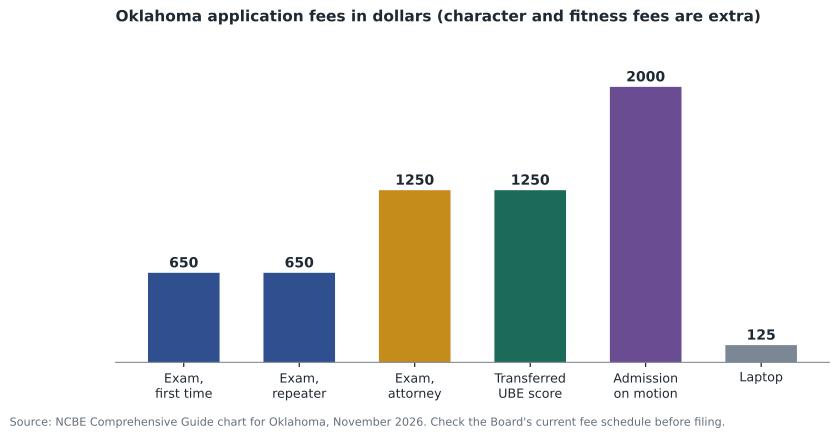
These figures are a snapshot. Fees are set by the Supreme Court and the Board and can change, and the late filing fees and the exact character and fitness charges are on the Board's own schedule. Talia's practice, which Hollis endorsed, is to print the Board's fee page on the day she files and keep it with her confirmation, so that if a question comes up later she can show what the published fee was on that date.
The NCBE report also has its own cost, paid to NCBE rather than to the Board. A student who registers on time pays for the student report during law school. Attorneys applying later pay for their own NCBE report. When a candidate budgets for the bar, the real total includes the Board's fees, the NCBE charges, the MPRE registration fee, a bar review course, travel and lodging for the exam, and often lost wages for the weeks of full-time study.
What slows an application
Hollis listed the documents that most often delay files in every state she has worked with, and Talia added the Oklahoma twists. Transcripts must come from every college attended, including summer programs and community college courses taken in high school. Fingerprint cards must be readable; smudged cards come back. Court records are needed for every charge or citation, even ones that were dismissed, deferred or expunged; Oklahoma's deferred sentences are a common source of confusion, because a deferred sentence that ended in dismissal is still something the applicant was charged with and must disclose if the question asks. Applicants who have lived in several states need complete address histories. And anyone who has appeared in a tribal court, as a party or for a citation, should treat those records exactly like state court records.
The practical rule is to order every outside record the week the application opens and to keep a log of what was requested, when, and when it arrived. A file that is complete except for one transcript is still incomplete.
Keeping the file current
Filing the application is not the end of the applicant's duty. An Oklahoma applicant must keep the information in the file accurate until admission. A new job, a new address, a traffic citation, a lawsuit, a change in a financial situation: if the application asked about it and the answer has changed, the applicant should report the change promptly. Talia had already sent one update, when she moved from her parents' home in Tahlequah to an apartment in Tulsa to start working for Wade. 'It felt silly to report an address change,' she said. 'It would have felt sillier to explain later why I had not.'
A filing checklist
Hollis turned the session's notes into a checklist that Talia could pass to the first-year in Wade's office. In the first year of law school: read the Board's materials, confirm that the law school is ABA-approved, and start a single folder, paper or electronic, for every admission document. By the start of the second year: request transcripts from every college attended, schedule fingerprinting, start the NCBE student report, and gather court records for any charge or citation. By October 15 of the second year: file the registration and keep proof of filing. During the third year: take the MPRE, keep the registration file current, and decide between July and February. By the first filing deadline for the chosen exam: file the bar application with the fee, the law school's certificate to follow after graduation, and any accommodation request. After filing: watch email for follow-up questions from the Board or NCBE and answer within days, not weeks.
Talia added one item of her own. 'Make a list of every place you have lived and worked, with dates, before you start any form,' she said. 'Every form asks for the same history in a slightly different way, and if the dates do not match from one form to the next, someone will ask why.' Hollis agreed. Inconsistent dates are one of the most common reasons an investigator calls an applicant, and the call is always easier when the applicant can point to a single master list.
Choosing February or July
Most new graduates sit in July, right after law school, and the Oklahoma calendar is built for them: the July application is due on February 1, during the final semester. Candidates who graduate in December, who need more time, or who did not pass in July sit in February. February 2027 is unusual in Oklahoma because it is the last legacy UBE. A candidate who sits in February 2027 and does not pass will retake on the NextGen exam in July 2027, with a different format and a different score scale. Lesson 5 covers what that means for planning.
Neither administration is easier. NCBE equates scores across administrations, so a 260 means the same thing in February as in July. February groups usually include more repeaters, which tends to make February pass rates lower, but that reflects who takes the exam, not its difficulty. The choice should turn on readiness, work and family obligations, and how much uninterrupted study time the candidate can protect.
Testing accommodations
An applicant with a disability may request testing accommodations, such as extra time, a separate room or assistive technology. Requests are made to the Board with supporting documentation and should be filed with or soon after the application, because the Board needs time to review them and arrange the testing site. A candidate who needs accommodations on the MPRE makes a separate request to NCBE for that exam. Talia did not need accommodations, but one member of her law school study group had received extra time and said the single most useful thing was to request it early and answer every follow-up quickly.
Worked problem
A first-year asks for a schedule
A first-year student who started law school in August 2026 works part time in Wade's office. She plans to graduate in May 2029 and sit the July 2029 Oklahoma exam. She asks what she must file and when.
Show solution
- Her second year begins in August 2027, so law student registration is due by October 15, 2027.
- The registration needs her bachelor's degree certificate (120 hours, 90 resident), transcript, two fingerprint sets, a photograph and an NCBE student report.
- The July 2029 bar application is due by the first deadline of February 1, 2029, with late deadlines of March 1 and April 1.
- The July 2029 exam will be a NextGen exam, because Oklahoma switches in July 2027.
Answer: She should calendar October 15, 2027 and February 1, 2029 now, order records early, and prepare for the NextGen format.
Common mistakes
MistakeOklahoma accepts foreign-educated lawyers who complete an LLM.
InsteadNCBE lists foreign law graduates as not eligible in Oklahoma; an ABA-approved JD is required.
MistakeThe late filing deadlines are just as good as the first deadline.
InsteadLate filing costs more and shortens the time for character and fitness review; plan for the first deadline.
MistakeA dismissed deferred sentence need not be disclosed.
InsteadIf the question asks about charges, a charge that ended in dismissal after a deferred sentence must still be disclosed.
MistakeA law student registration lasts until the student decides to apply.
InsteadRegistration is valid for ten years; an unactivated file is destroyed after that.
Practice problems
Work each problem on paper first, then reveal the answer to check.
What must accompany an Oklahoma law student registration?
Show answer
A bachelor's degree certificate based on at least 120 hours (90 resident) and a transcript, two fingerprint sets, a recent photograph and an NCBE student character report.
What are the deadlines for the February exam?
Show answer
September 3 first deadline; late deadlines October 1 and November 1.
What does a first-time non-attorney applicant pay?
Show answer
650 dollars plus the character and fitness fee, according to NCBE's chart.
Can the Board register a student who missed October 15?
Show answer
Yes, nunc pro tunc in its discretion, for students at ABA-accredited schools.
Summary and key terms
- Oklahoma uses two filings: law student registration by October 15 of the second year, and a bar exam application for a particular exam.
- Registration requires degree proof, fingerprints, a photograph and an NCBE student report; it lasts ten years.
- An ABA-approved JD is required; foreign law graduates are not eligible.
- Deadlines: February 1 for July (late March 1 and April 1); September 3 for February (late October 1 and November 1).
- Fees include 650 dollars for first-time and repeat applicants, 1,250 for attorneys and transfers, 2,000 for motion, plus character and fitness fees.
- Law student registration
- The Oklahoma filing made during the second year of law school that starts the character and fitness file.
- Nunc pro tunc
- Latin for "now for then"; here, a late registration the Board treats as timely.
- First filing deadline
- The regular deadline for a bar exam application, before late filing fees apply.
- Attorneys' exam
- NCBE's term for the exam taken by an applicant already licensed elsewhere, at a higher fee.
Lesson quiz · 5 questions
Score 60% or more to complete this lesson.
Create a free account to save your progress, take quizzes and earn a certificate.