
BAR-237 · Lesson 12 of 12 · 20 min
Capstone: Oklahoma practice questions and an exam-day plan
▶ Video coming soon A video version of this lesson is on the way.
The last session in the series came in November 2026, with the February 2027 exam about three months away. Hollis had written a set of original practice problems, some testing the general law the exam would ask about and some testing the Oklahoma law Talia would use at Wade's office, and she asked Talia to work them aloud. 'Tell me which law applies before you answer,' Hollis said. 'That is the habit that will carry you through the exam and through your first year.' After the problems, they would build an exam-week plan.
Part one: general law questions in exam style
The first three questions were written in the style of the MBE and the MEE. None is a released bar question; Hollis wrote them for the group.
Question one. A homeowner hires a contractor to replace a roof for 18,000 dollars, payment due on completion. Halfway through, the contractor learns that the homeowner has lost his job and tells him, in writing, that she will not finish unless he deposits the remaining price in an escrow account. The homeowner refuses and hires another contractor. The first contractor sues for the value of her work. What is the homeowner's best argument? Talia identified general contract law as the governing law and the issue as whether the contractor's demand was a repudiation. Under the common law, a party with reasonable grounds for insecurity may demand adequate assurance in some circumstances, but outside the sale of goods the doctrine is less settled, and a demand for terms beyond the contract, such as an escrow deposit not required by the contract, can itself amount to a repudiation. The homeowner's best argument is that the contractor repudiated by conditioning performance on a term the contract did not require, which discharged his duty and entitled him to hire someone else. Hollis noted that a sale of goods would bring in the UCC's express right to demand adequate assurance, and asked Talia to say that in one sentence in an essay to show she knew the difference.
Question two. In a negligence action against two defendants, a jury finds the plaintiff 20 percent at fault and each defendant 40 percent at fault, with damages of 200,000 dollars. One defendant is judgment-proof. How much may the plaintiff collect from the other defendant, assuming the jurisdiction follows the rules the MBE assumes unless told otherwise? Talia caught herself starting to answer with Oklahoma's several liability rule, wrote G in the margin, and answered from the MBE default: pure comparative negligence and joint and several liability. The plaintiff's recovery is reduced by 20 percent to 160,000 dollars, and either defendant is liable for the whole 160,000 dollars. 'And in Oklahoma?' Hollis asked. Talia answered: for an action accruing after November 1, 2011, several liability limits the solvent defendant to its own 40 percent share, or 80,000 dollars.
Question three. A police officer stops a car for speeding. While writing the ticket, he sees through the window a closed backpack on the back seat, asks the driver whether he can look in it, and the driver says nothing. The officer opens the backpack and finds drugs. The driver moves to suppress. Talia identified federal constitutional law as governing. Silence is not consent, and a traffic stop for speeding does not by itself supply probable cause to search a closed container; absent another exception, the search violated the Fourth Amendment and the evidence should be suppressed. Hollis added that the facts give no basis for a search incident to arrest, because the officer was issuing a ticket, not arresting the driver.
Part two: an Oklahoma essay for practice
The next problem was an Oklahoma law essay in IRAC form, written to rehearse the second half of the course. Oklahoma's bar exam does not test Oklahoma law, so this is practice for Wade's office, not for February.
The facts. On May 10, 2025, Odessa Varnell, a pedestrian, was struck in a crosswalk in a city of about 410,000 people by a city-owned street sweeper driven by a city employee. A private delivery truck, owned by Red Mesa Freight, had stopped in the crosswalk and blocked the sweeper driver's view. Odessa suffered a broken leg that healed and she returned to work after three months. Her medical bills were 61,000 dollars, her lost wages 14,000 dollars, and she claims substantial pain and suffering. She sent a letter describing the accident and her injuries to the city clerk on April 2, 2026. The city did not respond. She consulted Wade on November 2, 2026. A jury would likely find the sweeper driver 50 percent at fault, Red Mesa's driver 30 percent at fault, and Odessa 20 percent at fault for entering the crosswalk while looking at her phone. Advise her.
Issue one: the claim against the city. The city is a political subdivision, so the Governmental Tort Claims Act governs and is her exclusive remedy against the city and its employee acting within the scope of employment. Rule: under section 156 of Title 51, written notice must be presented to the clerk of the governing body within one year after the loss; under section 157, a claim is deemed denied if not approved within 90 days, and suit must be filed within 180 days after denial. Application: the loss occurred on May 10, 2025, and notice reached the clerk on April 2, 2026, within one year. Assuming the letter contained the required information or that any missing information is supplied when requested, notice was timely. The claim was deemed denied 90 days later, on or about July 1, 2026, and suit had to be filed within 180 days after that, on or about December 28, 2026. Conclusion: Odessa can still sue the city, but the petition must be filed before the 180-day period expires, and Wade should calculate the exact date from the statute and file well before it.
Issue two: the limits on recovery against the city. Rule: section 154 limits liability for any loss other than property to 175,000 dollars per claimant per occurrence for a city with a population of at least 300,000, bars punitive damages against the city, and makes the city liable only for its percentage of the total negligence. Application: the city has about 410,000 residents, so the higher limit applies. If the jury finds the city's driver 50 percent at fault, the city's share is 50 percent of Odessa's total damages, and the city's payment cannot exceed 175,000 dollars.
Issue three: the claim against Red Mesa. Rule: a private defendant is subject to ordinary Oklahoma tort law: the two-year limitations period in section 95 of Title 12, modified comparative negligence under section 13 of Title 23, several liability under section 15, and the noneconomic damages cap enacted in 2025, subject to its exceptions. Application: the accident was on May 10, 2025, so the two-year period runs on May 10, 2027. Red Mesa's driver is 30 percent at fault, and Red Mesa is vicariously liable for its employee's negligence in the course of employment. Under several liability, Red Mesa pays only 30 percent of Odessa's damages. Because her injuries healed and she returned to work, the 2025 cap is likely to apply to her noneconomic damages, though the exception for permanent and severe injuries and any challenge to the cap must be checked. Conclusion: Odessa should sue Red Mesa within two years; the city and Red Mesa can be joined in one action.
Issue four: Odessa's own fault. Rule: under section 13, a plaintiff's negligence bars recovery only if it is greater than the combined negligence of those who caused the harm, and otherwise reduces recovery proportionally. Application: Odessa is 20 percent at fault; the defendants together are 80 percent. She is not barred, and her damages are reduced by 20 percent before they are allocated. Conclusion: she recovers 80 percent of her damages, split between the defendants according to their shares, with the city's portion subject to the section 154 limit.
A worked number makes the advice concrete. Suppose the jury finds total damages of 300,000 dollars: 75,000 dollars in economic damages and 225,000 dollars in noneconomic damages. Odessa's 20 percent reduces recovery to 240,000 dollars. The city's 50 percent share is 150,000 dollars, under its 175,000 dollar limit. Red Mesa's 30 percent share is 90,000 dollars. The remaining 20 percent is Odessa's own. Because liability is several, if Red Mesa could not pay, the city would not pick up its share.
| Defendant | Governing rules | Deadline | Share of fault | Limits |
|---|---|---|---|---|
| City | Governmental Tort Claims Act | Suit within 180 days after the deemed denial (about late December 2026) | 50 percent | 175,000 dollars per claimant; no punitive damages |
| Red Mesa Freight | Ordinary tort law | Two years from May 10, 2025 | 30 percent | Noneconomic cap enacted in 2025, subject to exceptions |
| Odessa | Section 13 | Not applicable | 20 percent | Reduces recovery; not a bar |
Part three: a short professional responsibility problem
Hollis added one ethics problem, answered under the Model Rules for MPRE purposes and under Oklahoma's rules for practice. Odessa's settlement check from Red Mesa arrives, payable to Odessa and the firm. Wade's assistant suggests depositing it in the firm's operating account for convenience and writing Odessa a firm check the same day. Talia answered that the check belongs in the trust account. Client funds must be held separately from the lawyer's own funds, the firm's fee can be withdrawn only when earned and after the funds clear, and Odessa must be promptly notified and paid her share with an accounting. Under Oklahoma Rule 1.15 the records must be kept for five years, and if the funds are nominal or short-term they go in the IOLTA account. Depositing client funds in the operating account would be commingling, a classic disciplinary violation.
Part four: the exam-week plan
With the problems done, Hollis and Talia built a plan for the final three weeks before the exam and for exam week itself. In the last three weeks, Talia would complete two full timed practice exams, one MBE simulation of 200 questions under exam timing and one full written day of two MPTs and six essays, with careful review of every missed question. She would spend the remaining days on her weakest subjects according to her error log and on short daily drills of MBE questions. She would stop learning new material a few days before the exam and switch to review of her outlines and the rules she missed most often.
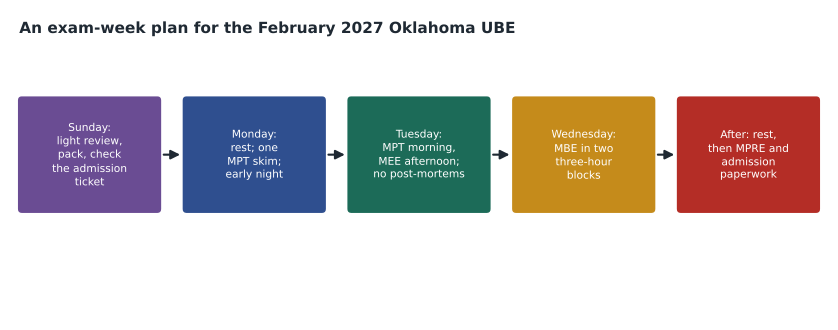
For exam week itself, Talia planned to drive to the exam city on Sunday afternoon and check into a hotel close to the testing site, to protect against February weather. On Sunday evening she would review lightly, pack her clear bag with the permitted items, charge her laptop and test the exam software one last time, and lay out her admission ticket and identification. Monday would be a rest day: a short walk, one quick skim of an old MPT to keep the process fresh, an early dinner and an early night.
Tuesday morning, the MPT. Talia would read each task memo first, budget about 45 minutes for reading and organizing and 45 for writing on each task, and follow the format instructions exactly. Tuesday afternoon, the six MEE essays: about 30 minutes each, with a quick issue outline before writing and a firm rule never to spend more than 35 minutes on any one essay. Tuesday evening she would not discuss the essays with anyone. 'Post-mortems only make Wednesday worse,' Hollis said. 'The essays are done and you cannot change them.' Wednesday, the MBE: 100 questions in each three-hour session, a pace of about 1.8 minutes per question, a check of her progress every 25 questions, and an answer for every question, because there is no penalty for guessing.
After the exam, rest. Then, for Talia, the remaining steps: no MPRE was needed because she had already passed it, so her list was to watch for the Board's results announcement, keep her character and fitness file current until admission, take the oath and sign the Roll of Attorneys within the one-year window, and enroll in the Oklahoma Bar Association. If the result was not a pass, her retake would be the NextGen exam in July 2027, and she would begin with NCBE's free sample materials.
A last word
Hollis ended the series the way she ends every series. 'You have done the work,' she said. 'On the exam, apply the general law and the law in front of you. In practice, apply Oklahoma law and check it every time. And between the two, take a week off.' Talia laughed and said Wade had already promised her one.
Worked problem
Time management on the MBE
In the first MBE session, Talia reaches question 25 after 50 minutes and question 50 after 1 hour 35 minutes. Is she on pace, and what should she do?
Show solution
- The target pace is about 1.8 minutes per question, or 45 minutes for every 25 questions, so 100 questions take 180 minutes.
- At question 25 the target is 45 minutes; she is 5 minutes behind. At question 50 the target is 90 minutes; she is still 5 minutes behind.
- She should pick up the pace slightly by making a decision on hard questions sooner, marking them, and returning only if time allows.
Answer: She is about five minutes behind, a recoverable gap; she should tighten her time on difficult questions and ensure every question gets an answer.
Common mistakes
MistakeUse Oklahoma's several liability rule on the MBE because the exam is given in Oklahoma.
InsteadApply the MBE default of pure comparative negligence with joint and several liability unless the question supplies a different rule.
MistakeTimely Governmental Tort Claims Act notice protects the claim indefinitely.
InsteadSuit must still be filed within 180 days after the claim is denied or deemed denied.
MistakeLeave hard MBE questions blank to save time.
InsteadThere is no guessing penalty; answer every question.
MistakeDiscuss the essays after the first day to see how you did.
InsteadAvoid post-mortems; they cannot change the result and can hurt the next day's performance.
Practice problems
Work each problem on paper first, then reveal the answer to check.
In the Varnell problem, why does the 175,000 dollar limit apply rather than 125,000?
Show answer
Because the city has a population of at least 300,000 under the latest federal decennial census.
What is Odessa's recovery reduction for her own fault?
Show answer
Twenty percent; she is not barred because her negligence is not greater than the defendants' combined 80 percent.
What is the target MBE pace?
Show answer
About 1.8 minutes per question, or 45 minutes per 25 questions.
What exam will a candidate who fails in February 2027 take next in Oklahoma?
Show answer
The NextGen exam in July 2027.
Summary and key terms
- On the exam, decide which law governs first: general law on the MBE and MEE, supplied law on the MPT.
- In Oklahoma practice, government defendants trigger the Governmental Tort Claims Act's notice, suit and damages rules; private defendants trigger ordinary tort rules.
- Several liability and section 154 limits shape what each Oklahoma defendant actually pays.
- Client settlement funds go into the trust account, never the operating account.
- An exam-week plan protects sleep, pace and focus: no post-mortems, steady MBE timing, and every question answered.
- IRAC
- Issue, rule, application, conclusion: the standard structure for essay and memo answers.
- Error log
- A record of missed practice questions and the rules behind them, used to target review.
- Commingling
- Mixing client funds with a lawyer's own funds, prohibited by the professional conduct rules.
- Pace check
- A planned check of elapsed time at set points during a timed exam session.
Lesson quiz · 5 questions
Score 60% or more to complete this lesson.
Create a free account to save your progress, take quizzes and earn a certificate.