
BAR-237 · Lesson 7 of 12 · 20 min
Oklahoma courts, judicial selection and civil procedure
▶ Video coming soon A video version of this lesson is on the way.
Wade Renfro gave Talia her first full petition to draft in the fall: a car-accident case for a client injured on a Tulsa County road. She brought the draft to her session with Hollis, not for the law of negligence, which they would cover later, but because she realized she was not entirely sure which court rules governed it, how long the client had to sue, and where an appeal would go. Hollis, who knew little Oklahoma procedure, suggested Talia teach her. 'If you can explain Oklahoma's courts to someone from Ohio,' she said, 'you understand them.'
Two courts of last resort
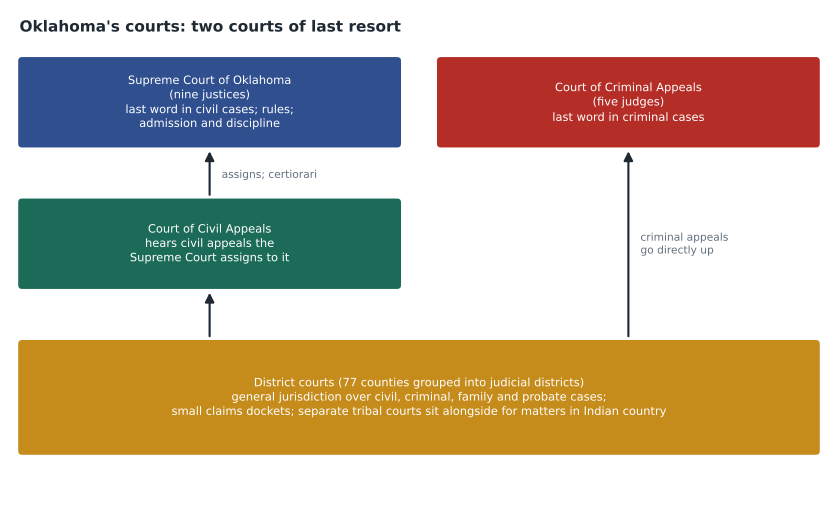
Oklahoma is one of only two states with two highest courts. (The other is Texas.) The Supreme Court of Oklahoma has nine justices and is the court of last resort in civil cases. The Oklahoma Court of Criminal Appeals has five judges and is the court of last resort in criminal cases. The Supreme Court also has administrative authority over the state's courts, adopts court rules, admits lawyers and disciplines them. When there is a dispute about whether a case belongs to the civil or the criminal side, the Oklahoma Constitution gives the Supreme Court the authority to decide which court has jurisdiction.
The split matters in practice in ways that surprise lawyers from other states. A question about the meaning of a criminal statute is decided finally by the Court of Criminal Appeals, while a question about the same statute in a civil case, such as a forfeiture, may be decided by the Supreme Court. The two courts can, and sometimes do, reach different conclusions on related questions. Lesson 10 shows an important example: after McGirt v. Oklahoma, the Court of Criminal Appeals decided the criminal jurisdiction questions, while the Supreme Court decided related civil and tax questions.
The Court of Civil Appeals and the assignment system
Below the Supreme Court sits the Court of Civil Appeals, Oklahoma's intermediate appellate court for civil cases. Civil appeals in Oklahoma are not filed in the Court of Civil Appeals. They are filed in the Supreme Court, which keeps some cases for itself and assigns most of the rest to the Court of Civil Appeals. A party who loses in the Court of Civil Appeals may ask the Supreme Court to review the decision by petition for certiorari, which the Supreme Court grants in its discretion. There is no intermediate appellate court on the criminal side; criminal appeals go directly from the district court to the Court of Criminal Appeals.
The assignment system affects how Oklahoma lawyers read cases. Opinions of the Supreme Court are binding precedent. Opinions of the Court of Civil Appeals that the Supreme Court has approved for publication carry precedential weight, while those released for publication by the Court of Civil Appeals itself are generally persuasive rather than binding, under the Supreme Court's rules. When Talia researches an Oklahoma civil question, she notes which court decided each case and how it was released, because the answer affects how much weight it carries.
The district courts
The trial courts of general jurisdiction in Oklahoma are the district courts, organized into judicial districts covering the 77 counties. District courts hear civil, criminal, family, juvenile and probate matters. District judges and associate district judges are elected in nonpartisan elections; special judges, appointed by the district judges, handle many routine matters such as small claims, preliminary hearings and some family dockets. Small claims procedure provides a simplified process for modest claims, up to a statutory ceiling that the Legislature has raised over time; a lawyer should check the current figure before advising a client.
Oklahoma also has specialized bodies that function like courts in particular areas. The Corporation Commission, which regulates oil and gas, utilities and transportation, has its own administrative law judges and its decisions are appealed to the Supreme Court; Lesson 9 covers its oil and gas work. Workers' compensation claims are heard by an administrative commission rather than the district courts. And tribal courts of the many tribal nations in Oklahoma exercise jurisdiction over many matters in Indian country.
How appellate judges are chosen
Oklahoma selects its appellate judges, including the justices of the Supreme Court and the judges of the Court of Criminal Appeals and the Court of Civil Appeals, through a merit selection system adopted by the voters in 1967 after a judicial bribery scandal. When a vacancy occurs, the Judicial Nominating Commission interviews applicants and sends three names to the governor, who appoints one. After an initial period, the new judge stands in a nonpartisan retention election, in which voters answer only whether the judge should be retained, and then stands for retention again at the end of each term.
The Judicial Nominating Commission has 15 members. Six are lawyers elected by members of the Oklahoma Bar Association, one from each of the six congressional districts as they existed in 1967. Six are non-lawyers appointed by the governor, who may not be licensed lawyers or have an immediate family member who is a lawyer, and no more than three of whom may belong to the same political party. Three are at-large members chosen by the Speaker of the House, the President Pro Tempore of the Senate, and the Commission itself, with no more than two from the same party.
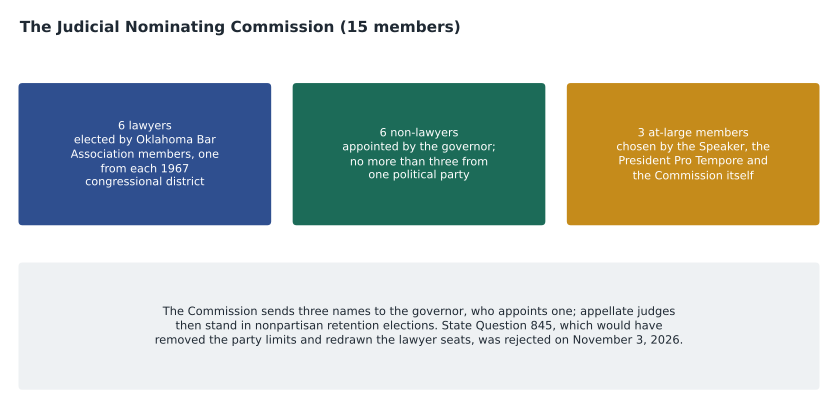
The system has been debated for years, and in 2026 the Legislature sent a constitutional amendment to the voters. State Question 845 would have removed the party-balancing limits on the Commission, allowed lawyers and their relatives to fill the governor's and at-large seats, allowed members to serve up to 12 consecutive years, and required the Bar Association to elect its six members using current congressional districts rather than the 1967 map. On November 3, 2026, voters rejected the measure decisively; unofficial results reported by Oklahoma news outlets showed roughly 72 percent voting no, subject to certification by the State Election Board. The 1967 structure therefore remains in place.
Civil procedure: the Oklahoma Pleading Code
Civil actions in Oklahoma district courts are governed principally by the Oklahoma Pleading Code, found in Title 12 of the Oklahoma Statutes beginning at section 2001, and the Oklahoma Discovery Code, which follows it later in the same title. Both were modeled on the Federal Rules of Civil Procedure, and much of their structure will look familiar to anyone who studied federal procedure for the MBE: a petition rather than a complaint, an answer, motions to dismiss for the familiar defenses, discovery through interrogatories, requests for production, requests for admission and depositions, and summary judgment. The vocabulary differs slightly. The initial pleading in Oklahoma is a petition, the party filing it is the plaintiff, and summary judgment practice is governed by the district court rules as well as the Pleading Code.
Because the codes track the federal rules, Oklahoma courts often find federal decisions interpreting similar federal rules persuasive. But the numbering is different, some time limits differ, and Oklahoma has its own local practices, so an Oklahoma lawyer should work from the Oklahoma text, not from memory of the federal rules. Service of process, for example, is governed by section 2004 of Title 12, which sets out who may serve, how, and the time within which service must be made after filing before the action is subject to dismissal.
Limitations and the savings statute
Oklahoma's general statute of limitations is section 95 of Title 12. For the cases Wade handles most often, the key periods are two years for injury to the person or to property and for fraud, three years for obligations not in writing, and five years for written contracts. Specific statutes set other periods, including the Governmental Tort Claims Act's notice and filing rules discussed in Lesson 8. Talia's client was injured in a collision, so the two-year period applied, measured from the date of the accident.
Oklahoma also has a savings statute, section 100 of Title 12. If an action is commenced within the limitations period and fails otherwise than on the merits, such as by a dismissal without prejudice, the plaintiff may commence a new action within one year after the failure, even if the limitations period has run in the meantime. The savings statute can be used once. Oklahoma lawyers learn early not to rely on it casually, because whether a particular dismissal qualifies is often litigated.
| Claim | Period | Source |
|---|---|---|
| Personal injury or injury to property | Two years | 12 O.S. section 95 |
| Fraud | Two years from discovery | 12 O.S. section 95 |
| Oral contract | Three years | 12 O.S. section 95 |
| Written contract | Five years | 12 O.S. section 95 |
| Claim against a governmental entity | Written notice within one year; suit within 180 days after denial | 51 O.S. sections 156 and 157 |
| Refiling after failure otherwise than on the merits | One year after the failure (once) | 12 O.S. section 100 |
The Oklahoma Citizens Participation Act
In 2014 Oklahoma enacted the Oklahoma Citizens Participation Act, its anti-SLAPP statute, beginning at section 1430 of Title 12. The Act allows a defendant sued over its exercise of the rights of free speech, petition or association on matters of public concern to file an early motion to dismiss. If the defendant shows the claim is based on protected activity, the plaintiff must establish by clear and specific evidence a prima facie case for each element of the claim, or the court must dismiss. Discovery is generally suspended while the motion is pending, and a successful movant may recover costs and attorney fees. The Act matters for any lawyer handling defamation, business disparagement or similar claims, and it is a trap for plaintiffs who file such claims without strong evidence ready.
Juries
The Oklahoma Constitution guarantees the right to a jury trial and allows civil verdicts by three-fourths of the jurors rather than requiring unanimity. In a twelve-person civil jury, nine jurors can return a verdict. Criminal felony verdicts must be unanimous. The three-fourths rule shapes trial strategy: a civil plaintiff needs nine votes, not twelve, and both sides think about jury selection with that number in mind.
Appeals
An appeal in a civil case begins with a petition in error filed with the Clerk of the Supreme Court. The deadline is short and strict: generally 30 days from the filing of the judgment or final order appealed from, under section 990A of Title 12. The deadline is jurisdictional; a late petition in error is dismissed. Post-trial motions filed within the time allowed can extend the time by delaying when the appeal clock starts, but the rules on which motions have that effect are technical. Hollis said that in every state she has worked with, the appeal deadline is the deadline new lawyers fear most, and rightly so.
Back to the petition
Talia's petition named the driver and his employer, alleged negligence and vicarious liability, and was filed in Tulsa County District Court, where the accident occurred. She calculated the two-year limitations date and calendared it with a reminder 90 days earlier. She also checked whether any defendant was a governmental entity, because a city truck or county road crew would change everything: the claim would require written notice within one year and would be subject to the Governmental Tort Claims Act's limits. Wade reviewed the draft and told her it was the first petition from a new clerk he had not needed to rewrite.
Worked problem
Choosing the right court and deadline
A client is injured on October 3, 2025, when a delivery van owned by a private company runs a stop sign in Oklahoma County. She consults Wade on November 20, 2026. A week later a dismissed earlier suit she filed herself without a lawyer comes to light: she filed in December 2025, and the court dismissed it without prejudice in September 2026 for failure to serve.
Show solution
- The claim is for personal injury against a private company, so the two-year period of 12 O.S. section 95 applies; it would run on October 3, 2027.
- Because the limitations period has not run, the client can simply file a new petition in Oklahoma County District Court and serve it properly.
- The savings statute (12 O.S. section 100) would matter only if the limitations period had expired; it should be preserved, not used unnecessarily.
- An appeal from any final judgment must begin with a petition in error filed with the Clerk of the Supreme Court, generally within 30 days.
Answer: File a new petition promptly in Oklahoma County District Court, within the two-year period ending October 3, 2027, and make proper service a priority this time.
Common mistakes
MistakeCivil appeals in Oklahoma are filed in the Court of Civil Appeals.
InsteadThey are filed in the Supreme Court, which assigns most of them to the Court of Civil Appeals.
MistakeThe Supreme Court of Oklahoma decides criminal appeals.
InsteadThe Court of Criminal Appeals is the court of last resort in criminal cases.
MistakeOklahoma civil verdicts must be unanimous.
InsteadThe Oklahoma Constitution allows a three-fourths civil verdict.
MistakeState Question 845 changed the Judicial Nominating Commission.
InsteadVoters rejected State Question 845 on November 3, 2026; the 1967 structure remains.
Practice problems
Work each problem on paper first, then reveal the answer to check.
Which two courts are Oklahoma's courts of last resort?
Show answer
The Supreme Court of Oklahoma for civil cases and the Court of Criminal Appeals for criminal cases.
How long is the general limitations period for personal injury in Oklahoma?
Show answer
Two years under 12 O.S. section 95.
How long does a plaintiff have to refile under the savings statute?
Show answer
One year after the failure of the earlier action otherwise than on the merits.
What is the usual deadline for a civil petition in error?
Show answer
Generally 30 days from the filing of the judgment or final order.
Summary and key terms
- Oklahoma has two courts of last resort: the Supreme Court for civil cases and the Court of Criminal Appeals for criminal cases.
- Civil appeals are filed in the Supreme Court, which assigns most to the Court of Civil Appeals.
- Appellate judges are chosen through the Judicial Nominating Commission and retention elections; voters rejected State Question 845 in November 2026.
- The Oklahoma Pleading Code and Discovery Code are modeled on the federal rules; limitations are mainly in 12 O.S. section 95, with a one-year savings statute.
- Civil verdicts need three-fourths of the jury; a civil petition in error is generally due within 30 days.
- Court of Criminal Appeals
- Oklahoma's court of last resort for criminal cases.
- Petition in error
- The document that begins a civil appeal in Oklahoma, filed with the Clerk of the Supreme Court.
- Judicial Nominating Commission
- The 15-member body that nominates candidates for appellate judgeships.
- Retention election
- A nonpartisan election in which voters decide whether a sitting judge should remain in office.
- Savings statute
- A statute allowing a new action within a set time after an earlier timely action fails otherwise than on the merits.
Lesson quiz · 5 questions
Score 60% or more to complete this lesson.
Create a free account to save your progress, take quizzes and earn a certificate.