
BAR-237 · Lesson 9 of 12 · 21 min
Oklahoma property, oil and gas, family law and probate
▶ Video coming soon A video version of this lesson is on the way.
Three of the files on Talia's desk one week captured the range of a small Oklahoma practice. An elderly widow in Creek County had received a letter from an oil company asking her to lease her mineral interest and warning that it would otherwise seek a pooling order. A young father wanted to know how long his divorce would take. And the family of a man who had died in Tulsa had found a handwritten will in his desk. Hollis asked Talia to take them in turn, starting with the minerals, because nothing in Oklahoma practice looks quite like oil and gas law to a lawyer from elsewhere.
The mineral estate
In Oklahoma, as in other producing states, the mineral estate can be separated from the surface estate. A landowner may own both, or the minerals may have been severed decades ago by a deed or reservation, so that one person owns the surface and others own undivided fractional interests in the oil and gas beneath it. Severed mineral interests are passed by will and inheritance like any other property, and after several generations a single tract can have dozens of owners, many of them living out of state and unaware of their interests. Title work for oil and gas, which Wade does regularly, consists largely of tracing these fractions through deeds, probate records and court orders.
The mineral estate is generally treated as dominant, meaning that the mineral owner and its lessee may use as much of the surface as is reasonably necessary to develop the minerals. Oklahoma tempers that rule by statute. The Surface Damages Act, in Title 52, requires an operator to give notice to the surface owner before entering to drill and to negotiate surface damages; if the parties do not agree, the statute provides for court-appointed appraisers to determine the damages. A surface owner who does not own the minerals cannot stop a well, but she is entitled to compensation.
The Corporation Commission and spacing
The Oklahoma Corporation Commission is a constitutional body with three elected commissioners that regulates oil and gas conservation, public utilities and certain transportation. For oil and gas, its most important tools are spacing and pooling. A spacing order establishes drilling and spacing units for a common source of supply, so that wells are not drilled closer together than necessary to drain the reservoir efficiently. Under Oklahoma's approach, only one initial well may be drilled in a unit, and production from the unit is shared among all the owners of interests in it in proportion to their interests, regardless of where the well is located within the unit.
Forced pooling
Because many owners share each unit, an operator who wants to drill must get them all to commit. Owners can lease their interests to the operator, assign them, or agree to participate by paying their share of the costs. If some owners refuse or cannot be found, the operator can apply to the Corporation Commission for a pooling order, which compels every owner in the unit either to participate or to accept one of the alternatives the order provides. This is often called forced pooling, and it is one of the defining features of Oklahoma oil and gas practice.
The process, as the Commission describes it, begins with the operator searching county and other records to identify every owner of drilling rights and their addresses, and filing an application naming the unleased owners as respondents. The operator gives notice by mail and by publication. An administrative law judge hears the application, verifies notice, considers whether the operator bargained in good faith before filing, sets the estimated costs and determines fair market value for the alternatives. Fair market value is generally based on recent arm's-length leases in the area, including leases in the unit and the surrounding units within roughly the past year. The resulting order is mailed to each respondent within three days of issuance.
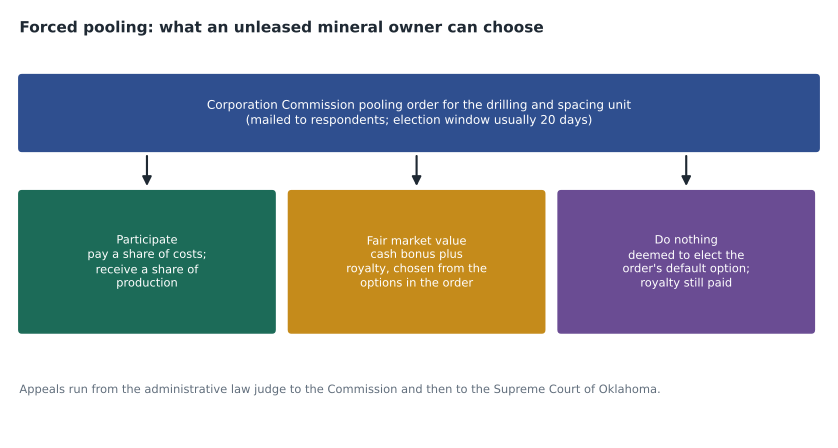
After the order issues, each respondent generally has 20 days to elect. An owner may participate, paying a proportionate share of drilling and operating costs and receiving a proportionate share of production. Or she may choose one of the fair market value alternatives, a combination of a cash bonus and a royalty; orders often offer several combinations, trading less cash for a larger royalty. An owner always keeps at least the statutory one-eighth royalty. An owner who makes no election is deemed to have chosen the option the order specifies as the default. Cash bonuses are typically due within about 30 to 35 days of the order, and amounts for owners with unknown addresses or title problems go into escrow. Orders usually require drilling to begin within a set period, commonly six months.
Pooling decisions can be appealed. A protested report of an administrative law judge can be appealed within the Commission, ultimately to the full Commission sitting en banc, and a final pooling order in a protested case can be appealed to the Supreme Court of Oklahoma. Talia's widow had received exactly the kind of letter that precedes a pooling application. Wade's advice was to compare the offer with recent bonuses and royalties in nearby units, consider whether she wanted to participate, and recognize that if she did not lease, a pooling order would likely offer her terms based on the same market.
Royalty payments
Once a well produces, Oklahoma's Production Revenue Standards Act governs the payment of proceeds to royalty and working interest owners. It sets deadlines for payment after production begins and for regular payments thereafter, and it requires interest on payments that are made late, at rates set by statute that depend on whether title is marketable. Disputes over deductions for gathering, compression and processing costs from royalty payments have generated substantial litigation in Oklahoma, including class actions. A royalty owner who suspects underpayment should start with the check stubs, which the Act requires to show specific information about volumes, prices and deductions.
Homestead and title
Oklahoma protects a family's homestead in both its constitution and its statutes. Under Title 31, a rural homestead may include up to 160 acres and an urban homestead up to one acre, with limits on how much of an urban homestead may be used for business, and the homestead is generally exempt from forced sale by most creditors. The homestead also limits conveyance: a married person generally cannot convey or mortgage the homestead without the other spouse joining in the instrument. Title examiners check for a spouse's signature on every deed that might involve a homestead.
Oklahoma also has a Marketable Record Title Act in Title 16, which in general extinguishes many interests older than a 30-year chain of record title unless they are preserved by a recorded notice, although mineral interests and certain other interests receive special treatment. And Oklahoma allows transfer-on-death deeds, which let an owner of real property name a beneficiary who takes the property at death without probate, as long as the deed is recorded before the owner's death.
Family law: divorce
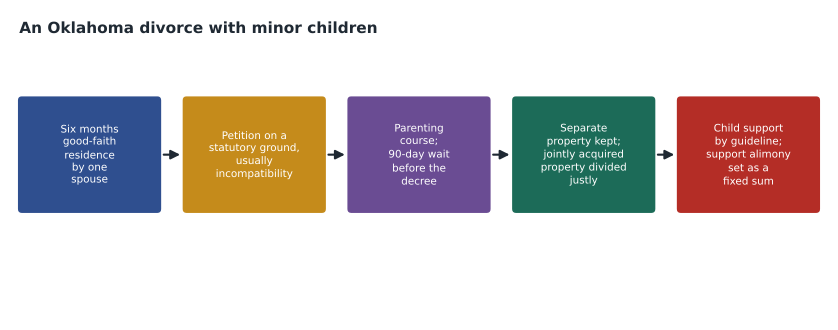
Oklahoma divorce law is in Title 43. Oklahoma lists statutory grounds for divorce, including abandonment, adultery, extreme cruelty and others, but in practice nearly every case is filed on the ground of incompatibility, which does not require proof of fault. To file, at least one spouse must have been an actual resident of Oklahoma, in good faith, for the six months immediately before filing. Without that residence, an Oklahoma court lacks jurisdiction to grant the divorce.
Timing depends on children. When there are no minor children and the parties have a complete agreement, a decree can be entered without a minimum waiting period. When there are minor children, Oklahoma imposes a 90-day waiting period after filing before the decree can be entered, which the court may waive only in special circumstances, and parents are generally required to complete a parenting education program. That was the answer for Talia's young father: at least 90 days, likely more if custody or support was contested.
Property division and alimony
Oklahoma is not a community property state. In a divorce, each spouse keeps his or her separate property, generally property owned before the marriage or received by gift or inheritance, and the court divides the jointly acquired property, the property accumulated during the marriage through the efforts of either spouse, in a manner that is just and reasonable. A just and reasonable division need not be equal. Appreciation in separate property caused by either spouse's efforts during the marriage may be treated as divisible, with the burden on the spouse claiming it. A valid antenuptial agreement can change these rules; Oklahoma law favors such agreements if they are fair and reasonable or the challenging spouse had full and fair disclosure.
Support alimony in Oklahoma is based on need and ability to pay, considering factors such as the length of the marriage, earning capacity and the standard of living. Oklahoma courts award support alimony as a fixed sum, payable in installments if appropriate, rather than as indefinite or permanent support. Oklahoma also distinguishes support alimony from alimony awarded as part of the property division, a distinction with consequences for modification and for bankruptcy.
Children
Child support in Oklahoma is calculated under statutory guidelines based on the parents' combined gross income and a schedule, with adjustments for health insurance, child care and parenting time. Support generally continues to age 18, or until 20 if the child is still attending high school. Custody decisions turn on the best interests of the child, and Oklahoma courts must consider which parent is more likely to foster the child's relationship with the other parent. Jurisdiction over custody between states follows the Uniform Child Custody Jurisdiction and Enforcement Act, which generally gives priority to the child's home state.
Common-law marriage
Oklahoma continues to recognize common-law marriage. A couple who are competent to marry, agree to be married, and then live together and hold themselves out to the public as married may be married without a license or ceremony. The party asserting the marriage must prove it by clear and convincing evidence. The point matters in divorce, where one party may need to establish the marriage before seeking a division of property, and in probate, where a surviving common-law spouse may inherit.
Probate: holographic wills
The handwritten will in the Tulsa desk raised the question Talia had flagged in Lesson 6. Oklahoma recognizes holographic wills: a will that is entirely written, dated and signed by the hand of the testator is valid without witnesses. Every element matters. A will partly typed, or undated, or signed by someone else at the testator's direction, is not a valid holographic will, though it might still be valid if it meets the requirements for an attested will, which include the testator's signature and two attesting witnesses. Oklahoma also allows self-proving affidavits that make attested wills easier to probate.
Small estates and summary administration
Not every estate needs full probate. Under section 393 of Title 58, a successor may collect a decedent's personal property by affidavit if the fair market value of the decedent's Oklahoma property passing by will or intestacy, less liens and encumbrances, does not exceed 50,000 dollars, no petition for a personal representative is pending or has been granted, and at least ten days have passed since death. Under section 245, any interested person may petition for summary administration if the estate is worth 200,000 dollars or less, if the decedent has been dead for more than five years, or if the decedent was domiciled in another jurisdiction. Summary administration is still a court proceeding, but a faster one, with a hearing generally set within about 45 days.
| Situation | Procedure | Threshold or condition |
|---|---|---|
| Personal property of a small estate | Small estate affidavit (58 O.S. section 393) | Oklahoma probate property not more than 50,000 dollars; at least 10 days after death |
| Smaller or older estates | Summary administration (section 245) | Estate of 200,000 dollars or less, death more than five years ago, or out-of-state domicile |
| Real property with a recorded TOD deed | Transfer-on-death deed | Deed recorded before the owner's death |
| Everything else | Regular probate | Petition, personal representative, notice to creditors, accounting and distribution |
The surviving spouse
Oklahoma protects a surviving spouse against disinheritance. A spouse who is left less by will than the law allows may elect to take a statutory share instead, which Oklahoma ties to the property acquired by the joint industry of the spouses during the marriage. The homestead also passes subject to the surviving spouse's right to occupy it. These protections are among the reasons Oklahoma estate planners always ask about a client's marital history, including any possible common-law marriage.
Worked problem
Three files, three rules
An unleased mineral owner receives a pooling order and does nothing for a month. A father with two children files for divorce on October 1, 2026 and wants a decree by Thanksgiving. A family finds a will written entirely in the decedent's hand and signed, but with no date.
Show solution
- The mineral owner had about 20 days to elect; having made no election, she is deemed to have chosen the order's default option, and she still receives at least the one-eighth royalty.
- With minor children, the 90-day waiting period after filing means a decree cannot normally be entered before about December 30, 2026, absent a rare waiver.
- An undated handwritten will is not a valid holographic will in Oklahoma, because the will must be entirely written, dated and signed by the testator. Unless it meets the requirements for an attested will, the estate may pass by intestacy or under an earlier will.
Answer: Each answer turns on a specific Oklahoma rule: the election window, the 90-day wait, and the dating requirement.
Common mistakes
MistakeA surface owner can block a well on her land.
InsteadThe mineral estate is dominant; the Surface Damages Act requires notice and compensation, not consent.
MistakeAn owner who ignores a pooling order gets nothing.
InsteadShe is deemed to elect the default option and keeps at least the statutory one-eighth royalty.
MistakeOklahoma divides marital property equally as community property.
InsteadOklahoma divides jointly acquired property in a just and reasonable manner, which need not be equal.
MistakeAny handwritten, signed will is valid in Oklahoma.
InsteadA holographic will must be entirely written, dated and signed in the testator's hand.
Practice problems
Work each problem on paper first, then reveal the answer to check.
How many days does a respondent usually have to elect under a pooling order?
Show answer
20 days.
How long must one spouse have lived in Oklahoma before filing for divorce?
Show answer
Six months, in good faith, immediately before filing.
What is the small estate affidavit threshold in Oklahoma?
Show answer
50,000 dollars of Oklahoma property passing by will or intestacy, net of liens.
Does Oklahoma recognize common-law marriage?
Show answer
Yes; it must be proved by clear and convincing evidence.
Summary and key terms
- The Corporation Commission establishes drilling and spacing units and issues pooling orders that force unleased owners to participate or accept bonus and royalty terms.
- Pooled owners generally have 20 days to elect and always keep at least the one-eighth royalty; the Surface Damages Act requires notice and compensation to surface owners.
- Oklahoma protects homesteads (160 rural acres or one urban acre) and allows transfer-on-death deeds.
- Divorce requires six months' residence; incompatibility is the usual ground; a 90-day wait applies with minor children; jointly acquired property is divided justly; common-law marriage is recognized.
- Holographic wills must be entirely written, dated and signed by the testator; small estate affidavits reach 50,000 dollars and summary administration 200,000 dollars.
- Spacing unit
- An area established by the Corporation Commission within which one initial well drains a common source of supply.
- Forced pooling
- A Corporation Commission order requiring all owners in a unit to participate in a well or accept specified alternatives.
- Jointly acquired property
- Property accumulated during the marriage through either spouse's efforts, divided justly on divorce.
- Holographic will
- A will entirely written, dated and signed by the testator's hand, valid in Oklahoma without witnesses.
- Summary administration
- A shortened probate proceeding for estates that meet the conditions of 58 O.S. section 245.
Lesson quiz · 5 questions
Score 60% or more to complete this lesson.
Create a free account to save your progress, take quizzes and earn a certificate.