
BAR-237 · Lesson 3 of 12 · 20 min
Character and fitness and the MPRE
▶ Video coming soon A video version of this lesson is on the way.
Talia had two items on her character and fitness file that worried her, and she raised them at the start of the third session. In 2022, during college, a hospital bill from an emergency room visit went to a collection agency while she was arguing with her insurer; she paid it in full in 2024. In 2023 she paid a speeding ticket in Wagoner County. 'Neither of them is a big deal,' she said, 'but every time I read the questions I worry that I described them wrong.' Hollis smiled. 'That worry is exactly the right instinct,' she said. 'In character and fitness the facts are rarely the problem. The description is.'
What the Board is deciding
Every applicant for admission in Oklahoma must show good moral character and fitness to practice law. Rule 1 of the admission rules sets out the qualifications to practice, and the Board must find an applicant qualified under it before recommending admission, whether the applicant comes by examination, transferred score or motion. The question is forward-looking: is there reason to believe this person will not meet the duties a lawyer owes to clients, courts and the public? Past conduct matters because it predicts future conduct, but the Board looks at the whole person, including how long ago something happened, how serious it was, what the applicant has done since, and how candidly the applicant reports it.
The applicant carries the burden. It is not the Board's job to prove that an applicant lacks good character; it is the applicant's job to show the Board that she has it. That is why the application asks for so much detail and why incomplete answers delay files. A file the Board cannot evaluate is a file the Board cannot approve.
How the investigation works in Oklahoma
Oklahoma begins the investigation early. The law student registration includes fingerprints for Oklahoma and FBI record checks and an NCBE Student Application Report for Character and Fitness. NCBE gathers information from the schools, employers, courts and references the applicant lists, and it may contact the applicant for more. When the applicant later applies for the bar exam, the application updates the file for everything since registration. The Board conducts the final review. It may ask for more documents, ask the applicant to explain something in writing, or require a personal interview.
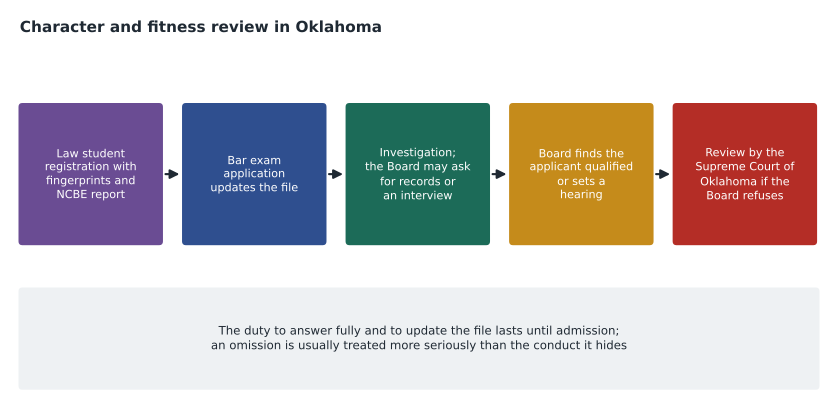
If the Board has concerns it cannot resolve on the papers, the applicant receives notice and an opportunity to be heard before the Board decides. An applicant whom the Board finds not qualified may seek review by the Supreme Court of Oklahoma, which has the final word on admission. The details of the hearing procedure and the time limits for seeking review are in the Board's rules and the notice the applicant receives, and an applicant facing a hearing should read them carefully and consider asking a lawyer experienced in admission matters for help.
NCBE's role is investigative, not decisional. NCBE's own guidance for Oklahoma states that application processes are set by the jurisdiction, that applicants should submit all required documents with the application, that incomplete or inaccurate responses cause delays, and that applicants should watch their email, NCBE account and text messages for investigator requests. Oklahoma makes the eligibility decision.
The areas that draw attention
Hollis listed the subjects that most often lead to questions in character and fitness reviews in every state, Oklahoma included.
| Area | What the Board looks for | What helps |
|---|---|---|
| Criminal history | Nature, seriousness and age of any charge, including deferred or dismissed charges | Court records, proof of completion, an honest account of what happened and what changed |
| Candor | Whether the application matches the records | Complete answers; disclosing when in doubt |
| Financial responsibility | Defaults, collections, judgments, unpaid taxes | Payment plans, proof of payment, an explanation of circumstances |
| Academic and employment discipline | Honor code findings, firings for cause | School and employer records; what the applicant learned |
| Conduct in litigation | Lawsuits as a party, sanctions, protective orders | Pleadings and dispositions |
| Substance use and conduct | Patterns of conduct that affect fitness | Treatment records where relevant; evidence of sustained stability |
Most of these areas are about conduct, not status. A medical bill in collections because of an insurance dispute, paid when the dispute ended, says little about whether someone will mishandle client money. A pattern of ignoring debts, lying to creditors and failing to appear in collection lawsuits says much more. Likewise, a single old citation rarely matters. What matters is whether the applicant disclosed it and described it accurately.
Candor is the whole game
Every experienced bar examiner Hollis has worked with says the same thing: applicants rarely fail character and fitness because of what they did, and often run into trouble because of what they did not disclose. An omission discovered by an investigator raises a new and more serious question: if the applicant was not candid with the Board, will she be candid with a court or a client? Lawyers in Oklahoma, as everywhere, have a duty of candor to the tribunal, and the admission process is the first time a future lawyer is tested on it.
The practical rules follow. Answer the question that is asked, read it literally, and when in doubt, disclose and explain. If a question asks about charges, disclose charges even if they were dismissed or expunged, unless the question itself excludes them. If a question asks about every address, list every address. Keep copies of everything filed. And remember that the duty does not end at filing: if something changes before admission, update the file.
Talia reread her two answers with Hollis. For the collection account she had given the date, the hospital, the amount, the insurance dispute, the date of payment, and attached the collection agency's letter confirming payment in full. For the speeding ticket she had given the date, the county, the speed, the fine and the date paid. 'That is what a good answer looks like,' Hollis said. 'Facts, dates, documents, and nothing argued or minimized. Do not explain why the speed limit was unfair.'
Rehabilitation
When an applicant does have serious conduct in her past, the question becomes rehabilitation. Boards in Oklahoma and elsewhere look at the time that has passed, the applicant's age at the time, restitution, completion of any sentence or probation, treatment where relevant, community service, employment history, and the applicant's own understanding of what went wrong. References from people who know the applicant well and know about the conduct carry more weight than general praise. An applicant who can explain the conduct plainly, without excuses, and point to a sustained record of responsible behavior since, is in a far stronger position than one who minimizes it.
The MPRE
Oklahoma requires the Multistate Professional Responsibility Examination. The rule requires a satisfactory score before admission by examination, and NCBE's chart lists Oklahoma's minimum scaled score as 80. The MPRE is a separate NCBE exam, given several times a year on computer at testing centers. It has 60 multiple-choice questions, of which 50 are scored, and scores are reported on a scale from 50 to 150. It tests the ABA Model Rules of Professional Conduct, the ABA Model Code of Judicial Conduct and generally accepted principles of the law governing lawyers, not Oklahoma's own rules.
NCBE's chart lists no time parameters for Oklahoma's MPRE requirement: Oklahoma does not require the score to have been earned within a set period before or after the bar exam. In practice the timing is set by the one-year rule. Because admission must be completed within one year after passing the bar exam unless the Board extends the time, a candidate who passes the bar exam but has not yet passed the MPRE must do so in time to complete admission within that year. Bar review providers summarize this as a requirement to satisfy the MPRE within a year of passing the bar exam.
Most Oklahoma students take the MPRE during law school, after taking the professional responsibility course. Talia took it in the spring of her third year and scored comfortably above 80. Hollis recommends that approach for everyone. It separates ethics preparation from bar preparation, it leaves time for a retake if needed, and it removes a loose end from the busy months after the bar exam.
Preparing for the MPRE
The MPRE rewards precise knowledge of a limited set of rules. Hollis's plan for it is short. First, learn the structure of the Model Rules: client-lawyer relationship, confidentiality, conflicts, duties to the court, duties to third parties, the firm and its supervisory duties, public service, advertising and solicitation, and the integrity of the profession, plus a smaller portion of judicial conduct. Second, focus on the rules that are tested most often: conflicts of interest under Rules 1.7 through 1.10, confidentiality under Rule 1.6 and its exceptions, and the safekeeping rules. Third, practice with released NCBE questions and read every explanation, including for questions answered correctly, because the MPRE often turns on a single word such as may, must or should.
The most common MPRE trap is answering from instinct about what feels ethical rather than from the rule. Another is confusing the Model Rules with a particular state's version. The MPRE tests the Model Rules. Oklahoma's own Rules of Professional Conduct follow the Model Rules closely, but where they differ, such as in the details of trust account administration, the MPRE answer is the Model Rule answer.
If the Board asks for an interview
A request for a personal interview is not a denial and often not even a sign of serious concern. It may simply mean that the Board wants to hear an applicant explain something the documents do not fully answer. Hollis gives the same advice for every interview. Reread the whole application first, because the interviewers will have it in front of them. Bring copies of every supporting document. Answer questions directly, briefly and truthfully. Do not volunteer arguments about why a rule was unfair or why another person was to blame. If you do not know an answer, say so and offer to find out. And treat the interview as what it is: the first professional conversation of a legal career with people who will be colleagues for decades.
If an applicant receives notice that the Board has concerns serious enough to require a hearing, the situation is different. A hearing is an adversarial proceeding with evidence and a record, and an applicant should think seriously about representation by a lawyer who knows Oklahoma admission practice. The applicant's own testimony, documents and witnesses will matter, and so will the applicant's demeanor and candor during the hearing itself.
Mental health and the application
Character and fitness questions about mental health have changed in many states in recent years. The trend, encouraged by the ABA and by courts reviewing these questions, is to ask about conduct rather than diagnosis or treatment. Seeking help is not misconduct, and boards do not want applicants to avoid treatment out of fear of the application. An Oklahoma applicant should read the current questions carefully, answer exactly what is asked, and, if a question raises concern, ask the Board or a lawyer for guidance rather than guessing. Hollis tells her groups that no candidate should skip counseling during bar study out of worry about the application.
Scores that transfer
An MPRE score is reported by NCBE to whichever jurisdictions the examinee designates, and a score earned for one state can be sent to another. A lawyer who took the MPRE years ago for another state can generally rely on that score in Oklahoma, because Oklahoma sets no time limit, provided the score meets 80. That matters for transferred-score and motion applicants, who must also satisfy the MPRE requirement.
Worked problem
Two disclosures and a missing record
An applicant's file lists a dismissed charge for public intoxication from college, but she cannot find the court record because the county moved to a new filing system. She also realizes she forgot to list a three-month summer job she was fired from for missing shifts.
Show solution
- She should request the record from the court clerk in writing, keep proof of the request, and tell the Board what she has done if the record does not arrive in time.
- The firing should be disclosed now in an amendment, with dates, the employer and a short factual explanation. Waiting for the investigator to find it turns a minor matter into a candor issue.
- Neither item is likely to prevent admission if disclosed accurately with supporting documents.
Answer: Disclose the job immediately, document efforts to get the court record, and keep every answer factual.
Common mistakes
MistakeThe Board must prove an applicant lacks good character.
InsteadThe applicant carries the burden of showing good moral character and fitness.
MistakeNCBE decides character and fitness for Oklahoma.
InsteadNCBE gathers information; the Oklahoma Board conducts the final review and decides.
MistakeOklahoma requires the MPRE within two years of the bar exam.
InsteadNCBE lists no time parameters for Oklahoma, but admission must be completed within one year after passing, so the MPRE must be done in time.
MistakeOklahoma's MPRE minimum is 85.
InsteadOklahoma's minimum scaled score is 80.
Practice problems
Work each problem on paper first, then reveal the answer to check.
What MPRE score does Oklahoma require?
Show answer
A scaled score of 80.
When does the character and fitness file start in Oklahoma?
Show answer
At law student registration, with fingerprints and an NCBE student report.
Who has the final word if the Board finds an applicant not qualified?
Show answer
The Supreme Court of Oklahoma.
What is the single most important rule for answering character questions?
Show answer
Candor: answer the question asked fully and accurately, and disclose when in doubt.
Summary and key terms
- Every Oklahoma applicant must show good moral character and fitness, and the applicant carries the burden.
- The file begins with law student registration and is updated by the bar application; NCBE investigates and the Board decides.
- Candor matters more than most underlying conduct; omissions create new and more serious concerns.
- Oklahoma requires an MPRE scaled score of 80, with no fixed time window, but admission must be completed within a year of passing.
- Rehabilitation evidence and documents matter when past conduct is serious.
- Character and fitness
- The review of whether an applicant has the honesty, judgment and reliability to practice law.
- MPRE
- NCBE's Multistate Professional Responsibility Examination; Oklahoma requires a scaled score of 80.
- Rehabilitation
- Evidence that an applicant has addressed past misconduct and shown sustained responsible behavior since.
- Candor
- Complete honesty in dealings with the Board, courts and clients.
Lesson quiz · 5 questions
Score 60% or more to complete this lesson.
Create a free account to save your progress, take quizzes and earn a certificate.