
BAR-237 · Lesson 4 of 12 · 19 min
The Oklahoma bar exam: the UBE, scoring and the 260 passing score
▶ Video coming soon A video version of this lesson is on the way.
With her application on file and her MPRE behind her, Talia's attention turned to the exam itself. She had a bar review course and a study calendar, but she wanted to understand exactly how the February 2027 exam would be scored. 'I keep hearing 260,' she said. 'I want to know what that number is made of, so I know where to spend my time.' Hollis pulled up a blank page and drew two days.
The Uniform Bar Examination in Oklahoma
Oklahoma adopted the Uniform Bar Examination by order of the Supreme Court of Oklahoma in June 2020 and gave its first UBE in July 2021. Through February 2027, the Oklahoma bar exam is the legacy UBE: three NCBE components given over two days, scored the same way in every UBE jurisdiction, producing a single score that can be transferred to other UBE jurisdictions. Oklahoma does not add any state-drafted questions and has no separate Oklahoma law component. NCBE's summary lists the required NCBE exams for Oklahoma as the MBE, the MEE, the MPT and the MPRE.
The two days
The first day, a Tuesday, is the written day. In the morning, candidates complete two Multistate Performance Test tasks, each designed to take 90 minutes. In the afternoon, they write six Multistate Essay Examination answers, each designed to take about 30 minutes. The second day, a Wednesday, is the Multistate Bar Examination: 200 multiple-choice questions, 100 in a three-hour morning session and 100 in a three-hour afternoon session. Of the 200 MBE questions, 175 are scored and 25 are unscored pretest questions that NCBE is trying out for future exams. Candidates cannot tell which questions are unscored, so every question deserves full effort.
Candidates who type their written answers do so on their own laptops using exam software approved by the Board, and they pay the laptop fee. Candidates who prefer to handwrite may do so. The Board publishes its rules on what may be brought into the exam room, the security procedures, and the exam site. Talia had already printed the list and taped it inside her closet door.
What each part tests
The MBE tests seven subjects: civil procedure, constitutional law, contracts (including sales under Article 2 of the Uniform Commercial Code), criminal law and procedure, evidence, real property and torts. Questions are fact patterns with four answer choices, and each question tests whether the candidate can apply a rule to facts under time pressure. The pace is about 1.8 minutes per question.
The MEE tests the MBE subjects plus business associations, which covers agency and partnership, corporations and limited liability companies. Beginning in July 2026, NCBE narrowed the MEE: conflict of laws, family law, secured transactions, and trusts and estates are no longer tested on the essays. Family law and trusts and estates can still appear on the MPT, where the law needed is supplied in the task's library. An essay question may combine two or more subjects, and graders reward a clear statement of the issue, an accurate rule, application to the facts and a conclusion.
The MPT tests lawyering skills rather than memorized law. Each task gives the candidate a file, with the facts in documents such as memos, letters, transcripts and notes, and a library of cases, statutes or regulations. The candidate must complete an assignment from a supervising lawyer: an objective memo, a persuasive brief, a client letter, a demand letter, a contract provision or a similar document. Everything needed is in the packet. The skill is organizing, reading closely, following instructions and writing clearly in limited time.
How the score is built
Each component is scored separately and then combined. The MBE produces a scaled score on a 200-point scale. NCBE equates MBE scores across administrations, so a given scaled score reflects the same level of performance on every exam regardless of whether one exam was a little harder than another. The MEE and MPT answers are graded by the jurisdiction's graders using NCBE's grading materials, and the raw written scores are then scaled to the MBE. That scaling ties the written scores to the distribution of MBE scores for the same group of examinees, so that the written component is measured on the same scale and carries the same level of difficulty from exam to exam.
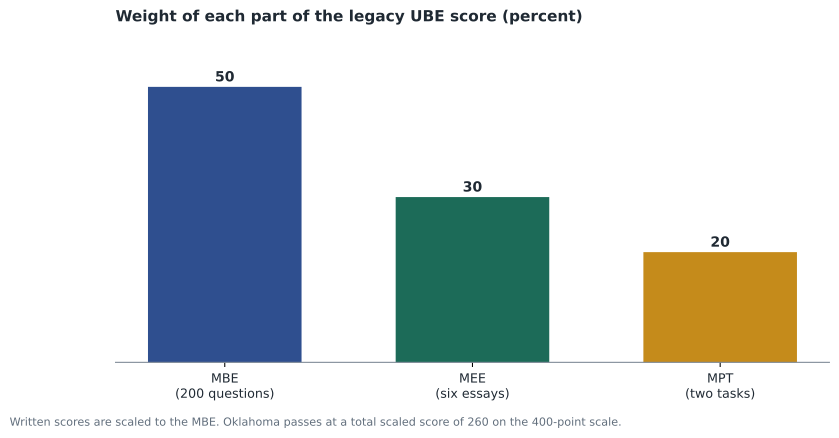
The weights are fixed for every UBE jurisdiction: the MBE is 50 percent of the total, the MEE 30 percent and the MPT 20 percent. The combined total is reported on a 400-point scale. Oklahoma's minimum passing score is 260. A candidate does not need to pass each component separately. Oklahoma, like every UBE jurisdiction, uses compensatory scoring: a strong MBE can make up for a weaker written score, and the reverse.
| Component | Format | Time | Weight |
|---|---|---|---|
| MPT | Two performance tasks | Two 90-minute tasks (Tuesday morning) | 20 percent |
| MEE | Six essays | Six 30-minute essays (Tuesday afternoon) | 30 percent |
| MBE | 200 multiple-choice questions (175 scored) | Two three-hour sessions (Wednesday) | 50 percent |
What 260 means in practice
Hollis gave Talia a way to think about 260 that she uses with every UBE candidate. Because the MBE and the written components each contribute half the total, a candidate can think of 260 as two halves of about 130 each. A candidate who earns a scaled MBE score of 135 needs a scaled written score of only about 125 to reach 260; a candidate with an MBE of 125 needs a written score of about 135. This is a simplification, because the written score is itself a weighted combination of the MEE and MPT, but it is a useful way to see that both halves matter and that neither alone decides the result.
The national mean MBE score varies from exam to exam, and February means are usually lower than July means because February groups include more repeaters. A target of 135 on the MBE gives a candidate a cushion in a 260 jurisdiction. Bar review providers often encourage students to aim for practice MBE scores in the mid-60s percent correct by the final weeks, though the relationship between raw practice percentages and scaled scores is approximate.
Where Oklahoma sits among UBE jurisdictions
Each UBE jurisdiction chooses its own passing score, typically between 260 and 270. Oklahoma's 260 is at the low end of that range, along with a number of other jurisdictions. That matters in two ways. First, it means a candidate who sits in Oklahoma needs a somewhat lower score to pass than a candidate in a 266 or 270 jurisdiction. Second, it matters for portability: a candidate who earns 262 in Oklahoma passes in Oklahoma but would not meet a 266 or 270 minimum if she later tried to transfer the score elsewhere. A candidate who knows she may want to practice in another state should think about that state's minimum, not just Oklahoma's.
Results and what comes next
The Board releases results after grading and scaling are complete, usually a few months after the exam. It notifies applicants and publishes information on its own schedule. A candidate who passes still needs to complete any remaining requirements, including the MPRE if not yet satisfied and the character and fitness review if anything remains open, and then take the oath and sign the Roll of Attorneys within the one-year window. A candidate who does not pass can apply to sit again. NCBE's chart refers to an attempt limit in the context of transferred scores; any limit on how many times a candidate may sit in Oklahoma is set by the Board's rules, and a repeater should check the current rule before reapplying.
Study priorities
Because the MBE is half the score, Hollis recommends that UBE candidates spend roughly half their practice time on MBE questions, with steady weekly essay and MPT practice. Talia's plan, built with her bar review course, gave her a daily set of MBE questions, two timed essays most days, and one full MPT every week. Hollis added one thing. 'Do at least two full MPTs under exam conditions before February,' she said. 'Candidates skip the MPT because it feels like it cannot be studied. It is 20 percent of the score, and it rewards practice more than any other part of the exam.'
She also cautioned against reading too much into individual practice scores. The early weeks of bar study are for learning the law and building speed. A candidate who scores poorly in the first practice set and steadily improves is on a better path than one who starts well and stalls. The useful measure is the trend across several weeks, not the score on any single day.
How graders read an essay
Hollis spent six years grading bar essays for a UBE jurisdiction, and she describes the experience the same way to every group. A grader reads hundreds of answers to the same question over a few weeks, with a grading guide prepared from NCBE's analysis and calibrated at a meeting of graders. The grader is looking for issues spotted, rules stated accurately, facts used to apply the rules, and conclusions. A grader is not looking for elegant prose, long introductions or citations to cases. An answer that is easy to scan, with a short heading for each issue and a sentence or two of rule followed by application, will be read more favorably than a dense block of text that contains the same ideas.
Essays are usually graded on a relative scale: the grader sorts answers into groups from strongest to weakest for that question. A candidate does not need a perfect answer. She needs an answer that is better than most. That is why spotting the main issues matters more than exhausting a minor one, and why running out of time on the sixth essay costs more than writing five slightly shorter answers and a complete sixth.
MPT technique
The MPT rewards a process. Read the task memo first and identify exactly what document is requested, for whom, and in what format. Skim the file to learn the story. Read the library carefully, extracting the rules and the factors courts apply. Then go back to the file and match facts to each rule. Outline before writing, and spend roughly half of the 90 minutes reading and organizing and half writing. The most common MPT errors are ignoring the format instructions, such as writing a persuasive brief when an objective memo was requested, and relying on outside law instead of the library. Graders are told to reward use of the materials supplied.
Exam-room logistics
The Board's instructions control what may be brought into the testing room, but every UBE jurisdiction has similar rules: an admission ticket and photo identification, a limited list of permitted items in a clear plastic bag, no phones or smart watches, and no notes. Candidates who type need a laptop that meets the software requirements, a charger, and a successful practice run with the exam software before exam week. Talia planned to stay in a hotel near the exam site the night before the first day, so that a winter storm or a traffic delay on the turnpike could not cost her the morning session. Hollis endorsed the plan and added that she should have a printed copy of the directions and her admission ticket, in case her phone battery or the hotel's wifi failed.
Worked problem
Reading a score report
A February candidate in another UBE jurisdiction receives a scaled MBE score of 131.4 and a scaled written score of 127.8. She wants to know whether that total would pass in Oklahoma and whether it would transfer to a 266 jurisdiction.
Show solution
- Add the two scaled halves: 131.4 plus 127.8 equals 259.2.
- UBE scores are reported as rounded totals; a total that rounds below 260 does not meet Oklahoma's minimum.
- The same total would also fall short of a 266 minimum.
Answer: The score would not meet Oklahoma's 260. A total at or above 260 would pass in Oklahoma, but transferring to a 266 jurisdiction requires at least 266.
Common mistakes
MistakeA candidate must pass the MBE and the written portion separately.
InsteadThe UBE uses compensatory scoring; only the combined total of 260 matters in Oklahoma.
MistakeAll 200 MBE questions count.
Instead175 are scored and 25 are unscored pretest questions.
MistakeThe MEE still tests family law and trusts and estates.
InsteadFrom July 2026 those subjects, along with conflict of laws and secured transactions, are no longer tested on the MEE; family law and trusts and estates may appear on the MPT with law supplied.
MistakeAn Oklahoma passing score transfers everywhere.
InsteadEach jurisdiction sets its own minimum; a 260 does not meet a 266 or 270 minimum.
Practice problems
Work each problem on paper first, then reveal the answer to check.
What is Oklahoma's legacy UBE passing score?
Show answer
260 on the 400-point scale.
What are the weights of the three components?
Show answer
MBE 50 percent, MEE 30 percent, MPT 20 percent.
When did Oklahoma first give the UBE?
Show answer
July 2021, after the Supreme Court of Oklahoma approved it in June 2020.
Which subject areas does the MEE test from July 2026?
Show answer
The seven MBE subjects plus business associations.
Summary and key terms
- Through February 2027, Oklahoma gives the legacy UBE: MPT and MEE on Tuesday, the MBE on Wednesday.
- The MBE is 50 percent, the MEE 30 percent and the MPT 20 percent of a 400-point total.
- Written scores are scaled to the MBE; scoring is compensatory.
- Oklahoma passes at 260, at the low end of the UBE range, which matters for transferring the score elsewhere.
- Results come a few months after the exam, followed by any remaining requirements, the oath and the Roll of Attorneys.
- MBE
- The Multistate Bar Examination, 200 multiple-choice questions on seven subjects.
- MEE
- The Multistate Essay Examination, six 30-minute essays.
- MPT
- The Multistate Performance Test, two 90-minute lawyering tasks with a supplied file and library.
- Scaling
- The statistical process that places written scores on the same scale as the MBE.
- Compensatory scoring
- A system in which only the combined total must reach the passing score.
Lesson quiz · 5 questions
Score 60% or more to complete this lesson.
Create a free account to save your progress, take quizzes and earn a certificate.