
BAR-237 · Lesson 8 of 12 · 20 min
Oklahoma torts: comparative negligence, several liability, damages caps and the Governmental Tort Claims Act
▶ Video coming soon A video version of this lesson is on the way.
Most of Wade Renfro's caseload is injury work, and most injury work in Oklahoma turns on a handful of statutes: how a plaintiff's own fault affects recovery, how liability is divided among defendants, what damages are available and capped, and what special rules apply when the defendant is a city, a county, a school district or the state. Talia had seen each of them in files, but never all together. Hollis asked her to walk through them in the order a lawyer meets them when a new client walks in.
Modified comparative negligence
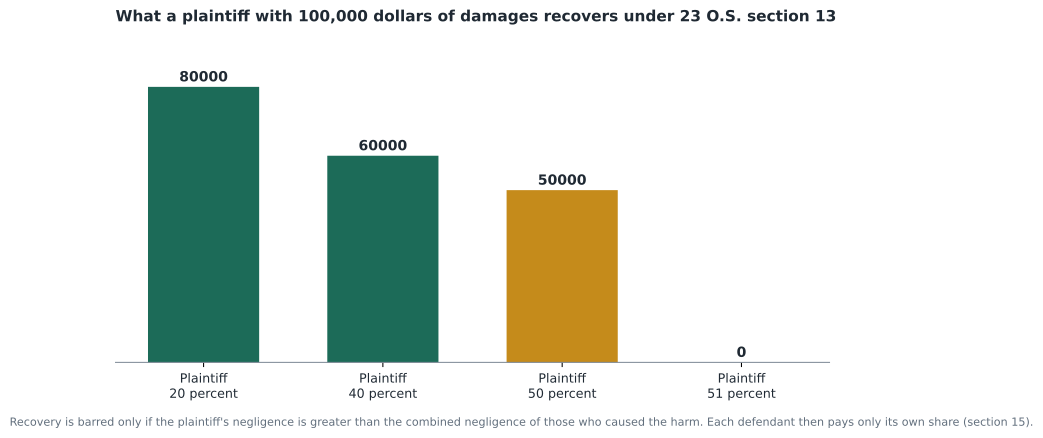
Oklahoma abolished the old all-or-nothing rule of contributory negligence by statute decades ago. The current rule is in section 13 of Title 23. In negligence actions for personal injury, wrongful death or property damage, a plaintiff's contributory negligence does not bar recovery unless it is of greater degree than the combined negligence of the persons, firms or corporations whose negligence caused the damage. When the plaintiff is not barred, her recovery is reduced in proportion to her own negligence. Section 14 of the same title provides the mechanics for the jury's findings.
Two features of the rule deserve attention. First, the comparison is between the plaintiff's negligence and the combined negligence of the defendants and others who caused the harm, not between the plaintiff and each defendant separately. A plaintiff who is 40 percent at fault, facing two defendants at 30 percent each, recovers, because 40 is not greater than 60. Second, a plaintiff at exactly 50 percent is not barred, because her negligence is not greater than the others' combined 50 percent. A plaintiff at 51 percent recovers nothing. Oklahoma lawyers sometimes describe this as a 50 percent bar rule, meaning the plaintiff can recover at 50 percent but not above.
Several liability
Until 2011, Oklahoma retained some forms of joint and several liability. For actions accruing on or after November 1, 2011, section 15 of Title 23 makes liability several only. In civil actions based on fault and not arising out of contract, each joint tortfeasor is liable only for the amount of damages allocated to that tortfeasor. The section does not apply to actions brought by or on behalf of the state, and it does not apply to claims arising out of contract.
Several liability changes the economics of an Oklahoma injury case. If one defendant is insolvent or uninsured, the plaintiff bears that loss for the insolvent defendant's share; the solvent defendants do not pay it. That makes the identification and allocation of every responsible party, including parties who are not sued, a central task. Defense lawyers seek to shift fault to others, and plaintiffs' lawyers work to keep fault on the defendants who can pay.
Damages and the noneconomic damages cap
Oklahoma's history with caps on noneconomic damages, the damages for pain and suffering, mental anguish, loss of consortium and similar harms, is a good example of how Oklahoma's constitution shapes tort reform. In 2011 the Legislature enacted a cap of 350,000 dollars on noneconomic damages in most bodily injury actions, codified at section 61.2 of Title 23. In Beason v. I. E. Miller Services, Inc., 2019 OK 28, the Supreme Court of Oklahoma struck down the cap as an impermissible special law under the Oklahoma Constitution, because it treated injured plaintiffs differently from the survivors of people who died, whose damages the Constitution protects from limitation. After Beason, Oklahoma had no general cap on noneconomic damages.
The Legislature responded in 2025. Senate Bill 453, signed by Governor Stitt on May 27, 2025 and effective September 1, 2025, reinstated a cap on noneconomic damages, reported as 500,000 dollars for most bodily injury claims, with a higher limit for certain severe mental injuries and an exception from the cap for permanent and severe injuries, and it adopted an expert-testimony standard aligned with the 2023 revision of Federal Rule of Evidence 702. The bill's supporters designed it to avoid the problems identified in Beason. Whether it succeeds will be decided by the Supreme Court of Oklahoma when the cap is challenged, and as of November 2026 a new lawyer should treat the cap's application to a particular case as a question to research carefully, including which injuries fall within the exception and which causes of action accrued after the effective date.
Economic damages, such as medical expenses and lost earnings, are not capped by these statutes. And Oklahoma's Constitution provides that the amount recoverable for injuries resulting in death shall not be subject to statutory limitation, which is why wrongful death damages sit outside the cap structure.
Punitive damages
Punitive damages in Oklahoma are governed by section 9.1 of Title 23, which sets up tiers. Where the jury finds by clear and convincing evidence that the defendant acted in reckless disregard of the rights of others, punitive damages are limited to the greater of 100,000 dollars or the amount of actual damages awarded. Where the jury finds by clear and convincing evidence that the defendant acted intentionally and with malice, the limit rises to the greater of 500,000 dollars, twice the actual damages, or the increased financial benefit the defendant derived from the conduct. Where the court finds, beyond a reasonable doubt, that the defendant acted intentionally and with malice and engaged in conduct life-threatening to humans, the statutory limits do not apply. Punitive damages are decided in a separate proceeding after the jury awards actual damages.
| Finding | Standard of proof | Limit on punitive damages |
|---|---|---|
| Reckless disregard | Clear and convincing evidence (jury) | Greater of 100,000 dollars or actual damages |
| Intentional and with malice | Clear and convincing evidence (jury) | Greater of 500,000 dollars, twice actual damages, or the defendant's increased financial benefit |
| Intentional, malicious and life-threatening | Beyond a reasonable doubt (court finding) | No statutory limit |
Medical negligence notes
Medical negligence cases in Oklahoma follow the general two-year limitations period, with discovery rules that can delay accrual. Oklahoma has also seen repeated constitutional challenges to procedural hurdles in these cases. The Supreme Court of Oklahoma struck down a requirement that plaintiffs file an affidavit of merit from a qualified expert, holding that it imposed an unconstitutional burden on access to the courts. A new lawyer handling a medical case should research the current state of every procedural requirement before filing, because Oklahoma's medical negligence rules have changed several times through both legislation and decisions.
The Governmental Tort Claims Act
Claims against the state and its political subdivisions, including cities, counties, school districts and many public authorities, are governed by the Governmental Tort Claims Act, which begins at section 151 of Title 51. The Act is the exclusive remedy for torts by governmental entities and their employees acting within the scope of employment. It waives sovereign immunity only to the extent and in the manner it provides, and it lists many exemptions, among them discretionary functions, legislative and judicial acts, and a long series of specific activities for which the entity is not liable. An Oklahoma lawyer reading a government claim checks the exemptions in section 155 before doing anything else.
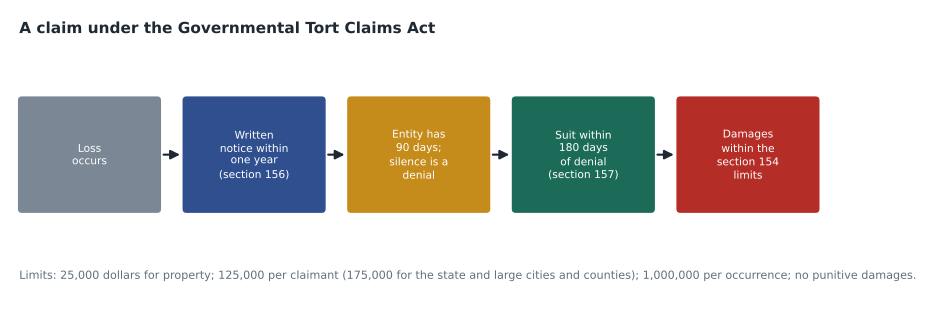
The Act's notice requirement is strict. Under section 156, a claim against the state or a political subdivision is forever barred unless written notice is presented within one year after the loss occurs. A claim against the state is filed with the Office of the Risk Management Administrator of the Office of Management and Enterprise Services; a claim against a political subdivision is filed with the office of the clerk of its governing body. The notice must state the date, time, place and circumstances of the claim, the entity involved, the amount of compensation or relief demanded, the claimant's name, address and telephone number, and information needed for Medicare reporting. For personal injury claims, the notice must also identify the claimant's health care providers and include releases; for lost earnings and property claims, supporting documentation. Most omissions do not invalidate the notice unless the claimant refuses to provide the information after the entity asks for it. Time during which the injured person is incapacitated by the injury does not count toward the one-year period, up to 90 days of incapacity.
Once notice is given, the entity has time to consider the claim. Under section 157, a claim is deemed denied if it is not approved within 90 days, and the claimant must file suit within 180 days after the denial. Missing that window bars the claim even if notice was timely. The combination of the one-year notice period and the 180-day suit period is the most common trap for new Oklahoma lawyers in injury practice, and it is why Talia now asks every new client, before anything else, whether any public vehicle, public property or public employee was involved.
Limits on recovery against government
Section 154 caps the total liability of the state and political subdivisions. For a claim arising after October 1, 1985, liability for property loss is limited to 25,000 dollars. Liability for any other loss to any single claimant from a single occurrence is limited to 125,000 dollars, except that the limit is 175,000 dollars for claims against the state, a city or county with a population of at least 300,000 according to the latest federal decennial census, or certain other political subdivisions defined in the Act. Higher limits apply to specified medical negligence claims against university hospitals and state mental health hospitals. Total liability for all claims arising from a single occurrence is limited to 1,000,000 dollars. Punitive damages may not be awarded against the state or a political subdivision. And the entity is liable only for its own percentage of the total negligence, consistent with Oklahoma's several liability rule.
Workers and contractors
Two other areas often come up in Wade's office. Injuries at work are generally handled through Oklahoma's administrative workers' compensation system rather than tort suits against employers, with limited exceptions. And in 2025, the Legislature enacted Senate Bill 642 in response to the Supreme Court of Oklahoma's decision in Knox v. Oklahoma Gas and Electric Co., which had expanded potential liability for injuries to workers of independent contractors and affected indemnity clauses; the new law restored the enforceability of certain indemnity agreements between businesses and contractors. Both areas change often, and a lawyer should check the current statutes before advising.
Putting it together
Hollis asked Talia to walk through a single case from intake to damages. A client is rear-ended by a city garbage truck in a city of about 400,000 people. Talia's first question: the defendant is a political subdivision, so the Governmental Tort Claims Act applies. Written notice must go to the city clerk within one year. If the city does not approve the claim within 90 days, it is deemed denied and suit must be filed within 180 days. The city is a city with a population over 300,000, so the per-claimant limit for bodily injury is 175,000 dollars, property damage is limited to 25,000 dollars, and no punitive damages are available. If the jury finds the client 20 percent at fault for braking suddenly, her damages are reduced by 20 percent, and the city pays only its own share of the fault, all subject to the statutory limits.
'And if the truck had belonged to a private hauler under contract with the city?' Hollis asked. Talia answered that the Governmental Tort Claims Act would generally not apply to the private company, so ordinary tort law would govern: two-year limitations, modified comparative negligence, several liability, the 2025 noneconomic damages cap subject to its exceptions and any constitutional challenge, and the punitive damages tiers. Hollis said that was the right instinct: in Oklahoma injury work, the identity of the defendant decides the procedure.
Worked problem
A sidewalk fall and a missed deadline
A client trips on a broken sidewalk maintained by a small town on March 1, 2025. She sends a letter describing the accident to the town clerk on February 15, 2026. The town never responds. She consults Wade in November 2026.
Show solution
- The town is a political subdivision, so the Governmental Tort Claims Act governs.
- Written notice reached the clerk within one year of the loss (February 15, 2026 is before March 1, 2026), so it was timely under section 156, assuming it contained or later supplied the required information.
- Under section 157 the claim was deemed denied 90 days after notice, around mid-May 2026, and suit had to be filed within 180 days after denial, around mid-November 2026.
- Whether any time remains depends on the exact dates; Wade must calculate them immediately and, if possible, file the same day.
Answer: Timely notice is not enough; the 180-day suit period after the deemed denial is likely to expire about now, so the petition must be filed at once if any time remains.
Common mistakes
MistakeOklahoma bars recovery when a plaintiff is 50 percent at fault.
InsteadA plaintiff at 50 percent recovers half; recovery is barred only when her negligence is greater than the combined negligence of others.
MistakeAn Oklahoma plaintiff can collect the whole judgment from any defendant.
InsteadFor actions accruing on or after November 1, 2011, liability in fault-based tort actions is several only.
MistakeBeason means Oklahoma has no noneconomic damages cap.
InsteadBeason struck the 2011 cap in 2019, but SB 453 enacted a new cap effective September 1, 2025, subject to exceptions and future challenges.
MistakeGiving a city notice within one year is all the Governmental Tort Claims Act requires.
InsteadSuit must also be filed within 180 days after the claim is denied or deemed denied.
Practice problems
Work each problem on paper first, then reveal the answer to check.
What is the per-occurrence cap on all claims under the Governmental Tort Claims Act?
Show answer
1,000,000 dollars.
What is the property loss limit under section 154?
Show answer
25,000 dollars.
Which case struck down the 2011 noneconomic damages cap?
Show answer
Beason v. I. E. Miller Services, Inc., 2019 OK 28.
What is the punitive damages limit for reckless disregard?
Show answer
The greater of 100,000 dollars or the actual damages awarded.
Summary and key terms
- Oklahoma uses modified comparative negligence: a plaintiff recovers unless her negligence is greater than the combined negligence of others (23 O.S. section 13).
- Liability in fault-based tort actions accruing on or after November 1, 2011 is several only (section 15).
- Beason (2019) struck the 2011 noneconomic damages cap; SB 453 enacted a new cap effective September 1, 2025.
- Punitive damages are tiered under section 9.1.
- Governmental Tort Claims Act claims require written notice within one year, suit within 180 days of denial, and are capped at 25,000 dollars for property, 125,000 or 175,000 per claimant and 1,000,000 per occurrence.
- Modified comparative negligence
- Oklahoma's rule reducing recovery by the plaintiff's fault and barring it when that fault is greater than the combined fault of others.
- Several liability
- Each tortfeasor pays only its allocated share of damages.
- Special law
- A law that singles out a class for different treatment in a way the Oklahoma Constitution forbids; the basis of Beason.
- Governmental Tort Claims Act
- The exclusive remedy for torts by Oklahoma governmental entities and their employees.
- Deemed denial
- Under section 157, a claim not approved within 90 days is treated as denied.
Lesson quiz · 5 questions
Score 60% or more to complete this lesson.
Create a free account to save your progress, take quizzes and earn a certificate.