
BAR-238 · Lesson 1 of 12 · 22 min
Becoming a lawyer in Oregon
▶ Video coming soon A video version of this lesson is on the way.
Hana Merritt grew up in Pendleton, in Umatilla County, where her mother keeps the books for a wheat cooperative and her father drives a grain truck every harvest. She finished law school at an Oregon law school in May 2026 and has worked since September as a law clerk at a three-lawyer general practice firm in Pendleton: farm leases, water rights, a few car crashes, divorces and estates. Many of the firm's clients live or farm on the Washington side of the Columbia, around Walla Walla, and the partners hold licenses in both states. Hana filed her application for the February 2027 Oregon bar exam on November 9, 2026, joined Hollis Marchetti's online study group the following week and asked for a series of one-on-one sessions on Oregon.
Hollis had another Oregon candidate in mind as well. Andre Baptiste, already a member of the group, is a third-year law student who graduates in May 2027 and plans to sit the Oregon exam in July 2027. Andre has a second option Hana did not take: Oregon's Supervised Practice Portfolio Examination, which lets a graduate qualify for a license through supervised paid work instead of a bar exam. Hollis invited him to join the Oregon sessions whenever he could, so that the two of them could compare notes on both routes. 'Two Oregon candidates, two different roads,' she said. 'That is exactly what this state looks like right now.'
This course follows those sessions, which were held in the fall of 2026 and are not dated individually. The first six lessons cover admission: who admits Oregon lawyers, who is eligible, the filing calendar and fees, character and fitness and the MPRE, the NextGen exam that Oregon first gave in July 2026 and its passing score, the move from the legacy Uniform Bar Examination, and the Supervised Practice Portfolio Examination. Lessons 7 through 10 cover distinctive Oregon law a new lawyer meets early: the courts, the state constitution and civil procedure; tort law and the Oregon Tort Claims Act; land use, family law and estates; and the Oregon Rules of Professional Conduct together with the Professional Liability Fund. Lesson 11 covers score transfer, admission by comity and practice after admission, and Lesson 12 is a capstone with original practice questions and an exam-day plan.
The Oregon Supreme Court admits lawyers
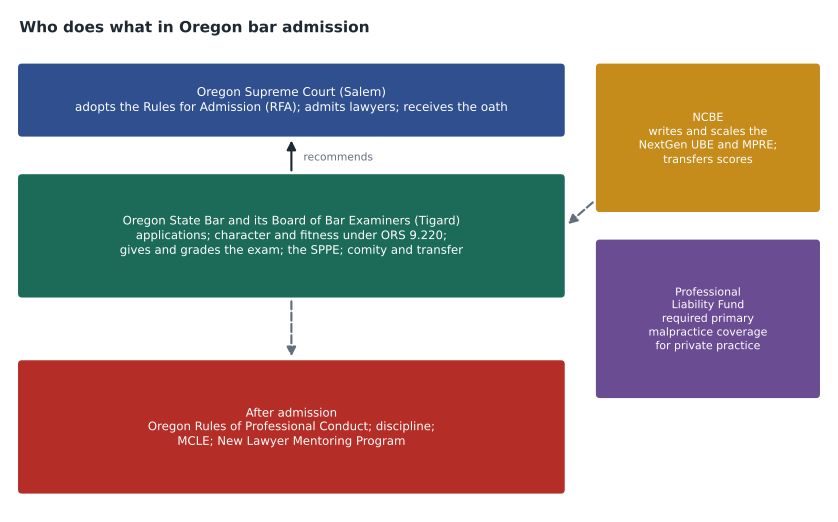
In Oregon, as in every state, the power to admit lawyers belongs to the state's highest court. The Oregon Supreme Court sits in Salem and has seven justices, one of whom serves as chief justice. The Oregon statutes on the bar, in chapter 9 of the Oregon Revised Statutes, recognize the Court's authority to admit applicants and require, among other things, that an applicant be of good moral character and fit to practice. The Court exercises that authority through the Rules for Admission of Attorneys, which Oregon lawyers abbreviate as the RFA. When a candidate reads that the application fee is non-refundable, or that names of applicants are published before admission, the authority for that statement is a numbered RFA, such as RFA 4.2 for fees or RFA 6.2 for publication.
The Court also decides the policy questions that shape the exam. On February 3, 2026, for example, it entered an order setting the passing score for the July 2026 NextGen exam at 615 and providing that the passing score for later administrations would be 620. When Oregon decided to become one of the first jurisdictions to give the NextGen exam, and when it approved the Supervised Practice Portfolio Examination as an alternative to the bar exam, those were decisions of the Court acting on recommendations from the bar and its examiners.
After admission, the Court continues to regulate lawyers. It adopts the Oregon Rules of Professional Conduct, it decides disciplinary cases that are appealed or that call for suspension or disbarment, and it approves the rules for minimum continuing legal education. Oregon's statute on the bar also describes the oath every new lawyer takes and files. The Oregon State Bar's admissions pages remind candidates that the signed oath goes to the Oregon Supreme Court in Salem, not to the bar.
The Oregon State Bar and its Board of Bar Examiners
The day-to-day work of admission is done by the Oregon State Bar, the state's integrated bar, through its Board of Bar Examiners. The Oregon State Bar is a public corporation created by statute, and every lawyer licensed in Oregon is a member, or in the bar's newer terminology a licensee. Its offices, at the Oregon State Bar Center in Tigard, just south of Portland, house the admissions department, which receives applications, checks eligibility, investigates character and fitness, administers the exam and handles every alternative route to admission.
The Board of Bar Examiners is the body that makes admissions decisions and recommendations within that system. Its members are appointed by the Supreme Court and include both lawyers and members of the public. The Board decides which applicants may sit, approves or recommends against admission on character and fitness grounds, oversees grading and certifies to the Court the applicants who have met every requirement. Oregon candidates often hear the Board called the BBX, and the bar's own materials on the Supervised Practice Portfolio Examination use that abbreviation.
The bar also runs programs that matter after admission. Its minimum continuing legal education department tracks credits, its New Lawyer Mentoring Program pairs new lawyers with experienced mentors, its Client Assistance Office and Disciplinary Counsel's Office handle complaints, and it collects annual license fees. Lesson 10 and Lesson 11 return to all of these.
NCBE's part
The National Conference of Bar Examiners writes the exams Oregon uses. Oregon gave the last legacy Uniform Bar Examination in February 2026 and the first NextGen Uniform Bar Examination in July 2026. NCBE writes the NextGen questions, scores the multiple-choice items, scales and equates the written work that Oregon's graders evaluate and reports a single score. NCBE also writes and administers the Multistate Professional Responsibility Examination, the ethics exam on which Oregon requires a scaled score of at least 85.
Candidates deal with NCBE directly for an NCBE account number, MPRE registration, the exam-day laptop software and score transfers. Oregon does not use NCBE's character and fitness investigation service; NCBE's jurisdiction page for Oregon tells applicants to contact Oregon directly for filing instructions, and the investigation is done by the bar's admissions staff in Tigard.
The Professional Liability Fund
One Oregon institution surprises lawyers from other states. Oregon requires every licensee in private practice whose principal office is in Oregon to carry malpractice coverage through the Professional Liability Fund, a fund created under Oregon law and run for the bar's lawyers. The primary coverage is 300,000 dollars per claim and in the aggregate each year, with a separate 75,000 dollar allowance for defense costs. The annual assessment for 2027 is 3,500 dollars per covered licensee. Lawyers who do not practice privately, such as government lawyers, judges and in-house counsel, can claim an exemption each year.
For a new lawyer, the fund is both a cost and a resource. Its practice management advisors, forms and handbooks are free to Oregon lawyers, and its loss prevention materials are written for exactly the mistakes new lawyers make. Hana's supervising partner told her that the first call he made after opening his own office years ago was to the fund, not to an insurance broker. Lesson 10 explains the fund in more detail.
The ways in
Oregon admits lawyers in several ways. The first is admission by examination: the applicant meets the education requirement, files an application, passes character and fitness review, passes the NextGen exam with a score of at least 620 for exams after July 2026, and files a passing MPRE score. Hana is on this route, and it is the route most new graduates take.
The second is the Supervised Practice Portfolio Examination. A graduate of an ABA-accredited law school who has a job offer from a qualifying Oregon employer and a qualifying supervising attorney works under a provisional license for at least 675 hours and builds a portfolio of written work, client interactions and negotiations that the Board of Bar Examiners grades. A portfolio that passes leads to an Oregon license without a bar exam. Oregon opened applications on May 15, 2024, and the first lawyers licensed through it were announced in early 2025. Lesson 6 covers this route in detail.
The third is admission by transferred score. Oregon accepts a qualifying NextGen or legacy UBE score earned in another jurisdiction within the preceding 36 months. The fourth is admission by comity, Oregon's form of admission on motion, for lawyers who have practiced elsewhere. Oregon also offers narrower admissions, such as house counsel status for lawyers employed by a business, law teacher admission, and active pro bono status. Lesson 11 covers these alternatives.
| Route | Who it fits | Main requirements |
|---|---|---|
| Bar exam (NextGen UBE) | New graduates and most other applicants | Education, character and fitness, NextGen score of 620 (615 for July 2026), MPRE 85 |
| Supervised Practice Portfolio Examination | ABA graduates with a qualifying Oregon job offer | 675 supervised hours, portfolio graded qualified, MPRE or the journaling alternative |
| UBE score transfer | Applicants who passed a UBE elsewhere | Qualifying score within 36 months, character and fitness, post-admission Oregon CLE |
| Comity | Lawyers licensed and practicing elsewhere | Practice requirement, 15 credits of Oregon CLE before admission, character and fitness |
The order of the steps
For a candidate sitting the exam, the steps follow a set order. First, the applicant creates an NCBE account and registers for the MPRE if she has not already passed it. Second, she files the Oregon application through the bar's online admissions system before the timely filing deadline and pays the fee. Third, the character and fitness investigation begins, and the applicant answers any follow-up requests. Fourth, she registers her laptop when the registration period opens. Fifth, she sits the exam. Sixth, after results, she completes any remaining requirements, takes the oath and files it with the Supreme Court. Seventh, before she begins private practice, she arranges Professional Liability Fund coverage, and in her first reporting period she completes the new-admittee continuing legal education and the New Lawyer Mentoring Program.
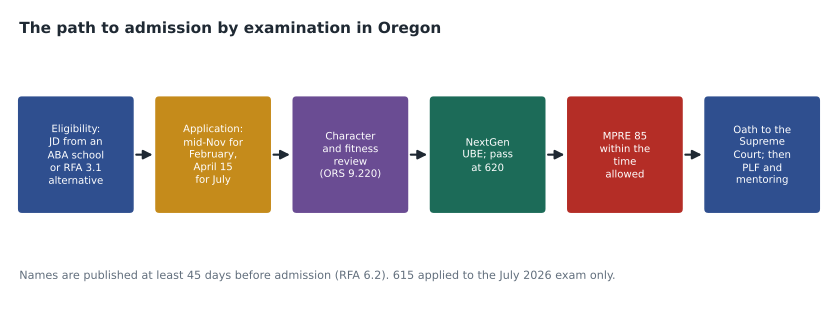
Hana asked why the oath comes so late. Hollis explained that the Court does not admit anyone until the Board has certified that every requirement is met, and that certification comes only after results. 'Passing the exam makes you eligible,' she said. 'It does not make you a lawyer. Until you file the oath and the Court admits you, you are a law clerk who passed a test.' Under RFA 6.2, the names of applicants are published at least 45 days before admission, and lawyers may send the admissions department information relevant to an applicant's character, which is another reason the last steps take time.
Why Oregon is a useful case study
Oregon is a small bar by national standards, but it has made several choices that the rest of the country is watching. It was among the first jurisdictions to give the NextGen exam. It is the first state to license lawyers through a supervised practice portfolio instead of a bar exam. It requires malpractice coverage for private practitioners and runs its own fund to provide it. It licenses paralegals to provide limited legal services in family law and landlord-tenant matters. And it changed its rule for experienced lawyers in 2022 from a reciprocity rule, which depended on how the other state treated Oregon lawyers, to a comity rule that looks at the applicant's own practice. A candidate who understands these choices understands a good deal about where licensing in the United States is heading.
Andre said that was the part he liked best. 'In law school they told us the bar exam was the only gate,' he said. 'Here there are four or five gates, and you have to know which one fits.' Hollis agreed, but she added a caution she would repeat throughout the course: rules change, and Oregon's have changed more than most. Every fact in these lessons is stated as of November 2026, and a candidate should confirm each one on the Oregon State Bar's admissions pages before relying on it.
Worked problem
Choosing a route
Hana graduated from an ABA-accredited law school in May 2026 and works as a law clerk at a Pendleton firm whose partners also practice in Washington. Her firm says it cannot take on a provisional licensee under the Supervised Practice Portfolio Examination this year. Which route to an Oregon license should she plan on, and why does portability matter to her?
Show solution
- A new graduate without an approved SPPE employer and supervisor cannot use the SPPE, because the job offer and the approvals come first.
- Comity requires years of practice elsewhere, so it is not available to a new graduate.
- The bar exam route is open to her as an ABA graduate who files a timely application.
- A NextGen UBE score can be transferred to other UBE jurisdictions such as Washington, while a license earned through the SPPE is not portable.
Answer: She should plan on the February 2027 NextGen exam, which leads to an Oregon license and gives her a portable score she can use to seek admission in Washington.
Common mistakes
MistakeThe Oregon State Bar admits lawyers.
InsteadThe Oregon Supreme Court admits lawyers; the bar and its Board of Bar Examiners run the process and make recommendations.
MistakeOregon still gives the legacy UBE.
InsteadOregon gave its last legacy UBE in February 2026 and its first NextGen UBE in July 2026.
MistakeThe oath is filed with the bar.
InsteadThe signed oath is filed with the Oregon Supreme Court in Salem.
MistakeMalpractice insurance is optional in Oregon, as in most states.
InsteadPrivate practitioners with a principal office in Oregon must carry Professional Liability Fund coverage.
MistakeThe SPPE license can be transferred to other states like a UBE score.
InsteadThe SPPE leads only to an Oregon license; it is not portable.
Practice problems
Work each problem on paper first, then reveal the answer to check.
What does RFA stand for in Oregon admissions?
Show answer
The Rules for Admission of Attorneys adopted by the Oregon Supreme Court.
When did Oregon give its first NextGen UBE?
Show answer
In July 2026; the last legacy UBE was in February 2026.
What passing score did the Court set for the July 2026 exam, and what applies afterward?
Show answer
615 for July 2026; 620 for later administrations.
What are the primary PLF coverage limits?
Show answer
300,000 dollars per claim and in the aggregate, plus a 75,000 dollar defense cost allowance.
How many days before admission are applicant names published under RFA 6.2?
Show answer
At least 45 days.
Summary and key terms
- The Oregon Supreme Court admits lawyers under the Rules for Admission (RFA) and ORS chapter 9.
- The Oregon State Bar and its Board of Bar Examiners in Tigard run applications, character and fitness and the exam.
- NCBE writes the NextGen UBE and the MPRE; Oregon requires an MPRE score of 85.
- Oregon gave its first NextGen exam in July 2026, with a 615 passing score then and 620 afterward.
- Routes in: the bar exam, the Supervised Practice Portfolio Examination, UBE score transfer and comity.
- Private practitioners must carry Professional Liability Fund coverage; the oath is filed with the Supreme Court.
- RFA
- The Rules for Admission of Attorneys adopted by the Oregon Supreme Court.
- Board of Bar Examiners
- The body, appointed by the Supreme Court, that makes admissions decisions and recommendations; often called the BBX.
- Professional Liability Fund
- The Oregon fund that provides required primary malpractice coverage to private practitioners with an Oregon principal office.
- SPPE
- The Supervised Practice Portfolio Examination, Oregon's supervised-work alternative to the bar exam.
- licensee
- The Oregon State Bar's term for a person licensed by the bar, including lawyers and licensed paralegals.
Lesson quiz · 5 questions
Score 60% or more to complete this lesson.
Create a free account to save your progress, take quizzes and earn a certificate.