
BAR-238 · Lesson 8 of 12 · 21 min
Oregon torts: comparative fault, several liability, damages and the Oregon Tort Claims Act
▶ Video coming soon A video version of this lesson is on the way.
Three files sat on Hana's desk in November. In the first, the intersection crash from Lesson 7, the other driver blamed her client for entering on a stale yellow light. In the second, a farmworker had been hurt when a county road crew left a trench unmarked on a gravel road outside Pendleton. In the third, a woman had fallen on ice at a grain cooperative's loading dock and wanted to know whether the cooperative, the snowplow contractor and the property owner could all be made to pay. The partner told her to learn three things before she touched any of them: how Oregon compares fault, how it divides liability among defendants and what changes when the defendant is a public body. Hollis turned that instruction into this lesson.
This lesson covers Oregon's general approach to negligence, its modified comparative fault rule, several liability and the reallocation of uncollectible shares, damages caps and the remedy clause after Horton and Busch, punitive damages and the Oregon Tort Claims Act, with its notice requirements and liability limits.
Oregon's approach to negligence
Oregon analyzes ordinary negligence somewhat differently from many states. In Fazzolari v. Portland School District No. 1J, 303 Or 1 (1987), the Oregon Supreme Court held that, unless the parties' status, a relationship or a particular standard of conduct creates, defines or limits the defendant's duty, the question is whether the defendant's conduct unreasonably created a foreseeable risk to a protected interest of the kind of harm that befell the plaintiff. In other words, Oregon courts usually ask about foreseeability and reasonableness rather than first deciding, as a separate legal question, whether a duty existed. The approach leaves more questions to the jury. Oregon lawyers cite Fazzolari constantly, and a new lawyer should read it early.
Comparative fault
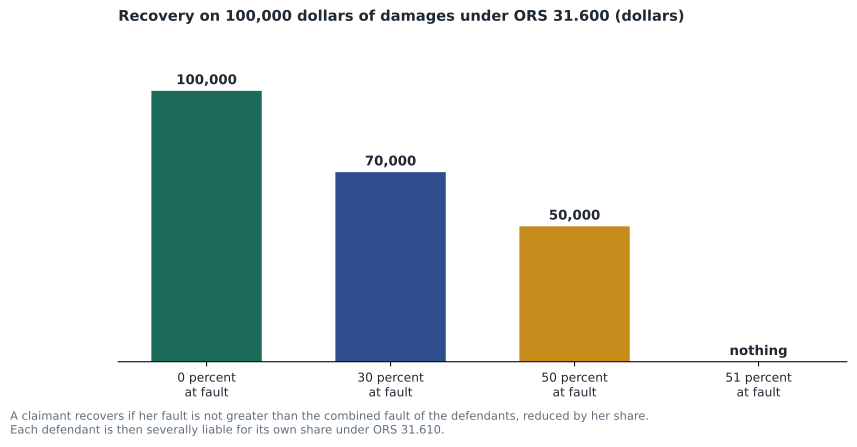
Oregon follows a modified comparative fault rule. Under ORS 31.600, contributory negligence does not bar recovery if the fault attributable to the claimant was not greater than the combined fault of the persons against whom recovery is sought, along with certain others the statute lists, but any damages allowed are diminished in proportion to the percentage of fault attributable to the claimant. A plaintiff who is 50 percent at fault can recover half her damages; a plaintiff who is 51 percent at fault recovers nothing.
The comparison is to the combined fault of the defendants and others the statute names, not to each defendant separately. The trier of fact compares the claimant's fault with that of the defendants, third-party defendants who are liable in tort to the claimant, and persons who settled with the claimant. Fault is generally not compared with persons who are immune, who are outside the court's jurisdiction or who are protected by a statute of limitations or repose, although settling persons are included. A defendant who claims that a third party or a settling person was at fault must prove that person's fault and that it contributed to the injury.
Several liability and reallocation
Oregon has largely abolished joint and several liability. ORS 31.610 provides that in actions for bodily injury, death or property damage, the liability of each defendant is several only and not joint. The court enters judgment against each defendant for its own percentage of fault applied to the total damages. A defendant found 20 percent at fault pays 20 percent of the damages, no matter how many other defendants there are and whether they can pay.
Oregon softens that rule with reallocation. On a motion filed within one year after the judgment becomes final, the court may determine that a party's share is uncollectible and reallocate it among the other parties, including the claimant, according to their respective percentages of fault. Two limits apply. A party's share may not be increased by reallocation if the claimant's fault is equal to or greater than that party's fault, or if the party's own fault is 25 percent or less. A share that cannot be increased for either reason is itself treated as uncollectible and reallocated among the remaining parties who are not exempt. The uncollectible party remains liable to the claimant unless the claimant signed a covenant not to sue or enforce.
The statute does not apply to actions for violations of laws on hazardous waste, hazardous substances or radioactive waste, or of state or federal air and water pollution standards, where other rules govern.
| Party | Fault | Share of 200,000 dollars | Effect of reallocating an uncollectible share |
|---|---|---|---|
| Plaintiff | 10 percent | Bears 20,000 dollars | Absorbs the uncollectible share, because B and C are exempt |
| Defendant A | 60 percent | 120,000 dollars | Uncollectible |
| Defendant B | 20 percent | 40,000 dollars | Exempt from increase: fault of 25 percent or less |
| Defendant C | 10 percent | 20,000 dollars | Exempt from increase: fault of 25 percent or less, and no greater than the plaintiff's |
Hollis used the table to make a point about settlement strategy. 'In Oregon you do not pick the deepest pocket and let it pay for everyone,' she said. 'Each defendant pays its own share. If the big defendant is insolvent and the others are small players, reallocation may not help you, and you need to know that before you value the case.'
The remedy clause and damages caps
Article I, section 10 of the Oregon Constitution provides that every person shall have a remedy by due course of law for injury done him in his person, property or reputation. For many years, under Smothers v. Gresham Transfer, Inc., 332 Or 83 (2001), Oregon courts read the clause as protecting causes of action that existed at common law in 1857, when the constitution was adopted. In Horton v. OHSU, 359 Or 168 (2016), the Supreme Court overruled Smothers and adopted a different test. Under Horton, the legislature may modify common-law remedies, but the court asks whether the legislature's departure from the common-law model is justified, considering factors such as whether the legislature provided a quid pro quo, the extent of the remaining remedy and the legislature's reasons. Horton upheld the Tort Claims Act's limit on damages against a state employee in that case.
The noneconomic damages cap was the next test. ORS 31.710(1) caps noneconomic damages, such as pain and suffering, at 500,000 dollars in many personal injury actions. In Busch v. McInnis Waste Systems, Inc., 366 Or 628 (2020), decided July 9, 2020, a jury had awarded a garbage-truck accident victim about 3 million dollars in economic damages and 10.5 million dollars in noneconomic damages, and the trial court reduced the noneconomic award to 500,000 dollars. The Supreme Court held that applying the cap to the plaintiff violated the remedy clause. The Court reasoned that the statute provided no quid pro quo to injured plaintiffs, that the cap had not been adjusted for inflation since 1987 and was not set at an amount capable of providing complete recovery in many cases, and that the goal of lowering insurance costs was not by itself enough to justify the limit.
Busch was decided as applied to the plaintiff in that case, and the cap remains on the books. Defendants continue to argue that it applies in other circumstances, and plaintiffs argue that Busch controls. A new Oregon lawyer should research the current case law whenever the cap might matter, and should note the difference between the noneconomic damages cap in ORS 31.710 and the separate limits in the Oregon Tort Claims Act, which Horton treated differently because the legislature had paired them with a substitute remedy against the public body.
Punitive damages
Oregon allows punitive damages only under statutory conditions. A party may not include a claim for punitive damages in its first pleading; it must move to amend and make a prima facie showing of evidence supporting the claim under ORS 31.725. At trial, punitive damages require clear and convincing evidence that the defendant acted with malice or showed a reckless and outrageous indifference to a highly unreasonable risk of harm, with a conscious indifference to the health, safety and welfare of others, under ORS 31.730. Oregon also requires that most of a punitive damages award be paid to the state: under ORS 31.735, the prevailing party keeps a minority share, and the larger share goes to state accounts, chiefly the Criminal Injuries Compensation Account. A lawyer should check the current percentages before advising a client on the value of a punitive claim.
The Oregon Tort Claims Act
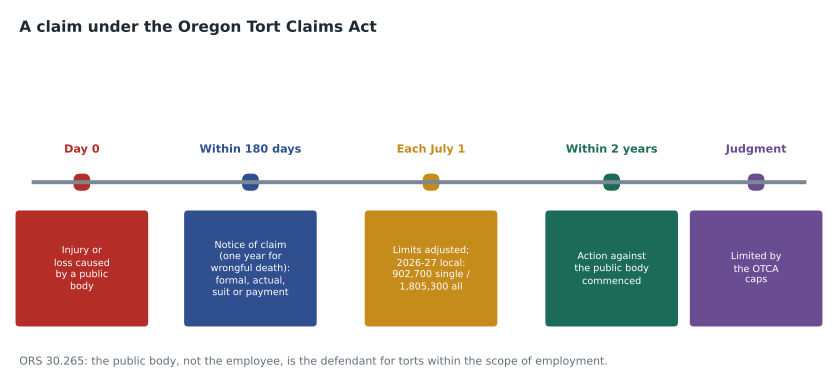
The Oregon Tort Claims Act, at ORS 30.260 to 30.300, governs tort claims against public bodies, including the state, counties, cities, school districts and other local governments, and against their officers, employees and agents acting within the scope of their duties. Under ORS 30.265, the public body is liable for the torts of its officers, employees and agents acting within the scope of their employment, and the sole cause of action for such a tort is an action against the public body. If an employee is sued, the public body is substituted as the defendant. The Act preserves several immunities, the best known of which is immunity for the performance of or failure to perform a discretionary function or duty, along with immunities for certain claims covered by workers' compensation and other listed categories.
The Act limits recovery. The liability limits are adjusted every year by the State Court Administrator, effective July 1. For the period from July 1, 2026 through June 30, 2027, the Oregon Judicial Department's published table gives these limits: for claims against the state for personal injury or death, 2,708,100 dollars for a single claimant and 5,416,200 dollars for all claimants arising from a single accident or occurrence; for claims against local public bodies, 902,700 dollars for a single claimant and 1,805,300 dollars for all claimants; and for property damage or destruction against the state or a local public body, 148,100 dollars for a single claimant and 740,300 dollars for all claimants.
| Public body | Claim | Single claimant | All claimants |
|---|---|---|---|
| State | Personal injury or death | 2,708,100 dollars | 5,416,200 dollars |
| Local public body | Personal injury or death | 902,700 dollars | 1,805,300 dollars |
| State or local | Property damage or destruction | 148,100 dollars | 740,300 dollars |
Notice of claim
The Act's notice requirement is the trap new lawyers fear most. ORS 30.275 requires that notice of claim be given to the public body within 180 days after the alleged loss or injury, or within one year in a wrongful death case. A claimant may give notice in several ways: formal written notice to the person or office the statute designates, actual notice that the public body or its agent received in a way that would lead a reasonable person to conclude that a claim is being made, the commencement of an action on the claim within the notice period, or payment of all or part of the claim. An action must then be commenced within two years after the alleged loss or injury. A lawyer whose client was hurt by a public body should calendar the notice date the day the file opens and send formal notice promptly rather than relying on actual notice.
Limitations and repose
Outside the Tort Claims Act, the general limitations period for personal injury is two years under ORS 12.110, subject to a discovery rule. Oregon also has statutes of ultimate repose, which cut off certain claims a fixed number of years after the act or omission regardless of discovery, and product liability claims have their own limitations and repose provisions. Wrongful death actions are brought by the personal representative of the decedent's estate under ORS 30.020 and have their own limitations period. A new lawyer should check every applicable period for each claim rather than assuming that two years governs everything.
Worked problem
The trench on the county road
On June 2, 2026, Hana's farmworker client was injured when his truck struck an unmarked trench left by a county road crew. He has 1.2 million dollars in damages. The county's road supervisor called him in July to ask how he was doing, but no one has sent the county anything in writing. It is now November 23, 2026. What should Hana do, and what can the client recover?
Show solution
- The Oregon Tort Claims Act applies, and the county, not the crew members, is the proper defendant under ORS 30.265.
- The notice of claim is due within 180 days of June 2, 2026, which falls in late November 2026; the supervisor's call may not amount to actual notice of a claim, so formal written notice should be sent immediately.
- The action must be commenced within two years, by June 2, 2028.
- Recovery against a local public body for a single claimant's injury is limited to 902,700 dollars for the July 2026 to June 2027 period; comparative fault under ORS 31.600 would reduce the damages if the client was partly at fault.
Answer: Send formal notice of claim to the county at once, file within two years, and advise the client that recovery is limited to the local-body limit of 902,700 dollars, reduced by any fault of his own.
Common mistakes
MistakeOregon is a joint and several liability state.
InsteadLiability is several only under ORS 31.610, with reallocation of uncollectible shares on motion.
MistakeA plaintiff 51 percent at fault recovers 49 percent.
InsteadShe recovers nothing; Oregon bars recovery when the claimant's fault is greater than the combined fault of the defendants.
MistakeBusch struck down the noneconomic damages cap in every case.
InsteadBusch held the cap unconstitutional as applied to that plaintiff; its reach in other cases is argued.
MistakeA public employee can be sued personally for torts within the scope of employment.
InsteadThe public body is the sole defendant and is substituted under ORS 30.265.
MistakeA claimant has two years to give a city notice of a claim.
InsteadThe notice is due within 180 days (one year for wrongful death); the action is due within two years.
Practice problems
Work each problem on paper first, then reveal the answer to check.
Under ORS 31.600, when is a plaintiff barred?
Show answer
When her fault is greater than the combined fault of the defendants and others the statute lists.
Which shares cannot be increased on reallocation under ORS 31.610?
Show answer
Those of parties whose fault is 25 percent or less, or no greater than the claimant's.
Which case overruled Smothers v. Gresham Transfer?
Show answer
Horton v. OHSU, 359 Or 168 (2016).
What is the single-claimant OTCA limit for a local public body from July 2026 to June 2027?
Show answer
902,700 dollars for personal injury or death.
How long does a claimant have to give notice of a wrongful death claim against a public body?
Show answer
One year.
Summary and key terms
- Fazzolari frames most Oregon negligence questions around foreseeability and reasonableness.
- ORS 31.600: recovery is barred only if the claimant's fault exceeds the defendants' combined fault; otherwise reduced.
- ORS 31.610: liability is several only, with reallocation on motion within one year, subject to the 25 percent and claimant-fault limits.
- Horton (2016) reset the remedy clause test; Busch (2020) held the 500,000 dollar noneconomic cap unconstitutional as applied.
- Punitive damages require leave to amend, clear and convincing evidence, and most of the award goes to the state.
- The OTCA substitutes the public body, sets annual limits and requires notice within 180 days (one year for death).
- modified comparative fault
- A rule that reduces a plaintiff's damages by her share of fault and bars recovery above a threshold.
- several liability
- Liability of each defendant only for its own share of the damages.
- reallocation
- The redistribution of an uncollectible share among other parties under ORS 31.610.
- remedy clause
- Article I, section 10 of the Oregon Constitution.
- notice of claim
- The notice a claimant must give a public body under ORS 30.275 before suing.
Lesson quiz · 5 questions
Score 60% or more to complete this lesson.
Create a free account to save your progress, take quizzes and earn a certificate.