
BAR-238 · Lesson 9 of 12 · 22 min
Oregon land use, family law and estates
▶ Video coming soon A video version of this lesson is on the way.
The Pendleton firm's general practice means that Hana's week can include a farm family that wants to put a second house on its wheat ground, a couple ending a twenty-year marriage and an estate whose only asset is that same wheat ground. One afternoon in November all three walked in the door. The farm family learned that the county could not approve the house without findings under the state's farmland rules. The divorcing couple learned that the farm one spouse had inherited might still be divided. And the estate's personal representative learned that the will's two witnesses mattered more than its handwriting. 'That is Oregon in one afternoon,' the partner told Hana. Hollis built this lesson around it.
This lesson introduces three areas of Oregon law a general practitioner meets early: the statewide land use planning system, dissolution of marriage, property division, support and custody, and wills, intestacy, the elective share and probate. Each is a large field; the aim here is to show what is distinctive about Oregon and where a new lawyer should start reading.
Statewide land use planning
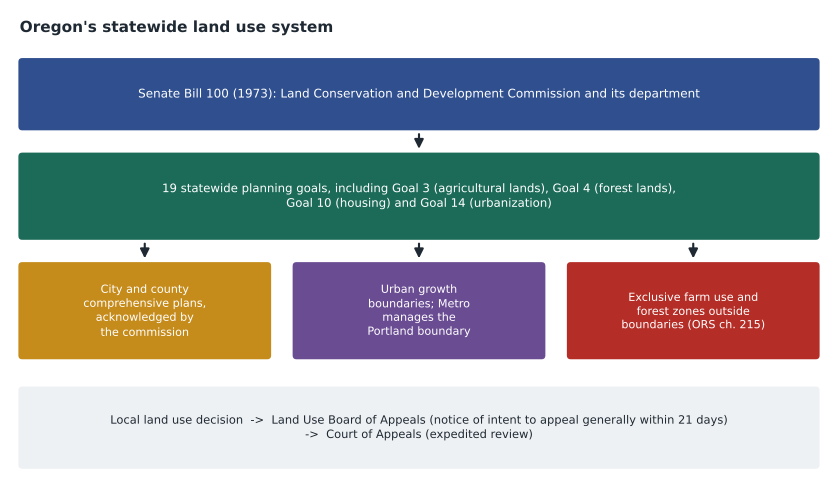
Oregon has one of the most centralized land use systems in the United States. In 1973 the legislature passed Senate Bill 100, which created the Land Conservation and Development Commission and required every city and county to adopt a comprehensive plan consistent with statewide planning goals. The commission, supported by the Department of Land Conservation and Development, adopted those goals, which now number nineteen. They cover citizen involvement, land use planning, agricultural lands, forest lands, natural resources and open spaces, air and water quality, natural hazards, recreation, economic development, housing, public facilities, transportation, energy and urbanization, along with goals for the Willamette River Greenway and for coastal resources.
Each city's and county's comprehensive plan and land use regulations must be acknowledged by the commission as complying with the goals. Once acknowledged, local governments make most individual land use decisions under their own plans and codes, but those decisions must still comply with state statutes and administrative rules, and they can be appealed to a specialized state tribunal.
Urban growth boundaries and farm and forest land
Goal 14, on urbanization, requires every city to have an urban growth boundary separating land available for urban development from rural land. Inside the boundary, cities plan for housing, jobs and public services over a planning period. Outside it, rural land is generally protected for farm, forest and other resource uses. In the Portland area, the boundary is managed by Metro, an elected regional government. Expanding a boundary requires a showing of need under the goal and its rules, and expansions are often contested.
Most rural land in eastern and western Oregon is zoned for exclusive farm use or forest use under Goals 3 and 4 and the statutes that implement them, principally ORS chapter 215. In an exclusive farm use zone, new dwellings and nonfarm uses are allowed only in listed circumstances, such as a dwelling customarily provided in conjunction with farm use on a property that meets income or acreage tests, a replacement dwelling or a lot-of-record dwelling for a long-held parcel. The farm family in Hana's office learned that their second house might qualify only under one of those tests, and that the county would have to make written findings explaining why.
Measures 37 and 49
Oregon's land use system has been tested at the ballot box. In 2004, voters approved Measure 37, which required governments to compensate landowners when land use regulations adopted after they acquired their property reduced its value, or else to waive the regulations. Thousands of claims followed. In 2007, voters approved Measure 49, which replaced Measure 37's broad remedy with narrower rights, chiefly the right to build a limited number of home sites on qualifying property. A new lawyer handling a rural property may still find Measure 49 authorizations in the title history.
Housing and middle housing
More recent legislation has focused on housing supply. In 2019, the legislature passed House Bill 2001, which requires larger cities and cities within the Portland metropolitan area to allow middle housing, such as duplexes and, in larger cities, triplexes, fourplexes, townhouses and cottage clusters, in areas zoned for single-family homes. Later legislation added rules for dividing lots for middle housing and further measures to speed housing approvals. A lawyer advising a residential developer in a larger Oregon city should start with these statutes and the local code that implements them.
Appeals to LUBA
Most land use decisions by local governments can be appealed to the Land Use Board of Appeals, known as LUBA, created in 1979. LUBA is a specialized tribunal that reviews land use decisions on the record. The appeal begins with a notice of intent to appeal, which generally must be filed within 21 days after the decision becomes final, and the deadline is strictly enforced. LUBA's decisions can be reviewed by the Court of Appeals on an expedited schedule. Local governments must also decide most permit applications within statutory time limits, often called the 120-day rule, after an application is complete. Land use practice in Oregon is therefore fast, record-based and specialized; a new lawyer should be cautious before taking on an appeal without guidance.
Dissolution of marriage
Oregon calls divorce dissolution of marriage, governed mainly by ORS chapter 107. Oregon is a no-fault state: a marriage may be dissolved when irreconcilable differences have caused its irremediable breakdown, and fault is generally not relevant to whether a dissolution is granted. Oregon also has a residency requirement. When the marriage was not solemnized in Oregon, at least one party must have been a resident of Oregon for six months before the suit is commenced. Oregon recognizes registered domestic partnerships as well, and their dissolution follows the same rules.
A dissolution case can resolve property division, spousal support, custody, parenting time and child support. Many cases end in a stipulated judgment that the parties negotiate, sometimes with mediation. Licensed paralegals, a category Oregon created recently, may provide limited services in family law matters, which is one reason a new lawyer may meet self-represented parties who have had some professional help.
Property division
Oregon is not a community property state. Under ORS 107.105(1)(f), the court divides the parties' property as is just and proper in all the circumstances. The statute creates a rebuttable presumption that both spouses contributed equally to the acquisition of property during the marriage, whether or not the property is held jointly. The Supreme Court explained the analysis in In re Marriage of Kunze, 337 Or 122 (2004): the court identifies the property, determines which items are subject to the presumption of equal contribution, decides whether the presumption has been rebutted, and then makes a division that is just and proper in all the circumstances.
Property one spouse brought into the marriage, inherited or received by gift may be treated differently, but it is not automatically excluded. If it has been commingled, or if the other spouse contributed to it, it may be divided. The inherited farm in Hana's office illustrated the point. The spouse who inherited it had kept it in her own name, but the couple had used marital income to pay its mortgage and improve its irrigation, so whether and how it would be divided depended on the facts and on what was just and proper.
Spousal support
Oregon recognizes three kinds of spousal support under ORS 107.105(1)(d). Transitional support helps a spouse attain education and training necessary for employment. Compensatory support compensates a spouse who made a significant contribution to the other spouse's education, training, career or earning capacity. Maintenance support allows one spouse to support the other for a specified or indefinite period. The statute lists factors for each, such as the length of the marriage, the parties' ages, health, earning capacity and standard of living. A court may award more than one kind of support in the same case.
Custody, parenting time and child support
Custody and parenting time are decided under the best interests of the child, with statutory factors in ORS 107.137 that include the emotional ties between the child and family members, each parent's interest in and attitude toward the child, the desirability of continuing existing relationships and any abuse of one parent by the other. Oregon has a distinctive rule on joint custody: a court may not order joint custody unless both parents agree to it. If they do not, the court awards sole legal custody to one parent and sets a parenting plan that gives the other parent parenting time. Child support is calculated under the Oregon Child Support Guidelines, adopted as administrative rules and administered with the Child Support Program, which use both parents' incomes and the parenting time schedule.
| Issue | Oregon rule | Where to start |
|---|---|---|
| Grounds | Irreconcilable differences; no fault | ORS chapter 107 |
| Residency | Six months if the marriage was not solemnized in Oregon | ORS 107.075 |
| Property | Just and proper division; presumption of equal contribution | ORS 107.105(1)(f); Kunze (2004) |
| Spousal support | Transitional, compensatory and maintenance | ORS 107.105(1)(d) |
| Custody | Best interests; joint custody only if both parents agree | ORS 107.137 and 107.169 |
| Child support | Guideline calculation from both incomes and parenting time | Oregon Child Support Guidelines |
Wills
Oregon's probate code is in ORS chapters 111 through 117. A will must be in writing, signed by the testator or by another person at the testator's direction and in her presence, and attested by at least two witnesses, under ORS 112.235. Oregon does not recognize a handwritten, unwitnessed holographic will made in Oregon, although a will valid where it was executed is generally valid in Oregon. Since 2015, ORS 112.238 has allowed a court to give effect to a document that was not executed with the required formalities if there is clear and convincing evidence that the decedent intended it to be a will, a version of the harmless error approach. A new lawyer should still supervise every execution as if the formalities were absolute, because a proceeding under that statute is expensive and uncertain.
Divorce affects wills automatically. Under Oregon law, a judgment of dissolution or annulment generally revokes provisions of a will in favor of the former spouse, unless the will provides otherwise. Lawyers handling a dissolution should advise clients to review their wills, beneficiary designations and powers of attorney at the same time.
Intestacy and the elective share
When an Oregon decedent dies without a will, ORS chapter 112 governs. If the decedent leaves a surviving spouse and all of the decedent's descendants are also descendants of the spouse, the spouse generally takes the entire intestate estate. If the decedent has descendants who are not descendants of the surviving spouse, the spouse takes one-half and the descendants take the rest. Without a spouse, the estate passes to descendants, then to parents, then to more remote relatives in the statutory order.
A surviving spouse who is left little or nothing by will can claim an elective share under ORS 114.600 to 114.725. Oregon's elective share is a percentage of an augmented estate that includes both the decedent's and the surviving spouse's property, and the percentage rises with the length of the marriage, reaching its maximum of one-third for marriages of fifteen years or more. The election must be made within statutory deadlines after the decedent's death or the start of probate, and a lawyer representing a surviving spouse should calendar those dates at once.
Probate and small estates
Probate in Oregon is handled in the circuit courts. A personal representative, named in the will or appointed by the court, gathers the assets, gives notice to interested persons and creditors, pays valid claims, files accountings and distributes the estate under court supervision. Oregon allows a simplified procedure for small estates by affidavit when the estate falls within statutory value limits for personal and real property; a lawyer should check the current limits, which the legislature has changed over time. Many Oregon families also use revocable trusts, governed by the Oregon Uniform Trust Code in ORS chapter 130, to avoid probate.
Worked problem
The inherited wheat ground
Hana's divorce client, married 22 years, inherited 480 acres of wheat ground from her father in 2012 and kept title in her own name. The couple used their joint earnings to pay down a mortgage on the land and to install a pivot irrigation system in 2018. Her husband claims a share of the land. How will an Oregon court approach it?
Show solution
- Oregon is not a community property state; the court makes a just and proper division under ORS 107.105(1)(f).
- The presumption of equal contribution applies to property acquired during the marriage, and inherited property is generally treated differently, but it is not automatically excluded.
- Under Kunze, the court asks whether the property has been integrated into the marital finances or improved with marital contributions, and then what division is just and proper.
- Payments of the mortgage and the irrigation investment from joint earnings are strong evidence that at least part of the value should be divided.
Answer: The court will likely treat the land's inherited value as hers but may divide the value attributable to marital contributions, such as the mortgage payments and the irrigation improvements, in reaching a just and proper division.
Common mistakes
MistakeOregon is a community property state.
InsteadOregon divides property as just and proper, with a presumption of equal contribution for property acquired during the marriage.
MistakeAn Oregon court can order joint custody whenever it is in the child's best interests.
InsteadJoint custody requires both parents' agreement.
MistakeA handwritten, unwitnessed will made in Oregon is valid.
InsteadOregon requires two attesting witnesses, though ORS 112.238 allows a court to give effect to a defective document on clear and convincing evidence.
MistakeA county can approve any house on farmland if the neighbors agree.
InsteadDwellings in exclusive farm use zones are allowed only in listed circumstances with findings.
MistakeA land use appeal to LUBA can be filed months later.
InsteadThe notice of intent to appeal is generally due within 21 days after the decision becomes final.
Practice problems
Work each problem on paper first, then reveal the answer to check.
What did Senate Bill 100 create in 1973?
Show answer
The Land Conservation and Development Commission and the statewide planning system.
How many statewide planning goals are there?
Show answer
Nineteen.
Which ballot measure narrowed Measure 37 in 2007?
Show answer
Measure 49.
What are Oregon's three kinds of spousal support?
Show answer
Transitional, compensatory and maintenance.
What is the maximum elective share percentage, and when does it apply?
Show answer
One-third, for marriages of fifteen years or more.
Summary and key terms
- SB 100 (1973) created statewide planning: nineteen goals, acknowledged local plans and urban growth boundaries.
- Farm and forest zones limit dwellings; Measures 37 and 49 shaped compensation; HB 2001 requires middle housing.
- LUBA reviews land use decisions; notices of intent to appeal are generally due in 21 days.
- Dissolution is no-fault; property is divided as just and proper with a presumption of equal contribution (Kunze).
- Support may be transitional, compensatory or maintenance; joint custody requires both parents' agreement.
- Wills need two witnesses (harmless error since 2015); intestacy favors the spouse; the elective share reaches one-third.
- urban growth boundary
- The line around a city separating urbanizable land from rural resource land.
- exclusive farm use zone
- A rural zone protecting agricultural land, where nonfarm uses are limited by statute.
- LUBA
- The Land Use Board of Appeals, which reviews local land use decisions.
- just and proper
- The standard for property division in an Oregon dissolution.
- elective share
- A surviving spouse's statutory share of the augmented estate, based on the length of the marriage.
Lesson quiz · 5 questions
Score 60% or more to complete this lesson.
Create a free account to save your progress, take quizzes and earn a certificate.