
BAR-238 · Lesson 12 of 12 · 21 min
Capstone: Oregon practice questions and an exam-day plan
▶ Video coming soon A video version of this lesson is on the way.
For the last Oregon session, Hollis gave Hana and Andre a packet of original problems and a blank calendar. 'The NextGen exam will not ask you about Oregon,' she said, 'so the first half of today is for you as an Oregon lawyer, not as an examinee. The problems use what you learned in this course, and I want you to answer them the way you would answer a partner: issue, rule, application, conclusion. The second half of today is for the exam. We are going to build your plan for February 23 and 24, hour by hour, and then we are going to stop worrying about it.'
This lesson contains three original Oregon practice problems with model answers in IRAC form, a short set of quick questions, and a written plan for the twelve weeks before the February 2027 exam, the two exam days and the steps after results. The problems are hypotheticals written for this course; they are not released bar exam questions.
Problem 1: the loading dock
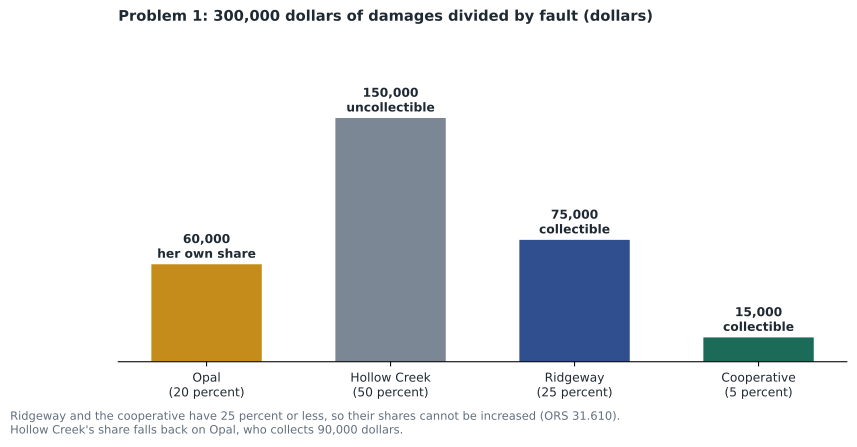
Facts. On January 8, 2026, Opal Tollefsrud slipped on ice at the loading dock of Blue Mountain Grain Cooperative in Umatilla County while picking up an order. The cooperative leases the dock from Hollow Creek Properties, which is responsible under the lease for snow and ice removal and had hired Ridgeway Plowing to do it. Ridgeway's crew had plowed that morning but had not sanded. Opal had seen the ice and chose to cross it anyway in smooth-soled boots. Her damages are 300,000 dollars, of which 180,000 dollars are noneconomic. At trial, the jury assigns fault as follows: Opal 20 percent, Hollow Creek 50 percent, Ridgeway 25 percent and the cooperative 5 percent. Hollow Creek has since dissolved, and its share is uncollectible. How much can Opal recover, and from whom?
Issue. How do Oregon's comparative fault and several liability statutes apply, and how is Hollow Creek's uncollectible share treated?
Rule. Under ORS 31.600, a claimant's contributory negligence does not bar recovery if her fault is not greater than the combined fault of the defendants, but her damages are reduced by her percentage of fault. Under ORS 31.610, each defendant's liability is several only. On a motion within one year after the judgment becomes final, the court may reallocate an uncollectible share among the other parties, including the claimant, by their percentages of fault, but a party's share may not be increased if its fault is 25 percent or less or if the claimant's fault is equal to or greater than its fault. A share that cannot be increased is treated as uncollectible and reallocated among the remaining parties who are not exempt.
Application. Opal's 20 percent is not greater than the defendants' combined 80 percent, so she recovers, with her damages reduced by 20 percent. The judgments are several: Hollow Creek 150,000 dollars (50 percent of 300,000), Ridgeway 75,000 dollars (25 percent) and the cooperative 15,000 dollars (5 percent). Hollow Creek's share is uncollectible. On reallocation, Ridgeway's share cannot be increased because its fault is 25 percent, which is 25 percent or less; the cooperative's cannot be increased because its fault is 5 percent and, independently, because Opal's fault exceeds it. Both protected shares are treated as uncollectible and fall to the only remaining nonexempt party, Opal herself. The noneconomic portion raises a further question: if the defense argues that ORS 31.710's 500,000 dollar cap applies, it would not matter here, because her noneconomic damages are below the cap.
Conclusion. Opal can collect 75,000 dollars from Ridgeway and 15,000 dollars from the cooperative, a total of 90,000 dollars. Hollow Creek's 150,000 dollar share cannot be reallocated to either remaining defendant. Her lawyer should pursue any assets or insurance of the dissolved company and should have explained this risk when the case was valued.
Problem 2: the second marriage
Facts. Walter Kaine, an Oregon resident, married Nadine in 2009 after his first wife died. Walter had two children from his first marriage; Walter and Nadine had none together. In 2010, Walter signed a typed will leaving everything to his two children. He signed it at his kitchen table with one witness, a neighbor; he intended to find a second witness but never did. Walter died in October 2026. His estate is worth 900,000 dollars, and Nadine has little property of her own. Nadine asks what she can claim.
Issue. Is the 2010 will valid, and what are Nadine's rights under intestacy or by an elective share?
Rule. Under ORS 112.235, an Oregon will must be in writing, signed by the testator and attested by at least two witnesses. Under ORS 112.238, a court may nonetheless treat a document as a will if there is clear and convincing evidence that the decedent intended it to be his will. If there is no valid will and the decedent leaves descendants who are not descendants of the surviving spouse, the surviving spouse takes one-half of the intestate estate. A surviving spouse may also claim an elective share of the augmented estate, a percentage that increases with the length of the marriage up to one-third for marriages of fifteen years or more.
Application. The will has only one witness and fails the formal requirements. The children may petition under ORS 112.238, arguing that Walter's signature and the typed document show clear and convincing evidence of intent; Nadine may argue that his plan to find a second witness shows the document was not final. If the will fails, Nadine takes one-half of the estate under intestacy because Walter's children are not her descendants, about 450,000 dollars before expenses. If the will is upheld, Nadine may claim an elective share. Because the marriage lasted seventeen years, her percentage is at the one-third maximum, applied to an augmented estate that includes both spouses' property. She must elect within the statutory deadline.
Conclusion. Nadine's lawyer should contest the will's validity, calendar the elective share deadline immediately and file a protective election, since the elective share is her floor if the children succeed under ORS 112.238. Intestacy would give her about one-half; the elective share would give her up to one-third of the augmented estate.
Problem 3: the flat fee and the county
Facts. Lucas Okerlund, admitted in Oregon in October 2026, opened a solo practice in Hermiston in November. He has not yet arranged Professional Liability Fund coverage, because he thought it could wait until his first trial. A client pays him a flat fee of 3,000 dollars to handle a claim against Umatilla County for flood damage to her barn caused, she says, by a county culvert that failed on September 1, 2026. Lucas puts the fee in his operating account; his fee agreement is oral. On November 23, 2026, he realizes he has not contacted the county. Identify his problems.
Issue. What are Lucas's obligations concerning malpractice coverage, the fee and the client's claim?
Rule. Oregon licensees in private practice with an Oregon principal office must carry PLF coverage. Under RPC 1.5(c)(3), a fee may be treated as earned on receipt only under a signed writing with the required explanations; otherwise advance fees belong in trust under RPC 1.15-1. Under the Oregon Tort Claims Act, ORS 30.275, notice of claim must be given within 180 days after the loss, and the action must be commenced within two years. The property damage limit against a local public body for a single claimant from July 1, 2026 is 148,100 dollars.
Application. Lucas began private practice without required PLF coverage and must obtain it at once. The flat fee, with no signed earned-on-receipt writing, is client money until earned; depositing it in his operating account commingled funds, and he should move it to trust and correct his records. On the claim, the 180-day notice period from September 1, 2026 runs until late February 2027, so notice is still timely, but he should send formal written notice now rather than rely on any informal contact. Any recovery will be limited to the local-body property damage limit.
Conclusion. Lucas must obtain PLF coverage, move the advance to his trust account or obtain a proper signed agreement, send formal notice of claim to the county promptly and calendar the two-year filing deadline of September 1, 2028. He should also call the PLF's practice management advisors and enroll in the New Lawyer Mentoring Program.
Quick questions
Hollis ended the problems with ten rapid questions, and both candidates answered aloud. Which court admits Oregon lawyers? The Oregon Supreme Court. What NextGen score does Hana need? 620. What MPRE score? 85. Which discovery device does Oregon lack? Interrogatories. How many jurors must agree in a civil case? Three-fourths. What standard applies to property division? Just and proper. Can an Oregon court order joint custody over a parent's objection? No. How long does a claimant have to notify a county of an injury claim? 180 days. What does the PLF cover per claim? 300,000 dollars, plus 75,000 for defense. How many hours does the SPPE require? 675.
Twelve weeks to February 23 and 24
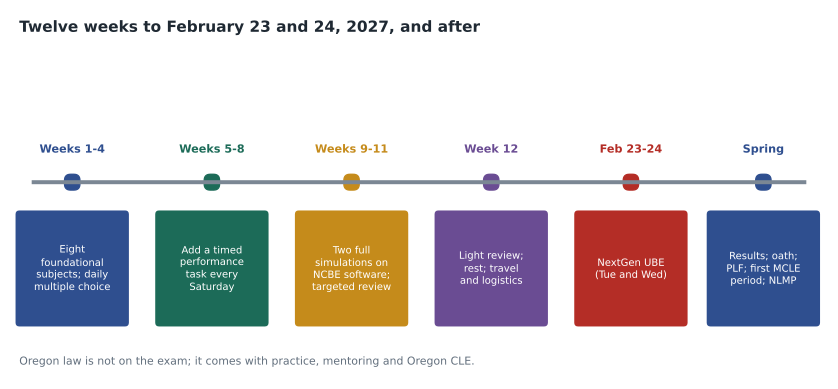
Then Hollis turned to the calendar. Hana's plan began on Monday, November 30, 2026, twelve weeks before the exam, and assumed she would keep working three days a week through January and stop working two weeks before the exam.
Weeks one through four, through late December, were for the eight foundational subjects: two subjects a week in pairs, with multiple-choice practice every weekday evening and one integrated set every Saturday. Weeks five through eight, January, added a full performance task every Saturday morning under timed conditions, with self-grading against NCBE's materials the same afternoon. Weeks nine through eleven, through mid-February, included two full simulations of all three sessions on NCBE's practice software, review of every missed question by subject and skill, and a last reading of family law and trusts and estates basics. Week twelve was light review, rest and logistics.
Logistics
Hollis gave Hana a logistics list for the final weeks. Register the laptop during NCBE's registration window and complete the software checks. Confirm the testing site when the admissions department announces it, and plan travel from Pendleton, with a weather margin, because February travel over the Blue Mountains or through the Columbia Gorge can be slow. Book lodging near the site for the nights of February 22 and 23. Read NCBE's and the bar's rules on what may be brought into the testing room, and pack the night before. Plan meals for the breaks. Set two alarms.
The exam days
On Tuesday, February 23, the morning session is the first of three. Hollis told Hana to begin each session with a plan she had already practiced: the standalone multiple-choice questions first, at a steady pace, then the integrated sets, then the performance task, adjusting if a session's layout differs. Between sessions she should eat, walk and avoid discussing questions with other candidates, because comparing answers helps no one and can unsettle everyone. Tuesday evening is for a short walk, dinner and sleep, not for study. Wednesday morning is the last session. When it ends, she is done.
After the exam
After the exam, Hana's checklist continues. Keep the application current. When results arrive in the spring, confirm that the MPRE score is on file and that nothing else is outstanding. File the signed oath with the Supreme Court. Arrange PLF coverage before beginning private practice in Oregon, or claim an exemption if she will not be in private practice. Start the first MCLE reporting period's 15 credits and enroll in the New Lawyer Mentoring Program. And, if she wants to practice in Washington, check Washington's rules for transferring her score.
Andre's plan was different, and Hollis drew it on the same calendar: business associations and the MPRE in the spring; the April 15 filing for July 2027; a January conversation with the nonprofit about the SPPE; and a decision point when the SPPE approvals either arrived or did not. 'Two plans, one calendar,' she said. 'The point is not to guess which one you will use. The point is to be ready for both.'
Hollis closed the session the way she closes every jurisdiction course. She asked each candidate to write down one reason they wanted to be an Oregon lawyer and to put it somewhere they would see it in February. Hana wrote: the farm families on both sides of the river. Andre wrote: tenants who cannot afford a lawyer and should not have to go without one.
Worked problem
A last-minute question
On February 22, 2027, the night before the exam, Hana notices that her laptop has installed an operating system update and that the exam software shows a warning. What should she do?
Show solution
- NCBE requires the registered laptop to pass its software checks before the exam.
- NCBE and the jurisdiction publish exam-day technical support instructions for this situation.
- Waiting until the morning risks a delayed start or a failed launch.
- Running the software check again tonight and contacting support immediately gives her the most time to fix the problem or arrange a backup.
Answer: She should rerun NCBE's software check at once, follow NCBE's published troubleshooting steps and contact technical support that night, rather than waiting until exam morning.
Common mistakes
MistakeA defendant 25 percent at fault picks up an insolvent co-defendant's share.
InsteadUnder ORS 31.610 a share of 25 percent or less cannot be increased by reallocation.
MistakeA will with one witness is always void in Oregon.
InsteadIt fails the formal rule, but ORS 112.238 lets a court give effect to it on clear and convincing evidence of intent.
MistakePLF coverage can wait until a new lawyer's first trial.
InsteadIt is required from the start of private practice with an Oregon principal office.
MistakeThe night before the exam is for one last full review.
InsteadIt is for rest and logistics; the work is done.
MistakeA candidate should compare answers with others between sessions.
InsteadComparing answers helps no one and can unsettle everyone.
Practice problems
Work each problem on paper first, then reveal the answer to check.
In Problem 1, how much can Opal collect, and why?
Show answer
90,000 dollars: Ridgeway and the cooperative are exempt from reallocation, so Hollow Creek's share falls on her.
In Problem 2, what share does Nadine take if the will fails?
Show answer
One-half, because Walter's descendants are not her descendants.
In Problem 3, when is notice of claim due to the county?
Show answer
Within 180 days after September 1, 2026, in late February 2027.
On which days is the February 2027 exam?
Show answer
Tuesday, February 23 and Wednesday, February 24, 2027.
What should a new Oregon lawyer arrange before starting private practice?
Show answer
Professional Liability Fund coverage.
Summary and key terms
- Several liability with reallocation can leave a plaintiff bearing an insolvent defendant's share when the others are exempt.
- A defective will may be saved under ORS 112.238; a surviving spouse's floor is intestacy or the elective share.
- New lawyers must carry PLF coverage, handle advances under RPC 1.5(c)(3) and 1.15-1 and calendar OTCA notice dates.
- A twelve-week plan moves from subjects to timed written work to full simulations and rest.
- Logistics: laptop registration, site, travel, lodging and the rules for the testing room.
- After results: oath, PLF coverage, the first MCLE period and the New Lawyer Mentoring Program.
- IRAC
- Issue, rule, application and conclusion, a standard structure for legal analysis.
- protective election
- A timely elective share claim filed to preserve a spouse's rights while other disputes are resolved.
- simulation
- A full practice exam under real timing and conditions.
- exam-day plan
- A written schedule and checklist for the exam days and the days before.
- software check
- NCBE's test confirming that a registered laptop can run the exam software.
Lesson quiz · 5 questions
Score 60% or more to complete this lesson.
Create a free account to save your progress, take quizzes and earn a certificate.