
BAR-238 · Lesson 6 of 12 · 22 min
The Supervised Practice Portfolio Examination
▶ Video coming soon A video version of this lesson is on the way.
Andre came to this session with a printout of the Oregon State Bar's applicant handbook for the Supervised Practice Portfolio Examination, covered in his handwriting. He had spent his 2L summer at a Portland nonprofit that represents tenants in eviction cases, and its managing attorney had told him, half joking, that she would hire him the day he graduated if he would let her supervise his portfolio. 'I want to know whether she was serious,' Andre said, 'and whether I should be.' Hana listened with real interest. Her firm had decided it could not take on a provisional licensee this year, but she wanted to understand the route she was not taking.
This lesson explains the Supervised Practice Portfolio Examination, usually called the SPPE: where it came from, who is eligible, what employers and supervising attorneys must do, how the provisional license works, what goes into the portfolio, how it is graded and what an SPPE license does and does not give a new lawyer. Every requirement described here comes from the bar's SPPE pages and applicant materials as of November 2026, and a candidate should check them again before applying.
What the SPPE is
The SPPE is an alternative route to an Oregon law license. Instead of sitting the bar exam, an eligible graduate works under a provisional license for an Oregon employer, under the supervision of an experienced Oregon lawyer, and builds a portfolio of real legal work. The Board of Bar Examiners grades the portfolio. A candidate whose portfolio meets every requirement is eligible for admission, subject to the same character and fitness requirement that applies to everyone.
Oregon is the first state to license lawyers this way. The idea grew out of several years of work by the bar's examiners and a task force on alternatives to the bar exam, and it drew on research about how new lawyers actually learn to practice. The Supreme Court approved the program's rules in late 2023; the regulations published with the program carry a November 2023 approval date. Applications opened on May 15, 2024. By June 10, 2024, according to the ABA Journal, 47 candidates had applied, along with 62 attorneys from 57 employers who wanted to supervise them. Lewis and Clark Law School reported in February 2025 that five lawyers, four of them its 2024 graduates, were among the first licensed through the program.
The bar exam remains available. The bar's SPPE pages say so directly, and most Oregon applicants still take the exam. The SPPE is a second door, not a replacement.
Who is eligible
A candidate must be at least 18 years old and must have a commitment from a qualified employer and a qualified supervising attorney. The education requirement is a JD or LLB from an ABA-accredited law school. There are two narrow alternatives. A graduate of a non-ABA law school in the United States may qualify if she is admitted in another United States jurisdiction with substantially equivalent admission requirements and has practiced there for at least three of the five years before applying. A foreign-educated applicant must show comparable admission requirements, admission in a common-law jurisdiction or in a United States jurisdiction after passing a bar exam, and a law degree equivalent to an ABA-accredited degree.
There is also a coursework requirement. By the end of the program, the candidate must have completed courses in business associations, civil procedure, constitutional law, contract law, criminal law or investigatory criminal procedure, evidence, torts and real property. Those are the same eight foundational subjects the NextGen exam tests, which is not a coincidence: Oregon wanted both routes to rest on the same core knowledge.
Andre checked his transcript against the list and found a problem. 'I never took business associations,' he said. It was the same gap he had noted when he first considered sitting the exam. Under the SPPE rules the course must be completed by the end of the program, so he had two options: take it in his last semester, or find another approved way to complete it. He enrolled for the spring.
The employer
The employer must be an Oregon-based law firm, solo practice, business, nonprofit or government agency. It must employ the candidate for at least 20 hours of legal work each week and pay at least the same salary and benefits it pays other recent graduates, with a limited exemption for positions funded by grants or stipends and for pro bono positions. It must provide professional liability coverage for the candidate or obtain a waiver, give the candidate a workspace and the tools to do the work, and provide reasonable accommodations for disability.
The pay requirement matters. One concern about supervised-practice pathways is that they could become unpaid apprenticeships available only to candidates who can afford them. Oregon addressed that by requiring pay parity. Andre's nonprofit was grant funded, so he would need to ask whether the limited exemption applied and what pay it would offer.
The supervising attorney
The supervising attorney carries much of the program's weight. She must be an active member of the Oregon State Bar, including for the two years before the application, and must have been active in a bar for at least three of the five prior years. Federal judges with chambers in Oregon are exempt from the bar membership requirement. She must have no public discipline in any jurisdiction, or a waiver. She must work for the same employer as the candidate and may not be an immediate family member. She must complete the SPPE's video training and at least two hours of training on diversity, equity and inclusion.
Her duties are practical. She supervises the candidate's workload, accommodates reasonable requests, gives regular feedback and completes the portfolio templates that document the candidate's work. She may delegate supervision of particular matters to other qualified Oregon lawyers in the same organization, which helps in larger offices where a candidate works on cases for several lawyers.
The order of applications
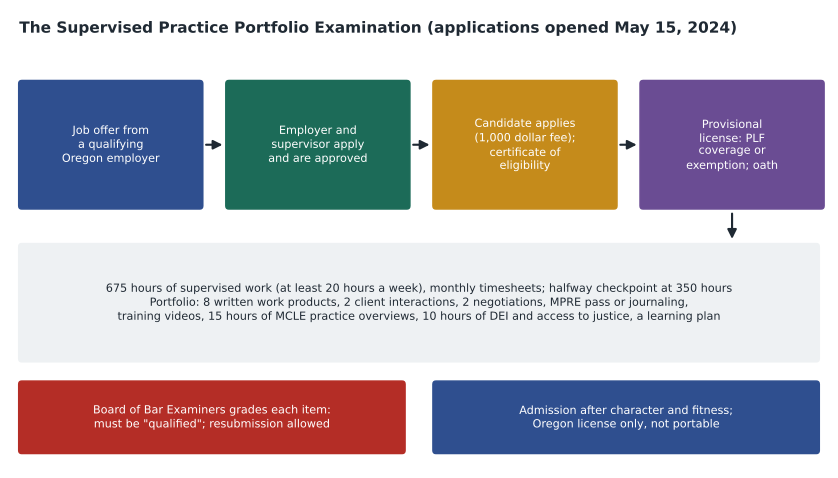
The sequence is strict. The bar's admissions page says a candidate may file her SPPE application only after four things have happened: she has received a job offer, the employer has applied, the supervising attorney has applied, and the admissions office has approved both the employer and the supervisor. The candidate then files her own application with an initial fee of 1,000 dollars.
The candidate's application has two stages. First, she obtains a certificate of eligibility by providing a certificate of graduation, a character and fitness form and any required proof of licensure or educational equivalency. Second, she obtains a provisional license. For that, she must show Professional Liability Fund coverage or an exemption, file employment and supervisor verification forms and take an oath. Only then may she begin the supervised work that counts toward the portfolio.
The provisional license
A provisional licensee performs real legal work for real clients, under supervision. She drafts documents, advises clients, appears where the rules allow and negotiates on her clients' behalf. She is bound by the Oregon Rules of Professional Conduct like any lawyer. Her supervising attorney remains responsible for supervising her work, and the employer must maintain malpractice coverage. For clients, the arrangement looks much like being represented by a new associate at a firm, with the difference that the associate's license depends on the quality of the work she is doing.
What goes into the portfolio
The portfolio has several required parts. The candidate must complete 675 hours of program work, recorded on monthly timesheets. She must submit eight pieces of written work product, document two client interactions, such as initial interviews or counseling sessions, and document two negotiations. She must satisfy a professional responsibility requirement, either with a passing MPRE score or by completing the journaling alternative. And she must complete up to four hours of SPPE training videos, 15 hours of continuing legal education practice overviews, 10 hours of activities on diversity, equity, inclusion and access to justice, and a learning plan.
| Component | Requirement |
|---|---|
| Supervised work | 675 hours, recorded on monthly timesheets |
| Written work product | Eight pieces |
| Client interactions | Two, such as initial interviews or counseling sessions |
| Negotiations | Two |
| Professional responsibility | A passing MPRE score or the journaling alternative |
| Training and education | Up to 4 hours of SPPE videos, 15 hours of MCLE practice overviews, 10 hours of DEI and access-to-justice activities |
| Learning plan | Kept current through the program |
| Halfway checkpoint | After 350 hours, with at least three portfolio items |
The halfway checkpoint is a review after 350 hours. The candidate must submit a current learning plan, her timesheets, evidence of progress on the professional responsibility and diversity requirements, and at least three pieces of work product, client interaction documentation or negotiation documentation. The checkpoint exists so that a candidate who is falling behind, or whose work is not yet at the required level, learns that early rather than at the end.
How long it takes
The bar's pages do not state a fixed program length, because it depends on how many hours the candidate works each week. The arithmetic is simple. At the minimum of 20 hours a week, 675 hours takes about 34 weeks, or roughly eight months. At 40 hours a week, it takes about 17 weeks, or a little over four months, though only time spent on qualifying program work counts. The ABA Journal reported in 2024 that candidates starting in mid-May could be licensed by the fall, which fits a full-time schedule. Grading time and the character and fitness process must also be added.
How the portfolio is graded
The Board of Bar Examiners assesses the written work products, client interactions and negotiations. Each one must earn a score of 'qualified.' A candidate whose work product is not yet qualified may submit additional work until each requirement is met, and materials may be submitted on a rolling basis rather than all at once. That is a significant difference from the bar exam: the SPPE does not ask a candidate to perform once, on one day, under artificial conditions. It asks her to show, repeatedly and in real work, that she can do what a new lawyer must do.
Hana pointed out that this could cut both ways. 'On the exam, a bad day costs you six months,' she said. 'Here, a bad memo just means you write another one. But you also cannot cram for it.' Hollis agreed. 'The SPPE rewards steady work,' she said. 'The exam rewards a burst of preparation. Different people are suited to different ones.'
What the SPPE license does not do
The most important limit is portability. An SPPE license is an Oregon license. It does not produce a UBE score, and no other state is required to recognize it. A lawyer licensed through the SPPE who later wants to practice in Washington, Idaho or California must satisfy that state's rules, which may mean sitting its bar exam or, after enough years of practice, qualifying for admission on motion if that state's rules treat an Oregon license as sufficient. The ABA Journal's 2024 coverage made the same point: the SPPE license is not portable, while the UBE score is.
Other states are watching. The ABA Journal reported that the Washington Supreme Court had approved supervised-practice pathways in concept in March 2024, without implementation dates at that time. A candidate who hopes to rely on a similar route elsewhere should check each state's rules directly.
Choosing between the SPPE and the exam
Hollis gave Andre a short list of questions. Do you have a real job offer from an employer and supervisor who will qualify, and will the pay work? Do you plan to stay in Oregon for at least several years? Are you better at steady, documented work than at a high-stakes exam? Can you finish the required coursework in time? If the answer to all four is yes, the SPPE is worth serious thought. If you may move, or if the offer is uncertain, the exam keeps more doors open.
For Hana, the answer was clear: no qualifying offer, a firm that serves clients on both sides of the Columbia and a real prospect of seeking Washington admission later. The exam was the right choice. For Andre, the answer depended on his nonprofit's budget. He decided to file for the July 2027 exam by the April deadline, take business associations and the March 2027 MPRE, and ask the nonprofit in January whether it would apply as an SPPE employer. If it did and both applications were approved, he would withdraw from the exam and take the transfer credit.
Worked problem
Checking an SPPE plan
A Salem solo practitioner, admitted in Oregon in 2023 and with no discipline, offers a recent ABA graduate a 25-hour-a-week job at the same hourly rate she pays her paralegal and proposes to supervise her SPPE portfolio. The graduate is the practitioner's nephew. Does the plan qualify?
Show solution
- The supervising attorney must have been an active Oregon member for the two years before applying and active in a bar for three of the prior five years; admission in 2023 may not satisfy the three-year requirement, depending on the date of application.
- The supervisor may not be an immediate family member of the candidate; whether a nephew counts depends on the SPPE rules' definition, which the parties must check.
- The employer must pay at least what it pays other recent graduates, not what it pays a paralegal.
- Twenty-five hours a week satisfies the 20-hour minimum.
Answer: Probably not as proposed: the pay must match recent-graduate pay, the supervisor's years of practice may be insufficient, and the family relationship must be checked against the rule. The hours are adequate.
Common mistakes
MistakeThe SPPE replaced the Oregon bar exam.
InsteadThe bar exam remains available; the SPPE is an alternative.
MistakeA candidate can apply for the SPPE and then look for an employer.
InsteadThe job offer and the approval of employer and supervisor come first.
MistakeAn SPPE license can be transferred to other UBE states.
InsteadIt is an Oregon license only and produces no UBE score.
MistakeSPPE work can be unpaid.
InsteadEmployers must pay at least what they pay other recent graduates, with a limited exemption for grant, stipend and pro bono positions.
MistakeOne failed work product ends the SPPE.
InsteadA candidate may submit additional work until each requirement is graded qualified.
Practice problems
Work each problem on paper first, then reveal the answer to check.
When did SPPE applications open?
Show answer
May 15, 2024.
How many hours of supervised work does the SPPE require?
Show answer
675 hours.
How many written work products, client interactions and negotiations are required?
Show answer
Eight, two and two.
What is the initial SPPE fee?
Show answer
1,000 dollars.
What happens at 350 hours?
Show answer
A halfway checkpoint with a learning plan, timesheets and at least three portfolio items.
Summary and key terms
- The SPPE is Oregon's supervised-practice alternative to the bar exam; applications opened May 15, 2024.
- Candidates need an ABA-accredited degree (or narrow alternatives), a qualifying job offer and the eight foundational courses.
- Employers must be Oregon-based, provide at least 20 hours a week, pay parity and malpractice coverage.
- Supervisors need Oregon membership, years of practice, no public discipline and training.
- The portfolio requires 675 hours, eight work products, two client interactions, two negotiations and an MPRE or journaling.
- The Board grades each item qualified; the license is Oregon-only and not portable.
- provisional license
- The limited license under which an SPPE candidate practices while building her portfolio.
- supervising attorney
- The experienced Oregon lawyer who oversees an SPPE candidate's work and completes portfolio templates.
- portfolio
- The record of an SPPE candidate's supervised work, graded by the Board of Bar Examiners.
- qualified
- The grade each SPPE work product, client interaction and negotiation must earn.
- learning plan
- The candidate's plan of the skills she will develop during the SPPE, kept current.
Lesson quiz · 5 questions
Score 60% or more to complete this lesson.
Create a free account to save your progress, take quizzes and earn a certificate.