
BAR-238 · Lesson 4 of 12 · 21 min
The Oregon bar exam: the NextGen UBE, scoring and the 620 passing score
▶ Video coming soon A video version of this lesson is on the way.
Hana knew one person who had taken the new exam: Priya, a friend from law school who sat Oregon's first NextGen administration in July 2026 and passed with a 631. Hana called her the night after her first session with Hollis and asked what it had felt like. Priya said three things. The multiple-choice questions felt familiar, though more of them asked what a lawyer should do next rather than what the rule was. The integrated sets felt like a small file landing on her desk. And the performance tasks were long, but they rewarded exactly the kind of work she did every day at her job. 'It felt less like a memory test,' Priya said, 'and more like a really long day at the office.'
This lesson describes the exam Hana will sit on February 23 and 24, 2027: the NextGen Uniform Bar Examination as Oregon gives it, what it tests, how the sessions are laid out, how the parts are weighted and scored, what Oregon's passing score of 620 means, and where Oregon law does and does not appear.
What NextGen is
The NextGen Uniform Bar Examination is NCBE's redesign of the bar exam. NCBE developed it after a multi-year study of what newly licensed lawyers actually do, and it replaces the legacy Uniform Bar Examination, which combined the Multistate Bar Examination, the Multistate Essay Examination and the Multistate Performance Test. Oregon chose to be among the first jurisdictions to give it. It gave its last legacy UBE in February 2026 and its first NextGen UBE in July 2026, on July 28 and 29, at Oregon's three law schools.
The new exam is built around two kinds of content. The first is foundational concepts and principles in eight subjects: civil procedure, contract law, evidence, torts, business associations, constitutional law, criminal law and real property. The second is foundational lawyering skills: legal research, legal writing, issue spotting and analysis, investigation and evaluation, client counseling and advising, negotiation and dispute resolution, and client relationship and management. Most questions test both at once, asking a candidate to apply a rule in the setting of a realistic task.
Two more subjects appear in a limited way during the first years. Family law and trusts and estates are tested through performance tasks, and may appear in integrated question sets, with the necessary legal resources provided, from July 2026 through at least February 2028. NCBE has announced that family law will be tested like the other foundational subjects from July 2028. A candidate sitting in 2027 should still know the basic concepts of both, but she will be given the law when those subjects appear.
How the exam is laid out
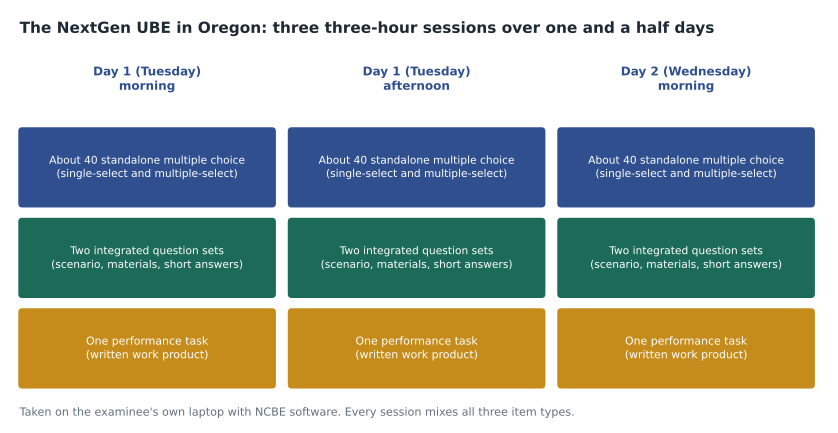
The NextGen exam is given in three sessions of three hours each over one and a half days. Oregon's NextGen administrations follow NCBE's national schedule. On the first day there is a morning session and an afternoon session; on the second day, there is one morning session. Each session has the same structure: about 40 standalone multiple-choice questions, two integrated question sets and one performance task. The exam is taken on a laptop running NCBE's secure software, which candidates register through NCBE ahead of time.
The three question types
Standalone multiple-choice questions look most like the legacy MBE, but they are not the same. Many have four options and one correct answer. Some ask the candidate to select two or more correct answers from a longer list. Many are set in practice: a client describes a problem, and the question asks what the lawyer should advise, what fact she most needs to learn, or which document best supports a claim. Doctrine still matters, but it is tested in use.
Integrated question sets begin with a common scenario, sometimes with documents or short legal sources, and then ask several related questions. Some are multiple-choice; others call for a short written answer, such as a sentence or two identifying the strongest argument, a short paragraph applying a rule or a brief draft of a provision. The sets combine doctrine and skills in a way that resembles a small assignment from a supervising lawyer.
Performance tasks are the longest items. Each gives the candidate a file of facts and a library of legal authorities and asks for a written work product, such as an objective memo, a persuasive brief, a client letter, a negotiation plan or a set of discovery requests. Some tasks include a research component in which the candidate must decide which authorities in the library matter. The tasks look like the legacy Multistate Performance Test but are more varied and more closely tied to everyday practice.
Weighting
NCBE weights the three question types differently. Standalone multiple-choice questions make up 49 percent of the total score, integrated question sets 21 percent and performance tasks 30 percent. In other words, a little more than half of the score comes from tasks that require written work or the analysis of documents, which is a substantial shift from the legacy exam, where the MBE alone carried half of the score.
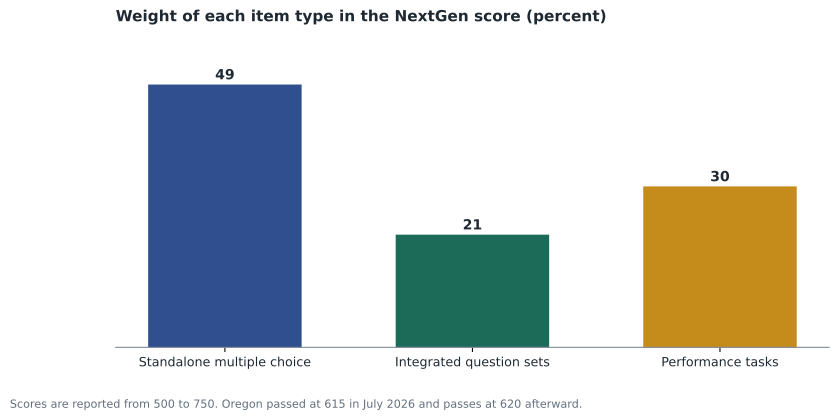
Hollis drew the practical lesson for Hana. 'You cannot treat the written work as an afterthought,' she said. 'Half of your score comes from reading files, organizing an answer and writing it clearly under time pressure. You do that every day at the firm, but not on a clock.'
Scoring
The NextGen exam is scored on a new scale that runs from 500 to 750. NCBE grades the multiple-choice items, and graders in each jurisdiction, trained under NCBE's guidance, grade the written responses. NCBE then scales and equates the results so that a given score means the same level of performance on every administration and in every jurisdiction. Candidates receive a single total score. There is no separate passing score for each question type or subject; strong performance in one area can make up for weaker performance in another.
Equating matters for a candidate's planning. The exam on February 23 and 24, 2027 will contain different questions from July 2026, and some forms are slightly harder than others. Equating adjusts for those differences. A candidate does not need to worry that she drew a harder exam; the score she receives is designed to reflect her performance as if every exam were equally difficult.
Oregon's passing score
On February 3, 2026, the Oregon Supreme Court entered an order setting the passing score for the July 2026 NextGen exam at 615 and providing that the passing score for later administrations would be 620. Hana's February 2027 exam is therefore scored against 620. The bar's admissions page recorded both figures, and bar review summaries report the same 620 standard going forward.
For comparison, NCBE's chart of NextGen passing scores showed a range of choices among the early jurisdictions. Missouri set 610, Washington set 610 for its first administrations, and Idaho set 616, for example. Oregon's legacy UBE passing score had been 270, which is why NCBE's chart lists 270 as the minimum legacy score Oregon accepts by transfer. The NextGen scale is not a simple conversion of the old one, and NCBE has published concordance information for jurisdictions setting new standards.
| Administration | Exam | Oregon passing score |
|---|---|---|
| Through February 2026 | Legacy UBE | 270 |
| July 2026 | NextGen UBE | 615 (Supreme Court order of February 3, 2026) |
| February 2027 and later | NextGen UBE | 620 |
How the first administration went
NCBE reported that about 2,643 applicants in ten jurisdictions sat the first operational NextGen exam on July 28 and 29, 2026. Most locations ran without significant incident, but three locations in three jurisdictions had problems. In Washington, an infrastructure issue at one venue led the Washington State Bar Association to cancel the July administration for most of its applicants and offer a make-up exam, a transfer to February 2027 or a refund. In Missouri, delayed starts meant some applicants finished the first day's sessions the next day, and one Maryland location started 45 minutes late. Oregon was not among the locations NCBE identified as affected.
On September 25, 2026, NCBE announced the national results. Of the 2,630 examinees who earned an official score, 72.7 percent passed, including 85.2 percent of first-time takers and 41.0 percent of repeaters. NCBE's analysis found no consistent difference in scores between examinees who experienced disruptions and those who did not. For a February 2027 candidate, the useful lesson is that the exam behaved much as the legacy exam did in pass rates and that the logistics, not the content, were the new risk.
Where Oregon law appears
Oregon law does not appear on the NextGen exam. The exam tests general principles of law that apply in most American jurisdictions, and where a task depends on particular rules, the task supplies them. NCBE's chart lists Oregon's jurisdiction-specific requirement for the NextGen exam as to be announced, and Oregon had not added a separate Oregon law test for exam applicants as of November 2026.
That does not mean Oregon law can be ignored. Oregon expects new lawyers to learn it in practice and through continuing legal education. Lawyers admitted by UBE score transfer must complete Oregon-specific credits after admission, including four credits on Oregon practice and procedure, and lawyers admitted by comity must complete 15 credits of Oregon practice, procedure and ethics before admission. Lessons 7 through 10 of this course introduce the Oregon law a new lawyer meets in the first year.
Hana found that reassuring and slightly alarming. 'So I study the general law for the exam,' she said, 'and then I learn the Oregon law on the job.' Hollis said that was right, and that it was not so different from the way she had learned Oregon water law at the firm. 'The exam checks whether you can think like a lawyer with the law in front of you,' she said. 'Your clients will check whether you know Oregon.'
Results
NCBE reports scores to the jurisdiction, and the Oregon State Bar releases results to applicants. For the July 2026 exam, national results were announced in late September. For a February exam, results usually come in the spring. Once she has passed, the candidate still has to complete any remaining requirements, take the oath and be admitted by the Supreme Court before she may practice.
Worked problem
Reading a score
Andre sits the July 2027 Oregon exam. His score report shows a total scaled score of 618. He did very well on the performance tasks and less well on the standalone multiple-choice questions. Has he passed?
Show solution
- Oregon's passing score for exams after July 2026 is 620.
- NextGen reports a single total score with no separate passing score for each part.
- Strong performance tasks can offset weaker multiple choice, but the total still has to reach 620.
- A score of 618 is below 620, even though it would have passed in July 2026 when the score was 615.
Answer: No. A total of 618 is below Oregon's 620 passing score for exams after July 2026; he would need to retake the exam.
Common mistakes
MistakeThe NextGen exam has a separate passing score for each section.
InsteadCandidates receive one total score on a 500 to 750 scale.
MistakeOregon's passing score is 615 for every NextGen exam.
Instead615 applied to July 2026 only; 620 applies to later exams.
MistakeMultiple choice is still half the score.
InsteadStandalone multiple choice is 49 percent; integrated sets 21 percent and performance tasks 30 percent.
MistakeThe exam tests Oregon law.
InsteadIt tests general principles; Oregon law is learned through practice and Oregon CLE requirements.
MistakeFamily law will not appear at all until 2028.
InsteadIt appears through performance tasks and possibly integrated sets, with resources provided, from July 2026.
Practice problems
Work each problem on paper first, then reveal the answer to check.
How long is the NextGen exam, and how is it divided?
Show answer
Three three-hour sessions over one and a half days.
What are the three question types and their weights?
Show answer
Standalone multiple choice 49 percent, integrated question sets 21 percent, performance tasks 30 percent.
What is the NextGen score scale?
Show answer
500 to 750.
When did the Oregon Supreme Court set Oregon's NextGen passing scores?
Show answer
February 3, 2026.
What was the national pass rate for the July 2026 NextGen exam?
Show answer
72.7 percent overall; 85.2 percent for first-time takers.
A sample session in practice
Hollis walked Hana through how a single three-hour session might feel. The session opens with a block of standalone multiple-choice questions. A candidate who spends about one and a half minutes on each will use about an hour on the block. Then come two integrated sets, each built around a short file: perhaps a client email, a lease clause and a statute, followed by several questions, two of them asking for short written answers. A careful candidate might spend about half an hour on each set. That leaves roughly an hour for the performance task, which may ask for a short memo or a letter based on a file and a library.
The timing is a guide, not a rule, and NCBE's software shows the time remaining for the whole session. What matters is that the candidate decides on a plan before the exam and checks it during the session. 'The worst outcome is a beautiful performance task and twenty blank multiple-choice questions,' Hollis said, 'or the reverse.'
What multiple-select questions reward
Multiple-select questions ask a candidate to choose every correct answer from a list. They reward precise knowledge and careful reading of each option on its own terms. A candidate who knows the rule well can usually eliminate the clearly wrong options and then test each of the remaining ones against the facts. Guessing is less useful than in single-answer questions, because a candidate must identify the full set of correct choices. NCBE's sample questions show how the format works, and Hollis asked Hana to complete every sample multiple-select question NCBE had published before January.
Reading the library
Performance tasks give candidates a library of legal sources, and NextGen tasks sometimes include more sources than the task needs. The skill is deciding quickly which authorities control, which are distinguishable and which are irrelevant. Hollis teaches a simple first pass: read the task memo twice, skim the library's headings and holdings, and mark each source with a one-word label, such as 'controls', 'compare' or 'skip', before reading anything closely. Hana found that the habit cut ten minutes from her practice tasks within two weekends.
Summary and key terms
- Oregon gave its first NextGen UBE on July 28 and 29, 2026 at its three law schools.
- The exam has three three-hour sessions, each with about 40 multiple-choice questions, two integrated sets and one performance task.
- Weights are 49, 21 and 30 percent; scores run from 500 to 750 and are equated.
- Oregon's passing score was 615 for July 2026 and is 620 afterward.
- Family law and trusts and estates appear with resources provided through at least February 2028.
- Oregon law is not tested; Oregon expects it to be learned in practice and Oregon CLE.
- NextGen UBE
- NCBE's redesigned Uniform Bar Examination, first given in July 2026.
- integrated question set
- A group of related questions built on one scenario, combining multiple-choice and short written answers.
- performance task
- A long written assignment based on a file of facts and a library of legal sources.
- equating
- The statistical process that makes scores comparable across different exam forms.
- foundational lawyering skills
- The practice skills NextGen tests, such as research, writing, counseling and negotiation.
Lesson quiz · 5 questions
Score 60% or more to complete this lesson.
Create a free account to save your progress, take quizzes and earn a certificate.