
BAR-238 · Lesson 7 of 12 · 22 min
Oregon courts, the Oregon Constitution and civil procedure
▶ Video coming soon A video version of this lesson is on the way.
Hana's first litigation assignment at the Pendleton firm was a car crash on Highway 395: a client whose pickup was struck at an intersection by a driver who said the light had been yellow. The partner asked her to draft the complaint and then, a month later, a discovery plan. Hana came back from the library puzzled. 'Where are the interrogatories?' she asked him. He smiled. 'There aren't any,' he said. 'Welcome to Oregon.' She told the story to Hollis, who said it was the best possible way to start this lesson.
This lesson describes how Oregon's courts are organized and how its judges are chosen, the place of the Oregon Constitution in Oregon litigation, and the features of the Oregon Rules of Civil Procedure that most often surprise lawyers trained on the federal rules. None of it is tested on the NextGen exam, but all of it appears in an Oregon lawyer's first year.
The court system
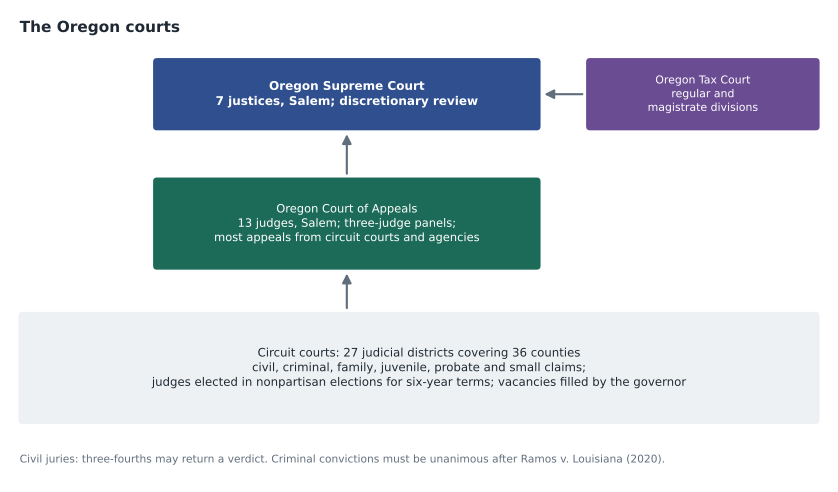
Oregon's courts form a single unified state system. At the top is the Oregon Supreme Court, with seven justices sitting in Salem. The justices choose one of their members as chief justice, who is also the administrative head of the Oregon Judicial Department. Most of the Supreme Court's work comes by petition for review from the Court of Appeals, and review is discretionary: the Court chooses the cases it hears. Some matters go directly to the Supreme Court, including review of Tax Court decisions, death penalty cases and certain election and ballot title challenges.
Below it is the Oregon Court of Appeals, an intermediate appellate court of thirteen judges, also based in Salem. It hears most appeals from the circuit courts and from many state agencies, usually in panels of three, and it decides a very large number of cases each year for a court of its size. For most Oregon litigants, the Court of Appeals is the last court that will hear their case.
The trial courts are the circuit courts, organized into 27 judicial districts covering Oregon's 36 counties. Some districts cover a single populous county, such as Multnomah County, which includes Portland; others combine several rural counties. Umatilla and Morrow counties, where Hana works, share a district. The circuit courts are courts of general jurisdiction and hear civil, criminal, family, juvenile, probate and small claims matters. Oregon also has a separate Tax Court, with a regular division and a magistrate division, which hears disputes over state taxes.
How judges are chosen
Oregon elects its judges. Justices of the Supreme Court, judges of the Court of Appeals and circuit judges are all elected in nonpartisan elections for six-year terms. In practice, many judges first reach the bench by appointment: when a vacancy occurs before the end of a term, the governor appoints a replacement, who then stands for election at the next general election. Contested judicial elections happen, but incumbents usually win. A new Oregon lawyer will appear before judges who arrived both ways, and will find that the local bar knows the judges of its district well.
The Oregon Constitution first
Oregon lawyers are taught to look at the Oregon Constitution before the federal Constitution. The Oregon Supreme Court has said that when a party raises both state and federal constitutional claims, the court should decide the state claim first, because a case resolved under state law does not need to reach the federal question. The approach is often associated with Justice Hans Linde, who wrote for the Court in Sterling v. Cupp, 290 Or 611 (1981), and it was stated plainly in State v. Kennedy, 295 Or 260 (1983). Oregon courts interpret their constitution independently, looking at its text, its history and the cases construing it, rather than simply following federal decisions.
Several provisions of Article I, Oregon's bill of rights, come up again and again. Article I, section 8 protects free expression in broad terms, and in State v. Robertson, 293 Or 402 (1982), the Court held that a law aimed at the content of speech or writing is generally invalid unless it falls within a historical exception, a framework Oregon lawyers still apply. Article I, section 9 protects against unreasonable searches and seizures, and the Oregon courts have interpreted it independently of the Fourth Amendment in several respects. Article I, section 10, the remedy clause, provides that every person shall have a remedy by due course of law for injury done him in his person, property or reputation. Lesson 8 shows how that clause shapes Oregon tort law.
Oregon is also a state of direct democracy. Since the early twentieth century, Oregon voters have been able to propose and adopt laws and constitutional amendments by initiative and to refer laws passed by the legislature to the ballot. Many important Oregon rules, from criminal sentencing to land use compensation, came from ballot measures, and a new lawyer should not be surprised to find that a statute she is reading was adopted by the voters.
Juries
Oregon civil juries in circuit court have twelve members, and the Oregon Constitution allows a civil verdict by three-fourths of the jury, so nine of twelve may return a verdict. Criminal verdicts are different. Oregon long permitted nonunanimous verdicts of ten to two in most felony cases, but the United States Supreme Court held in Ramos v. Louisiana, 590 U.S. 83 (2020), that the Sixth Amendment requires a unanimous verdict to convict of a serious offense, and that rule now applies in Oregon. The civil three-fourths rule was not affected.
The Oregon Rules of Civil Procedure
Civil procedure in Oregon circuit courts is governed by the Oregon Rules of Civil Procedure, known as the ORCP. The rules are drafted by the Council on Court Procedures, a body of judges, lawyers and a public member, and they take effect unless the legislature changes them. The ORCP took effect in 1980 and borrowed much from the federal rules, but they differ in ways that matter on the first day of practice. Trial court practice is also governed by the Uniform Trial Court Rules, which apply statewide, and by each district's supplementary local rules.
Oregon is a fact-pleading state. ORCP 18 requires a complaint to contain a plain and concise statement of the ultimate facts constituting a claim for relief. Oregon courts read that to require the facts supporting each element of the claim, not bare legal conclusions. A complaint that says only that the defendant 'was negligent and caused damage' invites a motion against the pleading. A better complaint alleges what the defendant did or failed to do, where and when, and how it caused the injury, and Oregon negligence complaints traditionally list the specifications of negligence one by one. Motions against pleadings, including a motion to dismiss for failure to state ultimate facts sufficient to constitute a claim, are made under ORCP 21.
Discovery without interrogatories
The surprise Hana found is real. The ORCP do not provide for written interrogatories to parties, the questions that federal litigators use to learn the other side's contentions, witnesses and documents. Oregon discovery relies instead on requests for production of documents under ORCP 43, requests for admission under ORCP 45, depositions under ORCP 39 and 40, and physical and mental examinations under ORCP 44. Lawyers who move to Oregon from other states learn to do with requests for production and depositions what they once did with interrogatories.
Expert discovery is also limited. Oregon's rules do not provide for routine pretrial disclosure of the other side's trial experts or of their opinions, so in many Oregon civil cases a lawyer does not learn exactly what the opposing expert will say until the expert testifies. There are exceptions, such as reports of medical examinations under ORCP 44, and lawyers sometimes agree to exchange information. The practical effect is that Oregon trial lawyers prepare for experts differently: they anticipate opinions, research the expert's prior testimony and prepare cross-examination on short notice.
| Topic | Federal Rules of Civil Procedure | Oregon Rules of Civil Procedure |
|---|---|---|
| Pleading standard | Plausibility-based notice pleading after Twombly and Iqbal | Fact pleading of ultimate facts (ORCP 18) |
| Interrogatories | Allowed (Rule 33) | Not provided for |
| Expert disclosure | Required reports and depositions (Rule 26) | No routine pretrial expert discovery |
| Civil jury verdict | Unanimous unless the parties stipulate otherwise | Three-fourths of the jury |
| Rulemaker | Supreme Court under the Rules Enabling Act | Council on Court Procedures, subject to the legislature |
Summary judgment and arbitration
Summary judgment under ORCP 47 is available when there is no genuine issue as to any material fact and the moving party is entitled to judgment as a matter of law. Oregon courts view the record in the light most favorable to the nonmoving party, and the rule provides that no genuine issue exists if, on the record, no objectively reasonable juror could return a verdict for the adverse party on the matter that is the subject of the motion. ORCP 47 also has a provision allowing a party opposing summary judgment to rely on an affidavit or declaration of its attorney stating that a qualified expert has been retained and will testify to facts or opinions that would create a genuine issue, which reflects Oregon's limits on expert discovery.
Smaller civil cases often go to court-annexed arbitration. Oregon statutes require mandatory arbitration of many civil claims below a dollar threshold set by statute, currently 50,000 dollars, with a right to a new trial in circuit court if a party is dissatisfied with the award. Small claims, with simplified procedures and no lawyers required, are available for claims of up to 10,000 dollars. A new lawyer should confirm the current thresholds before advising a client, because the legislature has raised them over time.
Limitations and appeals
Oregon's general limitations period for personal injury is two years under ORS 12.110, subject to a discovery rule that starts the period when the plaintiff knew or reasonably should have known of the injury and its cause. Contract claims generally have six years under ORS 12.080. Claims against public bodies have special notice requirements and limits under the Oregon Tort Claims Act, discussed in Lesson 8. A notice of appeal from a circuit court judgment must generally be filed within 30 days after the judgment is entered, under ORS 19.255, and the deadline is jurisdictional: missing it ordinarily ends the appeal.
Oregon practice is electronic. Lawyers file in the circuit courts and appellate courts through the Oregon Judicial Department's electronic filing system, and the Uniform Trial Court Rules set formatting and filing requirements that a new lawyer should read before her first filing. Hana learned that lesson when a clerk rejected her first motion because of a caption formatting problem the partner had never noticed in twenty years.
Worked problem
An intersection crash
Hana's client was struck at an intersection in Pendleton on March 3, 2026 by a driver from Walla Walla, Washington. The client wants to know what the other driver will say about the light, and the partner wants to know what the defense accident reconstruction expert will conclude. What can Hana do under the ORCP, and when must the complaint be filed?
Show solution
- The complaint must plead ultimate facts under ORCP 18: the duty, the specific acts or omissions, causation and damages.
- Oregon does not provide for interrogatories, so Hana should use requests for production under ORCP 43, requests for admission under ORCP 45 and a deposition of the other driver under ORCP 39.
- There is no routine pretrial discovery of the defense expert's opinions, so she should prepare for cross-examination by researching the expert and anticipating the opinion.
- The two-year personal injury period under ORS 12.110 runs from March 3, 2026, subject to the discovery rule.
Answer: She should plead specific facts, take the other driver's deposition and use requests for production and admission, prepare for the defense expert without expecting pretrial disclosure, and file well before March 3, 2028.
Common mistakes
MistakeOregon follows federal notice pleading.
InsteadOregon requires ultimate facts constituting a claim under ORCP 18.
MistakeInterrogatories are a standard Oregon discovery device.
InsteadThe ORCP do not provide for interrogatories.
MistakeAn Oregon civil jury must be unanimous.
InsteadThree-fourths of the jury may return a civil verdict.
MistakeOregon courts decide federal constitutional claims first.
InsteadOregon courts decide state constitutional claims first.
MistakeOregon judges are appointed for life.
InsteadThey are elected in nonpartisan elections for six-year terms, though many first arrive by appointment.
Practice problems
Work each problem on paper first, then reveal the answer to check.
How many judges sit on the Oregon Court of Appeals?
Show answer
Thirteen.
How many judicial districts do the circuit courts have?
Show answer
27, covering 36 counties.
Which case is associated with Oregon's state-constitution-first approach, written by Justice Linde?
Show answer
Sterling v. Cupp (1981); see also State v. Kennedy (1983).
What does ORCP 18 require in a complaint?
Show answer
A plain and concise statement of the ultimate facts constituting a claim.
What is the general personal injury limitations period in Oregon?
Show answer
Two years under ORS 12.110, with a discovery rule.
Federal court in Oregon
Many Oregon cases end up in federal court instead. The United States District Court for the District of Oregon sits in Portland, Eugene, Medford and Pendleton, and its cases follow the Federal Rules of Civil Procedure and the court's local rules, not the ORCP. Appeals go to the Ninth Circuit. A case like Hana's intersection crash, between an Oregon plaintiff and a Washington defendant, could be removed to federal court if the amount in controversy exceeded the jurisdictional threshold, and the procedural landscape would change overnight: interrogatories and expert reports would be available, notice pleading under Twombly and Iqbal would govern, and a unanimous jury would be required unless the parties agreed otherwise. Oregon litigators keep both sets of rules at hand, and part of a case's early strategy is choosing, or anticipating, the forum.
Reading the ORCP
Hollis suggested a practical exercise. Read ORCP 18, 21, 36, 39, 43, 44, 45 and 47 in full in one sitting, then read the corresponding federal rules. Note each place where the Oregon rule says something different or says nothing at all. The list Hana produced in an hour, she said, was more useful at work than anything in her civil procedure casebook, because it showed her where her law school instincts would mislead her in an Oregon courtroom.
Courts and Oregon geography
Oregon's geography shapes practice too. Most of the state's lawyers work in the Willamette Valley, from Portland through Salem to Eugene, while eastern Oregon districts cover enormous areas with few lawyers and judges. A lawyer in Pendleton may appear in circuit courts hours apart in the same week, often by remote appearance when the court allows it. Hana's firm keeps a list of each district's supplementary local rules and judges' practices, and she was told to read the list before her first appearance in each one.
Summary and key terms
- The Supreme Court (7 justices), Court of Appeals (13 judges), circuit courts (27 districts) and Tax Court form the system.
- Oregon judges are elected in nonpartisan elections for six-year terms; vacancies are filled by appointment.
- Oregon courts decide state constitutional claims first (Sterling v. Cupp; State v. Kennedy).
- Civil verdicts need three-fourths of the jury; criminal convictions must be unanimous after Ramos.
- The ORCP require fact pleading and provide no interrogatories and no routine expert discovery.
- Personal injury claims have two years; notices of appeal are due within 30 days.
- ORCP
- The Oregon Rules of Civil Procedure, drafted by the Council on Court Procedures.
- ultimate facts
- The facts supporting each element of a claim, which ORCP 18 requires a complaint to plead.
- first things first
- The Oregon practice of deciding state constitutional questions before federal ones.
- remedy clause
- Article I, section 10 of the Oregon Constitution, guaranteeing a remedy by due course of law for injury.
- Uniform Trial Court Rules
- Statewide rules governing practice and filing in the Oregon circuit courts.
Lesson quiz · 5 questions
Score 60% or more to complete this lesson.
Create a free account to save your progress, take quizzes and earn a certificate.