
BAR-238 · Lesson 11 of 12 · 21 min
Score transfer, admission by comity and practice after admission in Oregon
▶ Video coming soon A video version of this lesson is on the way.
Hana's firm has a partner who came to Oregon from Washington twelve years ago and another who came from Idaho last year. They took different routes into the Oregon bar, and neither of them sat the Oregon exam. When Hana asked how they had done it, the Idaho partner laughed. 'I filled out a very long form, took fifteen hours of Oregon CLE and waited,' he said. 'The hardest part was finding my old trust account records.' Hollis used the two partners' stories to frame the last substantive lesson: how lawyers already licensed or tested elsewhere join the Oregon bar, and what every new Oregon lawyer must do after admission.
This lesson covers admission by transferred UBE score, admission by comity, the limited forms of admission for house counsel and others, and the obligations that begin with admission: the oath, license fees, Professional Liability Fund coverage, minimum continuing legal education and the New Lawyer Mentoring Program. It ends with the question Hana cares about most: how an Oregon score can carry her into Washington.
Admission by transferred UBE score
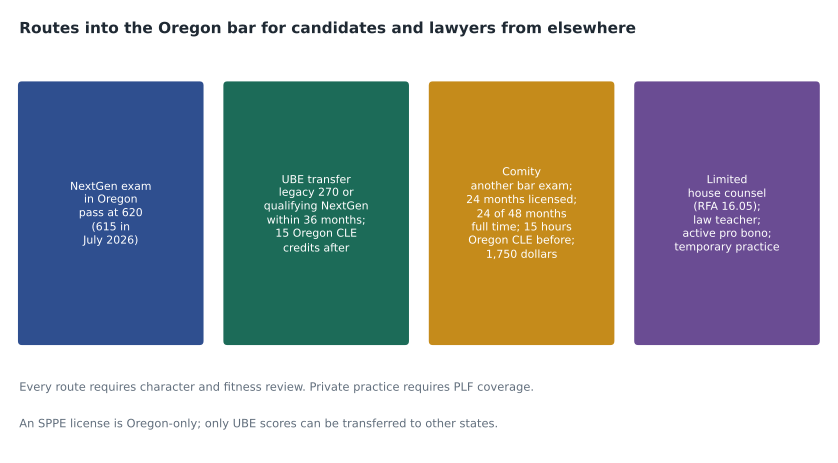
An applicant who earned a qualifying score on the Uniform Bar Examination in another jurisdiction can ask Oregon to accept it instead of sitting the Oregon exam. According to NCBE's chart and the bar's pages, Oregon accepts a legacy UBE scaled score of at least 270 earned within the preceding 36 months. Oregon also accepts NextGen UBE scores earned elsewhere; NCBE's chart listed a minimum of 615 at the time of Oregon's first NextGen administration, and an applicant should confirm the current minimum, since Oregon's own passing score for later exams is 620. Oregon does not accept a transferred MBE score alone, and it has no Oregon-specific test that transfer applicants must pass before admission.
The applicant must still satisfy everything else: the education requirement, character and fitness review, the MPRE and the oath. Oregon then adds a requirement after admission. Under the bar's rules, a lawyer admitted by UBE transfer must complete 15 credits of continuing legal education in the first reporting period: two ethics credits, one of them on Oregon ethics; ten practical skills credits, four of them on Oregon practice and procedure; and a three-credit introductory access to justice course approved by the bar. The MCLE program manager may waive the practical skills requirement for a lawyer who has practiced for three consecutive years in another jurisdiction.
Admission by comity
Lawyers with practice experience elsewhere may be admitted by comity, Oregon's form of admission on motion. Until July 2022, Oregon's rule for such lawyers was a reciprocity rule, which depended on whether the other jurisdiction offered similar treatment to Oregon lawyers. In July 2022, the Supreme Court and the bar amended the rule to a comity rule that looks at the applicant's own record instead. The bar's MCLE rules were updated to match effective April 1, 2024, and the prior-practice condition changed from three consecutive years immediately before admission to at least 24 of the 48 months immediately before admission.
The bar's comity application page sets out the requirements as of November 2026. The applicant must be an active member of the bar of another state, district or territory of the United States, must have passed that jurisdiction's bar exam, and must have been licensed in at least one United States jurisdiction for 24 consecutive months. She must have practiced full time, meaning an average of at least 30 hours a week of qualifying legal work, for at least 24 of the 48 months before applying. She must not have been administratively or disciplinarily suspended in the 60 months before applying and must have no known pending disciplinary matters elsewhere. She must hold a JD or LLB from an ABA-accredited law school or satisfy RFA 3.1(3).
Two Oregon-specific requirements follow. Before admission, a comity applicant must complete and certify 15 hours of continuing legal education approved by the bar's MCLE department: two hours on Oregon legal ethics, four on Oregon civil practice and procedure, and nine general hours emphasizing Oregon law. The courses may be completed in a window from six months before to six months after the application is filed. And the applicant must obtain Professional Liability Fund coverage, or substantially equivalent coverage, if she will be in private practice. The application fee is 1,750 dollars. There is no filing deadline, although processing may be slower near bar exam deadlines, and the application must be completed within six months of filing.
One caution. NCBE's chart for Oregon still described the practice requirement for admission on motion as five of the last seven years when it was checked for this course. The bar's own comity page and its explanation of the 2022 amendment describe the 24-of-48-month requirement. When an official state source and a national chart disagree, the state source controls, and a lawyer planning a comity application should confirm the current rule directly with the admissions department.
| Requirement | Comity (since July 2022) | UBE transfer |
|---|---|---|
| Exam | Passed the bar exam of the other jurisdiction | Qualifying UBE score within 36 months |
| Practice | Licensed 24 consecutive months; full time 24 of the last 48 months | None |
| Discipline | No suspension in 60 months; no pending matters | Character and fitness review |
| Oregon CLE | 15 hours before admission (2 Oregon ethics, 4 Oregon practice, 9 general) | 15 credits after admission (2 ethics, 10 practical skills including 4 Oregon practice, 3 access to justice) |
| Fee | 1,750 dollars | Set by the fee schedule |
Limited admissions
Oregon also offers narrower forms of admission. House counsel admission under RFA 16.05 is available to a lawyer employed by a business entity authorized to do business in Oregon who is admitted in another state, territory, commonwealth or the District of Columbia; a house counsel licensee may provide legal services only to her employer. Oregon has admission categories for law teachers and for out-of-state lawyers who want to provide pro bono services through qualifying programs, and rules for temporary practice in limited circumstances, including RFA 13.11 through 13.14. A lawyer licensed elsewhere who needs to appear in a single Oregon case usually seeks admission pro hac vice, which requires association with an active Oregon lawyer under the court rules.
The oath and license fees
Every new Oregon lawyer takes an oath, and the signed oath is filed with the Oregon Supreme Court in Salem. The Court then admits the applicant, and the bar enrolls her as an active licensee. Each year after that, she pays an annual license fee to the Oregon State Bar. Active licensees in private practice with an Oregon principal office also pay the Professional Liability Fund assessment, 3,500 dollars for 2027, unless they qualify for an exemption.
Minimum continuing legal education
Oregon's MCLE rules require 45 credits in each three-year reporting period. Within that total, bar review summaries of the current rules describe five ethics credits, one credit on child abuse and elder abuse reporting, a credit on mental health and substance use, and a three-credit access to justice requirement in alternating reporting periods; the bar's own MCLE page notes that these specialty requirements depend on the reporting period and directs licensees to their online MCLE dashboard for their exact requirements. Credits must be completed by midnight on April 30 of the last year of the reporting period, and the compliance report is due May 31. Up to 15 credits, including no more than six ethics credits, may carry over to the next period.
New admittees follow a special schedule. A lawyer's first reporting period begins on the date of admission and ends on April 30 of the following calendar year, and new admittees must complete 15 credits in that first period. The new-admittee requirement includes two ethics credits, one of them on Oregon ethics and professionalism, practical skills credits including four on Oregon practice and procedure, and the three-credit introductory access to justice course. After the first period, every period is three years. A comity admittee who meets the practice condition has a first period of three years beginning May 1 of the year after admission.
| Reporting period | Credits | Specific requirements (check your MCLE dashboard) |
|---|---|---|
| First period for new admittees: admission to April 30 of the next calendar year | 15 | Ethics including Oregon ethics and professionalism; practical skills including 4 on Oregon practice and procedure; 3-credit introductory access to justice course |
| Each later period: three years | 45 | Ethics; abuse reporting; mental health and substance use; access to justice in alternating periods |
| Deadlines | Complete by April 30; report by May 31 |
The New Lawyer Mentoring Program
Oregon was an early adopter of mandatory mentoring for new lawyers. The Oregon State Bar and the Supreme Court launched the New Lawyer Mentoring Program in 2011, loosely based on programs in Georgia and Utah, and it applies to incoming lawyer members. Each new lawyer is matched with an experienced mentor, and the two work through a core curriculum covering subjects such as professionalism, client relations, law office management, trust accounting and practice-area skills, adapted to the new lawyer's practice. The program formalizes the kind of mentoring that once happened informally in firms and local bar communities. Some new lawyers may qualify for exemptions or deferrals, and the bar's program pages describe the current requirements and how completion is certified.
Hana asked whether her supervising partner could be her mentor. Hollis said many new lawyers are mentored by someone in their own office, but that the program's rules govern who may serve and that a mentor from outside the firm can be valuable precisely because she is outside it. 'You will learn how your firm does things at your firm,' she said. 'A mentor can tell you how everyone else does them.'
From Oregon to Washington
Hana's long-term plan includes Washington. Her firm's clients farm on both sides of the Columbia, and the partners are licensed in both states. Because Washington is also a UBE jurisdiction that gives the NextGen exam, Hana can ask Washington to accept her Oregon NextGen score, provided it meets Washington's minimum and is within Washington's time limit, and provided she satisfies Washington's education, character and fitness and other requirements, including any Washington-specific component. She should check Washington's rules when she has her score rather than assuming that Oregon's rules apply in reverse. Andre, if he chooses the SPPE, would not have that option, because an SPPE license produces no transferable score.
Worked problem
A Washington lawyer moves to Portland
Zelda Carrow passed the Washington bar exam in 2019, has been licensed there since, and has practiced full time at a Seattle firm. She has never been disciplined. She is moving to Portland in March 2027 to join a firm and wants to be admitted in Oregon without sitting an exam. What route fits, and what must she do?
Show solution
- Her UBE score from 2019 is too old for transfer under the 36-month rule.
- Comity fits: she passed Washington's exam, has been licensed far more than 24 consecutive months and has practiced full time for well over 24 of the last 48 months, with no suspension or pending discipline.
- She must complete 15 hours of Oregon CLE, including two on Oregon ethics and four on Oregon civil practice and procedure, within six months before or after filing.
- She must pay the 1,750 dollar fee, pass character and fitness review, complete the application within six months and arrange PLF coverage before entering private practice in Portland.
Answer: She should apply by comity, complete the 15 hours of Oregon CLE, pay the fee, pass character and fitness and obtain PLF coverage before beginning private practice in Oregon.
Common mistakes
MistakeOregon admits lawyers on motion only from reciprocal states.
InsteadSince July 2022 Oregon uses a comity rule based on the applicant's own record.
MistakeA comity applicant needs five of the last seven years of practice.
InsteadOregon's comity page requires 24 consecutive months of licensure and full-time practice for 24 of the last 48 months; confirm with the bar.
MistakeOregon accepts a transferred MBE score.
InsteadOregon accepts UBE scores, not MBE scores alone.
MistakeNew lawyers have three years to earn their first CLE credits.
InsteadThe first period runs from admission to April 30 of the next calendar year and requires 15 credits.
MistakeAn SPPE license can be used to transfer into Washington.
InsteadOnly a UBE score is transferable; the SPPE license is Oregon-only.
Practice problems
Work each problem on paper first, then reveal the answer to check.
What legacy UBE score and age does Oregon accept by transfer?
Show answer
At least 270, earned within the preceding 36 months.
When did Oregon change from reciprocity to comity?
Show answer
July 2022, with the MCLE rule updated effective April 1, 2024.
How many hours of Oregon CLE must a comity applicant complete before admission?
Show answer
15: two Oregon ethics, four Oregon civil practice and procedure, nine general.
How many MCLE credits are required in each later three-year period?
Show answer
45.
When did the New Lawyer Mentoring Program begin?
Show answer
In 2011.
Planning the first year
Hollis asked both candidates to sketch their first year as Oregon lawyers. Hana's sketch had five entries: oath filed and admission in the spring; PLF coverage arranged before her first day as a lawyer at the firm; enrollment in the New Lawyer Mentoring Program within the first weeks; the new-admittee MCLE credits, including the Oregon practice and procedure credits and the access to justice course, spread over the months before April 30, 2028; and, in the summer, an application to Washington to transfer her score. Hollis approved, with one addition: a monthly trust account reconciliation from her first month, even if the firm's office manager handled the books.
Practicing across the border
Oregon and Washington lawyers work together constantly along the Columbia, in Portland and Vancouver and in the farm country around Pendleton and Walla Walla. A lawyer licensed only in Oregon may not practice Washington law in Washington simply because her clients are there, and Washington's own rules govern any temporary or limited practice. Hana's firm handles the line by having its dual-licensed partners sign Washington pleadings and supervise Washington matters. Until she is admitted in Washington, Hana will work only on Oregon matters and on Washington matters under the partners' supervision as the rules allow.
Summary and key terms
- Oregon accepts legacy UBE scores of 270 within 36 months and qualifying NextGen scores; not MBE scores alone.
- UBE transfer admittees complete 15 Oregon-focused credits after admission.
- Comity (since July 2022) requires another bar exam, 24 months licensed, 24 of 48 months full-time practice and 15 Oregon CLE hours before admission.
- House counsel (RFA 16.05), law teacher, pro bono and temporary practice provide narrower routes.
- After admission: oath to the Supreme Court, annual fees, PLF coverage, 15 new-admittee credits then 45 every three years.
- The New Lawyer Mentoring Program (2011) pairs new lawyers with mentors; Oregon scores can transfer to Washington.
- comity
- Oregon's admission on motion rule, based on the applicant's practice and record rather than reciprocity.
- score transfer
- Admission based on a UBE score earned in another jurisdiction.
- house counsel
- A limited license for a lawyer licensed elsewhere who provides legal services only to her employer.
- reporting period
- The period in which MCLE credits must be earned; three years after the first period.
- NLMP
- The Oregon State Bar's New Lawyer Mentoring Program.
Lesson quiz · 5 questions
Score 60% or more to complete this lesson.
Create a free account to save your progress, take quizzes and earn a certificate.