
BAR-240 · Lesson 1 of 12 · 21 min
Becoming a lawyer in Rhode Island
▶ Video coming soon A video version of this lesson is on the way.
Joana Arruda grew up in East Providence, in a Portuguese-American family where Sunday dinner usually turned into a debate about something in the Providence Journal. Her grandfather ran a small upholstery shop in Fox Point for forty years, and the first legal problem she remembers was his fight with a landlord over a leaking roof. She finished law school in May 2026 at an ABA-approved school in New England, decided against the July exam because she wanted a summer of work first, and has clerked since June at Faria & Quinlan, a four-lawyer firm in Pawtucket. In November 2026 she filed her petition for the February 2027 Rhode Island bar exam.
At her first one-on-one session with Hollis Marchetti, the study group's coach, Joana listed what she had heard. 'Rhode Island is a UBE state, so I am taking the same exam as people in Massachusetts and Connecticut,' she said. 'But my boss says Rhode Island does not do admission on motion at all, one of my classmates says you have to sit down for an interview with a lawyer before the exam, and somebody told me the passing score used to be 276. I want one map of how this works.'
Marchetti smiled. 'Rhode Island is small, and its admission system is small and very personal. The exam is the plain Uniform Bar Examination, and you need a 270. What makes Rhode Island different is the process around it. Every applicant files a petition with the Supreme Court. Every applicant, even someone transferring a score, meets a member of the Committee on Character and Fitness face to face. Experienced lawyers from other states cannot just be admitted on motion; they sit for the essay day of the exam instead. And Rhode Island has set a date for NextGen. Once you see the pieces, the rest is study.'
This lesson maps the whole process: who controls admission in Rhode Island, which bodies do the work, the routes into practice and the usual order of events for a first-time candidate like Joana. Later lessons take each step in detail and then turn to the Rhode Island law a new lawyer meets in Providence, Pawtucket, Warwick, Cranston, Newport or Westerly.
The Rhode Island Supreme Court controls admission
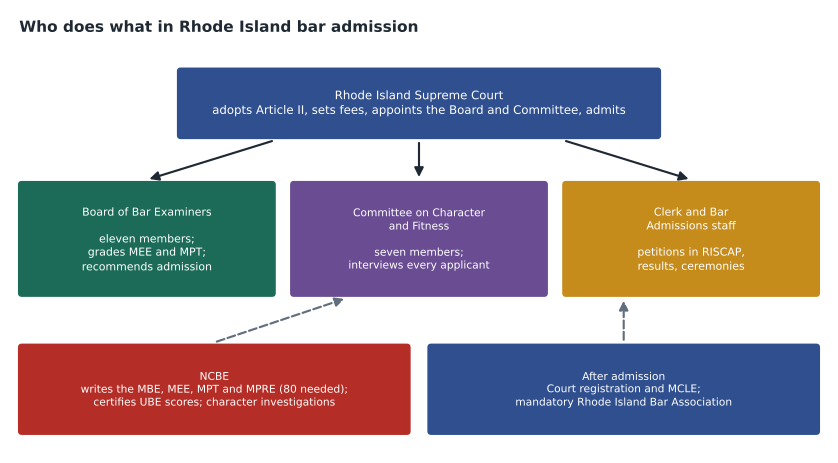
Admission to practice law in Rhode Island is a function of the judiciary. The Rhode Island Supreme Court adopts the rules for admission, which appear in Article II of its rules, titled Admission of Attorneys and Others to Practice Law. The Court sets the fees, appoints the Board of Bar Examiners and the Committee on Character and Fitness, and alone admits applicants. Changes to the exam come by order of the Court. In March 2021, for example, the Court lowered the passing score from 276 to 270, beginning with the February 2021 exam, and in May 2025 it accepted the Board's recommendation to adopt the NextGen bar exam beginning in July 2028.
Because the Court controls admission, the rules are the first source a candidate should read. Article II is short. It is supplemented by the Board of Bar Examiners Rules of Practice, a more detailed document that covers deadlines, the MPRE, exam-day rules, grading, results and the swearing-in. The Rules of Practice were most recently revised on January 6, 2026. If anything in a study guide, a website or this course conflicts with the current rules, the rules control. Every number here should be checked against the version in force for your administration.
The bodies that do the work
Rhode Island spreads the work of admission across a handful of bodies, most of them at the Licht Judicial Complex at 250 Benefit Street in Providence, which houses the Supreme Court.
The Board of Bar Examiners has eleven members appointed by the Court for five-year terms. It evaluates applicants' qualifications, examines their knowledge of the law and recommends admission to the Court. Board members grade the written components of the exam, the MEE and the MPT. The Board may waive its rules for good cause when doing so does not harm the public, although it does not waive passing scores.
The Committee on Character and Fitness has seven members: a member of the Board, the Attorney General or a designee, the Clerk of the Supreme Court or a designee and four members of the Rhode Island Bar, each serving a three-year term with a limit of two terms. The Committee interviews applicants, investigates their backgrounds and recommends admission, conditional admission or denial. Rhode Island is one of the few states where every applicant has an in-person interview with a Committee member, usually about a month before the exam.
The Clerk of the Supreme Court receives petitions, and the Bar Admissions staff in the Clerk's Office run the process day to day. They prefer to communicate by email. Applicants file through the Rhode Island Supreme Court Attorney Portal, known as RISCAP, which also handles deferrals, withdrawals, petitions to reapply and score transfers.
After admission, a lawyer deals with two more bodies. The Supreme Court registers and regulates lawyers through annual registration, the Disciplinary Board and Disciplinary Counsel, and the Mandatory Continuing Legal Education Commission. The Rhode Island Bar Association is a separate professional association that every Rhode Island lawyer must join. It is not the licensing authority; the Court is.
NCBE's part
The National Conference of Bar Examiners writes every exam component Rhode Island uses: the Multistate Bar Examination, the Multistate Essay Examination, the Multistate Performance Test and the Multistate Professional Responsibility Examination. Rhode Island applicants first complete NCBE's electronic character and fitness application, and then file their petition for admission in RISCAP, which attaches that NCBE application. For experienced attorneys and score-transfer applicants, NCBE also conducts a character investigation for a separate fee. NCBE certifies UBE scores, and Rhode Island treats an NCBE-certified score as final.
The routes into practice
Rhode Island has three main routes into regular practice, plus some limited and temporary forms of admission.
The first is admission on examination under Rule 1. That is Joana's route, and the route for nearly every recent graduate. The applicant sits for both days of the Uniform Bar Examination in Rhode Island and needs a total scaled score of at least 270.
The second is admission by transferred UBE score under Rule 1B. An applicant who earned a UBE score of at least 270 in another jurisdiction may transfer it, provided the exam was taken within two years before the petition is filed. Transfer petitions are processed on a rolling basis.
The third is the attorneys' examination under Rule 1A. A lawyer who has been admitted for at least five years in another state, district or territory and who has practiced full time, or taught full time at an ABA-accredited law school, for at least five of the last ten years may sit for only the written day of the exam, the MEE and MPT. The passing score on that day alone is 135. This is Rhode Island's substitute for admission on motion: Rhode Island has no reciprocity with any other jurisdiction and does not admit lawyers on motion.
Beyond those three routes, Rule 2 allows limited temporary admission in specific situations, such as lawyers working for indigent legal services programs, military spouses and lawyers awaiting a Rule 1A exam, and Rule 9 covers pro hac vice appearances by out-of-state lawyers, in-house counsel registration and senior law students. Lesson 11 covers these.
| Route | Who uses it | Key Rhode Island requirements |
|---|---|---|
| Rule 1: examination | Recent graduates and others who do not qualify for Rule 1A | ABA-accredited J.D.; both days of the UBE; total scaled score of 270; MPRE 80; character and fitness interview |
| Rule 1B: UBE score transfer | Applicants who passed the UBE elsewhere | Score of 270 or more from an exam taken within two years before the petition; MPRE 80; interview |
| Rule 1A: attorneys' examination | Lawyers admitted at least five years elsewhere with five of the last ten years in full-time practice or teaching | MEE and MPT only; scaled score of 135; MPRE 80; NCBE character investigation; interview |
The usual order of events
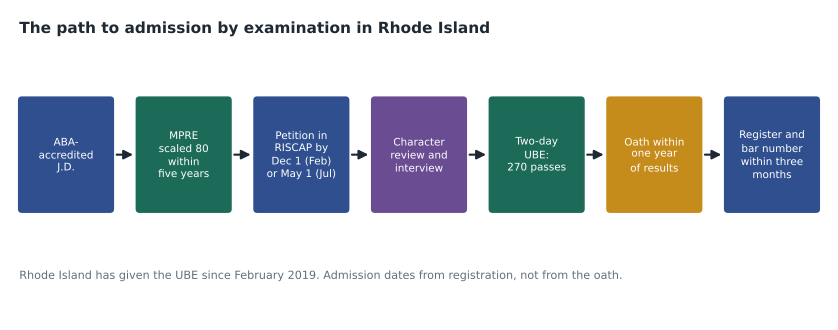
For a first-time candidate like Joana, the steps run in a predictable order. She earns a J.D. from an ABA-accredited law school and takes the MPRE, earning a scaled score of at least 80 within five years before the filing deadline. She completes NCBE's online application and then files her petition in RISCAP within the filing window: October 1 to December 1 for the February exam, or March 1 to May 1 for the July exam. She pays the 975-dollar application fee. Her character and fitness file is reviewed, and about a month before the exam she sits for a one-on-one interview with a Committee member and receives her admission ticket. She takes the two-day UBE, typically at the Rhode Island Convention Center in Providence. If she passes, she takes the oath at a ceremony in the Supreme Court courtroom, and then registers with the Court and receives her bar number.
Two points in that list surprise many candidates. First, admission is not complete at the oath. Under the Court's rules, a new lawyer is admitted on the date she first registers with the Court and receives a bar number, and only then may she practice. Second, the clock keeps running after the exam: the oath must be taken within one year of the release of results, and registration must follow within three months of the oath. Miss either deadline without good cause and the petition closes and the scores become void.
Why Rhode Island's process looks the way it does
Rhode Island adopted the Uniform Bar Examination beginning with the February 2019 exam. Before that, the state wrote and graded its own essay questions, many of them testing Rhode Island law. When it moved to the UBE, Rhode Island did not add a separate Rhode Island law test or course before admission. Instead, it relies on the portability and national standards of the UBE, keeps a careful character and fitness process built around personal interviews, and, since July 1, 2025, requires every newly admitted lawyer to complete a one-day Rhode Island Bridge the Gap course within 90 days of admission.
The absence of a pre-admission Rhode Island law requirement has a practical consequence for study. A Rhode Island candidate does not need to memorize Rhode Island law for the exam. The essays and performance tests test general principles and the law in the materials provided. What a candidate needs from Rhode Island law comes later, in the Bridge the Gap course and in practice, which is why the second half of this course is written for the first year of practice rather than for exam day.
Rhode Island's size shapes the process too. It is the smallest state, with five counties, a single statewide Superior Court, a single Family Court and a Supreme Court of five justices. Most lawyers know many of the judges and many of the lawyers on the other side. A candidate's reputation for candor starts with the petition and the interview, and it follows a new lawyer into a very small professional community.
Worked problem
Sorting out who to ask
Joana has four questions: (1) whether she must report a 2020 fender-bender and the registration fine that followed; (2) whether she may type her essays; (3) whether her August 2025 MPRE score still counts; (4) how many CLE hours she must earn in her first year. Where does each answer come from?
Show solution
- Disclosure: the petition and NCBE application questions, reviewed by the Committee on Character and Fitness. The rule is full candor; when in doubt, disclose and explain.
- Typing: the Board of Bar Examiners Rules of Practice, which allow a personal laptop for the written day with exam software registered directly with ExamSoft.
- MPRE timing: the Rules of Practice, which accept a scaled score of 80 earned within five years before the application deadline.
- CLE: Article IV of the Supreme Court Rules. A newly admitted lawyer completes Bridge the Gap within 90 days and is exempt from the regular annual requirement for that first period.
Answer: Each question has a home. Going to the right source first saves time and avoids relying on what classmates in other states remember.
Building a study year around the process
Marchetti ended the session by turning the map into a calendar. The petition was filed on November 12, 2026, well inside the December 1 deadline. The next items were administrative: answer any follow-up requests from Bar Admissions within ten days, watch for the interview notice, register with ExamSoft if she wanted to type, and keep the petition current by amendment if anything changed. Everything else was study, and because Rhode Island gives the plain UBE, the study plan could follow a standard national schedule built around the MBE, the MEE and the MPT.
Joana's one worry was Rhode Island law. 'Domingos keeps quizzing me on the 12 percent interest rule and the cap on suing the city,' she said. 'Should I be studying that now?' Marchetti's answer was no. 'Learn it for the firm and for practice. On the exam, a Rhode Island rule that differs from the general rule will cost you points if you use it instead of what the MEE tests. Keep the two in separate boxes until February 24.'
What this course covers
Lessons 2 to 5 cover eligibility and deadlines, character and fitness and the MPRE, the exam format and scoring, and the NextGen change planned for July 2028. Lesson 6 covers what the exam tests and how Rhode Island law relates to it, including Bridge the Gap after admission. Lessons 7 to 10 introduce the Rhode Island law a new lawyer meets early: the courts and civil procedure; torts, including pure comparative negligence, the governmental tort limits and prejudgment interest; family law and the Family Court; and the Rhode Island Rules of Professional Conduct. Lesson 11 covers score transfer, the attorneys' examination and practice after admission. Lesson 12 is a capstone with original practice questions and an exam-day plan.
Common mistakes
MistakeRhode Island tests Rhode Island law on the bar exam.
InsteadRhode Island gives the UBE with no Rhode Island law component; Rhode Island law comes in after admission through Bridge the Gap and practice.
MistakeAn experienced lawyer from another state can be admitted to Rhode Island on motion.
InsteadRhode Island has no admission on motion and no reciprocity; experienced lawyers take the essay day under Rule 1A or transfer a recent UBE score.
MistakeThe Rhode Island Bar Association decides who is admitted.
InsteadThe Supreme Court admits; the Board and the Committee evaluate; the Bar Association is a mandatory professional association, not the licensing body.
MistakeOnce you take the oath you may practice.
InsteadAdmission dates from registration with the Court and issuance of a bar number, which must follow the oath within three months.
Summary and key terms
- The Rhode Island Supreme Court adopts Article II, sets fees, appoints the Board and the Committee, and admits applicants.
- The eleven-member Board of Bar Examiners grades the written components and recommends admission; the seven-member Committee on Character and Fitness interviews every applicant.
- Applicants file the NCBE application and then a petition in RISCAP; NCBE writes the exams and certifies UBE scores.
- The main routes are examination (Rule 1, 270), UBE score transfer (Rule 1B, 270 within two years) and the attorneys' examination (Rule 1A, essay day only, 135); there is no admission on motion.
- Rhode Island has given the UBE since February 2019; the passing score has been 270 since February 2021.
- 0
- Article II
- 1
- Board of Bar Examiners
- 2
- Committee on Character and Fitness
- 3
- RISCAP
- 4
- Rule 1B score transfer
- 5
- attorneys' examination
- 6
- Bridge the Gap
- 7
- Rhode Island Bar Association
Practice problems
Work each problem on paper first, then reveal the answer to check.
Which body admits applicants to the Rhode Island bar?
Show answer
The Rhode Island Supreme Court.
What are Rhode Island's three main routes into practice?
Show answer
Examination under Rule 1, transfer of a qualifying UBE score under Rule 1B and the attorneys' examination under Rule 1A.
Who interviews Rhode Island applicants before the exam?
Show answer
A member of the Committee on Character and Fitness, usually about a month before the exam.
When did Rhode Island first give the UBE, and when did the passing score become 270?
Show answer
February 2019; the score was lowered from 276 to 270 beginning with the February 2021 exam.
Lesson quiz · 5 questions
Score 60% or more to complete this lesson.
Create a free account to save your progress, take quizzes and earn a certificate.