
BAR-240 · Lesson 9 of 12 · 20 min
Rhode Island family law and the Family Court
▶ Video coming soon A video version of this lesson is on the way.
Rui Coutinho, a 44-year-old machinist from Cumberland, came to Faria & Quinlan in October 2026 after nineteen years of marriage. He and his wife agreed the marriage was over. They disagreed about the house in Cumberland, which his parents had helped them buy, about his pension and about how much time their two teenagers would spend with each of them. Moira Quinlan handles the firm's family cases, and she asked Joana to sit in on the first meeting and then draft a memo on how the Family Court would approach the property.
'Family law in Rhode Island lives in one court,' Moira told Joana afterward. 'Divorce, custody, support, adoption, juvenile cases, all of it goes to the Family Court, and that court has its own rules, its own magistrates and its own culture. Learn the court before you learn the doctrine.'
Family Law left the MEE beginning in July 2026, although NCBE has said it may still appear as an MPT task through February 2028, where the library supplies the law. For a new Rhode Island lawyer, though, family matters are among the most common cases a small firm handles. This lesson covers the Family Court's jurisdiction, divorce, the division of property, alimony, custody and child support, and a few related rules about property and estates.
The Family Court
Rhode Island established its statewide Family Court in 1961, one of the earliest unified family courts in the country. It sits in Providence and in the courthouses in Kent, Washington and Newport counties, with justices and magistrates who hear only family and juvenile matters. Appeals from its final judgments go directly to the Supreme Court.
The Family Court's jurisdiction is set out in section 8-10-3 of the General Laws. It is broad. It covers divorce from the bond of marriage, divorce from bed and board and separate maintenance, along with the property matters that follow from them, such as partitions, accountings, receiverships, trusts and sequestration of assets. It covers antenuptial agreements, property settlement agreements and other contracts between spouses or prospective spouses. It covers alimony, child support, custody and visitation, and awards of counsel and witness fees. It covers paternity and support of children born outside marriage. And it covers juvenile matters, including delinquent, wayward, dependent and neglected children, adoption and name changes for children under 18.
Two specific grants show how detailed the statute is. The Family Court may order support for a child who is still in high school at 18, until 90 days after graduation but not past the child's nineteenth birthday. And it keeps jurisdiction to partition real estate held by the former spouses as tenants by the entirety for six months after a final divorce decree.
Domestic abuse complaints between family or household members are also heard in the Family Court, under the domestic abuse prevention chapter of Title 15. Protective orders between people who are not family or household members are generally handled in the District Court. A new lawyer should confirm the right court before filing for a client in an emergency.
Divorce
Rhode Island offers both fault and no-fault divorce. The fault grounds in section 15-5-2 include adultery, extreme cruelty, willful desertion, continued drunkenness, use of drugs and neglect or refusal to provide for the spouse. In practice, nearly every Rhode Island divorce is granted on the no-fault ground of irreconcilable differences that have caused the irremediable breakdown of the marriage, under section 15-5-3.1. A divorce may also be granted when the spouses have lived separately for a statutory period.
A plaintiff must satisfy the residency requirement before filing, which generally requires that one spouse has lived in Rhode Island for at least one year before the complaint is filed. After a hearing, the Family Court enters a decision pending entry of final judgment; the final judgment of divorce enters only after a statutory waiting period. During that period the parties are still married, which matters for health insurance, remarriage and the timing of transfers. Lawyers should check the current statutes for the exact periods before advising a client.
Most divorces settle. The parties sign a marital settlement agreement, which the Family Court reviews and, if it is fair and reasonable, approves and incorporates into the decision. A nominal divorce, in which the parties have resolved everything, can be heard quickly on an uncontested calendar.
Equitable distribution
Rhode Island divides marital property by equitable distribution under section 15-5-16.1. The Family Court assigns the marital estate between the spouses in a way it finds fair, considering factors the statute lists, including the length of the marriage, the conduct of the parties during the marriage, each party's contribution to the acquisition, preservation or appreciation of the marital estate, including contributions as a homemaker, the contribution of either spouse to the other's education or earning power, the health, age, occupation and earning capacity of each party, and the needs of the children. Equitable does not necessarily mean equal, although in a long marriage an equal division is common.
The court follows three steps. First, it identifies which property is marital and which is separate. Second, it values the marital property. Third, it applies the statutory factors to divide it. Property that a spouse owned before the marriage, or received by gift or inheritance, is generally excluded from the marital estate. That property can lose its separate character if the spouse commingled it with marital assets or transmuted it into marital property, for example by titling it jointly or using it for the family. Appreciation of separate property during the marriage may become part of the marital estate when it results from marital effort or funds.
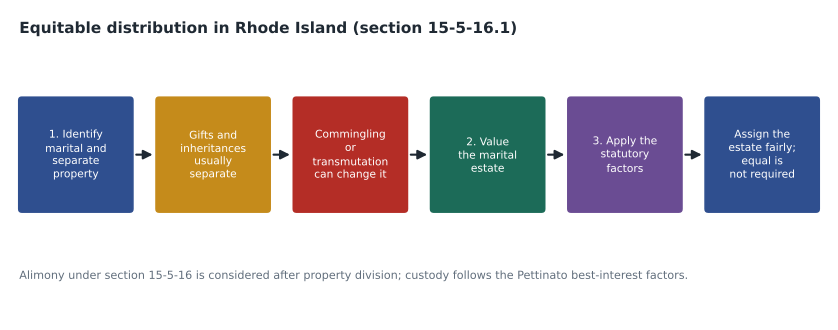
In Rui's case, the contribution from his parents toward the down payment raised the classic question. Was it a gift to Rui alone, a gift to both spouses, or a loan? The answer depends on the evidence of intent, how the money was handled and how the house was titled. Because the house was titled in both spouses' names and the money went straight into the joint purchase, the gift was likely to be treated as part of the marital estate, although the source of the funds could still be considered as a contribution under the statutory factors. The portion of his pension earned during the marriage was marital property, usually divided by a qualified domestic relations order.
Alimony
Rhode Island alimony is governed by section 15-5-16 and is primarily rehabilitative. The court considers factors such as the length of the marriage, the conduct of the parties, the health, age, station, occupation, skills and employability of each spouse, and the extent to which either is unable to become self-supporting. Alimony is meant to support a spouse while that spouse becomes self-sufficient, and it can be modified when circumstances change substantially. Long-term alimony is reserved for situations where self-sufficiency is not realistic. The court addresses alimony after it has divided the property, because the property a spouse receives affects that spouse's need.
Custody and placement
Custody decisions turn on the best interests of the child. The Rhode Island Supreme Court set out the leading factors in Pettinato v. Pettinato (1990), including the wishes of the parents, the reasonable preference of a child of sufficient maturity, the child's relationships with parents, siblings and others, the child's adjustment to home, school and community, the mental and physical health of everyone involved, the stability of each home, the moral fitness of the parents and each parent's willingness to support the child's relationship with the other parent. No single factor controls.
Rhode Island practice distinguishes legal custody, the right to make major decisions about the child, from physical placement, where the child lives. Joint legal custody is common, with physical placement with one parent and a parenting schedule for the other, or with shared placement. With teenagers like Rui's, the children's own preferences carry significant weight, and the Family Court may interview older children or appoint a guardian ad litem.
| Issue | Main Rhode Island source | Key idea |
|---|---|---|
| Family Court jurisdiction | Section 8-10-3 | Broad statutory jurisdiction over family and juvenile matters |
| Divorce grounds | Sections 15-5-2 and 15-5-3.1 | Fault grounds and the no-fault ground of irreconcilable differences |
| Property division | Section 15-5-16.1 | Equitable distribution of the marital estate under statutory factors |
| Alimony | Section 15-5-16 | Primarily rehabilitative; modifiable on changed circumstances |
| Custody | Pettinato v. Pettinato (1990) | Best interests of the child, weighed across multiple factors |
| Child support | Family Court guidelines | Income shares formula; support through 18 or high school, to 19 at most |
Child support
Child support in Rhode Island is set under guidelines issued by the Family Court, which use an income shares model: the court estimates what the parents would spend on the children if the family were together, based on their combined income, and divides that amount in proportion to their incomes. The guidelines also account for health insurance, child care and the parenting schedule. The court may deviate from the guideline amount when applying it would be unjust or inappropriate, with findings explaining why. As noted above, support generally continues to 18, or longer for a child still in high school, but not past 19. Enforcement of support orders is handled through the Family Court and the state's child support enforcement office, and Rhode Island enforces out-of-state orders under the uniform interstate support law.
Marriage and related property rules
Rhode Island has recognized marriages between people of the same sex since August 1, 2013. Because the state is so small, many Rhode Island lawyers handle matters involving couples who married, lived or own property in Massachusetts or Connecticut, and the Family Court regularly addresses interstate questions of jurisdiction and enforcement.
Rhode Island recognizes tenancy by the entirety for married couples, which protects the property from the separate creditors of one spouse and gives the survivor the whole on death. Divorce converts a tenancy by the entirety into a tenancy in common, which is why the Family Court keeps jurisdiction to partition entireties property for six months after the final decree.
When a married person dies, the estate is handled in the probate court of the city or town where the decedent lived. Rhode Island gives a surviving spouse statutory protections against disinheritance, including the right to elect a life estate in the decedent's real estate under chapter 25 of Title 33. Estate planning for Rhode Island clients therefore requires attention to the spouse's statutory rights as well as the terms of the will.
Worked problem
Rui's memo
Moira asks Joana for a one-page outline of how the Family Court would approach Rui's property and custody issues.
Show solution
- Court and ground: the Family Court, Providence County, on the ground of irreconcilable differences under section 15-5-3.1; confirm residency.
- Property: identify the marital estate (house, marital portion of the pension, savings); trace the parents' down payment contribution and argue its source under the contribution factor even if it is marital.
- Valuation: appraise the house; obtain a present value or plan a qualified domestic relations order for the pension.
- Alimony: likely not a major issue if both spouses work full time; address after property division.
- Custody: joint legal custody; placement and schedule under the Pettinato factors, with significant weight to the teenagers' preferences.
- Support: calculate under the Family Court guidelines once incomes and the schedule are known.
Answer: A clear outline organized by the Family Court's sequence lets the supervising lawyer advise the client quickly.
Common mistakes
MistakeRhode Island divides marital property equally.
InsteadSection 15-5-16.1 calls for equitable distribution under statutory factors; equal division is common but not required.
MistakeAn inheritance is always separate property.
InsteadInherited property is generally excluded, but commingling or transmutation can make it marital.
MistakeCustody turns on a single factor, such as the primary caretaker.
InsteadPettinato lists multiple best-interest factors, and no single factor controls.
MistakeChild support always ends at 18.
InsteadSupport may continue for a child still in high school, until 90 days after graduation but not past 19.
Practice habits for the Family Court
Family Court practice has its own rhythm. Many first appearances are before magistrates, many matters are resolved on calendars where dozens of cases are called in a morning, and most clients are going through one of the hardest periods of their lives. Three habits help. First, gather financial information early: tax returns, pay stubs, account statements and pension statements make every later step faster and support the financial statements the court requires. Second, keep the children out of the conflict, and advise clients that the court notices which parent supports the other's relationship with the children. Third, put every agreement in writing before the hearing, because an agreement that is not written down is easy to dispute later.
Family cases also raise professional conduct issues a new lawyer must watch for, including the ban on contingent fees tied to securing a divorce or the amount of support or property, the rules on limited appearances discussed in Lesson 10, and the duty not to communicate directly with a represented opposing party.
Finally, a new lawyer should learn the Family Court's own forms and local practices early, including its financial statement forms and child support worksheets, because the court expects them to be complete at the first hearing.
Summary and key terms
- Rhode Island's statewide Family Court, established in 1961, has broad statutory jurisdiction under section 8-10-3.
- Divorce may be granted on fault grounds or, more commonly, on irreconcilable differences under section 15-5-3.1, subject to residency and waiting periods.
- Marital property is divided by equitable distribution under section 15-5-16.1, after identifying and valuing the marital estate.
- Alimony under section 15-5-16 is primarily rehabilitative; custody follows the best interests factors in Pettinato v. Pettinato.
- Child support follows the Family Court's income shares guidelines; support can extend to 19 for a child still in high school.
- 0
- Family Court
- 1
- divorce from bed and board
- 2
- irreconcilable differences
- 3
- equitable distribution
- 4
- marital estate
- 5
- transmutation
- 6
- rehabilitative alimony
- 7
- best interests of the child
Practice problems
Work each problem on paper first, then reveal the answer to check.
Which court hears divorce, custody and adoption in Rhode Island?
Show answer
The Family Court.
What is the usual ground for divorce in Rhode Island?
Show answer
Irreconcilable differences causing the irremediable breakdown of the marriage, under section 15-5-3.1.
What are the three steps of equitable distribution?
Show answer
Identify marital and separate property, value the marital estate and apply the statutory factors to divide it.
Which case sets out Rhode Island's custody factors?
Show answer
Pettinato v. Pettinato (1990).
Lesson quiz · 5 questions
Score 60% or more to complete this lesson.
Create a free account to save your progress, take quizzes and earn a certificate.