
BAR-240 · Lesson 8 of 12 · 19 min
Rhode Island torts: pure comparative negligence, governmental liability limits and prejudgment interest
▶ Video coming soon A video version of this lesson is on the way.
In April 2026 Ilda Sequeira, a retired textile worker in her seventies, caught her foot on a heaved slab of sidewalk outside a pharmacy in Pawtucket and broke her wrist. She was looking at her phone when she fell. Her medical bills, physical therapy and the cost of help at home came to about 38,000 dollars by the fall, and her surgeon expected more. She came to Faria & Quinlan in September, and Domingos Faria gave the file to Joana to research. 'Three Rhode Island rules decide what this case is worth,' he told her. 'Find them, and tell me how they fit together.'
The three rules were pure comparative negligence, the statutory limits on damages against the state and municipalities, and Rhode Island's statute adding 12 percent interest to tort awards from the date of injury. This lesson takes each in turn and then shows how they interact in a case like Mrs. Sequeira's. It also notes several other Rhode Island tort rules a new lawyer meets early.
Pure comparative negligence
Rhode Island is a pure comparative negligence state. Section 9-20-4 of the General Laws provides that in actions for personal injury, wrongful death or damage to property, the fact that the injured person was not exercising due care does not bar recovery. Instead, the finder of fact reduces the damages in proportion to the injured person's share of the fault. The statute applies the same reduction to an owner of property or a person with control over it.
Under a pure system, a plaintiff can recover something no matter how much of the fault is assigned to her. A plaintiff found 70 percent at fault recovers 30 percent of her damages. That differs from the modified systems used in most states, where a plaintiff found more at fault than the defendant, or in some states 50 percent at fault, recovers nothing. On the bar exam, a candidate should know both systems; in Rhode Island practice, only the pure system applies.
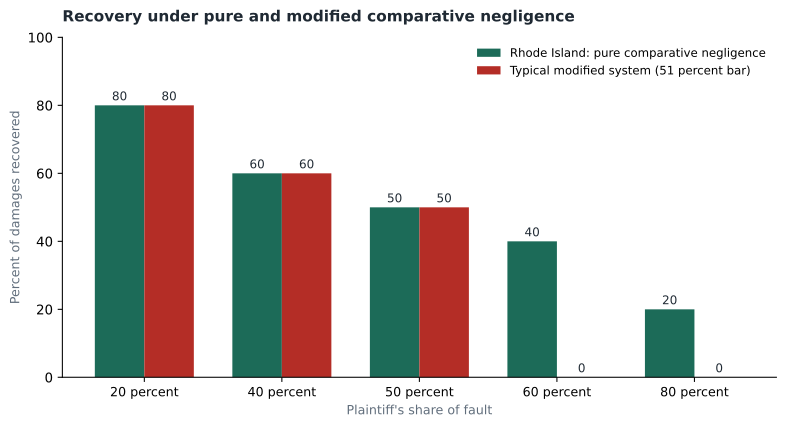
The pure system shapes litigation strategy. Because fault never bars recovery, a defendant's argument about the plaintiff's carelessness is an argument about the size of the award, not about liability. Plaintiffs with significant fault still have claims worth bringing. And juries are asked to assign percentages, so the verdict form and the jury instructions on apportionment matter a great deal.
Rhode Island decisions have treated assumption of the risk as a defense distinct from comparative negligence, asking whether the plaintiff actually knew of and appreciated the specific risk and voluntarily encountered it. Because the analysis is subjective and fact-specific, a new lawyer should read the current Rhode Island cases before relying on the defense in either direction.
Joint tortfeasors and contribution
When more than one defendant causes an indivisible injury, Rhode Island has not adopted a general statute abolishing joint and several liability. Each joint tortfeasor may therefore be liable to the plaintiff for the whole of the damages, with the right to seek contribution from the others under the Uniform Contribution Among Tortfeasors Act in chapter 6 of Title 10. That chapter also governs the effect of a release given to one tortfeasor on the claims against the others and the effect of court-approved settlements. A new lawyer settling with one of several defendants should read sections 10-6-7 and 10-6-12 before the release is drafted, because the form of the release affects what the remaining defendants owe.
Claims against the state and municipalities
Rhode Island waived much of its sovereign immunity for torts by statute, in the Governmental Tort Liability Act, chapter 31 of Title 9. The state and its political subdivisions may be sued in tort, but the Act limits the damages. Under section 9-31-2, damages in a tort action against the state or a political subdivision may not exceed 100,000 dollars. Under section 9-31-3, damages in a tort action against a city, town or fire district may not exceed 100,000 dollars.
Both sections have exceptions. The limit does not apply when the government was engaged in a proprietary function in committing the tort, and the state's limit also does not apply where the state has agreed to indemnify the federal government or one of its agencies. A proprietary function is one that is not traditionally governmental and could as easily be performed by a private business. Maintaining public sidewalks and roads, policing and fire protection are classic governmental functions; whether a particular activity is proprietary is a fact-specific question decided under Rhode Island case law.
The 100,000-dollar figure has not changed since the 1980s, according to the statute's history notes. Bills to rewrite the limits have been introduced in recent sessions. In 2025 and again in January 2026, House bills proposed restating the 100,000-dollar limits, carving out claims of willful misconduct or extreme recklessness and removing the state and municipalities from the prejudgment interest statute. The legislative record showed each referred to the House Judiciary Committee with no further action. A lawyer handling a claim against a Rhode Island government should check whether any change has been enacted.
| Defendant | Statute | Damages limit | Main exceptions |
|---|---|---|---|
| State and political subdivisions | Section 9-31-2 | 100,000 dollars | Proprietary function; state agreement to indemnify the federal government |
| Cities, towns and fire districts | Section 9-31-3 | 100,000 dollars | Proprietary function |
The public duty doctrine
Alongside the statutory limits, Rhode Island courts apply the public duty doctrine. The doctrine shields the state and municipalities from liability for negligence in performing discretionary governmental activities that private persons do not ordinarily perform, on the theory that duties owed to the public at large are not duties owed to any individual. It has exceptions. The special duty exception applies when the government owed a particular duty to a specific, identifiable plaintiff, for example because the plaintiff had specific contact with officials who knew of the danger. The egregious conduct exception applies when the government knowingly created or allowed a perilous situation, had notice of it and failed to correct it in a reasonable time.
Whether the egregious conduct exception applies can be a jury question. In Battaglia v. Lombardi (2022), a pedestrian fell into a manhole covered only by a loose pallet, and a jury found for her. The trial justice then granted judgment as a matter of law to the City of Providence under the public duty doctrine. The Rhode Island Supreme Court vacated that judgment, holding that the trial justice had usurped the jury's fact-finding role in deciding the egregious conduct exception did not apply.
Presenting claims to cities and towns
Before suing a Rhode Island city or town on a money claim, a plaintiff must present the claim to the town or city council under section 45-15-5 of the General Laws and give the council an opportunity to pay it. The statute sets a waiting period, forty days under the current text, before the plaintiff may sue. Presentment requirements are strictly applied, and the content and timing of the presentment should be checked against the current statute and case law when the file opens. A claim against the state has its own procedure, and claims against fire districts and other bodies may have their own rules.
Prejudgment interest at 12 percent
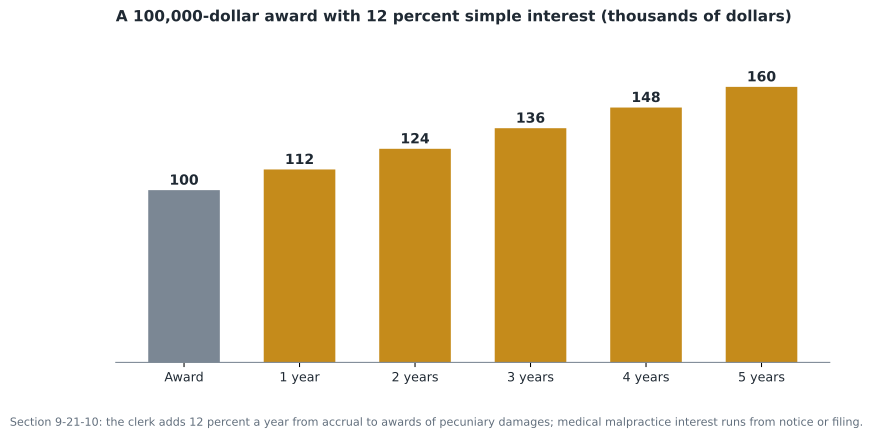
Rhode Island's prejudgment interest statute, section 9-21-10, is one of the most important rules in Rhode Island tort practice. In any civil action in which a verdict or decision awards pecuniary damages, the clerk adds interest at a rate of 12 percent a year from the date the cause of action accrued, and the interest becomes part of the judgment. The same 12 percent rate applies after judgment, on both the principal and the prejudgment interest. The interest is added by the clerk, not awarded by the jury, so it is automatic once there is a verdict or decision.
The statute has limits. It does not apply where a contract already provides for interest. And for personal injury and wrongful death claims against listed health care providers for professional negligence filed on or after January 1, 1987, interest runs not from the date of injury but from the earlier of written notice of the claim to the provider or its insurer, or the filing of the action.
Twelve percent a year is high by national standards, and it is simple interest from the date of injury. For a case that takes four years from injury to verdict, interest alone adds almost half again to the award. That changes settlement math dramatically. Defendants have a strong reason to settle early; plaintiffs have less pressure to accept a low early offer; and every settlement discussion in Rhode Island includes a calculation of accrued interest.
Wrongful death and other rules
Rhode Island's wrongful death statute, in chapter 7 of Title 10, allows an action by the executor or administrator for the benefit of the statutory beneficiaries, with a three-year limitation period. It is unusual in setting a statutory minimum award, so that damages in a successful action may not fall below a fixed floor stated in the statute. A new lawyer should read the current text for the amount and for how it interacts with other limits.
Other rules worth knowing early include the Liquor Liability Act, chapter 14 of Title 3, which creates a statutory claim against those who serve alcohol to visibly intoxicated persons or minors, and the absence of a general statutory cap on noneconomic damages in ordinary negligence and medical malpractice cases, which makes the governmental limits stand out. Each of these is a statute to read carefully at the start of a case.
Worked problem
Valuing Mrs. Sequeira's claim
Assume the sidewalk was owned and maintained by the City of Pawtucket, that a jury finds the city negligent under an exception to the public duty doctrine and assesses damages at 150,000 dollars, and that it finds Mrs. Sequeira 20 percent at fault for looking at her phone. The verdict comes three years after the fall. How do the three rules interact?
Show solution
- Comparative negligence: under section 9-20-4 her damages are reduced by 20 percent, from 150,000 to 120,000 dollars. Her fault does not bar recovery.
- Governmental limit: sidewalk maintenance is a governmental function, so section 9-31-3 limits damages against the city to 100,000 dollars.
- Interest: section 9-21-10 adds 12 percent a year from accrual. How interest interacts with the 100,000-dollar limit is a question to research in current Rhode Island case law before advising the client; recent bills would have removed governmental defendants from the interest statute altogether, which signals that the question matters.
- Process: the claim must first be presented to the Pawtucket City Council under section 45-15-5, and suit must be filed within the limitation period.
- Strategy: identify any private defendant, such as the pharmacy if it had a duty for the sidewalk, because claims against private parties are not subject to the cap and carry full interest.
Answer: Comparative fault reduces the award, the cap limits what the city pays, and the interest statute and any private defendant affect the true value of the case.
Joana's memo laid out the analysis in that order. Domingos added one note in the margin: 'Check who owns the slab.' The pharmacy's lease, it turned out, made the tenant responsible for snow and ice on the sidewalk but not for its repair, which kept the city as the main defendant.
Common mistakes
MistakeA plaintiff more than half at fault recovers nothing in Rhode Island.
InsteadRhode Island uses pure comparative negligence; fault reduces but never bars recovery.
MistakeMunicipalities in Rhode Island are fully immune from tort suits.
InsteadThe Governmental Tort Liability Act allows suits but limits damages, generally to 100,000 dollars, with a proprietary function exception.
MistakeThe jury decides whether to award prejudgment interest.
InsteadThe clerk adds 12 percent interest from accrual to awards of pecuniary damages by statute.
MistakeThe public duty doctrine is always decided by the judge.
InsteadWhether the egregious conduct exception applies can be a jury question, as in Battaglia v. Lombardi.
Settlement math in Rhode Island
Because of the 12 percent interest statute, Rhode Island lawyers routinely calculate accrued interest before every settlement conference. The calculation is simple: multiply the expected award of pecuniary damages by 12 percent for each year since accrual. A case expected to produce a 200,000-dollar verdict three years after the injury carries about 72,000 dollars of interest, so a defendant comparing a settlement today with a verdict next year must weigh roughly 24,000 dollars more of interest for each year of delay. Pure comparative negligence and the governmental limits then adjust the expected recovery. Writing out all three steps in a short settlement memo keeps the client's expectations realistic.
Summary and key terms
- Section 9-20-4 makes Rhode Island a pure comparative negligence state: a plaintiff's fault reduces damages proportionally but never bars recovery.
- Joint tortfeasors may each be liable for the whole, with contribution under chapter 10-6.
- Sections 9-31-2 and 9-31-3 limit tort damages against the state, municipalities and fire districts to 100,000 dollars, except for proprietary functions.
- The public duty doctrine protects governmental functions, with special duty and egregious conduct exceptions.
- Section 9-21-10 adds 12 percent simple interest a year from accrual to pecuniary damages awards, with special rules for medical malpractice and contracts with their own rate.
- 0
- pure comparative negligence
- 1
- joint tortfeasor
- 2
- Governmental Tort Liability Act
- 3
- proprietary function
- 4
- public duty doctrine
- 5
- egregious conduct exception
- 6
- prejudgment interest
- 7
- claim presentment
Practice problems
Work each problem on paper first, then reveal the answer to check.
A plaintiff is 75 percent at fault and her damages are 40,000 dollars. What does she recover in Rhode Island?
Show answer
10,000 dollars, because pure comparative negligence reduces her recovery by her 75 percent share.
What is the damages limit for a tort claim against a Rhode Island town performing a governmental function?
Show answer
100,000 dollars under section 9-31-3.
What rate of prejudgment interest applies under section 9-21-10, and from when?
Show answer
12 percent a year, from the date the cause of action accrued.
What are the two main exceptions to the public duty doctrine?
Show answer
The special duty exception and the egregious conduct exception.
Lesson quiz · 5 questions
Score 60% or more to complete this lesson.
Create a free account to save your progress, take quizzes and earn a certificate.