
BAR-240 · Lesson 5 of 12 · 19 min
Exam changes ahead: Rhode Island and the NextGen bar exam
▶ Video coming soon A video version of this lesson is on the way.
Joana's younger cousin Tiago started law school in August 2026, and at a family dinner he announced that he would be taking 'a completely different bar exam' from hers. He was right, though not in the way he thought. The NextGen bar exam is not a different subject, and it still tests the law a new lawyer needs. But it has a different structure, a different score scale and a different mix of skills, and Rhode Island has decided when it will switch.
Marchetti used Tiago's comment to explain why the change matters even to candidates like Joana who will never take NextGen. 'You need to understand the transition for three reasons,' she said. 'If you do not pass in February 2027, the clock is running. If you ever transfer your score, you need to know how states will treat old and new scores. And as a lawyer in a small firm you will be supervising and hiring people who took the new exam.'
This lesson explains Rhode Island's decision to adopt NextGen, the timeline, what the new exam looks like, what is still unsettled and what the transition means for candidates, repeat takers and score transfers.
Rhode Island's decision
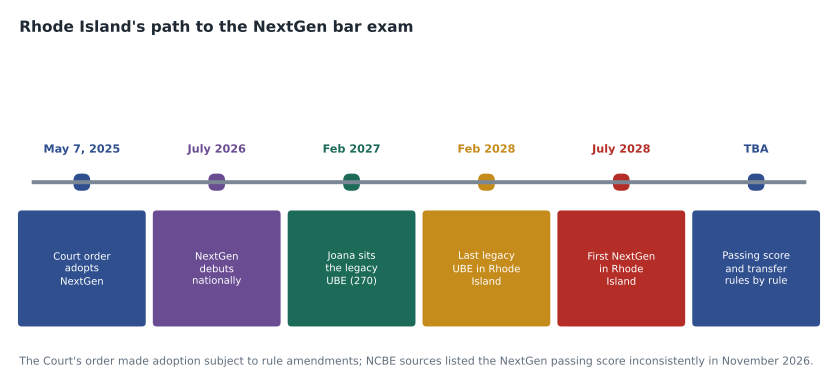
On May 7, 2025, the Rhode Island Supreme Court entered an order accepting the recommendation of the Board of Bar Examiners to adopt the NextGen Uniform Bar Examination, beginning with the July 2028 administration. The order says the Board conducted an extensive study before making its recommendation, and it makes adoption subject to the rule amendments needed to put the new exam in place. NCBE announced the same day that Rhode Island intends to administer the NextGen exam beginning in July 2028. NCBE's jurisdiction page lists February 2028 as the last administration of the current, or legacy, UBE in Rhode Island.
Rhode Island's choice of July 2028 puts it among the later adopters. NCBE first administered NextGen in July 2026 in a small group of jurisdictions and released the first results in September 2026. Many states, including several of Rhode Island's neighbors, have chosen dates in 2027 or 2028. A later start gives Rhode Island time to see how the first administrations go before its own applicants take it.
What NextGen looks like
The NextGen exam was designed from a national study of what lawyers do in their first three years of practice. NCBE describes it as testing nine areas of legal doctrine together with seven foundational lawyering skills, including legal research, legal writing and negotiation, with professional responsibility tested alongside the other subjects rather than only on a separate exam. The doctrinal areas include contracts, torts, evidence and family law, among others.
The format is shorter and more integrated than the current UBE. NCBE describes the exam as one and a half days, with six hours of testing on the first day and three hours on the second, compared with about twelve hours over two days for the legacy UBE. Instead of separate MBE, MEE and MPT components, NextGen uses a mix of question types, including multiple-choice questions, short written responses and longer integrated tasks that combine a set of facts with legal materials. Jurisdictions still administer the exam and grade the written portions.
NextGen scores are reported on a new scale. They are not on the 400-point scale of the legacy UBE, so a NextGen passing score cannot be compared directly to 270. States that have already given the exam have set passing scores on the new scale; Missouri, for example, set 610.
| Feature | Legacy UBE | NextGen UBE |
|---|---|---|
| Length | Two days, about 12 hours | One and a half days, about 9 hours |
| Structure | MBE, MEE and MPT as separate components | Integrated question sets mixing multiple-choice and written responses |
| Skills | Mostly doctrinal, with the MPT for skills | Nine doctrinal areas and seven foundational skills |
| Ethics | Separate MPRE | Professional responsibility tested within the exam; Rhode Island's MPRE rule after 2028 to be set by rule |
| Score scale | 400 points; Rhode Island passes at 270 | New scale; Rhode Island passing score not yet announced |
What is still unsettled
As of November 2026, several important details for Rhode Island had not been announced, and NCBE's own pages were not fully consistent. NCBE's general Rhode Island information page lists Rhode Island's NextGen passing score as to be announced. A printable NCBE jurisdiction summary, on the other hand, shows a NextGen passing score of 620. Until the Court amends Article II and the Board's Rules of Practice, candidates should treat the NextGen passing score as unsettled and check the Court's orders.
Other open questions are whether Rhode Island will accept transferred NextGen scores and from what date, whether there will be any Rhode Island component with the NextGen exam, which NCBE lists as to be announced, and whether Rhode Island will keep the MPRE requirement unchanged after the switch. Because the Court's 2025 order made adoption subject to rule amendments, those amendments will answer these questions. Candidates who plan to sit in 2028 or later should watch the Court's miscellaneous orders page.
What the transition means for candidates
For Joana and anyone else sitting before July 2028, nothing changes. They take the legacy UBE, need 270 and transfer their scores under the legacy rules. The February 2028 exam is the last chance to take the current format in Rhode Island.
For a repeat taker, the transition creates a deadline. A candidate who fails the February 2028 exam will retake on the NextGen exam in July 2028. That means a different format and a different preparation strategy, including practice with integrated questions and short written responses. A candidate who is close to passing in 2027 has a strong incentive to pass before the switch, and a candidate whose results are weak should plan early for the possibility of studying for a new format.
For law students who will graduate in May 2028 or later, Rhode Island will be a NextGen jurisdiction. They should use NCBE's NextGen study materials and sample questions, practice research and writing tasks under time pressure and expect professional responsibility to appear within the exam.
For score transfer, the transition raises a two-way question. Rhode Island will need to decide how it treats incoming NextGen scores, and other jurisdictions will each decide how they treat legacy UBE scores earned in Rhode Island. A legacy Rhode Island score of 270 or more is valuable because it meets every UBE jurisdiction's passing score, but it will still be subject to each receiving jurisdiction's age limits and transition rules.
Worked problem
Planning around the switch
Three people ask Joana for advice in November 2026. Marisa will graduate in May 2027. Tobiah failed the July 2026 Rhode Island exam with a 262. Tiago will graduate in May 2029. Which format will each likely take, and what should each do now?
Show solution
- Marisa can sit for the legacy UBE in July 2027, February 2028 or both; she should aim to pass in July 2027 and keep February 2028 as a backup.
- Tobiah should sit in February 2027 if he can still file by December 1, 2026, and treat July 2027 and February 2028 as his remaining legacy chances.
- Tiago will take the NextGen exam, because he will graduate after the switch; he should use NextGen materials and build research and writing skills in school.
- All three should check the Court's orders for rule amendments before filing.
Answer: The transition makes timing important for repeat takers and gives recent graduates a clear reason to pass before July 2028.
Why Rhode Island waited
The Court's order does not explain the choice of July 2028 beyond thanking the Board for its study. The practical reasons are familiar from other states. A later date lets the Board see the first national results, train graders on a new format, adjust the Rules of Practice, and give law schools time to change their academic support programs. It also gives Rhode Island's own law students two full years of notice. For a small jurisdiction that relies on Board members to grade written answers, time to prepare graders for a new kind of written task matters.
Staying current
Bar admission rules change, and the NextGen transition guarantees more changes before 2028. Three habits help. First, check the Rhode Island Supreme Court's miscellaneous orders page, where orders about admission appear. Second, read the Board's Rules of Practice in force for your administration, because revisions are dated. Third, use NCBE's jurisdiction pages for a quick overview but treat the Court's rules as controlling when they differ, as they do on the NextGen passing score.
Common mistakes
MistakeRhode Island already uses the NextGen exam.
InsteadRhode Island will first give NextGen in July 2028; February 2028 is the last legacy UBE.
MistakeA NextGen passing score can be compared directly with 270.
InsteadNextGen uses a new score scale, and Rhode Island's NextGen passing score had not been settled by rule as of November 2026.
MistakeThe MPRE ends when NextGen begins.
InsteadNextGen tests professional responsibility within the exam, but Rhode Island's post-2028 MPRE rule has not been announced.
MistakeA candidate who fails in February 2028 can retake the legacy UBE in July 2028.
InsteadFrom July 2028 Rhode Island gives only NextGen.
How NextGen changes preparation
Even though Joana will not take NextGen, she will supervise law clerks who do, and her cousin Tiago will take it in 2029. Marchetti summarized the differences in preparation. Integrated question sets require a candidate to read a short file, identify the legal issues and answer several related questions, some multiple-choice and some short written responses. That rewards the habits the MPT already teaches: reading the task first, using the materials and writing concisely. Doctrine is still tested, but the subject list is narrower and focused on the foundational concepts lawyers use most often in early practice.
Skills appear throughout. NCBE's list of foundational skills includes legal research, legal writing, issue spotting and analysis, investigation and evaluation, client counseling and advising, negotiation and dispute resolution, and client relationship and management. A NextGen candidate may be asked to evaluate which research source to consult, to draft a short piece of a document or to choose a negotiation strategy. Practice for these tasks looks different from memorizing outlines: it involves working through realistic files and explaining choices.
Ethics is woven in. Because NextGen tests professional responsibility within the exam, a candidate may face an ethics issue in the middle of a contracts or civil procedure question. A candidate who has studied the MPRE will recognize the issues; the challenge is spotting them when they are not labeled.
What stays the same
Some things do not change with NextGen. The Rhode Island Supreme Court still controls admission. Character and fitness still requires full candor and, unless the rules change, a personal interview. The Board still grades written work. The filing windows, the five-failure limit, the oath and registration deadlines and Bridge the Gap are all set by Rhode Island rules that the NextGen order did not alter. And the purpose stays the same: to admit lawyers who can practice competently and ethically on their first day.
A transition checklist
For anyone planning a Rhode Island exam in 2027 or 2028, Marchetti's checklist was short. Count your remaining legacy attempts before July 2028. Check the five-failure limit against every attempt anywhere. If you might transfer a score later, check the receiving state's rules for legacy and NextGen scores. Read every new order from the Court about Article II and the Rules of Practice. And if you will graduate after May 2028, start with NCBE's NextGen sample questions and study aids rather than legacy materials.
Supervising clerks who took NextGen
Marchetti's third reason for learning the transition was practical. By 2029, the law clerks and new associates at a firm like Faria & Quinlan will include people who took NextGen in Rhode Island or elsewhere. Their training will have emphasized research choices, short written analyses and client-facing tasks, and they may have spent less time memorizing long subject outlines than earlier graduates. A supervising lawyer should expect strong practical habits and should still check that a new colleague knows the Rhode Island rules that matter in the firm's work, which no national exam tests.
The transition also affects hiring across state lines. A candidate with a NextGen score from another state who wants to join a Rhode Island firm will need to know whether Rhode Island accepts transferred NextGen scores and from what date, which NCBE listed as to be announced in November 2026. A candidate with a legacy score will need to transfer it under Rule 1B within two years of the exam. Hiring partners in Rhode Island will need to ask both questions early.
The key dates in one place
For quick reference, the key Rhode Island dates are these. The Court ordered adoption on May 7, 2025. NextGen first appeared nationally in July 2026, with the first results in September 2026. February 2027 and July 2027 are ordinary legacy administrations. February 2028 is Rhode Island's last legacy UBE according to NCBE. July 2028 is Rhode Island's first NextGen administration. Every other detail awaits the amendments to Article II and the Rules of Practice.
Summary and key terms
- The Rhode Island Supreme Court adopted NextGen by order of May 7, 2025, beginning in July 2028, subject to rule amendments.
- NCBE lists February 2028 as Rhode Island's last legacy UBE.
- NextGen tests nine doctrinal areas and seven foundational skills over about nine hours, with ethics integrated, on a new score scale.
- Rhode Island's NextGen passing score, transfer rules and any jurisdiction component were not settled by rule as of November 2026; NCBE sources differ.
- Repeat takers face a format change after February 2028; candidates before then take the legacy UBE and need 270.
- 0
- NextGen UBE
- 1
- legacy UBE
- 2
- integrated question set
- 3
- foundational lawyering skills
- 4
- score scale
- 5
- transition
- 6
- miscellaneous order
Practice problems
Work each problem on paper first, then reveal the answer to check.
When will Rhode Island first give the NextGen exam?
Show answer
July 2028.
What is the last legacy UBE in Rhode Island according to NCBE?
Show answer
February 2028.
Why can a NextGen score not be compared directly with 270?
Show answer
NextGen scores are reported on a different score scale from the 400-point legacy UBE.
Where will the final Rhode Island NextGen rules appear?
Show answer
In amendments to Article II and the Board's Rules of Practice, issued by order of the Supreme Court.
Lesson quiz · 5 questions
Score 60% or more to complete this lesson.
Create a free account to save your progress, take quizzes and earn a certificate.