
BAR-240 · Lesson 3 of 12 · 20 min
Character and fitness and the MPRE
▶ Video coming soon A video version of this lesson is on the way.
Joana spent more time on two answers in her NCBE application than on everything else combined. The first was a 2020 car accident in Seekonk, Massachusetts, when she was a college sophomore: she rear-ended a pickup at a red light, nobody was hurt, the insurer paid the other driver and she was fined because her registration had lapsed by two weeks. The second was a semester in 2023 when her student loan servicer reported her 45 days late after a change in servicers. She had paid and the account had stayed current since. Neither felt like a big deal, but both felt embarrassing.
Marchetti's advice was the same advice every bar examiner gives. 'The Committee is not looking for perfect people. It is looking for honest ones. A fender-bender and a late payment are ordinary life. Leaving them out is what gets people in trouble. Disclose both, explain them in two sentences each, attach the paperwork and move on.'
This lesson covers how Rhode Island decides whether an applicant has the character and fitness to practice law, including the in-person interview that sets Rhode Island apart, and the MPRE requirement, which has its own score and timing rules.
The standard and the burden
Rule 4 of Article II places the burden squarely on the applicant. Every applicant must prove good moral character and fitness to practice law by clear and convincing evidence. That is a higher standard than the preponderance of the evidence used in most civil cases. An applicant who refuses to answer a question, fails to provide requested documents or gives incomplete information can be found to have failed that burden for that reason alone.
The question is forward-looking. The Committee asks whether the applicant can be trusted to meet the duties a lawyer owes to clients, courts and the public: honesty, diligence, financial responsibility, respect for the law and the ability to handle a client's affairs and money. Past conduct matters because it predicts future conduct, and evidence of rehabilitation matters because it shows change.
The Committee and its powers
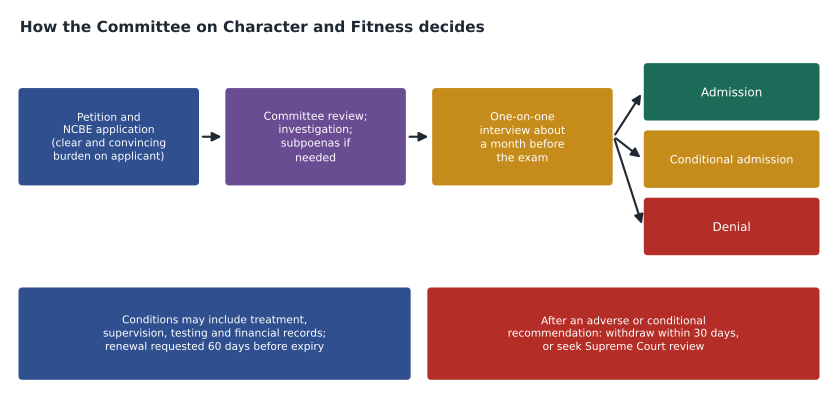
The Committee on Character and Fitness has seven members: a member of the Board of Bar Examiners, the Attorney General or a designee, the Clerk of the Supreme Court or a designee and four members of the Rhode Island Bar serving three-year terms. It reviews every petition, including those of score-transfer and attorney applicants. It may investigate, interview applicants and witnesses and issue subpoenas for witnesses and documents. It may ask an applicant to supply records, explanations and evaluations.
After review, the Committee recommends one of three outcomes: admission, conditional admission or denial. Conditional admission lets an applicant who otherwise qualifies begin practice subject to conditions designed to protect the public, such as treatment, supervision by another lawyer, drug or alcohol testing or periodic production of financial records. A conditionally admitted lawyer who wants the conditions renewed, or wants an unrestricted license, must ask at least 60 days before the conditional license expires.
An applicant who receives a conditional or adverse recommendation has 30 days to withdraw the petition. An applicant who disagrees with a decision may petition the Supreme Court for review within 30 days of the decision. Because the Court admits, the Court has the last word.
The interview
The feature of Rhode Island's process that surprises candidates most is the interview. The Board's FAQ explains that every applicant, including score-transfer applicants, has a one-on-one interview with a member of the Committee. For exam applicants, interviews are held about a month before each exam, in a conference room at the Supreme Court building at 250 Benefit Street in Providence. The applicant brings valid photo identification. An applicant who completes the interview satisfactorily receives the admission ticket needed to enter the exam. A previously interviewed applicant who is reapplying may not need another interview, and score-transfer applicants are scheduled only after their petitions are complete.
The interview is not an oral exam on the law. It is a conversation about the petition. The interviewer will have read the file and will ask the applicant to talk through anything that needs explanation: a criminal charge, a debt, a gap in employment, an academic issue, a past problem with alcohol or a disciplinary matter in another profession. The interviewer is also forming an impression of the applicant's candor and judgment. The best preparation is to reread the petition the night before and be ready to explain every yes answer calmly and completely.
Marchetti gave Joana a short list for her late-January interview. Arrive early. Bring the photo ID and a copy of the petition. Answer the question asked. If a fact is unflattering, say it plainly and then say what you learned and what you did about it. If you do not remember something, say so and offer to provide the record. Do not argue with the interviewer, and do not minimize.
What the Committee looks at
The issues that come up in Rhode Island are the issues that come up everywhere. The most common is candor itself: an applicant who leaves out a fact that later appears in a background check faces a far harder question than the underlying fact would ever have raised. Other common issues are criminal history, including arrests that did not lead to convictions and records that were expunged or sealed when the question asks about them; traffic and driving offenses; financial responsibility, including defaults, collections, tax problems and bankruptcy; academic discipline and honor code matters; substance use; disciplinary history in another profession or another bar; civil litigation in which the applicant was a party; and the applicant's conduct during the admission process itself.
Financial problems are evaluated for what they say about responsibility, not wealth. Student debt is normal. What matters is whether the applicant has dealt with debts honestly, communicated with creditors and kept promises made in repayment plans. A defaulted loan that the applicant ignored for years raises a different question from a late payment caused by a servicer change and fixed within weeks.
| Issue | What the Committee asks | What helps |
|---|---|---|
| Criminal or traffic record | What happened, how serious, how long ago, any pattern | Court records, proof of completion of sentence, a clear account |
| Debts and collections | Was the applicant responsible and honest with creditors? | Payment history, repayment agreements, explanation of circumstances |
| Academic discipline | Did it involve dishonesty? | The school's file, the applicant's account, later record |
| Substance use | Is there a current impairment risk? | Treatment records, evaluations, time in recovery, monitoring |
| Omissions | Why was a fact left out? | Prompt correction by amended petition before it is discovered |
Rehabilitation
When past conduct raises a concern, the applicant's job is to show rehabilitation. The factors that bar examiners look at are familiar: how old the applicant was at the time, how long ago it happened, how serious it was, whether it was isolated or part of a pattern, whether the applicant accepted responsibility, whether restitution was made, what the applicant has done since and whether others who know the applicant now can vouch for the change. A candid explanation backed by documents and references is the most persuasive form of evidence an applicant can offer.
Worked problem
Joana's two disclosures
Joana must answer questions about motor vehicle offenses and about debts more than 30 days past due. How should she handle the 2020 lapsed-registration fine and the 2023 late student loan report?
Show solution
- Answer yes to both questions; the fine is a motor vehicle offense and the report is a delinquency within the question.
- Give a short factual account of each: the date, what happened, the outcome.
- Attach the Massachusetts disposition record for the fine and a current statement from the loan servicer showing the account in good standing.
- Add one sentence on what changed: automatic registration renewal and autopay since 2023.
- Be ready to talk about both briefly at the interview.
Answer: Full, documented disclosure turns two minor issues into non-issues. Omitting either would create a candor problem far more serious than the facts.
The MPRE requirement
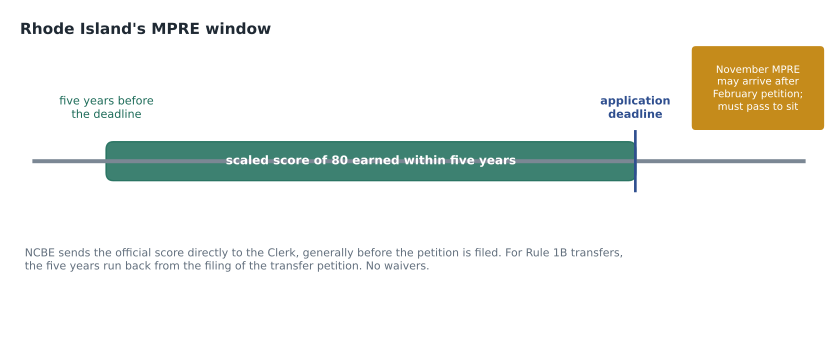
Every Rhode Island applicant must pass the Multistate Professional Responsibility Examination with a scaled score of 80 or higher. Rhode Island's timing rule is generous: the score must have been earned within five years before the application deadline for the exam the applicant is taking. Scores older than five years are not accepted. For Rule 1B score-transfer applicants, the five-year window runs back from the date the transfer petition is filed.
The score must come to Rhode Island directly from NCBE. The applicant asks NCBE to send the official score report to the Clerk, and the Rules of Practice say this should generally happen before the petition is filed. There is one exception built for February candidates: a score from the November MPRE may arrive after the petition for the February exam is filed, but the applicant must still pass it to sit for the February exam. The Board grants no waivers.
The MPRE itself is a two-hour multiple-choice exam of 60 questions, 50 of them scored, on the law governing lawyers: the ABA Model Rules of Professional Conduct, the ABA Model Code of Judicial Conduct and generally accepted principles from court decisions and other sources. It is given several times a year at testing centers. Scores are reported on a scale of 50 to 150. Because the MPRE tests the Model Rules rather than Rhode Island's version, Rhode Island's variations, covered in Lesson 10, do not matter for the MPRE but matter a great deal in practice.
Joana's MPRE
Joana took the MPRE in August 2025 and earned an 84. For the February 2027 exam, the application deadline is December 1, 2026, so any score from after December 1, 2021 would satisfy the five-year window. Her August 2025 score was comfortably inside it. She had asked NCBE to send the score to Rhode Island before she filed, and the confirmation was saved in her bar admission folder.
Some members of the study group needed different numbers. New York requires 85 and Montana 80; a candidate planning to transfer a Rhode Island score to another state later should check that state's MPRE score and timing rule as well, because they vary.
Common mistakes
MistakeAn arrest that did not lead to a conviction need not be disclosed.
InsteadAnswer the question as written; Rhode Island's questions reach arrests and charges, and omissions are the most serious problem.
MistakeThe interview is only for applicants with problems.
InsteadEvery applicant, including score-transfer applicants, has a one-on-one interview with a Committee member.
MistakeThe MPRE score must be from the last two years.
InsteadRhode Island accepts a scaled score of 80 earned within five years before the application deadline.
MistakeA November MPRE is too late for the February exam.
InsteadA November score may arrive after the February petition is filed, but the applicant must pass it to sit.
Candor during the process
The duty of candor does not end when the petition is filed. Bar examiners everywhere treat conduct during the admission process as evidence of character, and Rhode Island is no exception. An applicant who misses deadlines for requested documents, gives evasive answers at the interview, or fails to report a new citation within the ten-day updating period creates a new issue that the Committee must consider. The opposite is also true. An applicant who calls attention to a problem first, files an amended petition promptly and answers follow-up questions fully shows exactly the judgment the Committee is looking for.
Applicants sometimes ask whether they should hire a lawyer for the character and fitness process. For most applicants the answer is no: the process is designed to be handled by the applicant, and the interview is a conversation, not a hearing. An applicant with a serious issue, such as a felony conviction, a pending criminal case, a history of discipline in another profession or a prior denial elsewhere, may benefit from advice from a lawyer who regularly handles admission matters. Seeking that advice is not a mark against the applicant.
Health and accommodations
Character and fitness questions about mental health and substance use are among the most sensitive in the application. Across the country, bar examiners have narrowed these questions in recent years to focus on conduct rather than diagnosis or treatment, and NCBE's application reflects that trend. An applicant who is uncertain how to answer a health-related question should read it carefully, answer exactly what it asks and, where an explanation is needed, focus on current fitness and on any conduct the question reaches. Seeking help for a health condition is not itself a reason to deny admission, and the Bar Association's Confidential Assistance Committee is available to applicants and new lawyers alike.
Testing accommodations are a separate process. An applicant who needs accommodations on the exam because of a disability files a request with the petition, using the Board's forms and documentation. Requests are reviewed by independent medical professionals and the Supreme Court's ADA coordinator, and the Board decides whether the request is substantiated. Needs that do not meet the ADA standard, such as permission to wear a wrist brace or to pump breast milk, are handled through a separate administrative request. A change in need must be reported at least 30 days before the exam where possible.
Summary and key terms
- Applicants must prove good moral character and fitness by clear and convincing evidence; failure to cooperate can itself defeat the petition.
- The seven-member Committee may investigate and subpoena, and recommends admission, conditional admission or denial.
- Every applicant has a one-on-one interview with a Committee member, about a month before the exam, and receives an admission ticket.
- Candor is the central issue; rehabilitation is shown with documents, time and references.
- Rhode Island requires an MPRE scaled score of 80 earned within five years before the application deadline, reported directly by NCBE.
- 0
- clear and convincing evidence
- 1
- conditional admission
- 2
- character and fitness interview
- 3
- rehabilitation
- 4
- MPRE
- 5
- scaled score
- 6
- admission ticket
- 7
- candor
Practice problems
Work each problem on paper first, then reveal the answer to check.
What standard of proof applies to a Rhode Island applicant's character and fitness?
Show answer
Clear and convincing evidence, with the burden on the applicant.
What three recommendations can the Committee make?
Show answer
Admission, conditional admission or denial.
What MPRE score does Rhode Island require, and how old may it be?
Show answer
A scaled score of 80, earned within five years before the application deadline.
What must an applicant bring to the interview?
Show answer
Valid photo identification; it also helps to bring a copy of the petition.
Lesson quiz · 5 questions
Score 60% or more to complete this lesson.
Create a free account to save your progress, take quizzes and earn a certificate.