
BAR-240 · Lesson 6 of 12 · 19 min
What the exam tests and how Rhode Island law appears
▶ Video coming soon A video version of this lesson is on the way.
Joana wrote her first practice MEE torts essay on a Friday night after a long week at the firm. The question involved a pedestrian who was 60 percent at fault for her own injury. Joana confidently wrote that the pedestrian could still recover 40 percent of her damages, because that is what Domingos Faria had told her all week about Rhode Island's comparative negligence statute. Her essay lost points. The model analysis assumed no particular state, discussed both pure and modified comparative negligence and noted that in a modified jurisdiction the plaintiff would recover nothing.
'That is the trap this lesson is about,' Marchetti said. 'You live in two legal worlds right now. At the firm you are learning Rhode Island law. On the exam you are tested on general principles of law, the rules that most American jurisdictions follow or that NCBE tells you to apply. When the two differ, the exam answer wins on exam day and the Rhode Island answer wins every other day.'
This lesson explains what the Rhode Island exam tests, why there is no Rhode Island law component, how to handle Rhode Island rules you learn at work, and the Rhode Island Bridge the Gap course that every newly admitted lawyer must complete after admission.
No Rhode Island component
Some UBE states add a separate test or course on their own law before admission. Montana requires the Montana Law Seminar; New York has its own law course and exam; Washington and Missouri have state-specific components. Rhode Island does not. NCBE's chart shows no jurisdiction-specific component for the legacy UBE in Rhode Island, and it shows that Rhode Island does not require one before admission by transferred UBE score. For the NextGen exam, whether Rhode Island will add any component is listed as to be announced.
That means the entire Rhode Island bar exam is the UBE: the MBE, the MEE and the MPT, graded by the Board using NCBE's materials. Nothing on the exam asks for a Rhode Island statute, a Rhode Island case or a Rhode Island rule of procedure. A candidate who studies only Rhode Island law would be studying the wrong material.
What the UBE tests
The MBE tests general principles in seven subjects, with Contracts questions governed by the common law or by Article 2 of the UCC, and Civil Procedure and Evidence questions governed by the Federal Rules of Civil Procedure and the Federal Rules of Evidence. The MEE tests eight subject areas from July 2026, and the examinee is told to answer according to fundamental legal principles rather than the law of any particular jurisdiction unless the question says otherwise. The MPT supplies its own law in the library, which may come from a fictional jurisdiction.
In practice, general principles means the majority rule, the rule in a uniform act or restatement, or the federal rule where one applies. Where states are split, a strong MEE answer often identifies the split and analyzes both positions. Where the question tells you which rule to apply, you apply that rule.
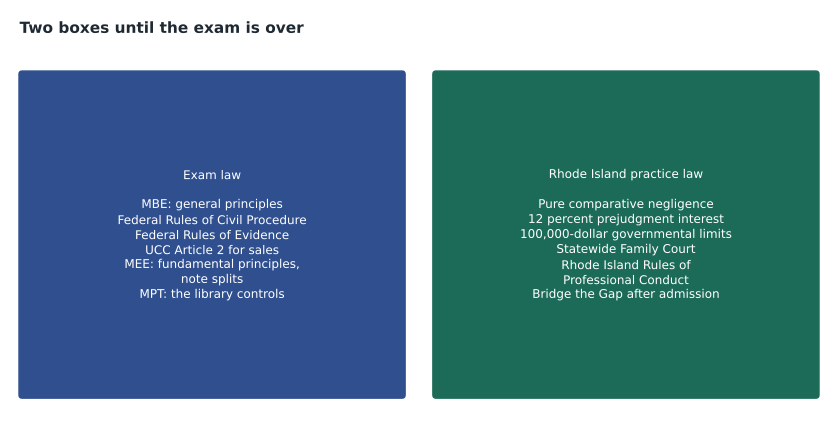
Where Rhode Island law differs from exam law
Most Rhode Island law looks like general American law, and much of it was written to track national models. Rhode Island's Superior Court Rules of Civil Procedure are modeled on the Federal Rules of Civil Procedure, and its Rules of Evidence are largely modeled on the Federal Rules of Evidence. Rhode Island's Rules of Professional Conduct are based on the ABA Model Rules. That overlap is good news: most of what you learn for the exam is also what you will use in Rhode Island courts.
There are, however, a number of points where Rhode Island takes its own path. A few of them could tempt a candidate on the exam.
| Topic | Usual exam approach | Rhode Island practice |
|---|---|---|
| Comparative negligence | Know pure and modified systems; modified bars a plaintiff more at fault than the defendant (or at 50 percent) | Pure comparative negligence: a plaintiff's fault reduces but never bars recovery |
| Prejudgment interest | Generally discretionary or limited to liquidated sums | Clerk adds 12 percent a year from accrual to awards of pecuniary damages |
| Suits against government | Discuss sovereign immunity and waivers generally | Statutory limits of 100,000 dollars for many claims against the state and municipalities, subject to exceptions |
| Contingent fees | Model Rule 1.5(c): writing signed by client | Same writing rule, plus quarterly billing for non-contingent, non-fixed fees unless agreed otherwise |
| Family law | MEE removed Family Law from July 2026; it may appear on an MPT | A separate statewide Family Court with broad jurisdiction |
A method for keeping the boxes separate
Marchetti gave Joana a method. Keep a single page, called a conflict sheet, listing every Rhode Island rule she learns at the firm that differs from what she is studying for the exam. Each line has three parts: the topic, the exam rule and the Rhode Island rule. When she reviews for the MEE, she reads the left column. When she drafts a memo for Domingos, she reads the right column. Writing the differences down keeps them from blurring.
The second part of the method is to read every MEE question's call carefully. If a question says to apply the law of a named state, or of a fictional state whose statute is given, apply it. If it says nothing, use general principles and, where there is a recognized split, identify it. Do not write about Rhode Island unless the question asks about Rhode Island, which on the MEE it will not.
The third part is for the MPT. The library is the law. If the library contains a statute from the fictional state of Franklin that adopts pure comparative negligence, apply pure comparative negligence. If it adopts a modified system, apply that. Bringing in an outside rule, even a correct Rhode Island rule, is an error on the MPT.
Worked problem
Two essay questions
Joana practices two MEE questions. In the first, a plaintiff is 55 percent at fault and the call asks about recovery, saying nothing about the jurisdiction. In the second, the facts say the state has adopted a pure comparative negligence statute. How should she handle each?
Show solution
- First question: state the general approaches. Under pure comparative negligence the plaintiff recovers 45 percent of damages; under modified comparative negligence a plaintiff more at fault than the defendant recovers nothing. Explain that most states use a modified system, then analyze under both.
- Second question: the facts supply the rule. Apply pure comparative negligence and reduce recovery by 55 percent.
- In neither answer should she cite the Rhode Island statute.
Answer: Answer the question asked, using the rule the question gives or general principles when it gives none.
Rhode Island Bridge the Gap
Rhode Island brings its own law into a new lawyer's training through Bridge the Gap, a requirement in Article IV, Rule 3.3 of the Supreme Court Rules. Every newly admitted attorney must complete the one-day Rhode Island Bridge the Gap course within 90 days of admission, meaning within 90 days after being sworn in and issued a bar number. The course is offered in person and as a video replay. Its curriculum is approved by the Mandatory Continuing Legal Education Commission, and the Supreme Court sets its fees.
Bridge the Gap does not count toward regular CLE credit, because its content is mandatory. A newly admitted lawyer is instead exempt from the regular annual CLE requirement for the reporting period in which the lawyer is admitted. A lawyer who has been admitted in another jurisdiction for at least three years when joining the Rhode Island bar may be exempt from Bridge the Gap, but must submit a certificate of good standing through the MCLE portal. Courses from other jurisdictions do not satisfy the requirement.
The consequences of missing the deadline are serious. A lawyer who does not complete the course on time is charged a makeup fee and removed from the Master Roll of attorneys without further notice, and practicing after removal is unauthorized practice. Reinstatement within six months requires completing the course and paying the fees; after six months it requires a petition to the Supreme Court. The rule took effect July 1, 2025.
How this shapes the rest of the course
Because Rhode Island law is not on the exam, Lessons 7 to 10 are written for the first year of practice. They cover the material a new lawyer in a small Rhode Island firm needs first: the courts and civil procedure; torts, including pure comparative negligence, the governmental limits and prejudgment interest; family law and the Family Court; and the Rhode Island Rules of Professional Conduct. A candidate who is short on time before the exam can skim those lessons now and return to them after results. A candidate who works at a firm, as Joana does, will find that they explain much of what happens at work.
Common mistakes
MistakeRhode Island tests its own law in a separate component.
InsteadThere is no Rhode Island component for the legacy UBE; Rhode Island law comes in through Bridge the Gap after admission.
MistakeOn the MEE, apply the law of the state where you are sitting.
InsteadApply general principles unless the question supplies a rule; the MPT library controls on the MPT.
MistakeBridge the Gap counts toward the first year's CLE hours.
InsteadBridge the Gap gives no CLE credit; new lawyers are instead exempt from the regular requirement for their first reporting period.
MistakeBridge the Gap can be done any time in the first year.
InsteadIt must be completed within 90 days of admission, or the lawyer is removed from the Master Roll.
How Joana's conflict sheet looked by November
By mid-November, Joana's conflict sheet had grown to a dozen lines. On comparative negligence, the left column read pure and modified systems, most states modified, and the right column read Rhode Island pure under section 9-20-4. On limitation periods, the left column read that the MBE tests the concept, not numbers, and the right column read three years for personal injury and ten years for most other civil actions. On interest, the left column read generally discretionary, and the right column read 12 percent from accrual by statute. On lawyer advertising, the left column read the Model Rules, and the right column read filing with Disciplinary Counsel within 48 hours. Reviewing the sheet took five minutes a week and kept her answers clean.
Marchetti added two lines from her own experience grading essays. First, Rhode Island candidates sometimes write about the Family Court in a family law MPT task that supplies a fictional state's statute; the library controls. Second, candidates who work in firms sometimes write like practitioners, citing statutes by number. On the MEE, a statute number from a real state adds nothing; a clear statement of the rule earns the point.
Learning Rhode Island law the efficient way
After the exam, a new Rhode Island lawyer has to learn a great deal of local law quickly. The efficient way is to start from the matters in front of you. When a file opens, read the governing statute in the Rhode Island General Laws, the leading Rhode Island Supreme Court decisions on the issue and the court's rules and administrative orders for the court where the case will be heard. Rhode Island Supreme Court opinions are published on the judiciary's website, and the Court's orders amending its rules appear on its miscellaneous orders page. The Rhode Island Bar Association offers practice manuals and CLE programs in the areas small-firm lawyers handle most, and Bridge the Gap introduces the practical side of Rhode Island practice in a single day.
Mentoring matters too. Rhode Island's bar is small, and experienced lawyers are generally willing to answer a quick question from a new lawyer. Joana already had two: Domingos for civil litigation and Moira for family law. Marchetti suggested she find a third outside the firm, through the Bar Association, so she would have someone to ask when a question touched her own firm's interests.
One more check: the call of the question
The final habit is the simplest. Before writing any MEE answer, read the call of the question twice and underline what it asks. A question that asks only whether a contract was formed does not ask about remedies, and a question that asks about one party's rights does not ask about the other's. Answering the question asked, and only that question, is the surest way to avoid the temptation to write about Rhode Island law the question never raised.
Summary and key terms
- Rhode Island gives the plain UBE with no Rhode Island law component.
- The exam tests general principles, the Federal Rules and the UCC; the MPT library supplies its own law.
- Rhode Island rules on comparative negligence, prejudgment interest, governmental liability, fees and family courts differ from what the exam tests; keep a conflict sheet.
- Every new lawyer must complete the one-day Bridge the Gap course within 90 days of admission, unless admitted elsewhere for at least three years.
- Bridge the Gap gives no CLE credit; missing it means removal from the Master Roll.
- 0
- general principles
- 1
- jurisdiction-specific component
- 2
- conflict sheet
- 3
- Bridge the Gap
- 4
- Master Roll
- 5
- MCLE Commission
- 6
- MPT library
Practice problems
Work each problem on paper first, then reveal the answer to check.
Does Rhode Island have a jurisdiction-specific component for the legacy UBE?
Show answer
No.
On an MEE question that names no jurisdiction, which comparative negligence rule should you apply?
Show answer
General principles: identify pure and modified systems and analyze under both, noting that most states use a modified system.
Within what time must a new Rhode Island lawyer complete Bridge the Gap?
Show answer
Within 90 days of admission, meaning after being sworn in and issued a bar number.
Who may be exempt from Bridge the Gap?
Show answer
A lawyer admitted in another jurisdiction for at least three years, who submits a certificate of good standing.
Lesson quiz · 5 questions
Score 60% or more to complete this lesson.
Create a free account to save your progress, take quizzes and earn a certificate.