
BAR-240 · Lesson 10 of 12 · 20 min
The Rhode Island Rules of Professional Conduct: where Rhode Island differs
▶ Video coming soon A video version of this lesson is on the way.
In November 2026 a Connecticut lawyer called Domingos Faria about a car-crash case. Her client lived in Woonsocket and had been hit on Route 146, and she wanted Faria & Quinlan to handle the Rhode Island suit and split the fee. Domingos asked Joana to draft the engagement letter, the contingent fee agreement and the fee-division letter, and to check everything against the Rhode Island Rules of Professional Conduct. 'You studied the Model Rules for the MPRE,' he said. 'Rhode Island starts from them, but it has added its own details. That is where new lawyers get caught.'
This lesson covers where Rhode Island's rules come from, the specific Rhode Island provisions a new lawyer meets in the first year, how to get ethics advice before acting and the Court's 2026 changes on technology and generative artificial intelligence. The MPRE tests the ABA Model Rules, not Rhode Island's version, so none of this is on the MPRE. All of it applies in practice.
Where the rules come from
The Rhode Island Rules of Professional Conduct are Article V of the Rhode Island Supreme Court Rules. They follow the structure and numbering of the ABA Model Rules, and most of the text is the same. The Court amends them by order. The version on the Court's website is marked revised October 2023, and the Court amended the commentary to Rule 1.1 again in June 2026. Lawyer discipline is governed by Article III, which sets up the Disciplinary Board and the Office of Disciplinary Counsel, and the Court decides discipline cases itself.
Because Rhode Island's rules track the Model Rules so closely, the differences are easy to miss. The way to find them is to read the Rhode Island text of each rule you rely on, including the commentary, rather than assuming the Model Rule applies.
Limited scope representation
Rhode Island's Rule 1.2 includes detailed provisions on limited scope representation that go beyond the Model Rule. A lawyer may limit the scope of a representation in a court case, but the limited representation must be set out in a written engagement or retainer agreement, and the client must first file a pro se appearance. Without leave of court and the client's written consent, a lawyer may not file an entry of limited appearance for more than one court event in a civil case. And a lawyer may not enter a limited appearance for the sole purpose of making evidentiary objections. The rules on communicating with a represented person in Rule 4.2 coordinate with these provisions: a client who has a lawyer for a limited appearance is treated as unrepresented for matters outside its scope.
Limited appearances are common in the Family Court and the District Court, where many litigants cannot afford full representation. A new lawyer who agrees to appear for one hearing must follow the paperwork precisely.
Communication and fees
Rule 1.4 allows a lawyer to satisfy the duty to explain the lawyer-client relationship by giving the client the statement of client's rights and responsibilities in Appendix 2 to the rules. Many Rhode Island firms attach it to every engagement letter.
Rule 1.5 contains several Rhode Island provisions. A contingent fee agreement must be in a writing signed by the client, and it must state the percentages that apply on settlement, at trial and on appeal. Where a fee is neither fixed nor contingent, the lawyer must provide billings to the client on a quarterly basis unless the agreement says otherwise. As under the Model Rule, a lawyer may not charge a contingent fee in a domestic relations matter whose payment depends on securing a divorce or on the amount of alimony, support or a property settlement, or a contingent fee for representing a defendant in a criminal case.
A division of fees between lawyers in different firms requires the client's agreement to the arrangement, including the share each lawyer will receive, confirmed in writing, along with the other conditions in the rule. The commentary to Rule 1.5 adds that a lawyer should conscientiously consider submitting a fee dispute to an arbitration or mediation procedure established by the bar.
| Rule | Rhode Island provision | Practical step |
|---|---|---|
| 1.2 | Limited scope in court requires a written agreement and a prior pro se appearance; one court event in a civil case without leave; not just for evidentiary objections | Use the court forms and a written limited scope agreement |
| 1.4 | Duty to explain the relationship can be met with the Appendix 2 statement of client's rights and responsibilities | Attach the statement to the engagement letter |
| 1.5 | Contingent fee writing signed by the client stating percentages for settlement, trial and appeal; quarterly billing for hourly matters unless agreed otherwise | Build both into the firm's templates |
| 1.6 | Permissive exceptions as published do not include the Model Rule's financial fraud exceptions | Read the Rhode Island text before disclosing |
| 1.15 and 1.19 | Trust records kept seven years; only a Rhode Island lawyer may sign trust checks; IOLTA interest to the Rhode Island Bar Foundation | Set up trust accounting before the first deposit |
Confidentiality
Rhode Island's Rule 1.6 protects information relating to the representation, as the Model Rule does, and allows disclosure only under permissive exceptions. As published in the current text, the exceptions allow a lawyer to reveal information to prevent the client from committing a criminal act likely to result in imminent death or substantial bodily harm, to secure legal advice about compliance with the rules, to establish a claim or defense in a controversy between lawyer and client or respond to allegations about the lawyer's conduct, and to comply with other law or a court order. The Rhode Island text does not include the Model Rule's exceptions that allow disclosure to prevent, mitigate or rectify a client's crime or fraud causing substantial financial injury. A Rhode Island lawyer who discovers a client's financial fraud must therefore analyze the problem under the Rhode Island text and the rules on withdrawal and candor, rather than relying on an exception that Rhode Island did not adopt.
Trust accounts and records
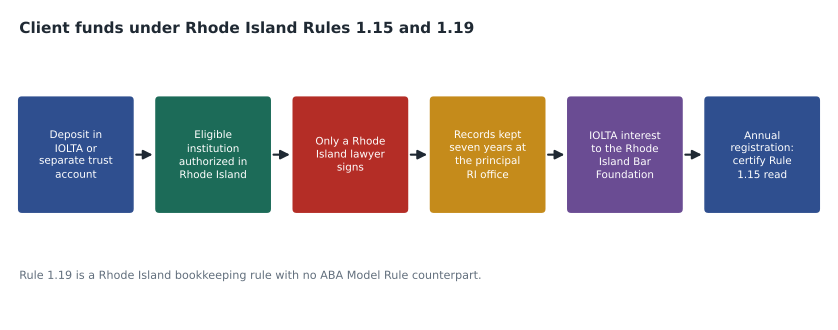
Rhode Island has detailed rules on client funds. Rule 1.15 requires lawyers to keep client and third-party funds separate in trust accounts and to keep complete records for seven years after the representation ends. Interest on lawyers' trust accounts, or IOLTA, must be held at eligible institutions authorized to do business in Rhode Island, and the interest is remitted to the Rhode Island Bar Foundation to fund legal services for the poor of Rhode Island.
Rule 1.19, a Rhode Island rule with no Model Rule counterpart, sets bookkeeping requirements. Records must be kept for seven years after the events they record, at the lawyer's principal Rhode Island office. Only a lawyer admitted to practice in Rhode Island may be an authorized signatory on a Rhode Island trust account. Where client funds cannot be returned because a client cannot be found, the rule provides a procedure for court orders, in the Superior Court if no action was commenced.
Annual registration ties these rules together. Every Rhode Island lawyer registers with the Supreme Court each year between April 1 and July 1, paying 200 dollars for active status, certifying that the lawyer has read Rule 1.15 and stating whether the lawyer carries professional liability insurance. Late filing brings a 125-dollar late fee and removal from the Master Roll.
Unauthorized practice and out-of-state lawyers
Rhode Island takes the regulation of the practice of law seriously. The commentary to Rule 5.4 notes that the Court has ultimate authority to regulate the practice of law, and the General Assembly has made unauthorized practice a statutory offense. Rhode Island's Rule 5.5 bars out-of-state lawyers from working from a law firm or office in Rhode Island, and its commentary explains when a lawyer working remotely from Rhode Island for an out-of-state employer has not established an office in Rhode Island. The commentary cites Rhode Island Supreme Court decisions on unauthorized practice, including In re Kimmel & Silverman, P.C. (2019).
For the Connecticut referral, that meant two things. The Connecticut lawyer could share in the fee only within Rule 1.5's conditions, and she could not appear in the Rhode Island case unless she was admitted pro hac vice under Article II, Rule 9, sponsored by a Rhode Island lawyer.
Advertising
Rhode Island's advertising rules add filing and disclosure duties. Under Rule 7.2, a copy of an advertisement must be sent to Supreme Court Disciplinary Counsel before or within 48 hours after it is first disseminated, and the lawyer must keep a copy for three years after its last dissemination. Under Rule 7.3, written solicitations must also be filed with Disciplinary Counsel. Rule 7.4 requires a lawyer who communicates about a specialty to include a disclaimer that the Rhode Island Supreme Court licenses all lawyers in the general practice of law and does not certify any lawyer as a specialist. Under Rule 7.5, a firm that lists lawyers not licensed in Rhode Island must identify them as not licensed to practice in Rhode Island.
| Rule | Rhode Island requirement |
|---|---|
| 7.2 | Send advertisements to Disciplinary Counsel before or within 48 hours of first dissemination; keep copies three years |
| 7.3 | File written solicitations with Disciplinary Counsel |
| 7.4 | Specialty statements include the disclaimer that the Court licenses all lawyers in the general practice of law and does not certify specialists |
| 7.5 | Identify lawyers not licensed in Rhode Island on firm letterhead and websites |
Reporting and lawyer assistance
Rule 8.3 requires a lawyer who knows another lawyer has committed a violation raising a substantial question about honesty, trustworthiness or fitness to inform the appropriate authority, as the Model Rule does. Rhode Island adds provisions about the Confidential Assistance Committee of the Rhode Island Bar Association, which helps lawyers with substance use and mental health problems, and protects the confidentiality of information the Committee receives. A new lawyer who is struggling, or who is worried about a colleague, can contact the Committee knowing its work is confidential.
Getting advice before acting
The Supreme Court's Ethics Advisory Panel gives Rhode Island lawyers written advice about their own prospective conduct under the Rules of Professional Conduct. A lawyer submits a request describing the facts and the question, and the Panel issues an opinion. The Court's rules give a lawyer who acts in good faith on the Panel's advice protection from discipline for that conduct. The Panel's published opinions, indexed by subject on the Court's website, are a useful first stop when a Rhode Island question arises.
Technology and generative AI
In June 2026 the Supreme Court amended comment 6 to Rule 1.1 on competence. The comment now says that, to maintain competence, a lawyer should keep abreast of changes in the law and its practice, including the benefits and risks associated with existing and developing technology, engage in continuing study and education and comply with continuing legal education requirements. The same order adopted Interim Guidelines for the Ethical Use of Generative AI by Rhode Island Lawyers and by Rhode Island Judicial Officers. The guidelines are advisory: they do not amend the Rules of Professional Conduct or the Code of Judicial Conduct and do not carry the force of law, but they show how the Court expects the existing rules on competence, confidentiality, supervision and candor to apply to AI tools.
Worked problem
The Connecticut referral
Joana drafts the documents for the Woonsocket client. The Connecticut lawyer proposes a one-third contingent fee, split 60 percent to Faria & Quinlan and 40 percent to her. What must the documents contain?
Show solution
- Contingent fee agreement: in writing, signed by the client, stating the percentage on settlement, at trial and on appeal, and how expenses are handled.
- Fee division: the client agrees to the arrangement, including each firm's share, confirmed in writing, and the division meets Rule 1.5's conditions on proportion of services or joint responsibility.
- Engagement letter: attach the Appendix 2 statement of client's rights and responsibilities.
- Appearance: if the Connecticut lawyer wants to appear, file a pro hac vice petition under Article II, Rule 9 with a Rhode Island sponsor; she may appear in no more than three cases in five years without a waiver.
- Funds: deposit settlement proceeds into the firm's Rhode Island trust account, signed only by a Rhode Island lawyer.
Answer: Following the Rhode Island text produces documents that satisfy both the Model Rule baseline and Rhode Island's added requirements.
Common mistakes
MistakeA Rhode Island lawyer may disclose a client's financial fraud under Rule 1.6 as under the Model Rule.
InsteadRhode Island's published Rule 1.6 does not include the Model Rule's financial fraud exceptions.
MistakeA lawyer can enter limited appearances for several hearings at once.
InsteadWithout leave and the client's written consent, a limited appearance covers only one court event in a civil case.
MistakeAdvertisements only need to comply in content.
InsteadRhode Island requires filing copies with Disciplinary Counsel within 48 hours and keeping them three years.
MistakeThe 2026 AI guidelines are binding rules.
InsteadThey are advisory and do not amend the Rules of Professional Conduct.
Summary and key terms
- Rhode Island's Rules of Professional Conduct are Article V of the Supreme Court Rules, based on the ABA Model Rules with Rhode Island additions.
- Rule 1.2 has detailed limited scope requirements; Rule 1.5 requires signed contingent fee agreements stating percentages and quarterly billing for hourly matters.
- Rhode Island's published Rule 1.6 omits the Model Rule's financial fraud exceptions.
- Rules 1.15 and 1.19 require seven-year records, Rhode Island-admitted signatories and IOLTA interest to the Rhode Island Bar Foundation.
- Advertising must be filed with Disciplinary Counsel; specialty claims need the general practice disclaimer; the June 2026 order added technology to comment 6 of Rule 1.1 and adopted advisory AI guidelines.
- 0
- Article V
- 1
- limited scope representation
- 2
- contingent fee agreement
- 3
- IOLTA
- 4
- Rule 1.19
- 5
- Disciplinary Counsel
- 6
- Ethics Advisory Panel
- 7
- Confidential Assistance Committee
Practice problems
Work each problem on paper first, then reveal the answer to check.
What must a Rhode Island contingent fee agreement state?
Show answer
It must be in a writing signed by the client and state the percentages for settlement, trial and appeal.
Within what time must an advertisement be sent to Disciplinary Counsel?
Show answer
Before or within 48 hours after it is first disseminated.
Who may sign checks on a Rhode Island trust account?
Show answer
Only a lawyer admitted to practice law in Rhode Island.
What did the Court's June 2026 order do?
Show answer
It amended comment 6 to Rule 1.1 to address technology and adopted advisory interim guidelines on generative AI.
Lesson quiz · 5 questions
Score 60% or more to complete this lesson.
Create a free account to save your progress, take quizzes and earn a certificate.