
BAR-240 · Lesson 7 of 12 · 19 min
Rhode Island courts and civil procedure
▶ Video coming soon A video version of this lesson is on the way.
Joana's first court assignment at Faria & Quinlan was to file a small collection case for a Pawtucket auto-body shop. The customer owed 3,800 dollars. Domingos Faria asked her where it should be filed. She said the Superior Court, because that is where the firm's other cases were. He shook his head. 'Under 5,000 dollars belongs in the District Court,' he said. 'Rhode Island is small, but it has more courts than people expect, and every one has its own jurisdiction.'
This lesson introduces the Rhode Island court system, how a civil case moves through it, the procedural rules a new lawyer uses every day, the main limitation periods and a few features of Rhode Island public law that come up in practice. The aim is a working map for the first year, not a treatise.
A unified state court system
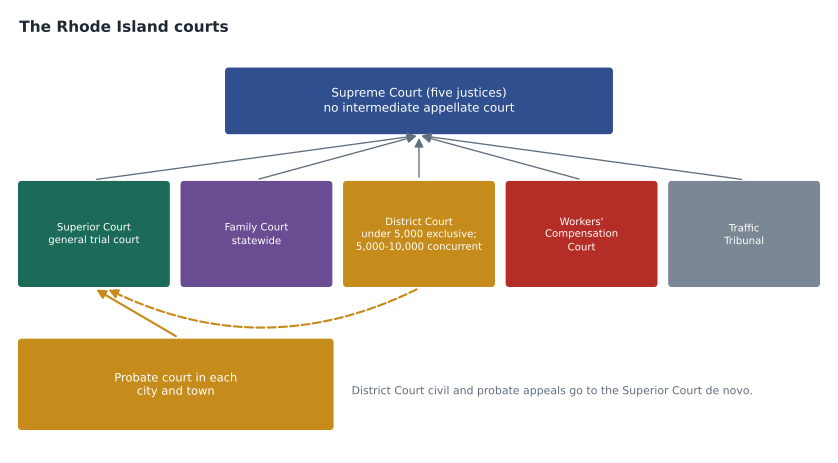
Rhode Island has a unified judicial system administered by the Supreme Court. Because the state has no county government in the usual sense, there are no county courts. The state courts are the Supreme Court, the Superior Court, the Family Court, the District Court, the Workers' Compensation Court and the Traffic Tribunal. Separately, each city and town has a probate court, staffed by part-time probate judges, which handles wills and estates. Courthouses are located in Providence, Warwick for Kent County, Wakefield for Washington County and Newport, with Providence County also serving Bristol County.
The Supreme Court
The Rhode Island Supreme Court has five justices and is the state's only appellate court. There is no intermediate court of appeals, so appeals from final judgments of the Superior Court, the Family Court and, in some matters, the District Court go directly to the Supreme Court. Some matters reach the Court only by petition for a writ of certiorari, which the Court may grant or deny, including review of many decisions of the Workers' Compensation Court and of decisions that are not otherwise appealable.
Two features of the Supreme Court are unusual. First, the Rhode Island Constitution allows the governor and either house of the General Assembly to ask the justices for advisory opinions on questions of law in certain circumstances, so the Court sometimes answers legal questions before any case exists. Second, the Court has broad supervisory authority over the practice of law and the other courts. It writes the rules of procedure for all the state courts, admits and disciplines lawyers and runs the court system's administration.
For a new lawyer, the most important point about appeals is timing. The appellate rules set a short period to file a notice of appeal in the trial court after entry of judgment, and the deadline is jurisdictional in practice. A lawyer should calendar the appeal deadline the day judgment enters and check the current Supreme Court Rules of Appellate Procedure for the exact period and any tolling motions.
The Superior Court
The Superior Court is the general trial court. It hears civil cases above the District Court's jurisdiction, all felony prosecutions, jury trials, equity matters such as injunctions and receiverships, and appeals from the District Court and from the municipal probate courts. It also hears appeals from many state administrative agencies. The Superior Court has specialized calendars, including a Business Calendar in Providence for complex commercial cases, and it uses court-annexed arbitration for some smaller civil cases.
Appeals from the District Court in civil cases go to the Superior Court for a trial de novo, meaning the case is tried again from the beginning, rather than reviewed on the record. Probate appeals also go to the Superior Court and are heard de novo. A party who loses in the District Court therefore gets a full second trial before any appeal reaches the Supreme Court.
The District Court
The District Court is the state's court of limited jurisdiction. On the civil side, it has exclusive jurisdiction over actions at law where the amount in controversy is under 5,000 dollars, and concurrent jurisdiction with the Superior Court for amounts over 5,000 up to 10,000 dollars. In the concurrent range, a defendant may demand removal to the Superior Court in the answer, and the case then proceeds as if it had been filed there. The District Court also hears small claims, landlord-tenant evictions and certain administrative appeals, and on the criminal side it handles misdemeanors, arraignments and bail on felony charges.
That is why Domingos sent the 3,800-dollar collection case to the District Court. Filing it in the Superior Court would have invited a motion to dismiss for lack of jurisdiction or a transfer, and it would have cost the client more.
| Court | Main civil jurisdiction | Where appeals go |
|---|---|---|
| Supreme Court | Appeals; certiorari; advisory opinions; bar admission and discipline | Final in state court; federal questions to the United States Supreme Court |
| Superior Court | General civil jurisdiction above 10,000 dollars; concurrent above 5,000; equity; jury trials | Supreme Court |
| District Court | Exclusive under 5,000 dollars; concurrent 5,000 to 10,000; small claims; evictions | Superior Court, trial de novo |
| Family Court | Divorce, custody, support, juvenile matters, adoption | Supreme Court |
| Probate courts (each city and town) | Wills, estates, guardianships of adults | Superior Court, de novo |
| Workers' Compensation Court | Workplace injury claims | Appellate division, then Supreme Court by certiorari |
The rules of civil procedure
Each Rhode Island court has its own rules of civil procedure, adopted by the Supreme Court. The Superior Court Rules of Civil Procedure are modeled on the Federal Rules of Civil Procedure, so most of what a candidate learns for the MBE applies: notice pleading, liberal joinder, Rule 12 motions, broad discovery under Rules 26 to 37, summary judgment under Rule 56 and the like. Rhode Island decisions often look to federal cases interpreting the parallel federal rule when the language is the same.
There are differences in the details, and they are the kind that trip up new lawyers. Deadlines for service, answers and motions may differ from the federal numbers. The District Court and the Family Court have their own rule sets. And each court issues administrative orders and practice rules on scheduling, motion calendars and electronic filing. Rhode Island courts use mandatory electronic filing for attorneys in most case types, and a new lawyer should complete the court system's e-filing training and read the current rules before the first filing.
Rhode Island also has a statute against strategic lawsuits against public participation. It protects a party's exercise of the right of petition or free speech on matters of public concern before government bodies, and allows an early motion to dismiss a claim based on that conduct. A new lawyer who receives a defamation or interference claim arising from testimony at a city council or zoning board meeting should look at it immediately.
Limitation periods
Rhode Island's limitation periods are found mainly in chapter 1 of Title 9 of the General Laws. The ones a new lawyer meets first are these. Actions for injuries to the person must generally be brought within three years after the cause of action accrues. Medical malpractice claims also have a three-year period, measured with a discovery rule. Wrongful death claims have a three-year period. Most other civil actions, including contract claims, have a general ten-year period, which is long by national standards. Slander has a much shorter period of one year.
The ten-year general period is one of the Rhode Island rules that surprises lawyers from other states. A contract claim that would be stale in Massachusetts after six years may still be timely in Rhode Island. But the general period does not apply where a more specific statute governs, such as claims for personal injury, claims under the Uniform Commercial Code for sales of goods or claims against governmental bodies with their own notice requirements. A lawyer should always check for a specific statute before relying on ten years.
| Claim | General Rhode Island period | Note |
|---|---|---|
| Personal injury | Three years from accrual | General Laws section 9-1-14 |
| Medical malpractice | Three years, with a discovery rule | Section 9-1-14.1 |
| Wrongful death | Three years | Chapter 7 of Title 10 |
| Most other civil actions, including contract | Ten years | Section 9-1-13; check for a more specific statute |
| Slander | One year | Section 9-1-14 |
Separation of powers and the advisory opinion
Rhode Island's constitutional structure has its own history. For much of the state's history the General Assembly exercised unusually broad power, including appointing members of many executive boards. In 2004 voters approved a constitutional amendment that expressly established separation of powers among the three branches. Rhode Island lawyers still encounter that history in cases about appointments and the powers of boards and commissions. And because the Supreme Court may give advisory opinions when asked by the governor or the General Assembly, some leading Rhode Island constitutional rulings come from advisory opinions rather than ordinary litigation.
Federal court and tribal land
Federal cases in Rhode Island are heard in the United States District Court for the District of Rhode Island in Providence, with appeals to the First Circuit in Boston. Admission to the federal district court is separate from admission to the state bar and has its own requirements.
Rhode Island has one federally recognized tribe, the Narragansett Indian Tribe. Under a 1978 federal settlement of the tribe's land claims, state law generally applies on the settlement lands in Charlestown. In Carcieri v. Salazar (2009), the United States Supreme Court held that the Secretary of the Interior lacked authority under the Indian Reorganization Act to take land into trust for the tribe, because the statute covered tribes that were under federal jurisdiction in 1934. The case is one of the leading modern decisions on federal Indian law and arose from a dispute over a small parcel in Charlestown.
Worked problem
Choosing the court
Joana sorts three new files for Domingos. (1) A landlord client wants to evict a tenant for nonpayment. (2) A Central Falls contractor is owed 8,200 dollars for a kitchen remodel. (3) A Warwick widow's husband died with a will naming her executor. Where does each begin?
Show solution
- Eviction: the District Court, which hears landlord-tenant evictions.
- Contractor: 8,200 dollars is in the concurrent range, so the claim may be filed in the District Court or the Superior Court; if filed in the District Court, the defendant may demand removal to the Superior Court in the answer. A loss in the District Court would lead to a trial de novo in the Superior Court.
- Will: the probate court of the city or town where the decedent lived, here the Warwick Probate Court, with appeals to the Superior Court.
Answer: Jurisdiction in Rhode Island turns on the type of case and the amount in controversy. Choosing the right court first saves time and fees.
Common mistakes
MistakeRhode Island has an intermediate court of appeals.
InsteadThere is none; appeals go directly to the five-justice Supreme Court.
MistakeA District Court civil loss is reviewed by the Supreme Court on the record.
InsteadCivil appeals from the District Court go to the Superior Court for a trial de novo.
MistakeAll Rhode Island civil claims have a ten-year limitation period.
InsteadPersonal injury, malpractice and wrongful death claims have three years, slander one year, and specific statutes control.
MistakeWills are probated in the Superior Court.
InsteadEach city and town has a probate court; appeals go to the Superior Court.
Practice habits for Rhode Island courts
Three habits help a new Rhode Island litigator. First, read the rules and administrative orders of the specific court before filing, because the Superior, District and Family Courts each have their own rules and calendars, and the Business Calendar and other specialized calendars have their own practices. Second, calendar every deadline that can be lost by waiting, including the time to answer, the time to demand removal from the District Court, the time to appeal and claim presentment periods for municipal defendants. Third, check at intake whether the defendant is a governmental body, because that changes the presentment requirement, the damages limit and the strategy of the whole case.
Small-state practice has one more feature worth naming. Rhode Island lawyers see the same judges, magistrates and opposing counsel over and over, often in the same week. A reputation for reliability, courtesy and candor with the court is built quickly and lost quickly, and it affects how every later case goes.
A fourth habit is practical: keep a short court directory with the clerk's office numbers, the e-filing help desk and the magistrates and calendars for each court where the firm practices. In a state this small, knowing which clerk's office handles which calendar saves hours over a year.
Summary and key terms
- Rhode Island has a unified state court system with no intermediate appellate court.
- The District Court has exclusive civil jurisdiction under 5,000 dollars and concurrent jurisdiction from 5,000 to 10,000; appeals go to the Superior Court de novo.
- The Superior Court is the general trial court; the Family Court, Workers' Compensation Court, Traffic Tribunal and municipal probate courts handle specialized matters.
- The Superior Court Rules of Civil Procedure track the federal rules, but details and practice orders differ.
- Key limitation periods: three years for personal injury, malpractice and wrongful death; ten years for most other civil actions; one year for slander.
- 0
- unified judicial system
- 1
- trial de novo
- 2
- concurrent jurisdiction
- 3
- probate court
- 4
- advisory opinion
- 5
- certiorari
- 6
- limitation period
- 7
- anti-SLAPP statute
Practice problems
Work each problem on paper first, then reveal the answer to check.
Where should a 4,000-dollar collection case be filed in Rhode Island?
Show answer
The District Court, which has exclusive jurisdiction under 5,000 dollars.
What happens when a party appeals a civil judgment of the District Court?
Show answer
The case is tried de novo in the Superior Court.
What is Rhode Island's general limitation period for personal injury?
Show answer
Three years from accrual.
What did Carcieri v. Salazar hold?
Show answer
The Secretary of the Interior could not take land into trust for the Narragansett Tribe under the Indian Reorganization Act because the tribe was not under federal jurisdiction in 1934.
Lesson quiz · 5 questions
Score 60% or more to complete this lesson.
Create a free account to save your progress, take quizzes and earn a certificate.