
BAR-245 · Lesson 1 of 12 · 20 min
Becoming a lawyer in Utah
▶ Video coming soon A video version of this lesson is on the way.
Mele Tuilagi grew up in West Valley City, the oldest of five children in a Tongan American family that still gathers every Sunday at her grandmother's house for a long lunch after church. She finished law school at an ABA-approved law school in May 2026, the first person in her family to earn a graduate degree. Since June 2026 she has worked as a law clerk at Arnesen & Ostler, a five-lawyer firm in downtown Salt Lake City that handles car crashes and falls, claims against cities and counties, divorces and custody cases, small business disputes and, because one partner grew up on a farm in Juab County, a steady stream of water rights matters. Her supervising partner, Brigid Arnesen, has practiced in Salt Lake County for twenty-two years. The water rights partner, Thayne Ostler, keeps a framed copy of an 1890s water decree on his office wall.
Mele joined Hollis Marchetti's online study group in the fall of 2026. At her first one-on-one call she listed what was confusing her. 'Brigid passed a Utah exam with Utah essays on it,' she said. 'Now everyone tells me Utah gives the Uniform Bar Examination, that the passing score dropped a few years ago, that Utah is moving to something called NextGen, and that there is a new way to get licensed without taking the bar exam at all. A classmate of mine is thinking about that route. I want one clear picture of the whole process before I commit to anything.'
Marchetti shared her screen and opened her checklist. 'Utah gives the Uniform Bar Examination. That means there are no Utah essays: the Multistate Performance Test and the Multistate Essay Examination on day one, the Multistate Bar Examination on day two, and a total scaled score of 260 or higher to pass for any exam from July 2023 on. Before July 2023 Utah required 270. The Utah Supreme Court has decided to move to the NextGen exam, but not until July 2028, so February 2027 is an ordinary UBE for you. Separately, the Court has approved an alternate pathway built on supervised practice and a performance exam, and we will look at whether it fits you. Whatever route you take, the Bar's character and fitness process has to clear you, and you need an MPRE score of 86.'
This lesson maps the whole system: who controls admission in Utah, the bodies that do the work, the routes into practice and the usual order of events for a first-time candidate. Later lessons take each step in detail and then turn to the distinctive Utah law that a new lawyer meets in Salt Lake City, Ogden, Provo, St. George, Logan or a county seat in the rural parts of the state.
The Utah Supreme Court controls admission
Admission to the practice of law in Utah is a judicial function. The Utah Constitution gives the Supreme Court authority to govern the practice of law, including admission and discipline, and the Court exercises that power by rule. Since 2025 the admission rules have been numbered as Chapter 4, Article 7 of the Supreme Court Rules of Professional Practice, starting at Rule 4-701. Before that renumbering they were Rules 14-701 and following of the Utah Code of Judicial Administration, and many documents, forms and cross-references still use the older 14-700 numbers. A candidate reading Rule 4-705 (admission by motion) and an older guide that cites Rule 14-705 is reading the same rule under two numbers.
The Court keeps the rules current. Amendments effective May 1, 2026, for example, added definitions of the Legacy UBE and the NextGen UBE, allowed applicants to transfer a NextGen score earned in another jurisdiction, and created a new Rule 4-722 that sets out how an applicant may petition the Court to waive a rule in extraordinary circumstances. Rule 4-702 now states plainly that the Board of Bar Commissioners has no authority to waive the rules itself.
That structure has a practical message. Bar review companies, classmates and senior lawyers are useful sources of background, but they are not authority. Mele keeps a folder with the current admission rules, the Office of Admissions instructions for the February 2027 exam and every email she receives from the Bar.
The Utah State Bar and its Office of Admissions
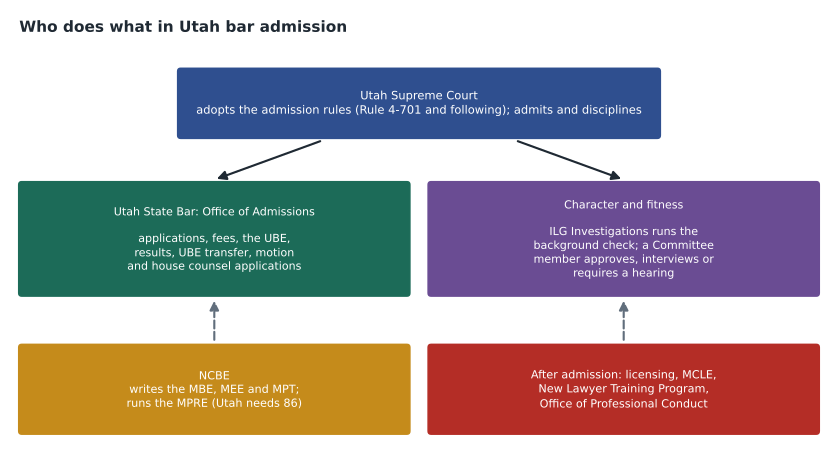
Utah has an integrated, or mandatory, bar. Every lawyer licensed in Utah is a member of the Utah State Bar, which operates under the Supreme Court's supervision. The Bar's Board of Bar Commissioners governs it, and the Supreme Court has delegated much of the work of admissions to the Bar. The Office of Admissions, part of the Bar, receives applications, collects fees, confirms that each applicant meets the educational and other requirements, arranges the exam, receives scores and processes applications for admission by transferred UBE score, by motion and as house counsel.
The Bar's admissions portal, at admissions.utahbar.org, is where applications are filed and where the Office posts instructions, deadlines and notices. Its general instructions describe eight application types. The ones most candidates meet are the bar exam applicant (a student applicant or an attorney applicant), the applicant for admission by motion, the applicant by transferred UBE score and the house counsel applicant. Each type has its own requirements under Article 7, and choosing the wrong type wastes time and money.
Character and fitness, NCBE and other bodies
Character and fitness review in Utah is handled by the Bar's own process, not by NCBE. The Office of Admissions uses ILG Investigations to run the background investigation based on the applicant's Character and Fitness Questionnaire. The Office then reviews the application and sends the report to a member of the Character and Fitness Committee, who may approve the applicant, deny the application or require an informal interview or a formal hearing. Lesson 3 covers that process in detail.
The National Conference of Bar Examiners writes the MBE, MEE and MPT, which together make up the UBE, and runs the Multistate Professional Responsibility Examination. Utah requires an MPRE scaled score of 86, one of the highest requirements in the country, and Utah does not put a time limit on the score. After admission, a new lawyer meets several other parts of the system: the Bar's licensing department, which handles the annual license renewal; the Mandatory Continuing Legal Education Board; the New Lawyer Training Program, a twelve-month mentoring program most new Utah lawyers must complete; and the Office of Professional Conduct, which investigates and prosecutes lawyer discipline.
| Body | What it does for a candidate or new lawyer |
|---|---|
| Utah Supreme Court | Adopts the admission rules; admits applicants; disciplines lawyers; approved the alternate pathway and the NextGen move |
| Utah State Bar (Board of Bar Commissioners) | Integrated bar that every Utah lawyer joins; administers admissions and licensing under the Court |
| Office of Admissions | Applications, fees, exam administration, results, UBE transfer, motion and house counsel applications |
| ILG Investigations and the Character and Fitness Committee | Background investigation; approve, interview, hearing or denial |
| NCBE | Writes the MBE, MEE and MPT; runs the MPRE (Utah needs 86) |
| MCLE Board and New Lawyer Training Program | Continuing legal education rules and new lawyer mentoring |
| Office of Professional Conduct | Investigates and prosecutes lawyer discipline |
The routes into Utah practice
There are several ways to become a Utah lawyer, and the right one depends on where the candidate is in her career. For a recent graduate like Mele, the main routes are two. The first is the familiar one: pass the UBE in Utah with a total score of 260 or more, satisfy the MPRE requirement and clear character and fitness. The second is new. In the fall of 2025 the Utah Supreme Court approved an alternate pathway to licensure, now in Rule 4-703A, that replaces the bar exam with a combination of specified law school skills courses, 240 hours of supervised practice after graduation and a written performance examination given by the Bar. Lesson 5 explains who is eligible and what the trade-offs are.
Lawyers who already hold a license elsewhere have other routes. A candidate who earned a qualifying UBE score in another jurisdiction may transfer it to Utah within 36 months under Rule 4-712. A lawyer admitted by bar examination in a state that offers reciprocity to Utah lawyers may seek admission by motion under Rule 4-705 after practicing full time for 36 of the 60 months before filing. In-house lawyers may apply for a house counsel license. Lesson 11 covers those routes and the rules of practice after admission.
Utah also licenses a different kind of legal professional. Since 2019 the Court has licensed paralegal practitioners, known as LPPs, who may advise and assist clients in limited areas such as certain family law matters, evictions and small debt collection cases. And since August 2020 the Court has run a regulatory sandbox through its Office of Legal Services Innovation, in which approved entities, some owned in part by nonlawyers, may offer legal services under supervision. Those innovations are not routes to a law license, but they shape the Utah market a new lawyer enters, and Lesson 10 covers them.
The usual order of events for a first-time candidate
For a first-time exam candidate, the process runs in a predictable order, and Marchetti asks every candidate to write it down with dates. First, the candidate confirms eligibility under the rules and chooses the correct application type. Second, the candidate files the online application through the admissions portal by the deadline, pays the Bar's application fee and the separate investigation fee, and uploads the notarized verification and other required documents. For the February 2027 exam the application deadline was October 1, 2026, and there is no late filing period: starting with the February 2026 exam, the Bar stopped accepting late applications.
Third, the character and fitness investigation runs in the background while the candidate studies. The Bar warns that processing can take up to six months and that the entire character process can take four to eight months. An exam applicant who has not resolved deficiencies in the application at least 30 days before the exam has the application held and moved to the next scheduled exam. Fourth, the candidate takes the MPRE, if she has not already, and has NCBE send the score to Utah. Fifth, the candidate sits for the exam. Sixth, after a passing score, the candidate is included in one of the Supreme Court's motions for admission, which happen four times a year, in February, May, August and October, pays the licensing fees and takes the oath.
Worked problem
Mele builds her admission calendar
Mele graduated in May 2026, took the MPRE in August 2025 and scored 91, filed her application on September 18, 2026, and plans to sit for the February 2027 exam. Build the sequence of events she should be tracking.
Show solution
- Eligibility: she holds a J.D. from an ABA-approved law school and is a student applicant under the admission rules.
- Filing: her application was filed before the October 1, 2026 deadline, with the Bar fee and the separate ILG investigation fee paid.
- Character and fitness: the investigation runs from September 2026; she must answer any request for information quickly and resolve deficiencies at least 30 days before the exam.
- MPRE: her 91 exceeds Utah's 86, and Utah sets no time limit; she must have NCBE send the score directly to the Office of Admissions.
- Exam: two days in February 2027, the MPT and MEE on day one and the MBE on day two.
- After a passing score: placement on the next motion for admission, payment of licensing fees within the window the Bar gives, and the oath.
Answer: Mele's calendar has six tracks. The filing deadline is behind her; the character file and the MPRE score report are the items most likely to cause delay if she ignores them.
Choosing the right route
Marchetti ended the call by asking Mele to answer one question in writing before their next session: which route, and why? Mele was eligible for the alternate pathway in principle, but she had family in Las Vegas and a partner who might take a job in Phoenix. 'The pathway license is not portable,' Marchetti reminded her. 'It gets you a Utah license, but no other state has to recognize it, and you cannot transfer a UBE score you never earned. If you might move, the exam keeps more doors open.' Mele chose the February 2027 UBE. Her classmate Kenji, who planned to stay in Utah for good and had already completed the required skills courses, chose the pathway. Both choices made sense for the people making them.
Common mistakes
MistakeUtah still writes its own essay questions.
InsteadUtah has adopted the UBE; there is no Utah essay component.
MistakeThe Utah passing score is 270.
InsteadFor exams from July 2023 on, the passing score is 260; 270 applied to earlier exams.
MistakeNCBE runs Utah character and fitness investigations.
InsteadUtah uses its own process, with ILG Investigations and the Bar's Character and Fitness Committee.
MistakeA late application is possible for a small extra fee.
InsteadSince the February 2026 exam there is no late filing period: February applications close October 1 and July applications close March 1.
MistakeThe alternate pathway license works in other states.
InsteadThe Bar warns that it is not a portable license; other jurisdictions set their own rules.
Summary and key terms
- The Utah Supreme Court controls admission; the rules are now Rules 4-701 and following of the Supreme Court Rules of Professional Practice (formerly 14-701 and following).
- The Utah State Bar is an integrated bar; its Office of Admissions runs applications, the exam and transfer, motion and house counsel admissions.
- Utah gives the UBE and requires a total score of 260 for exams from July 2023 on; the MPRE requirement is 86 with no time limit.
- Character and fitness review is handled by the Bar, using ILG Investigations and the Character and Fitness Committee.
- Routes into practice: the UBE, the new alternate pathway, transferred UBE score and admission by motion; LPPs and the sandbox shape the market.
- Admission motions are held four times a year, in February, May, August and October.
- 0
- Utah Supreme Court
- 1
- Supreme Court Rules of Professional Practice
- 2
- Utah State Bar
- 3
- Office of Admissions
- 4
- integrated bar
- 5
- Character and Fitness Committee
- 6
- alternate pathway
- 7
- licensed paralegal practitioner
Practice problems
Work each problem on paper first, then reveal the answer to check.
Where are Utah's admission rules found today?
Show answer
In Chapter 4, Article 7 of the Supreme Court Rules of Professional Practice, starting at Rule 4-701; they were formerly numbered 14-701 and following.
What total UBE score passes in Utah for the February 2027 exam?
Show answer
260 or higher.
Who conducts the character and fitness background investigation in Utah?
Show answer
ILG Investigations, on behalf of the Office of Admissions; a Committee member then decides.
When are motions for admission held?
Show answer
Four times a year, in February, May, August and October.
Lesson quiz · 5 questions
Score 60% or more to complete this lesson.
Create a free account to save your progress, take quizzes and earn a certificate.