
BAR-245 · Lesson 9 of 12 · 19 min
Utah family law under Title 81: divorce, alimony, custody and support
▶ Video coming soon A video version of this lesson is on the way.
Family law is a large part of Arnesen & Ostler's practice, and by November 2026 Mele had worked on a dozen divorce files. The one she discussed with Marchetti involved a couple from Layton: Annalise and Tavin Kimball, married for fourteen years, with two children, a house bought during the marriage, Tavin's pension, a cabin Annalise inherited from her grandmother and a small landscaping business Tavin started in the sixth year of the marriage. Annalise had left a job as a dental hygienist when their first child was born and had worked part time since. 'Every older outline I have cites Title 30,' Mele said. 'Brigid says to throw them out.' Brigid was right. This lesson covers Utah divorce law under the new Title 81, then alimony, property, custody and support.
The 2024 recodification: Title 81
Utah reorganized its domestic relations statutes in 2024 and 2025. Bills passed in the 2024 and 2025 general sessions moved the scattered provisions of Title 30 (husband and wife) and several chapters of Title 78B, including child support and the parentage act, into a new Title 81, the Utah Domestic Relations Code, effective September 1, 2024. Most rules carried over in substance, but the section numbers changed. Chapter 2 now covers marriage; Chapter 3, rights during marriage and premarital agreements; Chapter 4, dissolution of marriage, including divorce and spousal support; Chapter 5, the Uniform Parentage Act; Chapter 6, child support; Chapter 7, payment and enforcement; Chapter 8, the Uniform Interstate Family Support Act; Chapter 9, custody, parent-time and visitation; Chapter 11, the Uniform Child Custody Jurisdiction and Enforcement Act; and Chapter 13, adoption.
For a new lawyer, the lesson is simple: cite Title 81. Older cases and practice materials cite the former sections, such as section 30-3-5 for alimony, and a lawyer reading them must translate. The Legislature's recodification tables map old sections to new ones.
| Subject | Former location | Title 81 location |
|---|---|---|
| Divorce procedure and grounds | Title 30, Chapter 3 | Chapter 4, Part 4 (81-4-401 to 81-4-406) |
| Alimony | Section 30-3-5 | Chapter 4, Part 5 (81-4-501 to 81-4-505) |
| Child support guidelines and tables | Title 78B, Chapter 12 | Chapter 6 |
| Custody and parent-time | Title 30, Chapters 3 and 5 | Chapter 9 (parent-time schedules in Part 3) |
| Parentage | Title 78B, Chapter 15 | Chapter 5 |
| Interstate custody jurisdiction (UCCJEA) | Title 78B, Chapter 13 | Chapter 11 |
Filing for divorce: residence, waiting period and courses
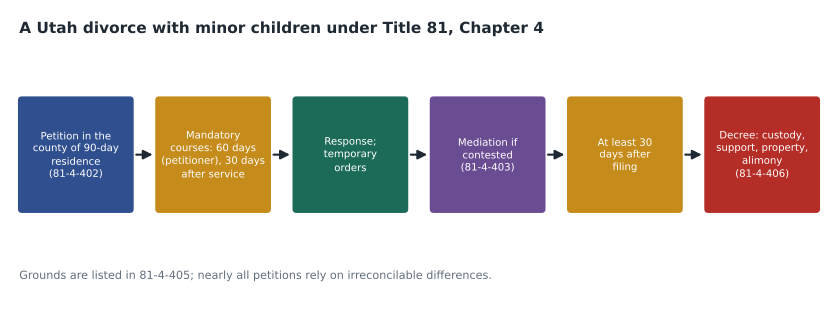
Under section 81-4-402, a petition for divorce may be filed if either spouse has been a resident of the county where it is filed for at least 90 days before filing, if a servicemember has been stationed in Utah under military orders for at least 90 days, or if both parties consent to the court's personal jurisdiction. A decree may not be entered until 30 days after the petition is filed unless the court finds extraordinary circumstances, though the court may enter temporary orders in the meantime.
When the parties have minor children, both must complete two mandatory courses, a divorce orientation course and a divorce education course for parents. The petitioner must complete them within 60 days after filing and the respondent within 30 days after being served. Until a party completes the courses, that party generally may not have motions heard, except for matters such as temporary restraining orders, and the decree generally requires certificates of completion from both. Parties without minor children may take the orientation course but are not required to.
If contested issues remain after a response is filed, section 81-4-403 requires the parties to attend at least one good-faith session with a qualified mediator, with costs shared equally unless the court orders otherwise. A party may be excused for good cause, such as a history of domestic violence that makes mediation unsafe.
Grounds for divorce
Utah is effectively a no-fault state, but it keeps a list of fault grounds. Section 81-4-405 permits divorce for impotency at the time of marriage, adultery, willful desertion for more than one year, willful neglect to provide the necessities of life, habitual drunkenness, conviction of a felony, cruel treatment causing bodily injury or great mental distress, irreconcilable differences, incurable insanity under specific procedures, and living separately under a decree of separate maintenance for three consecutive years without cohabitation. Nearly every petition relies on irreconcilable differences. Fault still matters, however, because the court may consider it in deciding alimony.
Alimony
Alimony is governed by Part 5 of Chapter 4. Section 81-4-502 lists the factors the court must consider, including the financial condition and needs of the recipient, the recipient's earning capacity, including any reduction in workplace experience from primarily caring for a minor child of the payor, the payor's ability to provide support, the length of the marriage, whether the recipient has custody of a minor child requiring support, whether the recipient worked in the payor's business, whether the recipient contributed to the payor's education, and the tax consequences for each party.
Several rules give the factors shape. The court generally looks to the standard of living existing at the time of separation, though it may use the standard at the time of trial, and in a short marriage without children it may look to the standard at the time of marriage. In a marriage of ten years or more, where the recipient reduced workplace experience by agreement to care for the payor's minor child, there is a rebuttable presumption that the court will equalize the parties' standards of living. The court may consider fault, defined as listed kinds of wrongful conduct during the marriage that substantially contributed to the breakup, such as sexual relations with someone other than the spouse or knowingly causing physical harm.
Duration is limited. Alimony generally may not be ordered for longer than the number of years the marriage existed, unless the court finds extenuating circumstances or good cause, and time paid as temporary alimony counts toward that period. The length of the marriage runs from the date of the legal marriage to the date the divorce petition is filed. Under the statute, for petitions filed on or after January 1, 2026, the court may aggregate two marriages between the same parties unless that would be inequitable.
Alimony ends automatically on the recipient's remarriage or death unless the decree says otherwise, under section 81-4-505. If the payor shows that the recipient is cohabiting, meaning living together on a regular basis in a relationship of a romantic or sexual nature, the court must terminate alimony, but the payor must seek termination within one year of learning of the cohabitation. The court may modify alimony for a substantial material change in circumstances, and a party's retirement qualifies unless the decree says otherwise. A new spouse's income generally may not be considered.
Dividing property
Utah is not a community property state. Its courts divide the marital estate equitably, under the court's authority to enter equitable orders about property in the decree. In practice, Utah courts generally begin with a presumption that marital property, meaning property acquired during the marriage, is divided equally, and they generally award each spouse his or her separate property, such as property owned before the marriage or received by gift or inheritance, unless it has been commingled with marital property, the other spouse contributed to its enhancement, or exceptional circumstances justify a different result. The alimony statute adds a related rule: in a long marriage where one spouse's earning capacity rose greatly through the joint efforts of both, the court considers that change in dividing property and may make a compensating adjustment.
Property division and alimony interact. A court that awards Annalise a larger share of the liquid assets may award less alimony, and a court that awards Tavin the landscaping business may need to offset its value with other assets. Retirement accounts and pensions earned during the marriage are usually divided by a qualified domestic relations order.
Worked problem
Annalise and Tavin's divorce
Annalise files in Davis County, where the family has lived for six years. The marriage lasted fourteen years to the date of filing. Assets: a marital house, Tavin's pension (all earned during the marriage), the landscaping business started in year six, and a cabin Annalise inherited and has kept in her own name, paying its costs from her inheritance. Annalise reduced her work to care for the children by agreement with Tavin. What are the main Utah issues?
Show solution
- Filing: residence in Davis County exceeds 90 days; with minor children, both must complete the orientation and parent education courses; a contested case goes to mediation.
- Grounds: irreconcilable differences under 81-4-405.
- Alimony: the 81-4-502 factors apply; because the marriage lasted at least ten years and Annalise reduced her work by agreement to care for the children, a rebuttable presumption of equalizing living standards arises; duration is generally limited to fourteen years.
- Property: the house, the marital portion of the pension and the business are marital and presumptively divided equally; the business must be valued.
- Separate property: the inherited cabin is generally Annalise's separate property if it has not been commingled or enhanced by Tavin's efforts.
Answer: The case will turn on valuing the business, dividing the pension by order, protecting the cabin as separate property and applying the equalization presumption to alimony.
Custody, parent-time and child support
Chapter 9 of Title 81 governs custody and parent-time. Utah distinguishes legal custody, the authority to make major decisions for a child, from physical custody, where the child lives, and parent-time, the schedule for each parent's time with the child. The court decides custody in the child's best interest, considering factors listed in the statute, and Utah law favors arrangements that give children frequent and meaningful contact with both parents when that is safe and in their interest. Part 3 of Chapter 9 sets out advisory minimum parent-time schedules and an optional schedule with more time for the noncustodial parent, which parties often use as starting points. When the parents live in different states, the Uniform Child Custody Jurisdiction and Enforcement Act in Chapter 11 decides which state's court may make a custody order, generally the child's home state, where the child has lived for six months.
Child support is governed by Chapter 6. Utah's guidelines combine the income of both parents and use statutory tables to set a base obligation, which is then divided between the parents in proportion to their incomes and adjusted for factors such as the parent-time schedule, health insurance, medical expenses and child care. Every decree involving children must include child support, medical expense and child care provisions and notice about the Office of Recovery Services, which enforces support.
Common mistakes
MistakeUtah divorce law is in Title 30.
InsteadSince September 1, 2024, it is in Title 81, the Utah Domestic Relations Code.
MistakeA spouse must have lived in Utah for a year to file.
InsteadSection 81-4-402 requires 90 days of residence in the filing county (or the other listed bases).
MistakeFault is irrelevant in a Utah divorce.
InsteadMost divorces use irreconcilable differences, but the court may consider fault in awarding alimony.
MistakeAlimony may last indefinitely after a long marriage.
InsteadIt generally may not exceed the length of the marriage, absent extenuating circumstances or good cause.
MistakeUtah divides all property as community property.
InsteadUtah divides marital property equitably, generally starting with equal division, and generally awards separate property to its owner.
Premarital agreements and temporary orders
Two other parts of Title 81 come up often. Premarital agreements, now in Chapter 3, let couples set their own rules for property and support, within statutory limits, and a well-drafted agreement can make a divorce far simpler. A lawyer asked to enforce or challenge one must look closely at how it was made, including disclosure and voluntariness. And in nearly every contested divorce, the first hearing concerns temporary orders: who stays in the house, temporary custody and parent-time, temporary support and who pays the bills while the case is pending. Temporary orders are often entered within the first weeks, and they shape the case, because the arrangements the court approves at the start frequently become the baseline for the final decree.
Family law and the exam
Family law left the MEE in July 2026, and it is not an MBE subject. During the transition period it may still appear as the subject of an MPT task, but the MPT library will supply the law, which may be fictional. A Utah candidate should not study Title 81 for the UBE. She should, however, be ready to read an unfamiliar family statute in an MPT library and apply it carefully, a skill her clerkship has given her.
Mele's last note on the Kimball file was about tone. Family cases are among the most stressful a client will face, and Brigid reminds every associate that the client's children will live with the result long after the decree is entered. Clear explanations, realistic expectations and steady communication are part of competent representation in a Utah divorce, just as they are in any other kind of case.
Summary and key terms
- Title 81, effective September 1, 2024, now holds Utah's domestic relations law; cite it rather than Title 30.
- Section 81-4-402: 90 days' county residence, a 30-day minimum before a decree and mandatory courses when there are minor children.
- Section 81-4-403 requires mediation in contested cases; section 81-4-405 lists the grounds, including irreconcilable differences.
- Section 81-4-502 sets alimony factors, a separation-date standard of living, an equalization presumption for long marriages and a duration limit tied to the marriage's length.
- Alimony ends on remarriage or death and on proof of cohabitation (81-4-505); retirement is a ground to modify (81-4-504).
- Custody and parent-time are in Chapter 9, child support in Chapter 6 and the UCCJEA in Chapter 11.
- 0
- Title 81
- 1
- Utah Domestic Relations Code
- 2
- irreconcilable differences
- 3
- mandatory courses
- 4
- mediation
- 5
- alimony
- 6
- cohabitation
- 7
- marital property
- 8
- separate property
- 9
- parent-time
- 10
- UCCJEA
Practice problems
Work each problem on paper first, then reveal the answer to check.
How long must a spouse reside in the county before filing for divorce?
Show answer
At least 90 days, under 81-4-402 (or another listed basis).
How long may alimony generally last?
Show answer
No longer than the number of years the marriage existed, absent extenuating circumstances or good cause.
What ends alimony automatically?
Show answer
The recipient's remarriage or death, unless the decree says otherwise.
Which chapter of Title 81 governs child support?
Show answer
Chapter 6.
Lesson quiz · 5 questions
Score 60% or more to complete this lesson.
Create a free account to save your progress, take quizzes and earn a certificate.