
BAR-245 · Lesson 3 of 12 · 20 min
Character and fitness and the MPRE
▶ Video coming soon A video version of this lesson is on the way.
Mele's character and fitness questionnaire took her three evenings. Most of it was easy: she had lived in two places in West Valley City, one apartment near campus and one in Salt Lake City, and had worked at a grocery store, a tutoring center and two law firms. Three items took longer. In 2019 she had received a speeding ticket on Interstate 15 in Juab County, driving to a family reunion in Nephi. In 2020 a campus parking fine had gone to collection before she paid it in 2021. And during her second year of law school she had put her federal student loans in a short forbearance after her father's surgery. 'None of it is serious,' Marchetti told her. 'What matters is that every item appears, with dates and documents, and that your explanations are short and true.'
This lesson covers Utah's character and fitness standard and process and the MPRE requirement. Both are conditions of admission on every route: an applicant who passes the exam, transfers a score or qualifies by motion is not admitted until the Bar is satisfied that she has the character and fitness to practice law and has an MPRE score of 86.
The standard
Rule 4-708 sets the character and fitness standard. The applicant must show good moral character and fitness to practice law, and the applicant bears the burden of proof. Like the model used in most states, the standard looks at whether the applicant's past conduct shows that she can be trusted to meet the basic obligations of a lawyer: honesty with clients, courts and opposing parties; diligence and reliability; financial responsibility; respect for the law; and the ability to handle the stress of practice without harming clients.
Character investigations focus on conduct, not labels. Conduct that typically prompts further inquiry includes unlawful conduct, academic misconduct, making false statements or omitting material facts, neglect of financial responsibilities, violation of court orders, evidence of mental or emotional conditions that currently impair the ability to practice, and dishonesty in employment. When a concern appears, the reviewer weighs mitigating and aggravating factors: the applicant's age at the time, how recent the conduct was, how serious it was, the circumstances, whether it formed a pattern, and, above all, evidence of rehabilitation and the applicant's candor in the admissions process itself.
Candor is the core requirement
Every bar coach repeats the same lesson, and Marchetti repeated it twice: the most common reason a minor matter becomes a serious problem is that the applicant failed to disclose it. A speeding ticket from 2019 says almost nothing about Mele's fitness to practice law. A speeding ticket from 2019 that she left off the questionnaire, and that the investigator then found in court records, says something important about whether she can be trusted to tell the truth when it is inconvenient. The Bar's instructions make the same point in their own way, warning that even failure to follow application instructions may reflect poorly on an applicant's character and fitness.
Candor also means updating. The duty to answer fully does not end when the application is filed. If an applicant receives a new citation, is named in a lawsuit, falls behind on a debt or faces any other matter covered by the questions after filing, she must amend the application promptly. Amending voluntarily is itself evidence of good character. Waiting and hoping the matter will not surface is the opposite.
The process
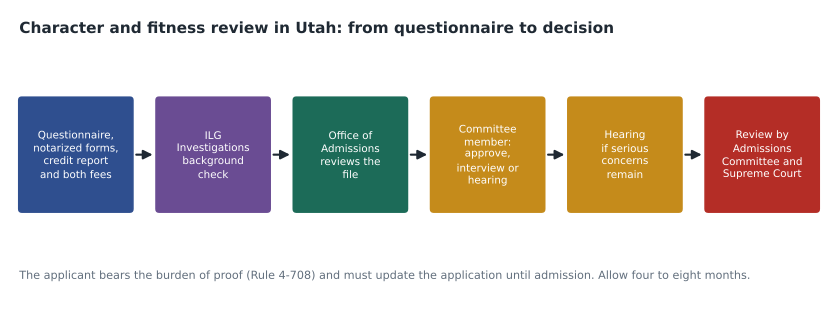
Utah's character and fitness process is run by the Bar, not by NCBE. Once the application and both fees are submitted, ILG Investigations conducts the background investigation on behalf of the Office of Admissions, using the questionnaire as its roadmap. It checks records, contacts references and employers, and reports what it finds. The Office of Admissions reviews the complete file and sends the ILG report to a member of the Character and Fitness Committee.
The Committee member then has three choices. The member may approve the applicant. The member may require an informal interview, a conversation in which the applicant explains a matter and answers questions. Or the member may require a formal hearing, which is used for more serious concerns and has more structure, including the opportunity to present evidence and witnesses. After a formal hearing the Committee may approve or deny. A denial can be reviewed under the rules, first by the Admissions Committee under Rule 4-715 and then, in appropriate cases, by the Utah Supreme Court. The Bar estimates that the entire process can take between four and eight months, which is why filing early matters.
Writing explanations that work
Most applicants have something to explain. Marchetti's rule for explanations has four parts: what happened, when, how it was resolved, and what the applicant learned or changed. Each explanation should be labeled with the question number it answers and supported by documents where documents exist. It should not argue, minimize or blame others. And it should be short, because a reviewer who reads six paragraphs about a parking fine starts to wonder what the applicant is not saying.
Mele's explanation of the collection matter took five sentences. 'In fall 2020 I received a campus parking citation for 45 dollars. I moved apartments that month and did not receive the notices, and the fine was referred to a collection agency. When I learned of it in March 2021 I paid it in full the same week. A copy of the receipt is attached. I now have all mail forwarded and check my credit report each year.' The explanation is complete, the document supports it, and the last sentence shows a change in habit.
| Item on Mele's file | Disclosed where | Support |
|---|---|---|
| 2019 speeding citation, Juab County | Traffic citations question | Court record showing the fine paid |
| 2020 parking fine sent to collection, paid 2021 | Financial questions | Receipt and current credit report |
| Student loan forbearance in 2024 | Financial questions | Servicer letter showing loans current |
| Four prior addresses | Residence history | Leases or utility records if asked |
Financial responsibility
Financial questions deserve special attention because they are common and often misunderstood. Debt is not a character problem. Most law graduates have substantial student loans, and a forbearance or deferral used as the loan program allows is not misconduct. What concerns reviewers is irresponsibility: ignoring debts, defaulting without communication, misrepresenting finances, or a pattern of unpaid judgments. The Financial Status Acknowledgment and the credit report required with the Utah application let the Office see the applicant's situation directly. An applicant with a past problem should show that it has been addressed, through payment, a payment plan or communication with the creditor, and should not wait for the investigator to ask.
The MPRE requirement
Every route to Utah admission requires a passing score on the Multistate Professional Responsibility Examination. Utah's required scaled score is 86, which places Utah among the states with the highest MPRE requirement. Utah does not expire MPRE scores: a qualifying score earned years ago still counts. For scores from exams taken in 1999 or later, the applicant asks NCBE to send the score directly to the Office of Admissions, which does not accept copies of score reports. For older scores, the applicant contacts the jurisdiction where she took the exam, and without verifiable proof of an 86 or higher, she must retake the MPRE.
The MPRE is a two-hour, 60-question multiple-choice exam, of which 50 questions are scored, testing the law governing lawyers as reflected in the ABA Model Rules of Professional Conduct and the Model Code of Judicial Conduct, along with generally accepted principles from court decisions and other sources. NCBE offers it several times a year at testing centers, and NCBE's own rules govern registration, accommodations and score release. The MPRE tests the ABA Model Rules, not Utah's rules, so a candidate preparing for it should not study Utah's distinctive provisions, such as its approach to fee sharing and nonlawyer ownership, as if they were the tested rule. Lesson 10 covers those Utah rules for practice.
Worked problem
Can Mele rely on her MPRE score?
Mele took the MPRE in August 2025 and scored 91. Her classmate Kenji scored 84 in March 2026 and plans to pursue the alternate pathway. A third classmate, Brigid's niece, scored 88 in 2014 while in law school in another state and never took a bar exam. Who satisfies Utah's MPRE requirement?
Show solution
- Mele: 91 is above 86, and Utah sets no time limit; she must have NCBE report it directly.
- Kenji: 84 is below Utah's 86, so it does not satisfy the requirement for the exam, transfer or motion routes; he should confirm the pathway's requirement with the Office and retake to keep every route open.
- The niece: 88 from 2014 is above 86 and does not expire in Utah; because the exam was after 1999, NCBE can report it directly.
Answer: Mele and the niece satisfy the requirement; Kenji does not and should register for the next MPRE.
Common mistakes
MistakeMinor matters can be left off because they are not serious.
InsteadEvery matter the questions ask about must be disclosed; omission is far more serious than the underlying matter.
MistakeHaving large student loans is a character problem.
InsteadDebt is not misconduct; irresponsibility, misrepresentation and ignored obligations are.
MistakeAn MPRE score expires after a few years in Utah.
InsteadUtah does not expire MPRE scores.
MistakeA score of 85 is close enough.
InsteadUtah requires 86; anything lower requires a retake.
MistakeThe MPRE tests Utah's Rules of Professional Conduct.
InsteadIt tests the ABA Model Rules and general principles; Utah's variations matter in practice, not on the MPRE.
Mental health and substance use questions
Candidates often worry about questions concerning mental health and substance use. Over the past decade many jurisdictions, following guidance from the American Bar Association and the National Conference of Bar Examiners, have narrowed or removed questions that ask about diagnosis or treatment, focusing instead on conduct and on whether any condition currently impairs the applicant's ability to practice. A candidate should read Utah's current questionnaire carefully and answer exactly the question asked, no more and no less. Seeking counseling or treatment is not misconduct, and reviewers understand that law school and bar preparation are stressful. What matters is conduct: missed obligations, dishonesty, or behavior that harmed others. A candidate who is unsure how a question applies should ask the Office of Admissions in writing rather than guess.
Utah's broader system also reflects concern for lawyer well-being. The alternate pathway requires a six-hour well-being training, and the Bar offers resources for lawyers and law students. Marchetti encourages candidates to use those resources during bar preparation, not only after admission.
What happens at an interview or hearing
Most applicants never meet a Committee member. Those who are asked to an informal interview should treat it as a professional meeting, not a trial. Prepare by rereading the application, the explanation at issue and any documents. Bring copies. Answer questions directly, acknowledge mistakes plainly and explain what has changed. Do not argue that the matter was not important; if the Committee member thought so, there would be no interview. A candidate facing a formal hearing, which is reserved for more serious concerns, should consider asking a lawyer experienced in admissions matters to help, because a formal hearing involves evidence, witnesses and a record that may be reviewed later.
Timing the MPRE
The MPRE is given several times a year, and Utah's lack of an expiration date means a candidate can take it whenever it fits her schedule, including during law school. Marchetti recommends taking it in the second or third year of law school, after the professional responsibility course, so that it is out of the way before full bar preparation begins. A candidate who has not taken it by graduation should register for the first administration that leaves time for the score to reach the Office before admission, remembering that NCBE needs time to release and report scores. Studying for the MPRE usually takes two to four weeks of part-time work with practice questions, and the most common mistake is studying Utah's rules instead of the Model Rules.
A note on timing and patience
The four-to-eight-month estimate means that a candidate who files on October 1 may not hear anything final until after the February exam, and silence is normal. Marchetti tells candidates not to read meaning into it. The investigation runs on its own schedule. What the candidate controls is responsiveness: answering any request from the Office or ILG within a few days, sending documents in the form requested and keeping contact information current. A candidate who moves, changes email addresses or changes jobs during the process should update the application at once, both because the questions require it and because a request sent to an old address can delay the file for weeks.
Mele set a weekly reminder to check the portal every Sunday evening. In mid-November 2026 she found a short request for the court record of her 2019 citation, which she had already obtained, and uploaded it the same night.
Summary and key terms
- Rule 4-708 requires good moral character and fitness; the applicant bears the burden of proof.
- Candor is the core requirement; applicants must disclose fully and update the application until admission.
- ILG Investigations investigates; a Character and Fitness Committee member approves, interviews or requires a hearing; review runs through Rule 4-715 and the Supreme Court.
- The process can take four to eight months.
- Explanations should say what happened, when, how it was resolved and what changed, with documents.
- Utah requires an MPRE score of 86, sent directly by NCBE, with no time limit.
- 0
- good moral character
- 1
- burden of proof
- 2
- candor
- 3
- informal interview
- 4
- formal hearing
- 5
- rehabilitation
- 6
- MPRE
- 7
- scaled score
Practice problems
Work each problem on paper first, then reveal the answer to check.
Who decides whether an applicant is approved after the investigation?
Show answer
A member of the Character and Fitness Committee, who may approve, require an interview or require a formal hearing.
What must an applicant do if she gets a traffic ticket after filing?
Show answer
Amend the application promptly to disclose it.
What MPRE score does Utah require, and does it expire?
Show answer
86, and Utah does not expire MPRE scores.
Does the MPRE test Utah's Rules of Professional Conduct?
Show answer
No; it tests the ABA Model Rules and general principles.
Lesson quiz · 5 questions
Score 60% or more to complete this lesson.
Create a free account to save your progress, take quizzes and earn a certificate.