
BAR-245 · Lesson 7 of 12 · 19 min
Utah courts and civil procedure: tiered discovery and the Business and Chancery Court
▶ Video coming soon A video version of this lesson is on the way.
Mele's first real litigation assignment at Arnesen & Ostler was a breach of contract case for a Sandy cabinet maker that had not been paid for a kitchen remodel. The unpaid balance was 62,000 dollars. Brigid Arnesen handed her the file with one question: 'Which tier?' Mele had spent law school learning the Federal Rules of Civil Procedure, and the question puzzled her until she opened the Utah rules. This lesson covers the structure of the Utah courts, the tiered discovery system that sets Utah civil procedure apart, the new Business and Chancery Court and a few deadlines a new lawyer cannot afford to miss.
The structure of the Utah courts
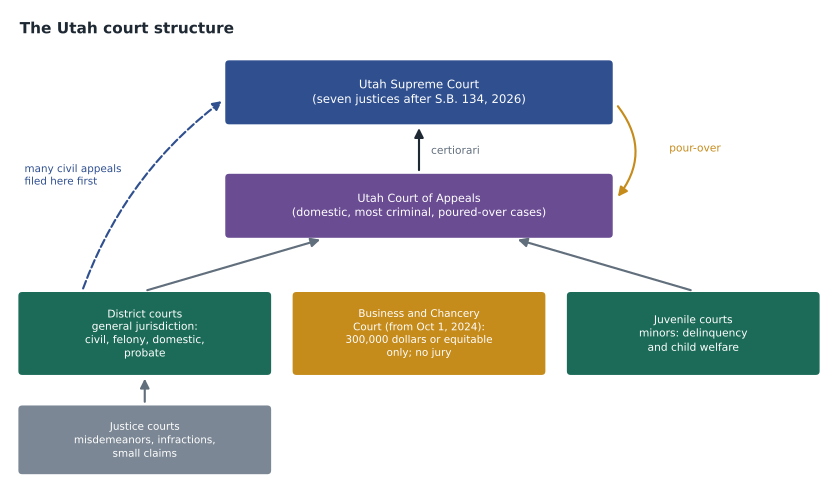
Utah's courts follow a familiar pattern with some local features. At the top is the Utah Supreme Court, the state's court of last resort. In January 2026 the Legislature passed and the Governor signed a bill, S.B. 134, that increased the Court from five justices to seven and added judges to other courts, including the Court of Appeals. With the new seats and departures from the Court during 2026, several appointments were made or pending during the year, each requiring confirmation by the Utah Senate. Below the Supreme Court is the Utah Court of Appeals, an intermediate appellate court.
Utah uses a distinctive method for allocating appeals. In many civil cases, the appeal is filed with the Supreme Court, which may keep the case or transfer it to the Court of Appeals, a practice often called pouring over. Other categories of cases, such as most domestic relations appeals and appeals from many criminal cases, go to the Court of Appeals by statute. A litigant who loses in the Court of Appeals may seek review in the Supreme Court by petition for a writ of certiorari, which is discretionary.
The main trial courts are the district courts, courts of general jurisdiction organized into judicial districts across the state. District courts hear civil cases, felony criminal cases, domestic relations cases, probate and appeals from justice courts, among other matters. Juvenile courts hear cases involving minors, including delinquency and child welfare. Justice courts, operated by cities and counties, hear class B and C misdemeanors, infractions and small claims cases.
Judges in Utah's courts of record are selected through a merit process. A nominating commission screens applicants and sends the Governor a list of nominees; the Governor appoints from the list; and the Utah Senate confirms. Judges then stand in nonpartisan retention elections, in which voters decide whether to keep them. The Judicial Performance Evaluation Commission evaluates judges and publishes its recommendations before each retention election.
The Business and Chancery Court
Utah added a new trial court in 2024. The Legislature created the Utah Business and Chancery Court in 2023, and it opened on October 1, 2024. It is a statewide court with limited jurisdiction under Title 78A, Chapter 5a of the Utah Code, designed to handle complex business disputes with a judge who specializes in them. Its first judge is Judge Rita Cornish.
To be eligible, a case generally must seek either at least 300,000 dollars in damages or solely equitable relief, and it must be a business-focused dispute, such as a breach of contract between businesses, a corporate governance dispute, an intellectual property or trade secret claim, a securities matter, a franchise dispute or an antitrust claim. The court does not hold jury trials. A plaintiff who files there waives a jury on all claims in the complaint, and if a defendant demands a jury in its first responsive pleading, the case leaves the Business and Chancery Court for the district court. The filing fee is the ordinary civil fee plus an additional Business and Chancery Court fee, and an existing district court case may be transferred by motion.
Utah's tiered discovery system
The biggest difference between Utah and federal civil procedure is discovery. In 2011 the Utah Supreme Court adopted major amendments to the Utah Rules of Civil Procedure built around two ideas: proportionality and early disclosure. Under Utah Rule 26, discovery must be proportional to what is at stake in the case, and the party seeking discovery bears the burden of showing proportionality and relevance. Standard discovery is limited according to the amount in controversy, and parties who want more must justify it.
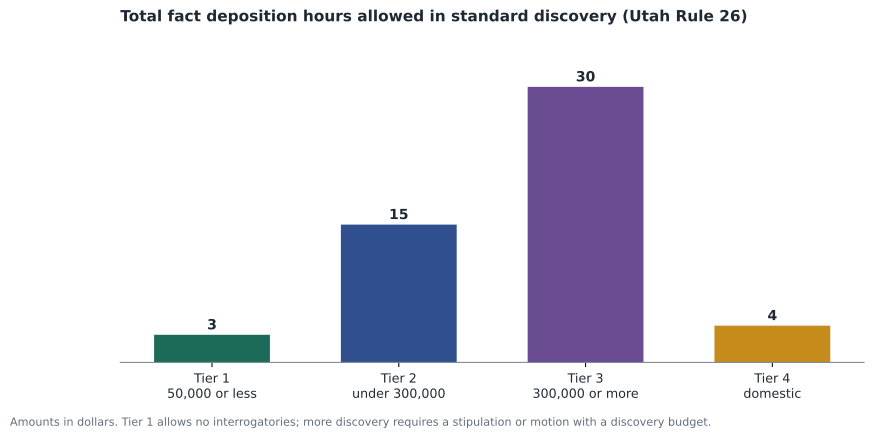
The tiers are set out in Rule 26. A complaint must state the discovery tier in its caption or allege a specific amount of damages. A case with no claim for money damages is assigned to Tier 2. And a pleading that qualifies for Tier 1 or Tier 2 waives any right to recover damages above that tier's limit, unless the pleading is amended under Rule 15. Domestic relations cases have their own tier.
| Tier | Amount in controversy | Fact deposition hours | Interrogatories | Requests for production | Requests for admission | Days to complete fact discovery |
|---|---|---|---|---|---|---|
| Tier 1 | 50,000 dollars or less | 3 | 0 | 5 | 5 | 120 |
| Tier 2 | More than 50,000 and less than 300,000 dollars, or non-monetary relief | 15 | 10 | 10 | 10 | 180 |
| Tier 3 | 300,000 dollars or more | 30 | 20 | 20 | 20 | 210 |
| Tier 4 | Domestic relations cases | 4 | 10 | 10 | 10 | 90 |
The days to complete standard fact discovery run from the date the first defendant's first disclosure is due, and they do not include expert discovery. A party that wants more than the standard limits must seek extraordinary discovery before the close of standard discovery and after reaching the standard limits. It may do so by stipulation, with a statement that the extra discovery is necessary and proportional and that each party has reviewed and approved a discovery budget, or by motion, explaining why the discovery is necessary and proportional, certifying the budget approval and certifying that the parties tried to resolve the issue without the court.
Initial disclosures and the cost of not disclosing
Utah's disclosure obligations are broader than the federal ones and come earlier in the case. Each party must disclose, without waiting for a discovery request, the witnesses it may call, the documents it may use and a computation of damages, among other information, and the plaintiff's disclosure comes first. Experts are handled through a separate disclosure sequence. The sanction for failure is strong. Under Rule 26(d), a party that fails to disclose or supplement may not use the undisclosed witness, document or material at any hearing or trial unless the failure is harmless or the party shows good cause. In practice that means a document left out of an initial disclosure may be excluded at trial, no matter how helpful it would have been.
Worked problem
Choosing the tier for the cabinet maker
The cabinet maker is owed 62,000 dollars on the remodel contract and wants interest and attorney fees under the contract. Brigid thinks the client might also have a claim for lost profits on two other jobs the homeowner's complaints cost it, perhaps another 40,000 dollars. Which tier should the complaint plead, and what follows?
Show solution
- Amount: the contract claim alone exceeds 50,000 dollars, so Tier 1 is not available without waiving the excess.
- Total: with lost profits, the claim is roughly 102,000 dollars, still less than 300,000 dollars, so Tier 2 fits.
- Waiver: pleading Tier 2 waives recovery above the Tier 2 limit unless the complaint is amended, which is acceptable here.
- Limits: Tier 2 allows 15 hours of fact depositions, 10 interrogatories, 10 requests for production, 10 requests for admission and 180 days of fact discovery.
- Disclosures: the firm must disclose its witnesses, documents and damages computation early; anything left out risks exclusion under Rule 26(d).
- Forum: the claim is below 300,000 dollars, so the Business and Chancery Court is not available; the case belongs in district court.
Answer: Plead Tier 2 in district court, compute damages carefully for the initial disclosure and plan discovery within the Tier 2 limits.
Deadlines a new lawyer must calendar
Several Utah deadlines catch new lawyers. The statutes of limitations in Title 78B, Chapter 2 vary by claim. As general starting points, many negligence claims and claims on oral contracts carry a four-year period, claims on written contracts carry six years, and wrongful death claims carry two years, but every claim must be checked against the statute and its exceptions. Medical malpractice claims have a two-year period under the Utah Health Care Malpractice Act and a mandatory prelitigation review process that must be started before suit. Claims against government entities require a notice of claim within one year under the Governmental Immunity Act, discussed in Lesson 8. And the time to file a notice of appeal is generally 30 days after entry of the judgment or order appealed from, under the Utah Rules of Appellate Procedure.
Civil procedure and the exam
Federal civil procedure is one of the seven MBE subjects and an MEE subject, and the UBE tests the Federal Rules of Civil Procedure and federal jurisdiction, not the Utah rules. Utah's tiers, its disclosure sanctions and its Business and Chancery Court will never be the answer to an exam question. They are, however, the first things a Utah litigator thinks about when a new case comes in, which is why Mele's two-column outline has a Utah note next to every federal discovery rule.
Common mistakes
MistakeUtah discovery works like federal discovery with local forms.
InsteadUtah Rule 26 sets tiered limits by amount in controversy and puts the burden of proportionality on the requesting party.
MistakeA plaintiff can plead Tier 1 and still recover any amount proved.
InsteadA Tier 1 or Tier 2 pleading waives damages above that tier's limit unless amended.
MistakeA late-disclosed document can be used if it is important.
InsteadUnder Rule 26(d) it may be excluded unless the failure was harmless or there is good cause.
MistakeAny business case can go to the Business and Chancery Court.
InsteadIt generally requires at least 300,000 dollars or solely equitable relief and a business-focused dispute, and there are no jury trials.
MistakeThe Utah Supreme Court has five justices.
InsteadS.B. 134 (January 2026) increased the Court to seven justices.
Small claims and justice courts
Not every civil dispute belongs in district court. Utah's justice courts hear small claims cases, which use simplified procedures designed for people without lawyers, and the small claims limit sets the ceiling for those cases. A small claims judgment can be appealed for a new trial in district court. The small claims limit matters for another reason as well: it sets the boundary of the debt collection matters in which a licensed paralegal practitioner may assist a client, as Lesson 10 explains. A new lawyer should check the current small claims limit in the Utah Code before advising a client whether to file there.
Appeals and the 30-day clock
Utah's appellate deadlines are short and strictly enforced. The notice of appeal is generally due 30 days after entry of the final judgment or order, and certain post-judgment motions affect the time. Because many civil appeals are filed with the Supreme Court and then poured over to the Court of Appeals, the docketing process can look unfamiliar to lawyers trained in federal practice. A new lawyer should read the Utah Rules of Appellate Procedure on the filing of the notice, the docketing statement and the briefing schedule as soon as a judgment is entered.
Practical tips for the first Utah case
Brigid's tips for Mele's first case were practical. Put the tier in the caption and make sure the damages computation in the initial disclosure matches it. Calendar every disclosure deadline the day the answer is filed. Draft a discovery budget early, even in Tier 2, because a request for extraordinary discovery requires one. Use the standard limits strategically: in Tier 2, ten interrogatories go quickly, so spend them on the facts that cannot be learned any other way. And read the judge's standing orders, because Utah district judges often have their own procedures for discovery disputes, which are usually raised through a short statement of discovery issues rather than a long motion.
Mele summarized the Utah differences in a single page for her two-column outline. On the left were the federal rules she would apply on the exam. On the right were the Utah notes: tiers in the caption, early disclosures with a damages computation, exclusion for failure to disclose and extraordinary discovery only with a budget.
Summary and key terms
- The Utah Supreme Court (seven justices after S.B. 134 in 2026), the Court of Appeals, district courts, juvenile courts and justice courts make up the system; many civil appeals are filed in the Supreme Court and may be poured over.
- Judges are appointed from nominating commission lists, confirmed by the Senate and retained by voters.
- The Business and Chancery Court opened October 1, 2024 for business disputes of at least 300,000 dollars or solely equitable relief, without juries.
- Utah Rule 26 sets discovery tiers: Tier 1 up to 50,000 dollars, Tier 2 to less than 300,000 dollars, Tier 3 at 300,000 dollars or more, Tier 4 for domestic cases.
- Extraordinary discovery requires a stipulation or motion with proportionality and budget certifications.
- Undisclosed evidence may be excluded under Rule 26(d) unless harmless or for good cause.
- 0
- Utah Supreme Court
- 1
- pour-over
- 2
- district court
- 3
- justice court
- 4
- retention election
- 5
- Business and Chancery Court
- 6
- proportionality
- 7
- discovery tier
- 8
- extraordinary discovery
- 9
- initial disclosures
Practice problems
Work each problem on paper first, then reveal the answer to check.
What tier applies to a case seeking 120,000 dollars?
Show answer
Tier 2 (more than 50,000 and less than 300,000 dollars).
What happens if a party fails to disclose a witness?
Show answer
The witness may not be used at a hearing or trial unless the failure was harmless or there is good cause.
When did the Business and Chancery Court open?
Show answer
October 1, 2024.
How many justices sit on the Utah Supreme Court after S.B. 134?
Show answer
Seven.
Lesson quiz · 5 questions
Score 60% or more to complete this lesson.
Create a free account to save your progress, take quizzes and earn a certificate.