
BAR-245 · Lesson 4 of 12 · 19 min
The Utah bar exam: UBE format, scoring and the 260 passing score
▶ Video coming soon A video version of this lesson is on the way.
At the October session, Marchetti asked each member of the group to explain, in two minutes, how their exam is scored. Mele went first. 'Utah gives the UBE. Day one is two performance tests in the morning and six essays in the afternoon. Day two is the MBE, two hundred multiple-choice questions. The MBE is half my score, the essays thirty percent and the performance tests twenty percent. The written scores are scaled to the MBE, everything goes onto a 400-point scale, and I need 260.' Marchetti nodded. 'Good. Now tell me why the scaling matters for how you study.' This lesson answers that question and walks through the exam itself.
Utah and the Uniform Bar Examination
The Uniform Bar Examination is a set of three NCBE tests, given on the same days and graded under common standards in every UBE jurisdiction, so that a score earned in one jurisdiction can be transferred to others. Utah has adopted the UBE and does not add a Utah-specific test or course requirement to it. NCBE's 2026 summary of Utah's requirements lists no jurisdiction-specific component, and Utah does not give a separate shorter exam for experienced attorneys: every exam applicant takes the same test.
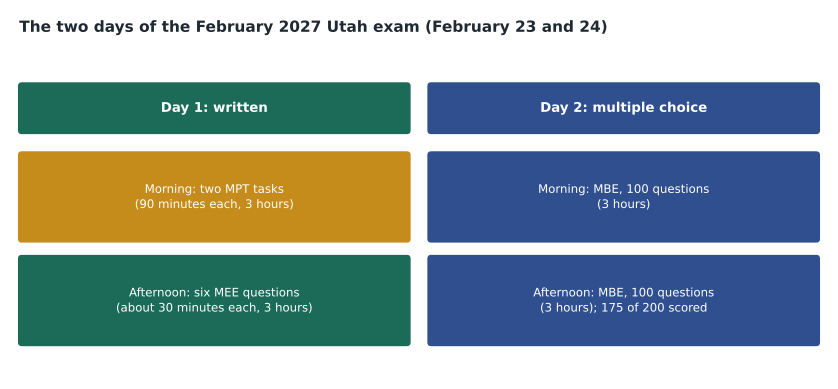
For the February 2027 administration, the exam runs over two days, Tuesday, February 23 and Wednesday, February 24, 2027, the national dates for the MEE and MBE. The Office of Admissions sends admitted applicants detailed instructions about the site, check-in, permitted items and laptop software, and those instructions control.
Day one: the MPT and the MEE
The morning of day one is the Multistate Performance Test: two 90-minute tasks, three hours in all. Each task gives the candidate a file of facts (memos, interview notes, letters, documents) and a library of legal authorities, which may include cases, statutes and regulations, some of them fictional. The candidate must complete a lawyering task such as an objective memo, a persuasive brief, a client letter, a contract provision or a discovery plan, using only the materials provided. The MPT tests skills, not memorized law, and it rewards organization, following the task instructions and careful use of the library.
The afternoon is the Multistate Essay Examination: six questions in three hours, about 30 minutes each. Starting with the July 2026 exam, NCBE narrowed the MEE subject list. It no longer includes conflict of laws, family law, trusts and estates or secured transactions. The current MEE subjects are business associations (agency and partnership, corporations and limited liability companies), civil procedure, constitutional law, contracts including Article 2 of the Uniform Commercial Code, criminal law and procedure, evidence, real property and torts. A question may combine subjects. Family law and trusts and estates may still appear as the subject of an MPT task during the transition period, through the last legacy UBE, because the MPT library supplies the law.
The MEE tests general principles, not Utah law. Unless a question says otherwise, the candidate applies the generally accepted rule, uniform acts such as the UCC, and the federal rules for civil procedure and evidence. A Utah candidate who answers an MEE civil procedure question by applying Utah's discovery tiers, or a torts question by applying the Utah Liability Reform Act, has answered a question the examiners did not ask. Lesson 6 takes that problem up directly.
Day two: the MBE
Day two is the Multistate Bar Examination: 200 multiple-choice questions in two three-hour sessions of 100 questions each. Of the 200 questions, 175 are scored and 25 are unscored pretest questions that are indistinguishable from the scored ones. The MBE covers seven subjects: civil procedure, constitutional law, contracts, criminal law and procedure, evidence, real property and torts. Each question has four answer choices and a single best answer, and there is no penalty for guessing. Candidates average about 1.8 minutes per question.
Weighting, grading and scaling
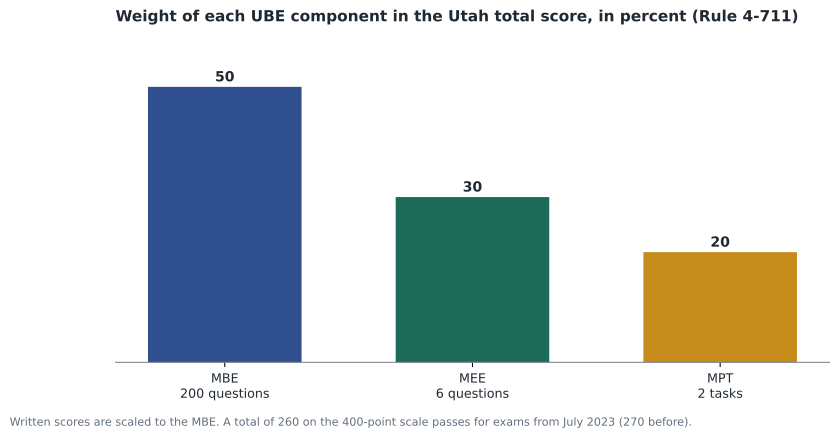
Utah's Rule 4-711 sets out how the parts combine. The MBE is weighted 50 percent, the MEE 30 percent and the MPT 20 percent. The MEE and MPT answers are graded by the Board's graders using NCBE's grading materials and the Board's procedures and standards; the rule describes a uniform scale from zero to five points. The MEE and MPT raw scores are added together to form the raw written component, which is then scaled to the MBE using the standard deviation method. The scaled written score and the MBE scaled score are combined on a 400-point scale, and a total of 260 or above passes.
Scaling deserves a moment because it changes how candidates should think about the written portion. Graders grade relatively: they sort answers into groups, so a strong answer is one that is better than most of the others in the pile, not one that would satisfy a law professor. Scaling to the MBE then places the written scores on the same scale as the MBE, so that the written component carries its intended weight. Because the written raw scores are mapped onto the MBE distribution, a candidate's written score depends partly on the overall strength of the group taking that exam. The practical lesson for study is that the written portion is half the score once the MEE and MPT are combined, and steady, well-organized answers on every question are worth more than a brilliant answer on one question and a blank on another.
The passing score: from 270 to 260
For years Utah required a total UBE score of 270, one of the higher requirements among UBE jurisdictions. Effective with the July 2023 exam, the Utah Supreme Court lowered the passing score to 260. Rule 4-711 now states both numbers: 270 or above passes any exam given before July 2023, and 260 or above passes the July 2023 exam and later administrations. The same two-step rule governs transferred scores under Rule 4-712, which accepts a pre-July 2023 score of 270 or more and a later score of 260 or more.
The change matters for transfer candidates. A lawyer who earned a 265 in another UBE state in February 2023 cannot transfer it to Utah, because a pre-July 2023 score needs 270 under the Utah rule. A lawyer who earned 265 in February 2025 can, as long as the 36-month transfer window has not closed.
| Exam date | Utah passing total (own exam or transferred score) |
|---|---|
| Before July 2023 | 270 or above |
| July 2023 and later legacy UBE | 260 or above |
| NextGen UBE (from July 2028 in Utah) | To be announced; transferred NextGen scores accepted under Rule 4-712 |
Worked problem
Reading a score report
After the February 2027 exam, Mele's study partner from another UBE state receives a score report showing an MBE scaled score of 132 and a written scaled score of 126, for a total of 258. Did she pass in Utah? What would the same total have meant before July 2023?
Show solution
- Combine: on the 400-point scale used by UBE jurisdictions, the total is reported as 258.
- Compare: Utah requires 260 for exams from July 2023 on. 258 is below 260, so she did not pass in Utah.
- Before July 2023 the requirement was 270, so the same total would also have failed.
- Transfer: a 258 cannot be transferred to Utah; she could transfer it only to a UBE jurisdiction whose minimum is 258 or lower.
Answer: She missed Utah's passing score by two points. Because Utah does not regrade, her only path is to retake or use a different route.
Results, retakes and no regrading
The Bar releases results after grading, by the method its notices describe. Rule 4-711 makes the results final: answers will not be reread, reevaluated or regraded. A candidate who fails may retake, subject to the six-exam limit discussed in Lesson 2, and should use the score report to target study. The score report shows the MBE scaled score and the written score, which helps a candidate see whether the MBE or the written component pulled the total down.
What the format means for study
Marchetti's advice to Utah candidates follows from the format. First, half the score is the MBE, so daily timed multiple-choice practice is essential. Second, the written half is graded relatively and scaled, so consistent, organized answers matter more than length: issue, rule, application, conclusion, in that order, for every issue the call raises. Third, the MPT is the most learnable part of the exam, worth 20 percent, and candidates who practice full timed MPTs gain points quickly. Fourth, and most important for Utah candidates who work in Utah firms during study, every answer on the UBE applies general law, not the Utah rules they use at work.
Common mistakes
MistakeUtah adds a Utah law test to the UBE.
InsteadUtah has no jurisdiction-specific component.
MistakeThe MEE still tests family law and trusts and estates.
InsteadFrom July 2026 the MEE dropped conflict of laws, family law, trusts and estates and secured transactions; family law and trusts may appear on the MPT during the transition.
MistakeAll 200 MBE questions count.
Instead175 are scored; 25 are unscored pretest questions.
MistakeA 265 earned anywhere at any time transfers to Utah.
InsteadA pre-July 2023 score needs 270; a later score needs 260; the score must be within 36 months.
MistakeA candidate who misses by a point can ask for regrading.
InsteadRule 4-711 bars rereading and regrading.
How graders read an MEE answer
Graders in UBE jurisdictions work from NCBE's analyses and grading guides, attend calibration sessions and read many answers to the same question. They are looking for a few things: whether the candidate identified the issues the question raised, stated the correct rule, applied the rule to the specific facts and reached a conclusion. They are not looking for elegant prose, long quotations or every rule the candidate knows about the subject. An answer that discusses the three issues the call asks about, in the order the call asks, with the facts that matter for each, will score well. An answer that writes two pages about one issue and misses the other two will not, however good those two pages are.
Marchetti's practical rules for the MEE follow. Read the call of the question first, then the facts. Outline for five minutes. Use headings that track the call. State each rule in a sentence or two. Spend most of the words on application, using the facts by name. End each issue with a conclusion, even a tentative one. And stop at about 30 minutes, because an unfinished last answer costs more than a slightly shorter middle one.
Pacing the MBE
The MBE gives candidates three hours for each set of 100 questions, which works out to 1.8 minutes a question. Candidates who fall behind usually do so on long fact patterns early in the session. Marchetti teaches a checkpoint system: by the end of the first hour, about 33 questions answered; by the end of the second hour, about 67; with the last hour for the rest and a few minutes to review marked questions. A candidate who reaches a checkpoint behind should speed up gradually, not panic. Because there is no penalty for guessing, every question should have an answer before time is called.
The MPT is the most learnable section
The MPT counts for 20 percent of the total, more than many candidates realize. It does not require memorized law, and the skills it tests improve quickly with practice: reading the task memo carefully, identifying the exact document requested, organizing the library into rules, and using the facts from the file. Mele, who wrote memos at work every week, still found her first timed MPT harder than she expected, because the time limit forced choices. By her fourth full practice MPT she had a system: 45 minutes to read and outline, 45 minutes to write, and the last five minutes to check that she had answered every question the task memo asked.
Utah's scaling of the written component means that the MPT and the MEE rise and fall together. A candidate who neglects the MPT to spend more time on MEE subjects may lose more points than she gains.
Reading the score report after a failure
A candidate who fails should use the score report as a diagnostic. If the MBE scaled score is well below the written score, the next round of study should emphasize timed multiple-choice practice and the subjects where practice sets show the most misses. If the written score is lower, the candidate should write and self-grade timed MEE answers against NCBE analyses and complete more full MPTs. In either case, the score report shows only part of the picture, so Marchetti asks repeat candidates to bring their old practice materials and their study calendar to the first planning session, because how a candidate studied often explains the score better than what she studied.
Summary and key terms
- Utah gives the UBE with no Utah component: two MPT tasks and six MEE questions on day one, the 200-question MBE on day two.
- The February 2027 exam is February 23 and 24, 2027.
- Rule 4-711 weights the MBE 50 percent, the MEE 30 percent and the MPT 20 percent; written scores are scaled to the MBE.
- The passing total is 260 for July 2023 and later exams and 270 for earlier ones.
- The MEE now tests eight subject areas; conflict of laws, family law, trusts and estates and secured transactions left in July 2026.
- Results are final; there is no regrading.
- 0
- Uniform Bar Examination
- 1
- MPT
- 2
- MEE
- 3
- MBE
- 4
- pretest questions
- 5
- scaling
- 6
- standard deviation method
- 7
- 400-point scale
Practice problems
Work each problem on paper first, then reveal the answer to check.
How are the UBE components weighted in Utah?
Show answer
MBE 50 percent, MEE 30 percent, MPT 20 percent.
What passing total applies to the February 2027 exam?
Show answer
260.
Which four subjects left the MEE in July 2026?
Show answer
Conflict of laws, family law, trusts and estates, and secured transactions.
How many MBE questions are scored?
Show answer
175 of the 200.
Lesson quiz · 5 questions
Score 60% or more to complete this lesson.
Create a free account to save your progress, take quizzes and earn a certificate.