
BAR-245 · Lesson 2 of 12 · 20 min
Eligibility, education, deadlines and fees
▶ Video coming soon A video version of this lesson is on the way.
In mid-September 2026, two weeks before the filing deadline for the February exam, Mele sat at her kitchen table with the admissions portal open and a printed copy of the Office of Admissions instructions beside her. Brigid Arnesen had given her one piece of advice: 'Read the rule for your application type before you read anything else, and file early. The Bar does not take late applications anymore.' This lesson covers the eligibility rules, the education requirement, the filing calendar and the fees for Utah bar exam applicants, and then the special situations that trip candidates up.
Choosing the application type
Utah's admission rules recognize several types of applicants, and each has its own requirements. The two exam types are the Student Applicant, a person who has graduated or will graduate from an approved law school and has not been admitted elsewhere, and the Attorney Applicant, a lawyer already admitted in another jurisdiction who chooses or needs to take the Utah exam. Other application types cover admission by motion, admission by transferred UBE score, house counsel, military lawyers and others. The Bar's general instructions tell applicants to review Article 7 of the rules to decide which type fits before starting the online application.
The distinction matters for fees and for documents. Under NCBE's 2026 summary of Utah's requirements, a first-time non-attorney applicant pays an application fee of 550 dollars and an attorney applicant pays 850 dollars, and the same amounts apply to repeat takers in each category and to applications for admission by transferred UBE score. Every applicant must take the exam on a personal laptop computer and pays a nonrefundable laptop fee of 200 dollars; tablets and smartphones cannot be used. The character and fitness investigation is billed separately: the applicant pays the Bar's admission fee and then a separate fee to ILG Investigations, and the application is not submitted until both are paid. Fees change, so the Bar's current fee schedule controls.
| Item | Amount or rule (check the Bar's current schedule) |
|---|---|
| Student (non-attorney) exam applicant | 550 dollars |
| Attorney exam applicant | 850 dollars |
| Transferred UBE score applicant | 550 dollars (non-attorney) or 850 dollars (attorney) |
| Admission by motion | 850 dollars |
| Laptop (every applicant writes on a personal laptop) | 200 dollars, nonrefundable |
| Character and fitness investigation | Separate fee paid to ILG Investigations before submission |
The education requirement
A Student Applicant must hold a first professional degree in law, the J.D., from an approved law school, which in practice means a law school accredited by the American Bar Association. Utah has two ABA-approved law schools, and graduates of ABA-approved schools anywhere in the country are eligible on the same terms. A candidate who will graduate shortly before the exam may apply before graduation, but must provide proof of graduation before being allowed to sit.
Utah also has routes for people whose education does not fit that mold, and NCBE's chart notes that an ABA-approved J.D. is not required in every case. Graduates of law schools outside the United States may qualify under Rule 4-704(d), but only if they studied in a country where English common law is the predominant basis of the legal system and meet further requirements, including additional education at an ABA-approved law school and a period of practice in a common law jurisdiction. The Office of Admissions warns that a master of laws degree alone, without a qualifying first degree, does not meet the requirements unless the applicant fits that rule. Graduates of non-ABA-approved domestic schools generally qualify only as attorney applicants, after admission in another state and a specified period of practice there. Each of these routes depends on the details of the rule, and the applicant bears the burden of proof, so the Bar recommends official course descriptions or affidavits from the school.
Mele had none of those complications. Her school would send its certification of graduation directly to the Office of Admissions in June, and she had already confirmed that the Office had received it.
The filing calendar
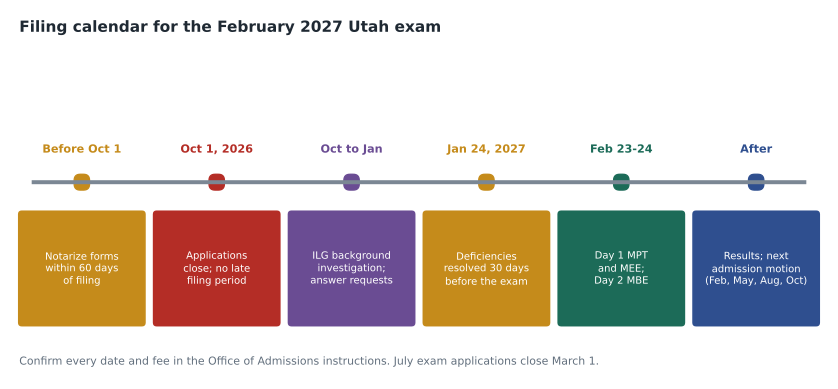
Utah gives the exam twice a year, in February and in July. Applications for the February exam close on October 1 of the preceding year, and applications for the July exam close on March 1. The Bar's general instructions state that, starting with the February 2026 exam, there is no late deadline. Rule 4-707 governs the deadlines, and the alternate pathway materials repeat the point: late applications will not be accepted. That is a significant change from the past, when a candidate could file late by paying a late fee, and it is the reason Marchetti asks every Utah candidate to treat the deadline as a hard wall.
A few other dates hang on the main deadlines. Requests for pregnancy-related accommodations are due by the same October 1 or March 1 date. The Verification and Acknowledgment and the Authorization and Release must be signed and notarized within 60 days before submission, so a candidate who notarizes them in June and files in late September must do them again. And because the character investigation takes months, applicants who have not resolved deficiencies at least 30 days before the exam have their applications held and moved to the next exam.
What goes into the application
The online application is long, and the Bar expects it to be complete. The core is the Character and Fitness Questionnaire, which asks for the applicant's full address history, employment history (internships, paid or unpaid, count as employment), criminal records, traffic citations, civil cases, financial matters and other background. The applicant also uploads the signed and notarized Verification and Acknowledgment and the Authorization and Release, a Financial Status Acknowledgment and a credit report, and any other documents the Office requests.
The Bar's instructions add a warning worth taking seriously: failing to follow the instructions 'may also reflect poorly on your character and fitness to practice law.' An application that arrives with missing pages, unsigned forms or answers that do not match the records the investigator finds creates a character problem out of what began as a clerical one. An applicant who filed a complete application within the past two years and is applying again files a reapplication rather than a new application.
Worked problem
Checking Mele's application against the rules
Mele planned to file on September 18, 2026. She had notarized her Verification and Acknowledgment on June 30, 2026, during a slow week at the firm. Her credit report was printed on September 10. She held an MPRE score of 91 from August 2025. Is her filing plan sound?
Show solution
- Deadline: September 18 is before the October 1, 2026 deadline, and there is no late period, so filing early is wise.
- Notarized forms: they must be signed and notarized within 60 days of submission. June 30 is more than 60 days before September 18, so she must sign and notarize them again.
- Credit report: printed eight days before filing, which is current.
- Fees: she pays the 550-dollar student application fee, the 200-dollar laptop fee that every applicant pays and the separate investigation fee to ILG Investigations; the application is not submitted until the Bar and ILG fees are paid.
- MPRE: 91 exceeds 86; she must ask NCBE to send the score directly, because a copy of the score report is not accepted.
Answer: The plan is sound except for the notarized forms, which Mele re-executed on September 15 before filing on September 18.
Repeat takers and the attempt limit
A candidate who fails the exam may sit again, but Utah limits the number of attempts. Under Rule 4-711, an applicant who has sat for six examinations, in Utah or in any other United States jurisdiction, without earning a passing UBE score in Utah may not sit again or be admitted by transferred UBE score unless the Admissions Committee grants permission for good cause shown. The petition must show good cause by clear and convincing evidence and must be filed by the retake deadline; late petitions are not accepted. Six is more generous than some states' limits, but the rule counts attempts in every jurisdiction, not just Utah.
Utah also does not regrade. Rule 4-711 states that answers will not be reread, reevaluated or regraded by the Bar or its designees. A candidate who misses by a point cannot ask for a second look; she can only retake.
Special situations
Several other situations deserve a word. A candidate who needs testing accommodations for a disability must request them through the Bar's process with supporting documentation, and should do so with the application rather than waiting. A candidate with immigration status questions should read the current rules and ask the Office directly. A candidate who changes address, gets a new traffic citation or becomes involved in any court matter after filing must update the application, because the duty of candor continues until admission. And because every Utah applicant writes on a personal laptop, each candidate must enroll and install the exam software when the Bar instructs, generally five to seven weeks before the exam, and test it well before exam day.
For a candidate who is unsure whether a rule applies, the Office of Admissions is the place to ask, in writing, and the written answer belongs in the folder. Utah's new Rule 4-722 allows a petition to the Supreme Court to waive a rule in extraordinary circumstances, but the Court will not act without first asking for the Bar's response, and the standard is demanding. Planning ahead is a much better strategy than asking for an exception.
Common mistakes
MistakeUtah allows late filing for an extra fee.
InsteadSince the February 2026 exam, February applications close October 1 and July applications close March 1, with no late period.
MistakeThe notarized forms can be signed any time before filing.
InsteadThey must be signed and notarized within 60 days of submission.
MistakeAn LL.M. from an ABA-approved school qualifies a foreign lawyer by itself.
InsteadAn LL.M. without a qualifying first degree is not enough unless the applicant meets Rule 4-704(d).
MistakeA score report copy satisfies the MPRE requirement.
InsteadNCBE must send the score directly to the Office of Admissions.
MistakeUtah limits candidates to six Utah attempts.
InsteadThe limit is six exams in any United States jurisdiction without a passing Utah UBE score, subject to a good cause petition.
A filing checklist that works
Marchetti gives every Utah candidate the same one-page filing checklist, and Mele taped hers to the inside of a kitchen cabinet. Before opening the portal: read the rule for the application type and print the Office's current instructions. Before answering the questionnaire: gather every address since adulthood with move-in and move-out months, every job and internship with a supervisor's contact information, every traffic citation and court matter, and a current credit report. Before signing: compare the questionnaire answers line by line with the credit report and the court records. Before paying: confirm both fees, the Bar's application fee and the separate investigation fee. Before submitting: confirm that the notarized forms were signed within the last 60 days. After submitting: save the confirmation, calendar the 30-day deficiency deadline before the exam and check the portal every week.
The checklist sounds fussy, and it is meant to be. The candidates who have trouble in Utah's process are rarely the ones with complicated histories. They are the ones who rush the application in the last week of September, forget an address, notarize the forms in June, or leave a question about a dismissed citation blank because they were not sure how to answer. Each of those mistakes produces a deficiency letter, and every deficiency letter costs weeks in a process that already takes months.
When to ask the Office of Admissions
Some questions cannot be answered from the rules alone. A candidate who graduated from a law school that lost its accreditation, a candidate with a foreign degree and an American LL.M., a candidate who sat for an exam elsewhere and withdrew before finishing, and a candidate unsure whether an old matter was expunged all need an answer from the Office. Marchetti's advice is to ask early, in writing, with the relevant facts and the rule number, and to keep the answer. A written answer from the Office is not a ruling of the Supreme Court, but it is far better than a classmate's recollection of what someone said at an information session.
Mele had one question of that kind. Her 2019 speeding ticket had been resolved by paying a fine through the Juab County justice court, and she was not sure whether a justice court matter counted as a 'court matter' for the questionnaire. She emailed the Office, received a reply the next day telling her to list it with the traffic citations, and saved the email to her folder.
Mele's own filing took one evening longer than she planned, mostly because she had to find the move-in month for her first apartment near campus. She found it in an old email from the landlord, added it to the questionnaire and moved on. Small details like that are exactly what the investigator checks.
Summary and key terms
- Choose the correct application type under Article 7 before filing; exam applicants are student or attorney applicants.
- NCBE reports fees of 550 dollars (non-attorney) and 850 dollars (attorney or motion); every applicant also pays a 200-dollar laptop fee and a separate ILG investigation fee.
- Student applicants need a J.D. from an approved (ABA-accredited) law school; foreign graduates may qualify only under Rule 4-704(d).
- Applications close October 1 for February and March 1 for July; there is no late filing period.
- Notarized forms must be signed within 60 days of submission; deficiencies must be resolved 30 days before the exam.
- Rule 4-711 limits applicants to six exams in any jurisdiction without a passing Utah score, absent good cause; there is no regrading.
- 0
- Student Applicant
- 1
- Attorney Applicant
- 2
- approved law school
- 3
- Rule 4-707
- 4
- reapplication
- 5
- attempt limit
- 6
- good cause
- 7
- Rule 4-722 waiver petition
Practice problems
Work each problem on paper first, then reveal the answer to check.
When do applications for the July exam close?
Show answer
March 1, with no late filing period.
What is the separate fee in addition to the Bar's application fee?
Show answer
The fee paid to ILG Investigations for the character and fitness investigation.
May a foreign-trained lawyer qualify in Utah?
Show answer
Only under Rule 4-704(d): a common law education plus further requirements, including additional ABA-school education and practice.
Will the Bar regrade an essay answer?
Show answer
No. Rule 4-711 says answers are not reread, reevaluated or regraded.
Lesson quiz · 5 questions
Score 60% or more to complete this lesson.
Create a free account to save your progress, take quizzes and earn a certificate.