
BAR-245 · Lesson 10 of 12 · 19 min
Utah lawyer regulation and legal innovation: the Rules of Professional Conduct, licensed paralegal practitioners and the sandbox
▶ Video coming soon A video version of this lesson is on the way.
In early November 2026, a client asked Brigid Arnesen whether she could pay a 'finder's fee' to the lawyer in St. George who had sent her a referral. The same week, a former paralegal at the firm told Mele she had become a licensed paralegal practitioner and was opening her own practice helping people with uncontested divorces. And Thayne Ostler forwarded an article about a legal technology company operating in Utah's regulatory sandbox. 'Utah has done more to change the rules for lawyers in the last six years than most states have done in fifty,' Brigid said. 'And the rules on referral fees changed again on November 1.' This lesson covers the Utah Rules of Professional Conduct where they differ from the ABA Model Rules, the licensed paralegal practitioner program and the regulatory sandbox.
Where Utah's rules live
The Utah Rules of Professional Conduct are adopted by the Utah Supreme Court. Like the admission rules, they now appear in the Supreme Court Rules of Professional Practice, in Chapter 3, so that Rule 5.4 is cited as Rule 3-5.4 in the current numbering; older materials cite them as Chapter 13 of the Utah Code of Judicial Administration. The Utah rules follow the ABA Model Rules in most respects, and the MPRE tests the Model Rules. But Utah has made several significant changes, especially on fees, nonlawyer involvement and advertising, and a Utah lawyer must know them.
Utah lawyers are also bound by the Utah Standards of Professionalism and Civility, adopted by the Supreme Court, which describe expected conduct toward clients, opposing counsel, courts and others, and Utah's CLE rules require an hour of professionalism and civility each year. Discipline is handled by the Office of Professional Conduct, which investigates complaints and prosecutes cases under the Supreme Court's disciplinary rules.
Fees and referral fees after November 1, 2026
Utah's rules on sharing fees went through two rounds of change. In August 2020, as part of its regulatory reform, the Court replaced Rule 5.4 with two rules: Rule 5.4A for traditional practice, which loosened the ban on sharing fees with nonlawyers if written notice was given to the client, and Rule 5.4B for lawyers working in sandbox entities. The Court also eliminated paragraph (e) of Rule 1.5, the Model Rule's restrictions on dividing fees between lawyers in different firms.
Effective November 1, 2026, the Court adopted a new set of amendments to Rules 1.0, 1.4, 1.5, 5.4 and 8.4 and a new Rule 5.8. Current Rule 3-5.4 provides that a lawyer may provide legal services only if there is at all times no interference with the lawyer's professional independence of judgment, duty of loyalty to the client and protection of client confidences. A lawyer may let a third party recommend, retain or pay the lawyer to serve someone else. But the rule now prohibits referral fees outright, and it permits fee sharing with another lawyer only as new Rule 5.8 provides.
Under Rule 5.8, lawyers in different firms may share a fee only if no lawyer receives any part of the fee until the fee is payable by the client, the sharing does not increase the total fee, and the client agrees to the arrangement, including each lawyer's share, and the agreement is confirmed in writing. Each lawyer's share must also be reasonable in relation to the total fee. The amended Rule 1.0 defines fee sharing, legal fees and referral fees for these purposes.
Sharing fees with nonlawyers is now narrower than under the 2020 rule. Under Rule 3-5.4(e), a lawyer or firm may share legal fees with a nonlawyer only if the fee is reasonable, the arrangement is authorized as required by Standing Order No. 15, the order that created the sandbox, and the lawyer gives written notice to the affected client, and to any other person paying the fee, describing the relationship and the fee-sharing arrangement before accepting the representation or before sharing fees from an existing client. Under Rule 3-5.4(f), a lawyer may practice in an organization in which nonlawyers hold a financial interest or managerial authority only if the nonlawyers or the organization are authorized under Standing Order No. 15, and only after giving the client written notice of the nonlawyer interest and a written description of the organization's structure.
Worked problem
Brigid's client and the finder's fee
Brigid's client, a St. George business owner, was referred by a St. George lawyer who did no work on the matter. The client asks whether Arnesen & Ostler can pay that lawyer 10 percent of its fee as a thank-you. Separately, the firm's marketing consultant, a nonlawyer, proposes a percentage of fees from clients she brings in. What does Utah's current rule allow?
Show solution
- Referral fee: Rule 3-5.4(c), effective November 1, 2026, prohibits referral fees, so a payment for the referral alone is not allowed.
- Fee sharing with the St. George lawyer: allowed only under Rule 5.8, meaning the client agrees in writing to each lawyer's share, the total fee does not increase, no one is paid until the fee is payable and the shares are reasonable in relation to the total fee.
- Marketing consultant: sharing fees with a nonlawyer requires authorization under Standing Order No. 15 and written notice to the client; the firm has no such authorization, so the proposal is not permitted.
- Independence: whatever arrangement the firm uses, no one may interfere with the lawyers' independent judgment, loyalty or protection of confidences.
Answer: The firm should decline both the finder's fee and the consultant's percentage. If the St. George lawyer will share responsibility or work on the case, the firm can propose a Rule 5.8 arrangement with the client's written agreement.
Advertising and solicitation
Utah also simplified its advertising rules in 2020. It repealed Model Rules 7.1 through 7.5 and replaced them with a single Rule 7.1, which prohibits false or misleading communications about the lawyer or the lawyer's services and prohibits interacting with a prospective client in a way that involves coercion, duress or harassment. The change removed the traditional ban on in-person solicitation, though a lawyer who solicits a person who has said she does not want contact, or who uses pressure tactics, still violates the rule. Utah lawyers should not assume that other states' rules are as permissive; many still follow the Model Rules' detailed solicitation provisions.
A new comment on settlement and misconduct complaints
The November 2026 amendments also added comment [3b] to Rule 8.4, addressing a recurring problem: a lawyer conditioning the resolution of a legal dispute on a promise that the other side will withdraw, or will not file, a misconduct complaint against the lawyer. Such agreements interfere with the disciplinary system, and the comment addresses them directly.
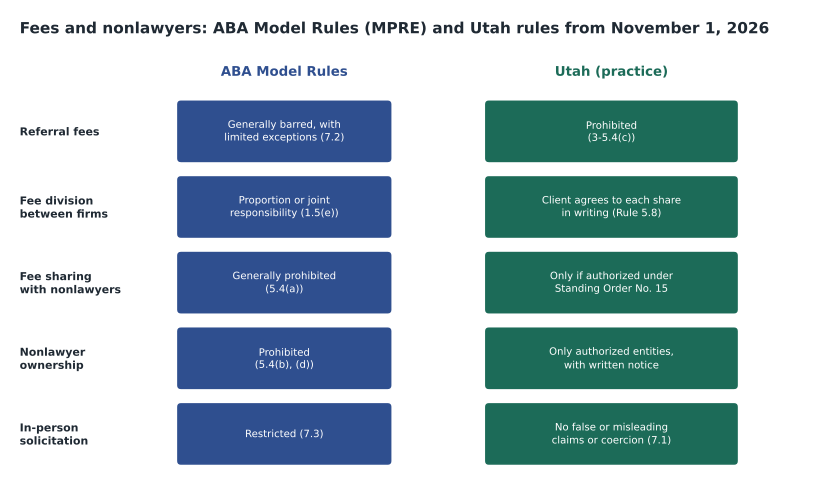
| Issue | ABA Model Rules (tested on the MPRE) | Utah rules (practice, from November 1, 2026) |
|---|---|---|
| Referral fees | Generally no payment for a recommendation, with limited exceptions (Rule 7.2) | Prohibited (Rule 3-5.4(c)) |
| Fee division between firms | Rule 1.5(e): proportion to services or joint responsibility, client consent in writing, reasonable total | Rule 5.8: client agrees in writing to each share, no increase in total, paid only when payable, reasonable shares |
| Fee sharing with nonlawyers | Generally prohibited (Rule 5.4(a)) | Only if authorized under Standing Order No. 15, with written client notice |
| Nonlawyer ownership | Prohibited (Rule 5.4(b) and (d)) | Only for entities authorized under Standing Order No. 15 |
| In-person solicitation | Restricted (Rule 7.3) | Not banned as such; no false or misleading claims, coercion, duress or harassment (Rule 7.1) |
Licensed paralegal practitioners
Utah created a new legal profession in 2018 and 2019. Licensed paralegal practitioners, or LPPs, are licensed by the Supreme Court through the Utah State Bar under Rule 4-802 (formerly 14-802), which creates an exception to the prohibition on the unauthorized practice of law. LPPs may practice only in specified areas: certain family law matters, including temporary separation, divorce, parentage, cohabitant abuse, civil stalking, custody and support and name change; forcible entry and detainer (eviction) cases; and debt collection matters where the amount does not exceed the small claims limit.
Within those areas, an LPP may, for natural persons only, enter into a written contract with the client, interview the client, help the client choose and complete court-approved forms, sign, file and serve those forms, gather and explain documents, review and explain the other side's documents, negotiate and advocate for a settlement and prepare the settlement paperwork, and explain court orders. In court, an LPP may sit with the client, provide emotional support, answer factual questions directed to the client and take notes, but the Bar's description of the program does not include arguing as an advocate at hearings. LPPs may not represent corporations or charge contingency fees, must maintain trust accounts and must provide pro bono services. They may own their own firms or hold a non-controlling interest in a firm with lawyers.
Applicants qualify through one of several educational routes, including a law degree, a paralegal degree or certain national paralegal credentials, plus 1,500 hours of substantive law-related experience in the three years before applying, with 500 hours in family law for that area. They must pass a professional ethics exam and a separate exam for each practice area. Licensed LPPs complete six hours of CLE each year, including one hour of ethics and one of professionalism and civility.
For a new lawyer, LPPs are colleagues, competitors and sometimes co-counsel. A lawyer may receive a referral from an LPP when a divorce becomes contested or complex, and a firm may employ LPPs to handle form-based work under appropriate arrangements.
The regulatory sandbox
In August 2020 the Utah Supreme Court issued Standing Order No. 15, creating a pilot legal regulatory sandbox administered by the Office of Legal Services Innovation. The sandbox lets approved entities offer legal services in ways that the traditional rules would not allow, such as entities owned in part by nonlawyers, technology-based services and arrangements in which nonlawyers provide limited legal help under supervision, subject to reporting and monitoring for consumer harm. Lawyers who work in or with an authorized entity rely on Rule 3-5.4(e) and (f).
The sandbox was designed as a pilot, and it is now in its final stage. Committee materials from 2026 describe the sandbox as scheduled to end in the fall of 2027, and in October 2026 the Court published for comment, through December 11, 2026, an amendment to its rule on the Office of Legal Services Innovation to allow the committee to keep working with fewer members during the sandbox's final months. A Supreme Court regulatory reform committee, launched in May 2025, is studying what should replace the sandbox, including possible permanent changes to Rule 5.4, and its preliminary discussions have considered options such as limited nonlawyer ownership with registration and reporting. None of those options had been adopted as of November 2026, so a lawyer should watch the Court's rules pages for the final decision.
Regulation and the MPRE
The MPRE tests the ABA Model Rules, so a Utah candidate studying for it should learn the Model Rules on fee division, nonlawyer ownership and solicitation and treat Utah's approach as a practice note. After admission, the Utah rules control, and Utah's are among the most distinctive in the country.
Common mistakes
MistakeA Utah lawyer may pay another lawyer for a referral if the client is told.
InsteadSince November 1, 2026, Rule 3-5.4(c) prohibits referral fees; fee sharing between lawyers must satisfy Rule 5.8.
MistakeUtah lets any firm share fees with a nonlawyer if the client gets written notice.
InsteadFee sharing with nonlawyers now requires authorization under Standing Order No. 15 plus written notice.
MistakeUtah still follows Model Rules 7.2 through 7.5.
InsteadUtah consolidated its advertising rules into a single Rule 7.1 in 2020.
MistakeAn LPP may represent a small business in a collection case.
InsteadLPPs serve natural persons only and may not represent corporations.
MistakeThe sandbox is a permanent program.
InsteadIt is a pilot scheduled to end in fall 2027, with a committee studying what follows.
Trust accounts
Whatever the changes to fee rules, the basics of client money remain the same. Utah lawyers must keep client funds in trust accounts separate from the firm's own money, keep complete records and certify compliance with the IOLTA program each year. Misuse of client funds remains among the most serious disciplinary violations in every state, including Utah.
Summary and key terms
- Utah's Rules of Professional Conduct are now numbered in Chapter 3 of the Supreme Court Rules of Professional Practice (Rule 5.4 is Rule 3-5.4).
- From November 1, 2026, referral fees are prohibited, fee sharing between lawyers is governed by new Rule 5.8, and fee sharing with nonlawyers and nonlawyer ownership require Standing Order No. 15 authorization and written notice.
- Utah replaced Model Rules 7.1 to 7.5 with a single Rule 7.1 in 2020; a new Rule 8.4 comment addresses settlements conditioned on withdrawing misconduct complaints.
- LPPs, licensed under Rule 4-802, may help natural persons in specified family, eviction and small debt matters but may not argue as advocates or represent corporations.
- The sandbox, created by Standing Order No. 15 in August 2020, is scheduled to end in fall 2027 while a committee considers permanent reforms.
- 0
- Utah Rules of Professional Conduct
- 1
- referral fee
- 2
- Rule 5.8
- 3
- fee sharing
- 4
- Standing Order No. 15
- 5
- nonlawyer ownership
- 6
- licensed paralegal practitioner
- 7
- regulatory sandbox
- 8
- Office of Legal Services Innovation
- 9
- Office of Professional Conduct
Practice problems
Work each problem on paper first, then reveal the answer to check.
May a Utah lawyer pay a referral fee to another lawyer?
Show answer
No; Rule 3-5.4(c) prohibits referral fees from November 1, 2026.
What does Rule 5.8 require for sharing a fee between firms?
Show answer
Client agreement in writing to each share, no increase in the total fee, payment only when the fee is payable and reasonable shares.
In which areas may an LPP practice?
Show answer
Specified family law matters, forcible entry and detainer, and debt collection within the small claims limit.
When is the sandbox scheduled to end?
Show answer
In the fall of 2027, according to the court committee's 2026 materials.
Lesson quiz · 5 questions
Score 60% or more to complete this lesson.
Create a free account to save your progress, take quizzes and earn a certificate.