
BAR-245 · Lesson 6 of 12 · 19 min
What the exam tests and how Utah law appears
▶ Video coming soon A video version of this lesson is on the way.
Three months into her clerkship, Mele noticed something odd about her practice MEE answers. In a torts essay about a multi-car collision, she had written that no defendant could be liable for more than its own share of fault. In a civil procedure essay she had mentioned discovery tiers. And in a property question about a buyer who failed to record, she had written about water shares. 'Every one of those is right in Utah,' Marchetti wrote in the margin, 'and every one is wrong on the UBE.' This lesson explains the gap between what the exam tests and the Utah law Mele uses at work, and then uses Utah water law, the most distinctive body of law in the state, to show how Utah rules differ from the general principles the exam expects.
The UBE tests general law
Utah has no jurisdiction-specific component, so nothing on the February 2027 exam tests Utah law as such. The MBE tests generally accepted principles, the Federal Rules of Civil Procedure and the Federal Rules of Evidence, and Article 2 of the UCC. The MEE tests the same kinds of rules, and its instructions tell candidates to apply fundamental legal principles rather than the law of any particular jurisdiction unless the question says otherwise. The MPT supplies its own law in the library, which may be fictional. A Utah rule appears on the exam only if a question happens to adopt it.
That makes the risk for a Utah candidate the reverse of the usual one. A candidate in a state with its own essays must learn the state's law. A Utah candidate must set aside the Utah law she uses every day, at least for two days in February. The habit to build is to ask, for every issue: what is the general rule, and is the question telling me to apply something different?
| Topic | What the UBE usually expects | What Utah law says (for practice) |
|---|---|---|
| Comparative fault | Apply the system the question states; know pure and modified versions | Modified: a plaintiff recovers only if the defendants' combined fault exceeds hers (Utah Code 78B-5-818) |
| Multiple defendants | Joint and several liability as the traditional rule, with modern variations | No defendant pays more than its own proportion of fault |
| Discovery | Federal Rule 26 proportionality and federal limits | Utah Rule 26 tiers set by the amount in controversy |
| Divorce and property | Not on the MEE from July 2026; may appear on an MPT with its own law | Title 81 of the Utah Code; equitable division of marital property |
| Water | Riparian and prior appropriation basics in property questions | Prior appropriation; the State Engineer; beneficial use; forfeiture after seven years of nonuse |
How Utah law can still help
None of this means Utah law is useless for the exam. Understanding why Utah chose a rule usually requires understanding the general rule it changed, and that deepens a candidate's grasp of the tested law. Mele's clerkship work on comparative fault made her better at MBE comparative negligence questions, once she stopped assuming Utah's version. And the MPT rewards exactly the skills of a working clerk: reading a file, reading a library and producing a usable document under time pressure.
The key is labeling. Marchetti asks Utah candidates to keep two columns in their outlines: the general rule, which is what they write on the exam, and a short Utah note, which they use at work and, after admission, in practice. Lessons 7 through 10 of this course fill in the Utah column for civil procedure, torts, family law and lawyer regulation. The rest of this lesson takes up water.
Water law: prior appropriation in Utah
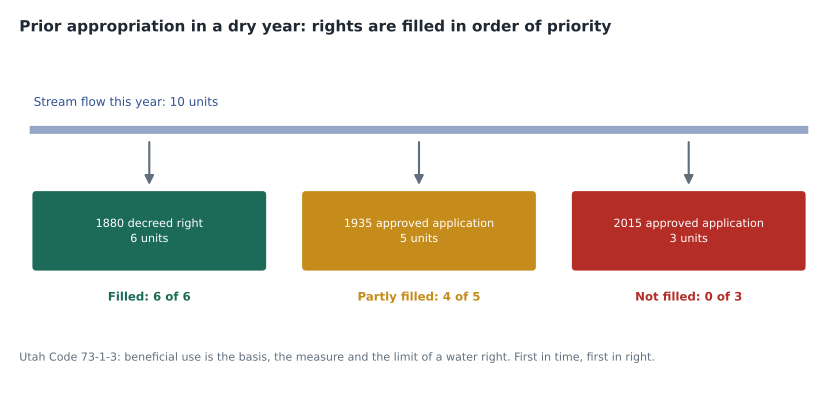
Utah sits in the second-driest state in the country, and its law of water reflects that. Like other western states, Utah follows the doctrine of prior appropriation rather than the riparian system of the eastern states. Under riparian doctrine, owners of land along a stream share the right to make reasonable use of its water. Under prior appropriation, a person acquires a right to water by putting it to beneficial use, and rights are ranked by their priority date: first in time, first in right. In a dry year, the holder of the oldest right takes her full allotment before the holder of a later right takes any.
Utah's statutes build on two foundations. Section 73-1-1 of the Utah Code declares that the waters of the state, whether above or under the ground, are the property of the public, subject to existing rights to their use. Section 73-1-3 states that beneficial use is the basis, the measure and the limit of all rights to the use of water. A water right is therefore a right to use a defined quantity of public water, for a defined purpose, at a defined place, with a defined priority. It is not ownership of the water itself.
How water rights are created and changed
Today, a new right to appropriate water in Utah is acquired by applying to the State Engineer, who heads the Division of Water Rights. The State Engineer approves an application only if the statutory criteria are met, which include that there is unappropriated water in the proposed source, that the proposed use will not impair existing rights or interfere with the more beneficial use of the water, that the plan is physically and economically feasible, and that it will not be detrimental to the public welfare. Many older rights predate the permit system and are recognized through court decrees and general adjudications, in which a district court determines all the rights on a river system.
An existing right can be changed, for example to move the point of diversion, the place of use or the nature of use, but only through a change application to the State Engineer. The central question on a change application is whether the change will impair other rights. A farmer who wants to sell her water right to a city cannot simply let the city start pumping; the change must be approved, and it may be limited to the amount of water historically consumed so that downstream users who relied on return flows are not harmed.
Losing a water right: forfeiture
Because beneficial use is the measure of the right, a right that is not used can be lost. Under section 73-1-4, a water right, or a portion of it, becomes subject to forfeiture when the holder fails to put it to beneficial use for a period of at least seven years. Forfeiture is not automatic. The current statute requires a judicial action, filed within 15 years after the end of the latest seven-year period of nonuse, or a proposed determination by the State Engineer in a general adjudication. When a court declares a forfeiture, the right reverts to the public, and the freed water first satisfies other rights in order of priority.
The statute also protects holders who have good reasons not to use their water. A holder may file a nonuse application with the State Engineer, which may be approved for up to seven years for reasonable cause, such as financial hardship, conservation practices, conditions beyond the owner's control or pending legal proceedings, and approved nonuse time does not count toward the seven years. The statute lists many other situations in which forfeiture does not apply, including water used under a written lease, rights enrolled in approved conservation fallowing programs, periods when the source does not yield enough water or when water is unavailable because of the right's priority, water stored in reservoirs or aquifers, certain rights held by public water suppliers for reasonable future needs, use through an authorized water bank and water saved through conservation as quantified by the State Engineer.
Worked problem
A farm, a deed and a water right
Thayne Ostler's client owns 80 acres in Juab County with a decreed irrigation right from 1902. Her son farmed the land until 2015; since then the fields have been fallow, with no nonuse application and no lease. A buyer wants the land and the water for a new orchard. What issues should the firm flag?
Show solution
- Basis: the right is measured by beneficial use; more than seven years of nonuse (2015 to 2026) makes it subject to forfeiture under section 73-1-4.
- Not automatic: forfeiture requires a judicial action filed within 15 years after the nonuse period ends, or a State Engineer proposed determination in a general adjudication.
- Exemptions: the firm should check whether any statutory exemption applies, such as an approved conservation program or a period of insufficient supply.
- Going forward: the client can file a nonuse application to stop new nonuse time from counting, if she has reasonable cause.
- Transaction: the deed and contract should describe the water right expressly, and the buyer should check the Division of Water Rights records and consider a change application if the orchard changes the place or nature of use.
Answer: The right is at risk but not lost. The firm should research exemptions, consider a nonuse application and draft the sale documents to address the water right and the forfeiture risk directly.
Water and the exam
On the MBE, water rights appear rarely, and when they do the question tests the general distinction between riparian rights and prior appropriation, or the basic rules on groundwater and surface water. The question will tell the candidate which system applies or test the difference between them. A Utah candidate should know the general features of both systems and should not import Utah's application procedure, forfeiture rule or exemptions into an exam answer. In practice, by contrast, water rights affect real estate closings, farm and ranch estates, municipal growth and divorce property divisions across the state, and many Utah lawyers meet them in their first year.
Common mistakes
MistakeUtah law should be applied on the UBE because the exam is given in Utah.
InsteadThe UBE tests general principles and federal rules unless a question says otherwise.
MistakeA Utah candidate can skip general rules she does not use at work.
InsteadThe general rule is the one tested; the Utah rule is a practice note.
MistakeOwning land along a stream gives a Utah owner a right to its water.
InsteadUtah follows prior appropriation; rights come from beneficial use and are ranked by priority.
MistakeA water right not used for seven years is automatically gone.
InsteadForfeiture requires a judicial action or a State Engineer proposed determination in an adjudication, and many exemptions apply.
MistakeA water right can be moved to a new place of use by agreement alone.
InsteadA change application to the State Engineer is required.
Groundwater, water companies and shares
Utah's prior appropriation system applies to groundwater as well as surface water, and the State Engineer manages groundwater basins, some of which are closed to new appropriations because they are fully used. Many Utah water users do not hold water rights directly at all. Instead they own shares in mutual irrigation companies or canal companies, which hold the underlying rights and deliver water to shareholders. A share in such a company is personal property governed by the company's articles and bylaws, not a water right of the kind the State Engineer records in the shareholder's name. That distinction matters in real estate transactions, divorces and estates: a lawyer must find out whether a client holds a decreed or approved right, shares in a company, or both, and must check the company's rules on transfers. The forfeiture statute addresses shareholders too, allowing them to file nonuse applications after notifying the company.
Water rights in other practice areas
Water appears in places a new lawyer might not expect. In a divorce, a water right or company shares acquired during the marriage may be marital property that must be valued and divided. In an estate, water rights pass with the decedent's property and may need to be described specifically in a will, trust or deed. In a commercial lease of farmland, the lease may need to address who must keep the water in beneficial use to avoid forfeiture. And in municipal practice, cities acquiring water for growth must work through change applications and the State Engineer's review. Thayne Ostler's advice to every new associate is simple: whenever a file involves land outside a city, ask about water.
A word about recording and title
Utah, like every state, has a recording act that protects good-faith purchasers who record, and Utah title practice relies heavily on title insurance. On the MBE, recording act questions test the three general types of statutes, race, notice and race-notice, and the question will state or describe the statute. A Utah candidate should know all three types and apply the one the question gives, not the Utah statute she learned at work.
Summary and key terms
- The UBE tests general law, the federal rules and UCC Article 2; Utah has no Utah component.
- Keep two columns: the general rule for the exam and a Utah note for practice.
- Utah follows prior appropriation: waters are public property (73-1-1), and beneficial use is the basis, measure and limit of a right (73-1-3).
- New rights and changes require applications to the State Engineer; changes must not impair other rights.
- Seven years of nonuse makes a right subject to forfeiture under 73-1-4, but only through a judicial action or adjudication, with nonuse applications and exemptions.
- 0
- generally accepted principles
- 1
- jurisdiction-specific component
- 2
- prior appropriation
- 3
- riparian rights
- 4
- beneficial use
- 5
- priority date
- 6
- State Engineer
- 7
- change application
- 8
- forfeiture
- 9
- nonuse application
Practice problems
Work each problem on paper first, then reveal the answer to check.
Does the February 2027 exam test Utah law?
Show answer
No; Utah has no jurisdiction-specific component.
What is the basis, measure and limit of a Utah water right?
Show answer
Beneficial use, under Utah Code 73-1-3.
How long must a right go unused before it is subject to forfeiture?
Show answer
At least seven years.
How is a change in the place of use approved?
Show answer
By a change application to the State Engineer, who considers impairment of other rights.
Lesson quiz · 5 questions
Score 60% or more to complete this lesson.
Create a free account to save your progress, take quizzes and earn a certificate.