
LES-103 · Lesson 1 of 12 · 22 min
Sources of criminal law: the Criminal Code, statutes and the courts
▶ Video coming soon A video version of this lesson is on the way.
The first class of Criminal Law for Law Enforcement starts with a question on the whiteboard: what makes something a crime? Professor Ray Desjardins, who spent 28 years with the Port Ardent police before he started teaching at Georgian Shores College, lets the room argue for a few minutes. Marco DiSanto says a crime is anything that hurts someone. Amara Okafor points out that cheating on a partner hurts people and is not a crime, while possessing a prohibited knife hurts no one and is. Priya Sandhu, who spent five years investigating bank fraud, says a crime is whatever the law says it is, and that the hard part is reading what the law actually says. Professor Desjardins circles her answer. This term, he says, the class will learn to read criminal law the way a good officer does: as a set of precise rules, each with elements that must be proved, which tell an officer when there are grounds to act and what evidence to gather. He introduces his co-instructor for the course, assistant Crown attorney Margaret Liu, who reviews police charges in Port Ardent every week and will tell them, often bluntly, which charges survive in court and why.
What criminal law is
Criminal law is the part of the law that defines conduct the state forbids and punishes. Three features separate it from other law. First, a crime is treated as a wrong against society as a whole, not just against the victim, so the case is brought by the state in the name of the King, which is why cases are named R. v. Smith (Rex, or Regina when a queen reigns, against Smith) and the victim is a witness rather than a party. Second, the consequences are the most serious the law imposes: a criminal record, fines, probation, imprisonment and the stigma of conviction. Third, because the stakes are so high, the accused is presumed innocent and the prosecution must prove every element of the offence beyond a reasonable doubt. In Canada this standard is protected by section 11(d) of the Charter, and in R. v. Lifchus (1997) the Supreme Court told judges how to explain it to juries: it is not proof to an absolute certainty, but it is much closer to certainty than to proof on a balance of probabilities.
A civil case is different. If Amara's neighbour damages her fence, she can sue for the cost of repairs; she controls the case, needs to prove it only on a balance of probabilities, and the remedy is money. The same act may be both a civil wrong and a crime. If the neighbour broke the fence deliberately, the state may also prosecute for mischief, and the two cases proceed separately with different standards of proof. Officers deal only with the criminal side, but they should understand the difference, because people often call the police about matters that are purely civil, such as a landlord keeping a damage deposit or a contractor who did poor work. Explaining that something is a civil dispute, and where the person can go for help, is part of the job.
Who makes criminal law
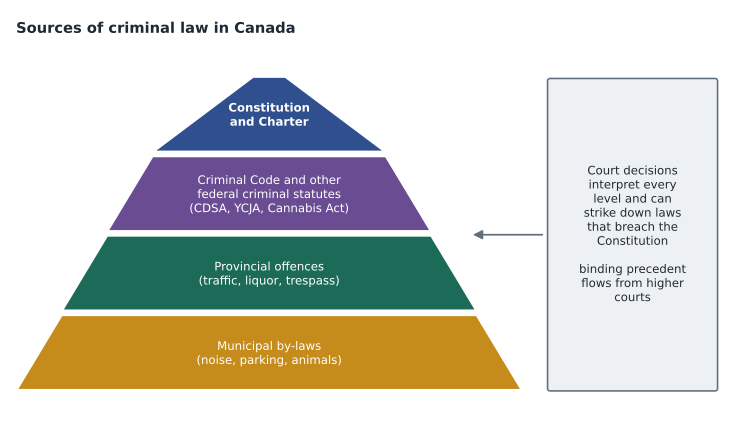
In Canada, the Constitution Act, 1867 divides law-making power between Parliament and the provinces. Section 91(27) gives Parliament exclusive power over the criminal law and criminal procedure, which is why the same Criminal Code applies from St. John's to Victoria. Section 92(14) gives the provinces power over the administration of justice, so provinces run the courts, employ Crown prosecutors for most offences and oversee policing. Section 92(15) lets provinces create penalties to enforce their own laws, which is the source of provincial offences such as speeding under Ontario's Highway Traffic Act. Municipalities can make by-laws only under powers delegated by the province, such as noise and parking by-laws.
Canada's Criminal Code was first enacted in 1892, borrowing heavily from a draft English code that England itself never adopted. It has been amended thousands of times and is now a statute of more than 800 sections, organized into Parts by subject: offences against public order, against the person, against property, and so on, followed by procedure. Many offences are also found in other federal statutes. The Controlled Drugs and Substances Act covers drug offences, the Cannabis Act covers cannabis, the Youth Criminal Justice Act sets the rules for young people aged 12 to 17, and the Firearms Act covers licensing and registration. Parliament continues to change the Code: in June 2026, for example, the Bail and Sentencing Reform Act tightened bail for repeat and violent offending, and the Protecting Victims Act created new offences, including a coercive control offence and offences for threatening to share intimate images.
No crime without a law
A basic principle of criminal law is often stated in Latin as nullum crimen sine lege: there is no crime without a law. People can be punished only for conduct that was clearly defined as a crime before they did it. In Canada, section 9 of the Criminal Code abolished common law offences, the crimes once created by judges rather than legislatures, with the single exception of contempt of court. Section 11(g) of the Charter protects against conviction for an act that was not an offence when it was committed, and section 11(i) gives an accused the benefit of a lesser punishment if the penalty changed between the offence and sentencing. For an officer, this principle means that the question is never whether conduct seems wrong but whether it fits a specific offence. A man who shouts insults at a referee may be rude, but unless his conduct meets the elements of a defined offence, there is nothing to charge.
The same principle requires laws to be clear. A law so vague that ordinary people cannot tell what it forbids, or that leaves police free to arrest whomever they dislike, violates the constitution. In R. v. Nova Scotia Pharmaceutical Society (1992), the Supreme Court of Canada said a law is unconstitutionally vague if it fails to give fair notice to citizens and to limit enforcement discretion, offering no sufficient guidance for legal debate. Old vagrancy laws were once used to move along people whom police or the community considered undesirable, and their history is a reminder that clear limits on police power protect everyone.
The role of the courts
Legislatures write criminal law, but courts decide what the words mean. When a section is ambiguous, judges look at its words in context, its purpose and its history. Because criminal law can take away liberty, a real ambiguity that remains after these steps is resolved in favour of the accused. In R. v. McIntosh (1995), the Supreme Court of Canada applied this principle to a confusing self-defence provision, holding that where a penal provision is reasonably capable of two interpretations, the one more favourable to the accused must be adopted. Courts also develop the general principles that apply to every offence, such as what counts as intent, when an accused caused a result and how defences work. Many of these principles appear in no statute at all and are found only in case law.
Courts are bound by precedent, a principle known as stare decisis. A lower court must follow the decisions of the courts above it. In Ontario, a judge of the Ontario Court of Justice follows the Superior Court of Justice and the Court of Appeal for Ontario, and every court in the country follows the Supreme Court of Canada, which is the final court of appeal for all law in Canada, federal and provincial. This is why Ms. Liu tells the class that a single appeal decision can change how every officer in the province or state must investigate a type of case, and why police services issue training bulletins when an important decision comes down.
| Source | Canadian example | What it does for an officer |
|---|---|---|
| Constitution | Charter, sections 7 to 14 | Limits what the law and police may do |
| Criminal statute | Criminal Code, s. 348 break and enter | Defines the offence and its elements |
| Other statutes | CDSA, Cannabis Act, YCJA | Defines further offences and procedures |
| Lesser offences | Highway Traffic Act; municipal by-laws | Regulates conduct with lighter penalties |
| Court decisions | R. v. Lifchus; R. v. McIntosh | Interprets words and sets general principles |
Reading a statute like an investigator
Officers do not need to memorize the Criminal Code, but they must be able to find and read the section that fits a situation. Statutes are written in a precise structure. A Criminal Code citation such as section 348(1)(b) means section 348, subsection (1), paragraph (b). Section 348(1) says that every one who breaks and enters a place with intent to commit an indictable offence in it, or breaks and enters a place and commits an indictable offence in it, or breaks out of a place after committing an indictable offence in it or after entering with intent to commit one, is guilty. Each paragraph is a separate way of committing the offence, and the charge must say which one. Every word matters. Definitions sections tell the reader what terms mean, and the same word can have a narrower or broader meaning than in everyday speech.
The code below shows one way to break a citation into its parts, the first step in finding the right provision. Linh Tran, who hopes to become a crime analyst, likes the idea that statutes can be read as structured data. Records systems in police services do exactly this when they let officers select an offence by its section number.
# Breaking a Criminal Code citation into its parts
import re
pattern = re.compile(r"s\. (\d+(?:\.\d+)?)(?:\((\d+)\))?(?:\(([a-z])\))?(?:\((i+|iv|v)\))?")
labels = ["section", "subsection", "paragraph", "subparagraph"]
for citation in ["s. 348(1)(b)", "s. 267(a)", "s. 264.1(1)(a)", "s. 430(4)", "s. 334"]:
    m = pattern.fullmatch(citation)
    parts = [f"{label} {value}" for label, value in zip(labels, m.groups()) if value]
print(f"{citation:16s} -> " + ", ".join(parts))s. 348(1)(b) -> section 348, subsection 1, paragraph b s. 267(a) -> section 267, paragraph a s. 264.1(1)(a) -> section 264.1, subsection 1, paragraph a s. 430(4) -> section 430, subsection 4 s. 334 -> section 334
A citation tells you where to look, but the work starts when you read the provision itself. Ms. Liu gives the class a habit to practise all term: read the whole section, including any definitions it refers to; list its elements one per line; and then, for each element, write down what evidence would prove it. That list becomes the investigator's checklist, and lesson 3 will turn it into a formal tool.
From the street to the charge
Knowing the law matters at every step of police work. Before acting, an officer needs grounds to believe a specific offence has been committed. In Ontario, police lay most charges themselves by swearing an information before a justice of the peace, and the Crown then reviews the charge and decides whether to continue; in British Columbia, Quebec and New Brunswick, Crown counsel must approve charges before they are laid. The Crown continues a prosecution only if there is a reasonable prospect of conviction and it is in the public interest. Choosing the right offence and documenting the evidence for each element is what makes the difference between a case that proceeds and one that collapses.
Ms. Liu describes the most common problems she sees in police files. An officer charges a more serious offence than the evidence supports, perhaps because the victim was very upset, and the case is later reduced or withdrawn. An officer writes that a suspect intended something without recording the words and actions that showed intent. An officer charges the right offence but under the wrong subsection, so the charging document has to be amended. Or the report never addresses an element at all, such as the value of stolen property, which determines the level of the offence. Each of these can be avoided by reading the section and building the file around its elements, which is the core skill of this course.
Worked problem
Choosing the right law
At 2 a.m. Constable Dev Malhotra is called to a residential street where a man has been setting off fireworks and shouting in the middle of the road for twenty minutes. Several neighbours have come out of their homes, and one says she is afraid he will set a car on fire. When Dev arrives, the man stops, apologizes and says he is celebrating a new job. What laws could apply?
Show solution
- Municipal law: the Port Ardent noise and fireworks by-law prohibits discharging fireworks outside permitted dates and making unreasonable noise at night, and is enforced by a ticket under the Provincial Offences Act.
- Criminal law: section 175(1)(a) of the Criminal Code makes it an offence to cause a disturbance in or near a public place by shouting, but the Supreme Court held in R. v. Lohnes (1992) that there must be an externally manifested disturbance of the public peace, such as people gathering or being interfered with in their use of the place.
- Fire safety law: the fire code and the province's fireworks rules may also apply, and the fire department can be consulted if fireworks were used dangerously near vehicles.
- Choice: the conduct has stopped, no one is hurt and the man is cooperative, so a by-law ticket and a warning that further conduct will lead to a criminal charge fits the facts. If he resumes after being warned, the causing a disturbance offence becomes stronger, because people are now clearly disturbed in their use of the street.
Answer: Several laws can fit one incident, at different levels of seriousness. The officer identifies each, checks whether the elements are met, and chooses the response that fits the facts, recording the warning so that a later officer knows about it.
Common mistakes
MistakeIf conduct is clearly wrong, it must be a crime.
InsteadOnly conduct that meets the elements of an offence defined in law is a crime; many harmful acts are civil wrongs or not unlawful at all.
MistakeThe victim decides whether a criminal case goes ahead.
InsteadThe Crown brings the case on behalf of society; the victim's views matter but do not control the decision.
MistakeCourt decisions are less important than the statute.
InsteadCourts interpret the statute's words and set general principles, so a single decision can change how an offence must be investigated.
MistakeReading the section number is enough.
InsteadOfficers must read the whole section and its definitions and charge the specific subsection or division that fits the facts.
Summary and key terms
- Criminal law defines conduct the state forbids and punishes; the state prosecutes and must prove every element beyond a reasonable doubt.
- Parliament makes criminal law under section 91(27); provinces create provincial offences and administer justice; municipalities make by-laws.
- The Criminal Code of 1892, amended many times, is the main source, with other federal statutes such as the CDSA and the Cannabis Act.
- There is no crime without a law: common law offences are abolished, laws cannot apply retroactively and vague laws are unconstitutional.
- Courts interpret statutes, resolve real ambiguity in favour of the accused and bind lower courts through precedent.
- Officers read the whole provision, list its elements and gather evidence for each one.
- Criminal Code
- The federal statute that defines most crimes in Canada and sets out criminal procedure.
- Provincial offence
- An offence created by a provincial statute, such as speeding, usually prosecuted by ticket.
- By-law
- A rule made by a municipality under powers given to it by the province.
- Reasonable doubt
- A doubt based on reason and common sense; proof beyond it is much closer to certainty than to a balance of probabilities.
- Stare decisis
- The principle that courts follow the decisions of higher courts.
- Vagueness
- A defect in a law that fails to give fair notice of what it forbids or to limit enforcement discretion.
Practice problems
Work each problem on paper first, then reveal the answer to check.
Give two differences between a criminal case and a civil case.
Show answer
The state prosecutes a criminal case and must prove guilt beyond a reasonable doubt; in a civil case the injured person sues and proves the case on a balance of probabilities, usually for money.
Why does the same Criminal Code apply in every province?
Show answer
Because section 91(27) of the Constitution Act, 1867 gives Parliament exclusive power over criminal law.
What does the principle of no crime without a law mean for an officer on a call?
Show answer
The officer must identify a specific offence whose elements fit the conduct; conduct that seems wrong but fits no offence cannot be charged.
Why are ambiguous criminal laws read in favour of the accused?
Show answer
Because criminal law can take away liberty, people must have clear notice of what is forbidden, so real ambiguity is resolved in their favour.
Lesson quiz · 5 questions
Score 60% or more to complete this lesson.
Create a free account to save your progress, take quizzes and earn a certificate.