
LES-103 · Lesson 3 of 12 · 22 min
Elements of an offence: the prohibited act
▶ Video coming soon A video version of this lesson is on the way.
Professor Desjardins opens week three with a photograph of a set of car keys on a kitchen table. A man has been drinking heavily at home. His car is in the driveway and the keys are on the table, ten metres away. Is he committing an offence? The class says no. Now, the professor says, imagine he is asleep behind the wheel with the engine running to keep warm. Now imagine he is driving. Somewhere along that sequence, conduct that the law does not care about becomes conduct that it punishes, and the line is drawn by the words of the offence. Every offence is built from elements, the specific facts the prosecution must prove, and the first group of elements describes what the accused did. Lawyers call it the actus reus, Latin for the guilty act. This lesson is about that group of elements and about how officers gather evidence of each one.
The building blocks of every offence
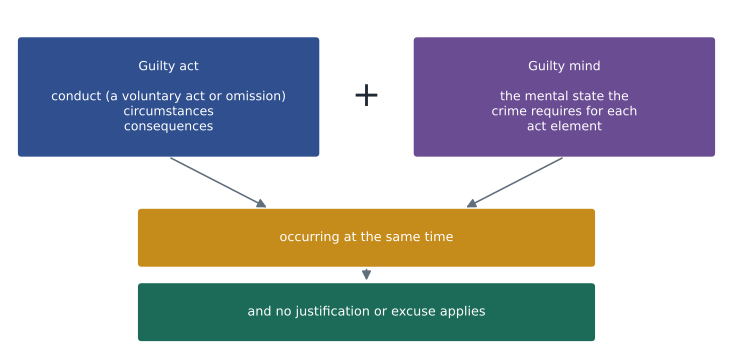
Criminal liability usually requires two things at the same time: a prohibited act and a guilty state of mind. The second element, called mens rea or the guilty mind, is the subject of lesson 4. The two must coincide, meaning the guilty mind must exist at some point during the guilty act. A man who accidentally knocks someone down the stairs and then, seeing the person injured, is glad, has not committed an assault: he had no guilty mind when he acted. Courts apply this requirement sensibly, however. When an act continues over time, as when a driver accidentally parks on a police officer's foot and then refuses to move, the guilty mind can arise during the continuing act, as an English court held in Fagan v. Metropolitan Police Commissioner (1969), a case still taught in both countries.
The actus reus of an offence can have three parts. The conduct is what the accused did or failed to do, such as taking, touching, entering or driving. The circumstances are facts that must exist for the conduct to be criminal, such as that the property belonged to someone else, that the person touched did not consent, or that the victim was a peace officer. The consequences are results that the conduct must cause, such as death, bodily harm or damage. Not every offence has all three. Some offences, sometimes called conduct crimes, are complete as soon as the act is done, whatever its result: uttering a threat is complete when the words are communicated, whether or not the victim is frightened. Others, called result crimes, require a consequence: homicide requires a death, and assault causing bodily harm requires an injury. Breaking an offence into these parts tells an investigator exactly what facts to prove.
| Offence | Conduct | Circumstances | Consequences |
|---|---|---|---|
| Theft (s. 322) | Taking or converting property | Property belongs to another; no colour of right | None required |
| Assault causing bodily harm (s. 267(b)) | Applying force | No consent | Bodily harm |
| Break and enter (s. 348(1)(b)) | Breaking and entering | A place, as defined; committing an indictable offence inside | None required |
| Uttering threats (s. 264.1) | Communicating words or conduct | The threat is to cause death or bodily harm | None required |
The act must be voluntary
The criminal law punishes conduct that is the product of a person's will. A reflex, a spasm, a movement during an epileptic seizure, or an act done while sleepwalking is not a voluntary act, and there is no actus reus. Canadian courts call this the defence of automatism. In R. v. Parks (1992), the Supreme Court of Canada upheld the acquittal of a man who drove 23 kilometres while sleepwalking and killed his mother-in-law, accepting expert evidence that he was asleep throughout. In R. v. Stone (1999) the Court set strict rules for the defence: the accused must prove on a balance of probabilities that he or she acted involuntarily, and if the cause is a disease of the mind the result is a verdict of not criminally responsible rather than a complete acquittal. Involuntariness is rare in practice and usually raised by the defence with medical evidence, but it explains why officers record details such as whether a person appeared conscious, confused or responsive.
Voluntariness is judged at the right moment. A person who knows she has untreated epilepsy and drives anyway may be liable for a crash during a seizure, because the voluntary act was choosing to drive. Self-induced intoxication is usually treated differently from automatism, under special rules covered in lesson 11. And the act need not be the final movement. A person who sets a timer on a fire-starting device and walks away has acted voluntarily, even though he is miles away when the fire starts.
Omissions: when failing to act is a crime
As a general rule, the criminal law does not punish people for failing to help. A passer-by who watches a stranger drown without lifting a finger may be morally contemptible but commits no crime in most cases. A failure to act becomes criminal only when the law imposes a duty to act. The Criminal Code imposes several such duties. Section 215 requires parents, guardians and heads of families to provide the necessaries of life to children under 16, spouses and common-law partners to provide them to each other, and anyone who has charge of a person who cannot care for himself or herself, through age, illness or detention, to provide for that person. Section 216 imposes a duty on anyone who undertakes medical or other lawful acts that may endanger life to use reasonable knowledge, skill and care, and section 217 says anyone who undertakes to do an act is under a legal duty to do it if an omission would be dangerous to life. In R. v. Browne (1997), the Ontario Court of Appeal held that such an undertaking must be clearly made and relied on, not a casual promise.
Omission cases often reach police as deaths or near-deaths of children, elderly people or people with disabilities who were left without food, medical care or supervision. Investigating them means proving the relationship that created the duty, what the accused knew about the person's condition and what help was available. Officers should note the condition of the home, the food and medication present, the person's appearance and what caregivers say about their routine, because the case may depend on showing that a reasonable caregiver would have acted.
Possession
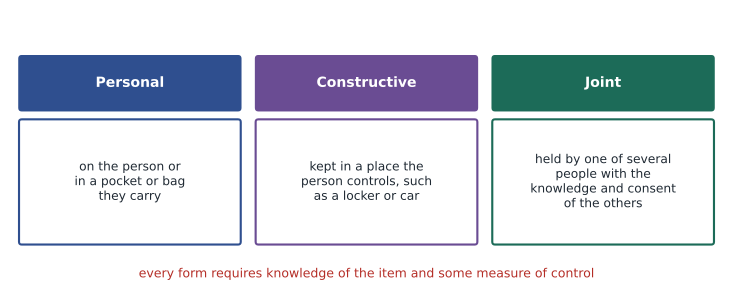
Many offences, especially drug and weapons offences, are defined by possession rather than an act in the ordinary sense. Possession is a state, not a movement, but the law treats it as a guilty act when the person knows of the item and has control over it. Section 4(3) of the Criminal Code defines three forms. Personal possession means the person has the item on his or her person or in a bag he or she is carrying. Constructive possession means the person knowingly has the item in another place, such as a storage locker or a car, for his or her own use or benefit or that of another. Joint possession means that one of two or more persons, with the knowledge and consent of the rest, has the item, in which case all are in possession. In R. v. Morelli (2010), the Supreme Court held that possession requires knowledge of the item and some measure of control over it; merely viewing images on a screen is not possession of them. In R. v. Beaver (1957), the Court held that a person who did not know a package contained heroin did not possess heroin.
In practice, possession is often the hardest element to prove when an item is found in a shared space. A gun under the front passenger seat of a car with four occupants, a bag of drugs in a kitchen used by five roommates, a knife in the console of a borrowed vehicle: in each case the prosecution must show that a particular person knew the item was there and had control over it. Officers build that proof from details. Where exactly was the item? Whose belongings were near it? Who owns or rents the car or room? Did anyone make a statement, a furtive movement or an attempt to hide it as police approached? Are there fingerprints or DNA on it? Were there texts on a phone about it? Each detail is a brick in the wall of knowledge and control.
Turning elements into an investigation plan
Ms. Liu tells the class that the most useful document in any file is the one most officers never write: a list of the elements of each charge, with the evidence for each one beside it. She shows them a case from last year. A man pushed an officer who was arresting his brother outside a bar. The officer charged assaulting a peace officer under section 270. At trial the defence argued that the officer was not lawfully engaged in her duty because the brother's arrest was unlawful, an element the file barely addressed. The case survived only because the arresting officer's notes happened to record the grounds. The code below shows the checklist approach applied to that charge.
# Elements checklist: assaulting a peace officer, Criminal Code s. 270(1)(a)
elements = [
    ("intentional application of force", ["officer's notes: pushed with both hands", "bystander video"]),
    ("without consent", ["officer's notes: told him to step back twice"]),
    ("victim was a peace officer", ["uniform, marked car, badge number"]),
    ("officer engaged in the execution of her duty", ["grounds for the brother's arrest: witness statement"]),
    ("accused knew the victim was a peace officer", []),
]
missing = [name for name, evidence in elements if not evidence]
for name, evidence in elements:
    mark = "OK  " if evidence else "GAP "
    print(f"{mark}{name:46s} {'; '.join(evidence) or 'no evidence recorded'}")
print(f"{len(elements) - len(missing)} of {len(elements)} elements supported; gaps: {missing}")OK intentional application of force officer's notes: pushed with both hands; bystander video OK without consent officer's notes: told him to step back twice OK victim was a peace officer uniform, marked car, badge number OK officer engaged in the execution of her duty grounds for the brother's arrest: witness statement GAP accused knew the victim was a peace officer no evidence recorded 4 of 5 elements supported; gaps: ['accused knew the victim was a peace officer']
The checklist shows a gap: nothing in the file records why the accused would have known the victim was a police officer. In reality the answer is obvious, since she was in uniform beside a marked car, but obvious facts still have to be in evidence. A single line in the notes, such as that the accused looked at the officer, said a crude word about police and then pushed her, closes the gap. Linh points out that the checklist could be built into a records system, prompting officers to record evidence for each element before a charge is submitted. Ms. Liu says several services are trying exactly that.
Circumstances and definitions
Many of the hardest questions in criminal law are about circumstances, and the answers are often in definitions sections. Is a garden shed a place for the purposes of break and enter? Section 348(3) defines place to include a dwelling house, a building or structure or any part of one, a railway vehicle, vessel, aircraft or trailer, and a pen or enclosure in which fur-bearing animals are kept. Is a lawn chair stolen from a porch taken from a dwelling house? Section 2 defines dwelling house to include a building or structure kept or occupied as a permanent or temporary residence, including any building within the yard that is connected to it by a doorway or covered passageway. Is a person who is texting with a phone in hand while stopped at a red light driving? That depends on the provincial definition of driving and holding, not on common sense. Officers who know the definitions avoid two errors: undercharging, because an everyday word seems too narrow, and overcharging, because an everyday word seems broader than the legal one.
Worked problem
Who possesses the pills?
At 1 a.m., Constable Dev Malhotra stops a car for a burned-out headlight. There are three occupants: the driver, who owns the car, a front passenger and a rear passenger. As Dev approaches, he sees the front passenger lean forward and reach under his seat. After a lawful search, Dev finds a bag of 40 pills under the front passenger seat, which a field test indicates contain fentanyl. Who can be charged with possession?
Show solution
- Knowledge and control must be shown for each person separately; presence in the car alone is not enough.
- Front passenger: the furtive movement toward the exact spot where the bag was found, made as police approached, supports an inference that he knew about the bag and was trying to hide it, and the bag was within his reach and control.
- Driver and owner: ownership and control of the car give some control over its contents, but without evidence of knowledge, such as statements, texts, fingerprints or the bag being in plain view, constructive possession will be hard to prove. Ownership alone is not enough.
- Rear passenger: the bag was not within easy reach and there is no evidence of knowledge; charging him would not be supported.
- Further evidence: Dev should record exactly what he saw and when, photograph the bag in place before moving it, seize phones under proper authority if grounds exist and submit the bag for fingerprint and DNA analysis.
Answer: The front passenger can be charged with possession, and possibly possession for the purpose of trafficking if the quantity, packaging and other evidence support it. The driver and rear passenger should not be charged unless further evidence shows knowledge and control.
Common mistakes
MistakeBeing near an item is possession.
InsteadPossession requires knowledge of the item and some control over it; mere presence or access is not enough.
MistakeFailing to help someone in danger is always a crime.
InsteadAn omission is criminal only when the law imposes a duty to act, such as a parent's duty to a child.
MistakeAn act done during a seizure or while sleepwalking is a crime if harm results.
InsteadThe act must be voluntary; involuntary movements are not a guilty act, though choosing to drive while knowing of the risk may be.
MistakeEveryday meanings of words decide the elements.
InsteadDefinitions in the statute control, and they can be narrower or broader than ordinary speech.
Summary and key terms
- Most offences require a guilty act and a guilty mind at the same time, and the absence of a valid defence.
- The guilty act can include conduct, circumstances and consequences; conduct crimes need no result, result crimes do.
- The act must be voluntary; reflexes and acts during unconsciousness or sleep are not voluntary acts.
- Omissions are criminal only where the law imposes a duty to act.
- Possession under section 4(3) can be personal, constructive or joint, and always requires knowledge and control.
- An elements checklist links each element to the evidence that proves it and exposes gaps before a charge is laid.
- Actus reus
- The guilty act: the conduct, circumstances and consequences that make up the physical side of an offence.
- Mens rea
- The guilty mind: the mental state required by the offence.
- Concurrence
- The requirement that the guilty act and the guilty mind exist at the same time.
- Omission
- A failure to act, which is criminal only where the law imposes a duty.
- Constructive possession
- Knowingly having an item in a place under one's control, rather than on one's person.
- Result crime
- An offence that requires a consequence, such as death or injury, caused by the conduct.
Practice problems
Work each problem on paper first, then reveal the answer to check.
Name the three possible parts of the guilty act and give an example of each.
Show answer
Conduct, such as taking; circumstances, such as the property belonging to another; consequences, such as bodily harm.
Why is a sleepwalker who injures someone usually not guilty of assault?
Show answer
Because the movement was not voluntary, so there is no guilty act.
Give one situation in which a failure to act can be a crime.
Show answer
A parent failing to provide necessaries of life to a child under 16, under section 215.
What two things must be shown to prove possession of an item found in a shared space?
Show answer
That the person knew of the item and had some control over it.
Lesson quiz · 5 questions
Score 60% or more to complete this lesson.
Create a free account to save your progress, take quizzes and earn a certificate.